 ICACT20260145 Slide.01
[Big Slide] |
Chrome  Click!! |
 |
Good afternoon everyone.
My name is Bo-Yu Chen,
and today I’ll be presenting the first part of our work on extractive summarization.
This paper is titled “ Meta-Heuristic Approaches with LM-based Selectors for Extractive Summarization. ”
In this work, we explore how to generate high-quality summaries without fully relying on large language models. |
| ICACT20260145 Slide.02
[Big Slide]
|
Chrome Click!! |
 |
To give you a quick overview of the talk, I’ll start with a brief introduction,
then focus on our method.
After that, the experimental results and conclusions will be presented. |
| ICACT20260145 Slide.03
[Big Slide]
|
Chrome Click!! |
 |
Now, lets move to the first part: the Introduction. |
| ICACT20260145 Slide.04
[Big Slide]
|
Chrome Click!! |
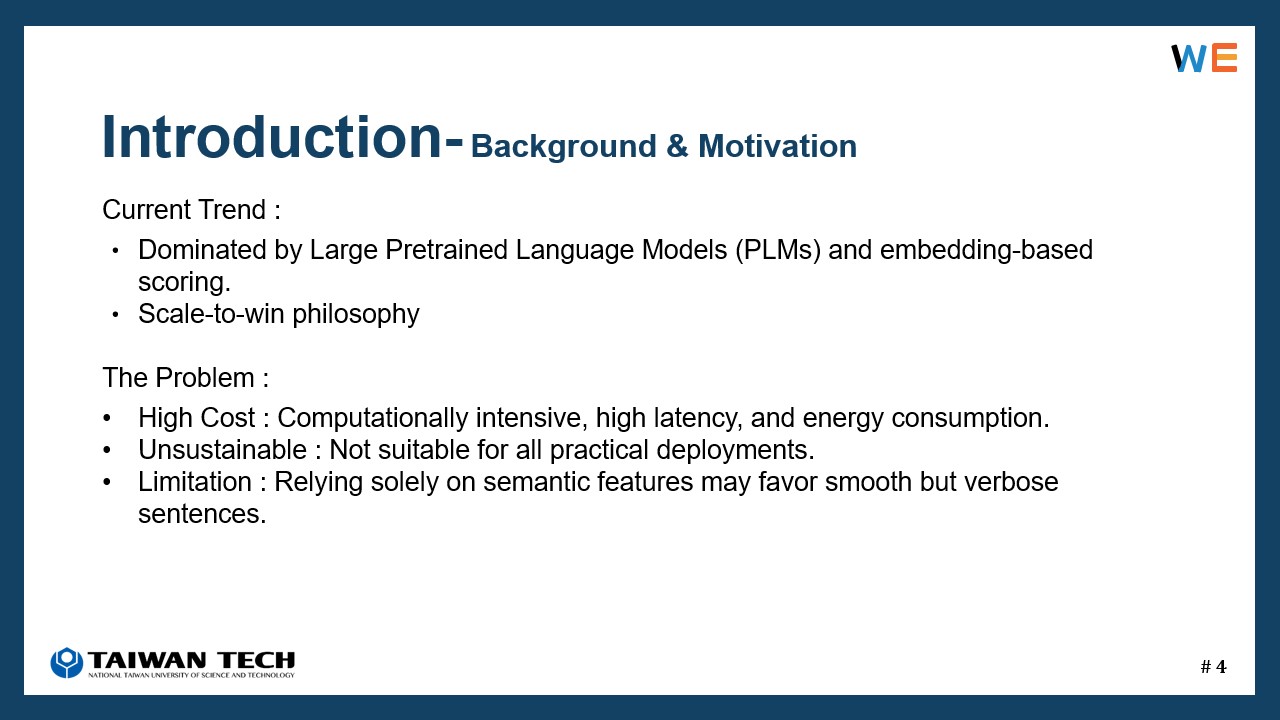 |
Let me start with the background and motivation.
Right now, most extractive summarization methods are based on large pretrained language models or embedding-based scoring.
These models work very well, but in most cases, better performance means larger models.
Larger models usually require more computation, they are slower, and they consume more energy.
Because of that, they are not always a good fit for real-world or resource-limited settings.
Another thing we noticed is that when we rely only on semantic embeddings, the summaries can be fluent, but sometimes they become too long and lose the structure of a good summary.
So we started to ask a simple question: do we really need very large models
to get a good extractive summary? |
| ICACT20260145 Slide.05
[Big Slide]
|
Chrome Click!! |
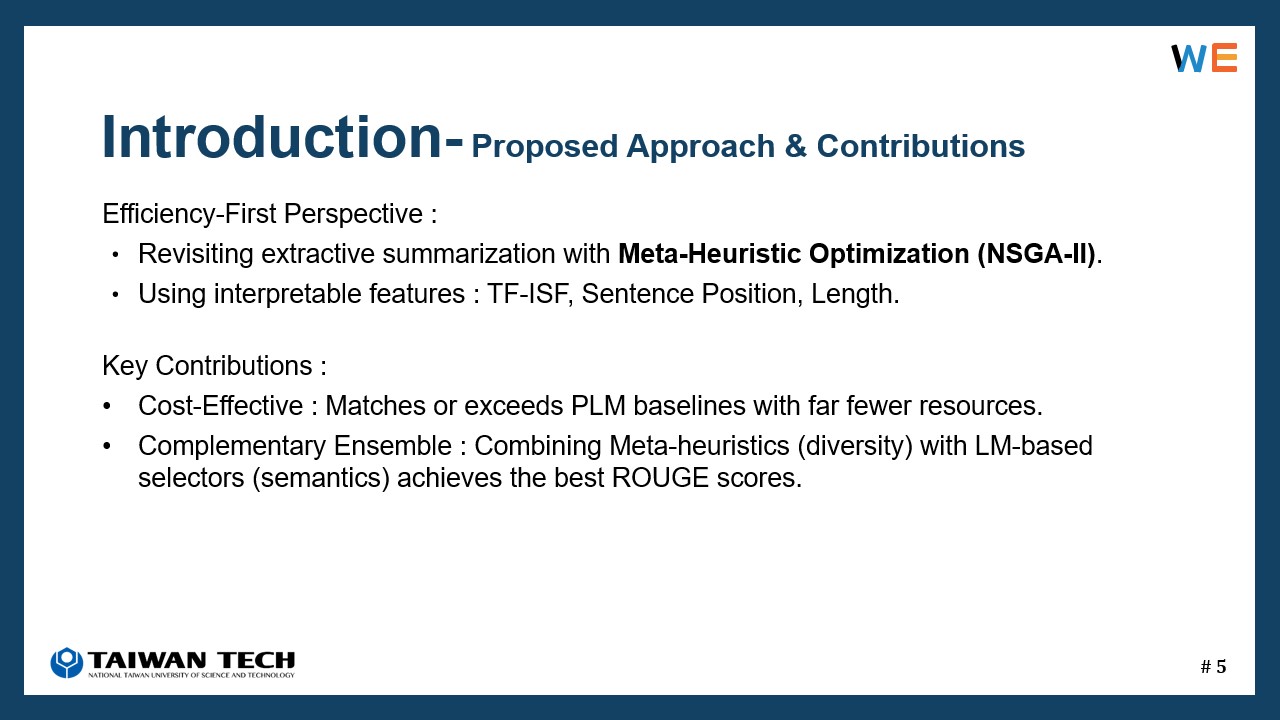 |
To deal with these issues, we rethink extractive summarization from an efficiency-first perspective.
The core idea is simple. We focus on sentence selection, and treat it as a multi-objective optimization problem.
We use a meta-heuristic algorithm, NSGA-II, together with simple and interpretable features, such as TF–ISF and sentence position.
This allows us to balance relevance and redundancy efficiently.
I will explain the details of this design in the following method section. |
| ICACT20260145 Slide.06
[Big Slide]
|
Chrome Click!! |
 |
Lets look at how we approached this problem. |
| ICACT20260145 Slide.07
[Big Slide]
|
Chrome Click!! |
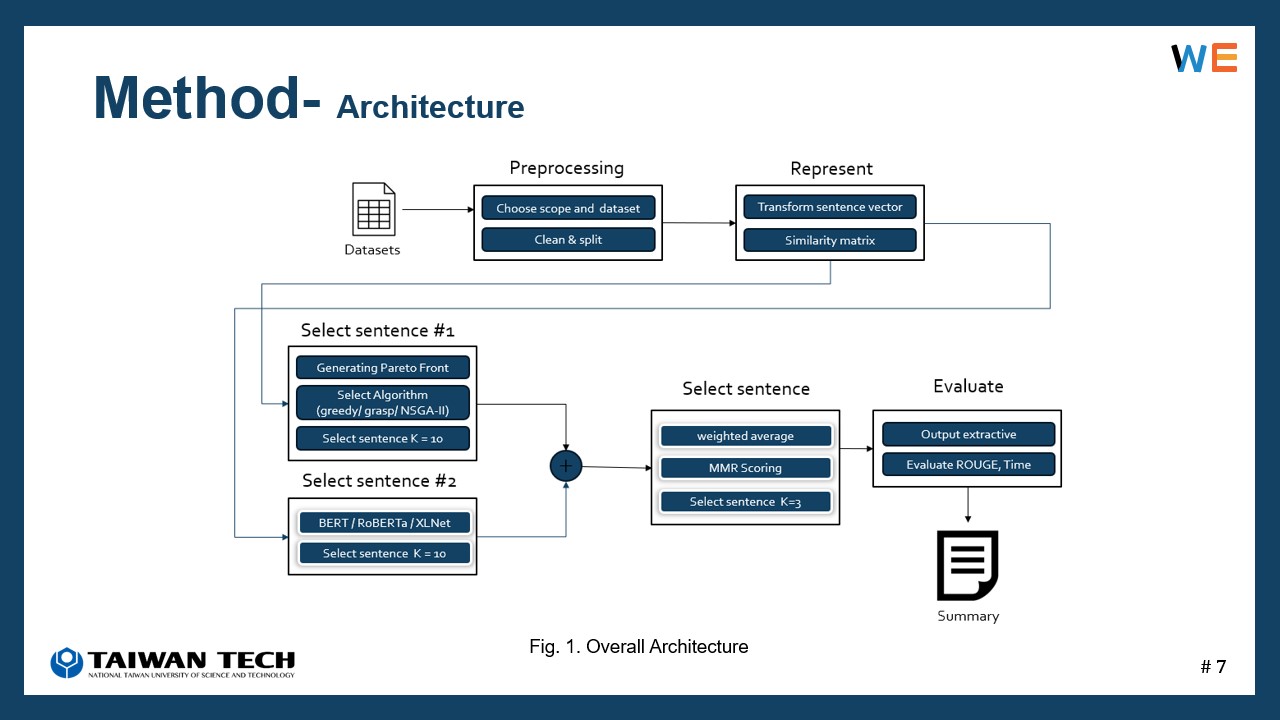 |
This figure shows the overall architecture of our approach.
Our system architecture can be divided into two major stages. The first stage is data preprocessing. We clean the article, convert everything to lowercase, and split it into individual sentences to form the candidate pool.
For these candidate sentences, we compute several features, such as TF-ISF, sentence length, position score, and the similarity matrix.
The second stage forms the core of our method, which focuses on generating and selecting candidate sentences.
In this stage, we use two parallel branches.
One branch is based on meta-heuristic algorithms, and the other branch uses language-model embeddings.
Each branch selects the top ten candidate sentences, and we then merge the two sets.
Finally, we apply MMR to balance relevance to the document and diversity among sentences.
From the merged candidate set, we select three sentences as the final summary. |
| ICACT20260145 Slide.08
[Big Slide]
|
Chrome Click!! |
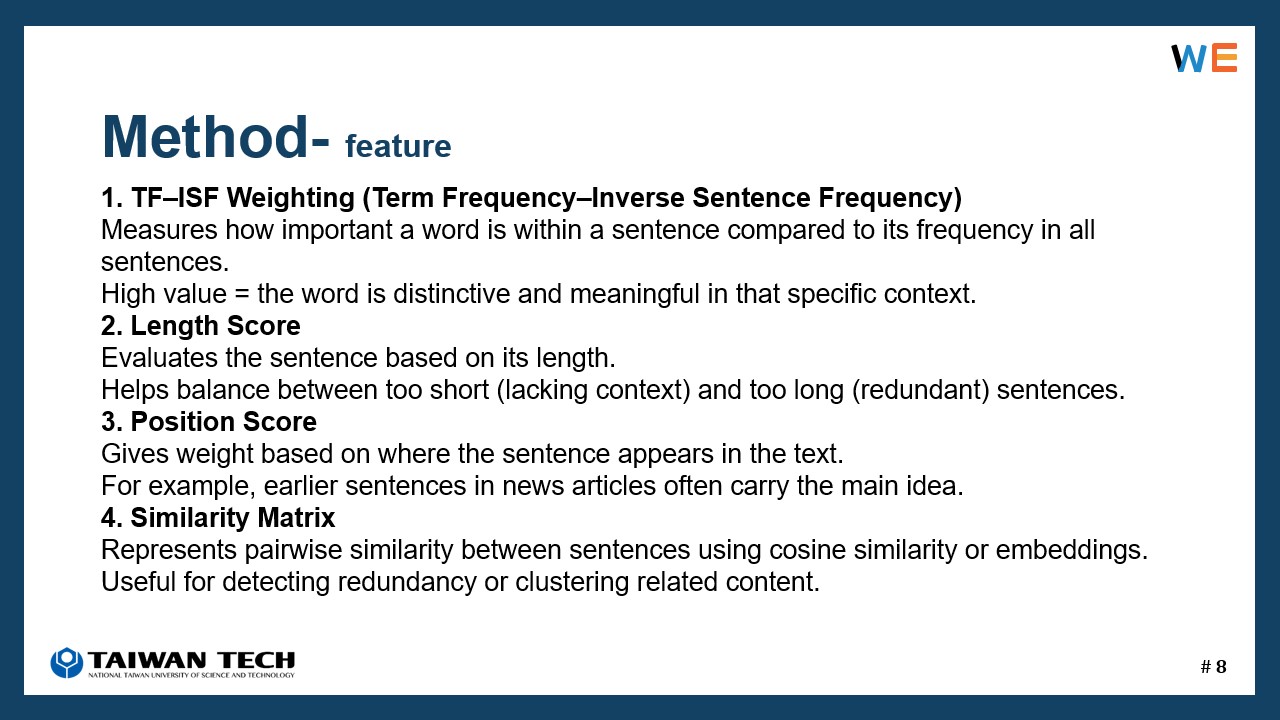 |
Now, let me explain how we evaluate each sentence.
The first one is TF-ISF. It helps us identify words that are important in a sentence, but not common across the entire document.
The second feature is sentence length. Very short sentences usually lack context, while very long ones tend to be redundant.
The third feature is sentence position. This is especially useful for news articles, where key information often appears early.
The final feature is the similarity matrix. It helps us detect redundancy and avoid selecting sentences that are too similar.
Together, these features provide a simple but effective way to capture the key content of an article.
So instead of using heavy models at this stage, we rely on these simple signals to guide sentence selection. |
| ICACT20260145 Slide.09
[Big Slide]
|
Chrome Click!! |
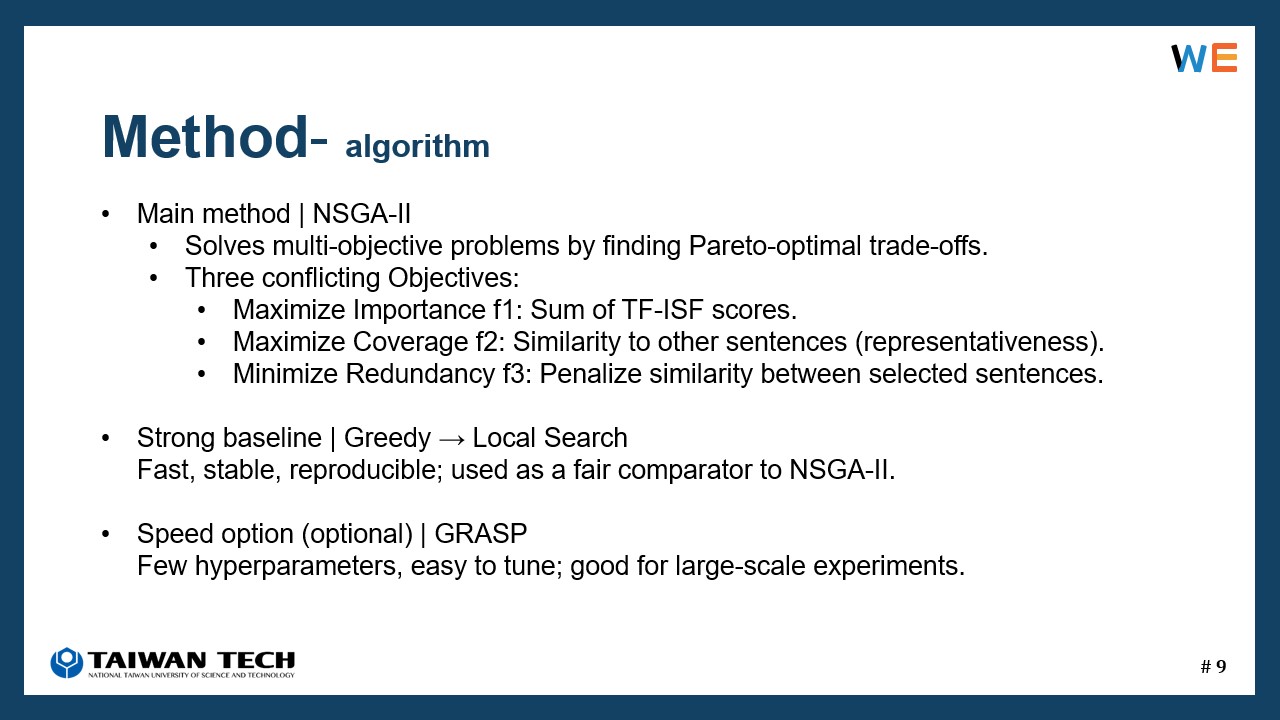 |
Using these features, we then perform sentence selection.
For sentence selection, we use NSGA-II as our main algorithm.
The reason is simple. Extractive summarization naturally involves trade-offs.
We want sentences to be important, representative of the document, and at the same time not redundant.
Instead of combining these goals into a single score, we let NSGA-II handle these trade-offs directly.
For comparison, we also include a greedy method and GRASP as fast baseline approaches. |
| ICACT20260145 Slide.10
[Big Slide]
|
Chrome Click!! |
 |
Besides heuristic features, we also incorporate lightweight language-model signals.
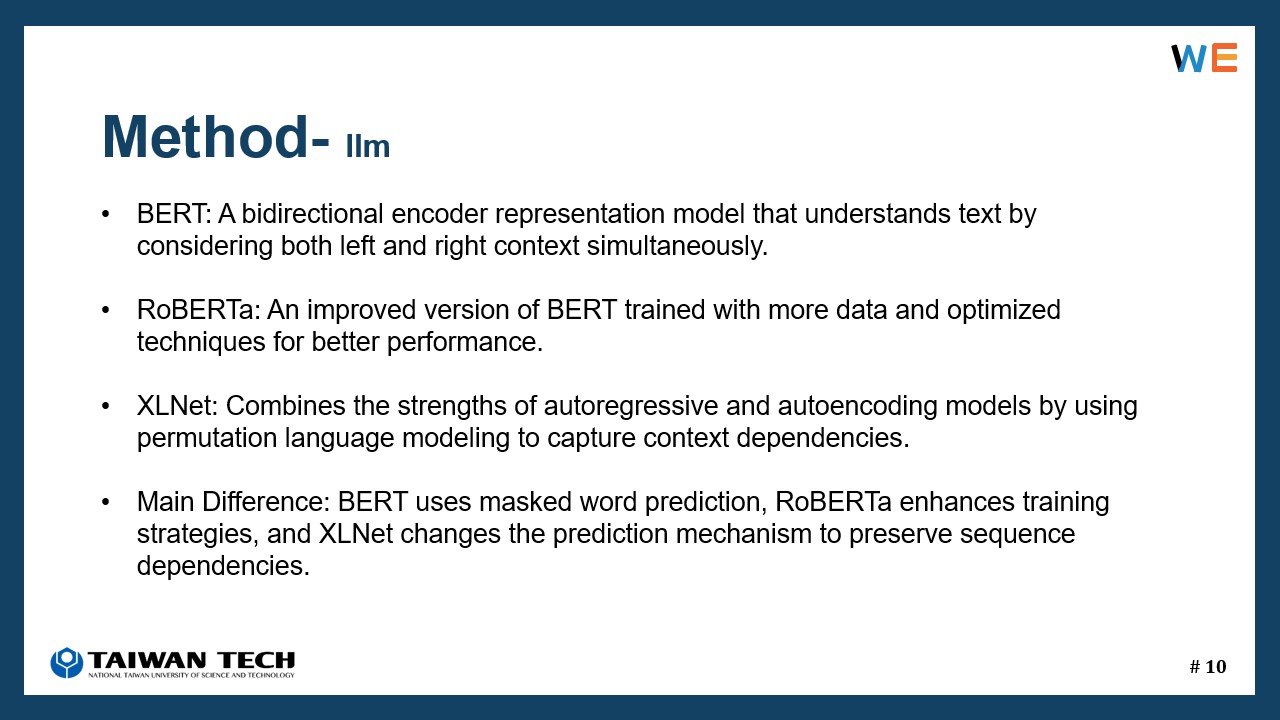
we use three pretrained models: BERT, RoBERTa, and XLNet.
In simple terms, BERT captures context from both directions.
RoBERTa is an improved version of BERT, trained with more data and more stable training strategies.
XLNet uses a permutation-based objective to better model sequence dependencies.
Although these models differ in their designs, in our system they all play the same role. They are used only to generate sentence embeddings.
These embeddings help us identify semantically meaningful sentences, rather than directly generating summaries. |
| ICACT20260145 Slide.11
[Big Slide]
|
Chrome Click!! |
 |
Next, lets discuss the Evaluation setup. |
| ICACT20260145 Slide.12
[Big Slide]
|
Chrome Click!! |
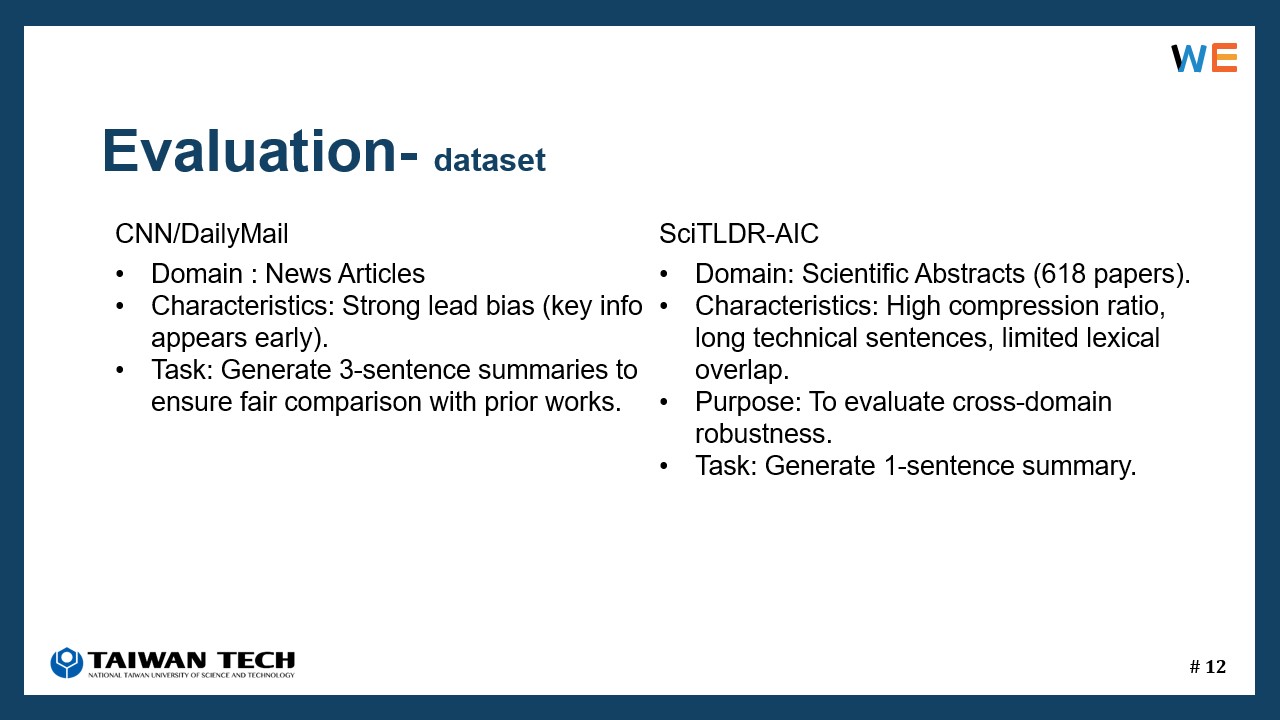 |
For evaluation, we selected two distinct datasets to test different aspects of our model.
First, we used CNN/DailyMail. This is the standard benchmark for news summarization. Since news articles often have lead bias, we followed the standard practice of generating 3-sentence summaries to ensure a fair comparison with prior works.
However, to verify our models robustness, we didnt want to stop at news. We also tested it on SciTLDR-AIC. This dataset consists of scientific abstracts and represents a much harder challenge due to its technical language and high compression ratio. For this task, we aimed to generate a concise 1-sentence summary. |
| ICACT20260145 Slide.13
[Big Slide]
|
Chrome Click!! |
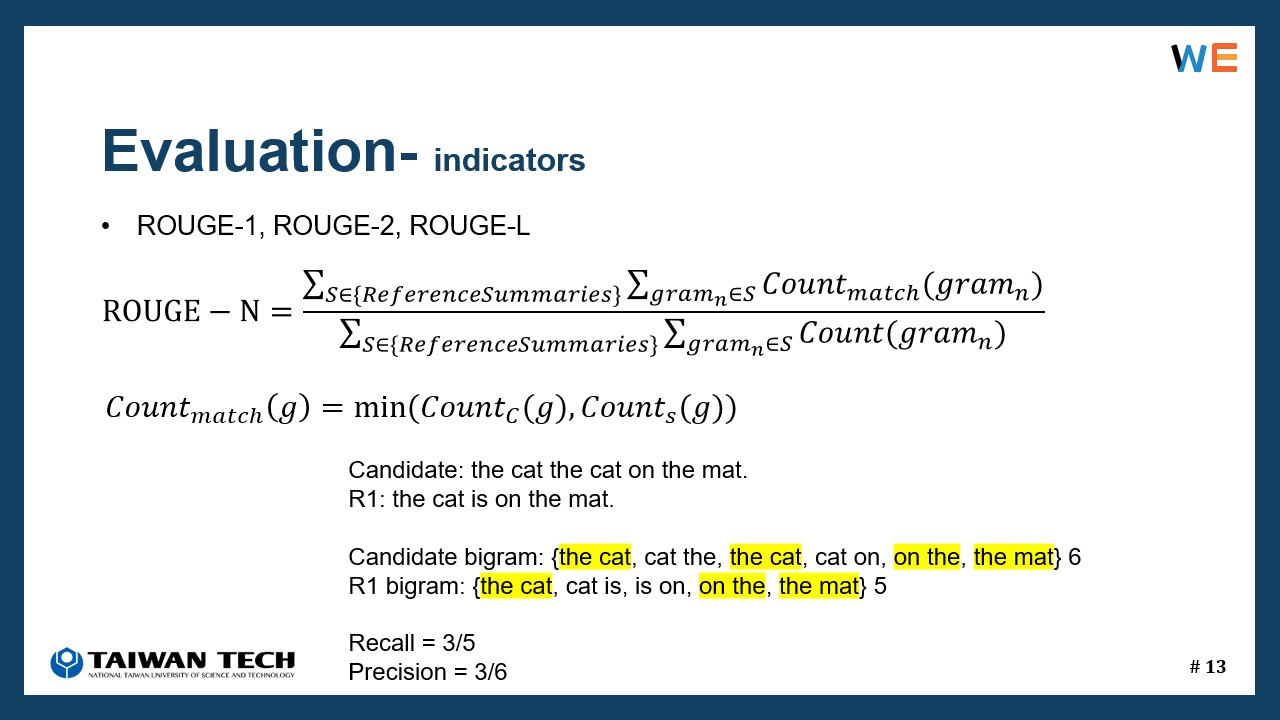 |
Next, for evaluation metrics, we used the standard ROUGE framework to measure the quality of our summaries against the reference text.
We report three score: ROUGE-1 for unigram overlap, ROUGE-2 for bigrams and ROUGE-L, which measures the longest common subsequence to evaluate sentence structure and fluency.
These metrics allow us to directly compare our results. |
| ICACT20260145 Slide.14
[Big Slide]
|
Chrome Click!! |
 |
Now, lets reveal the Results. |
| ICACT20260145 Slide.15
[Big Slide]
|
Chrome Click!! |
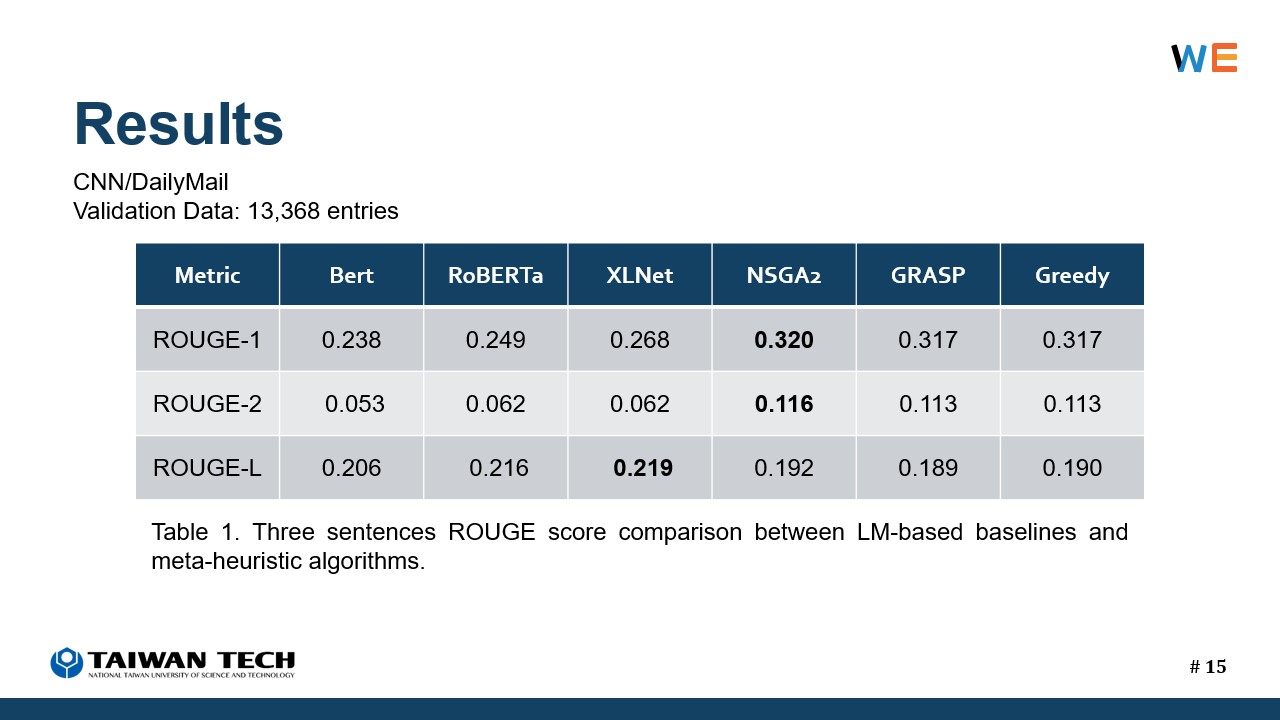 |
Here are the results on the CNN/DailyMail dataset.
As you can see, the column NSGA2 shows the method just only using only the meta heuristic algorithm. We can see that the ROUGE-1 score and ROUGE-2 scores significantly outperforms the BERT baseline.
However, we do notice that LM-baselines retain a slight advantage on ROUGE-L, likely because embeddings capture longer-range semantic structures better. |
| ICACT20260145 Slide.16
[Big Slide]
|
Chrome Click!! |
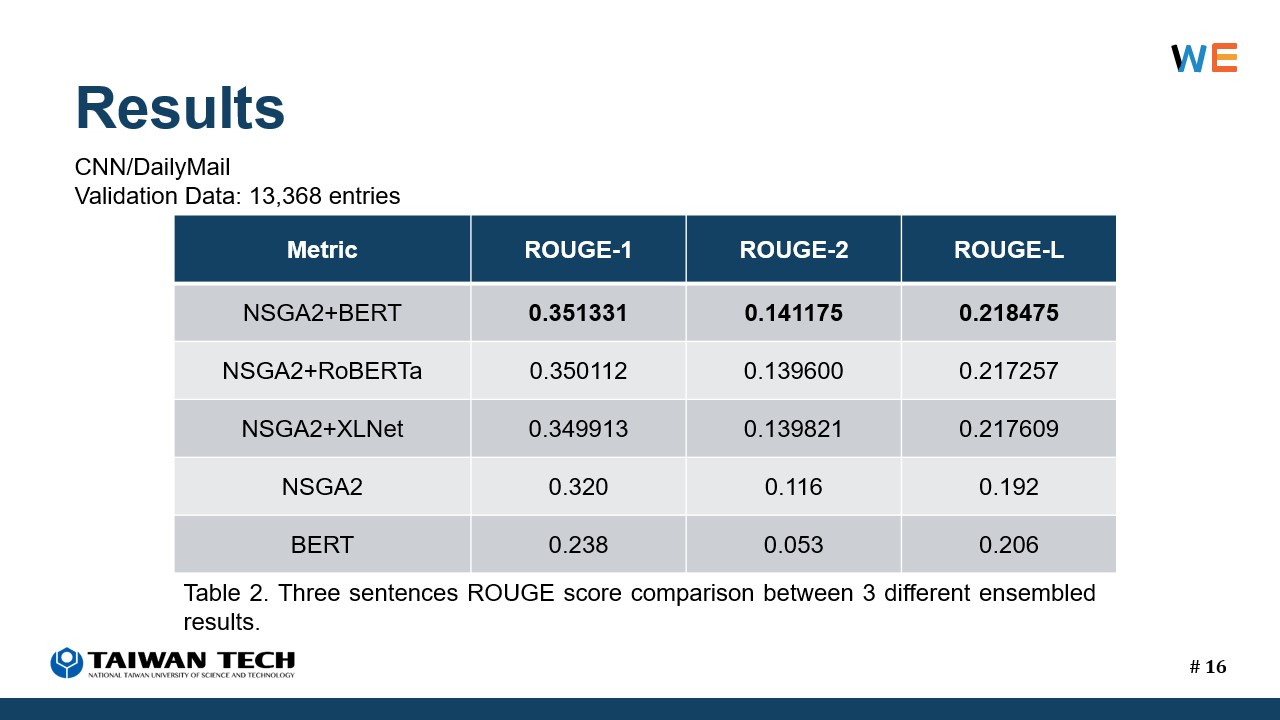 |
Since NSGA2 excels at coverage and LM-baselines are good at semantics, we combined them to see if we could get even better results.
Table 2 shows the performance of our Ensemble strategy. The first row, NSGA2 with BERT, achieves a ROUGE-1 score of 0.351. This is the highest score in our experiments, significantly surpassing both the standalone NSGA2 and the LM-based methods.
This result proves that the two approaches are complementary.
|
| ICACT20260145 Slide.17
[Big Slide]
|
Chrome Click!! |
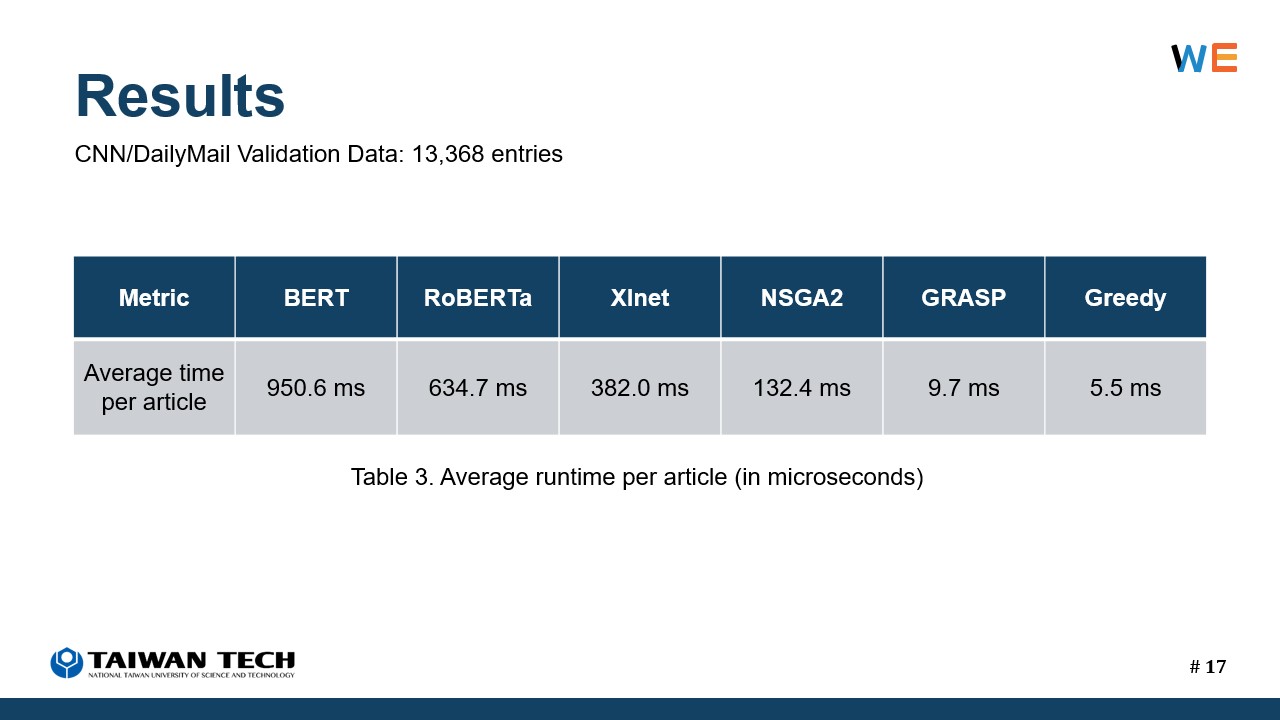 |
Next, lets look at efficiency. Table 3 compares the average runtime per article. The LM-based methods, like BERT, take nearly 950ms per articles. In contrast, NSGA2 takes only 132ms. This proves that meta-heuristics can generate high-quality summaries with significantly lower computational cost. |
| ICACT20260145 Slide.18
[Big Slide]
|
Chrome Click!! |
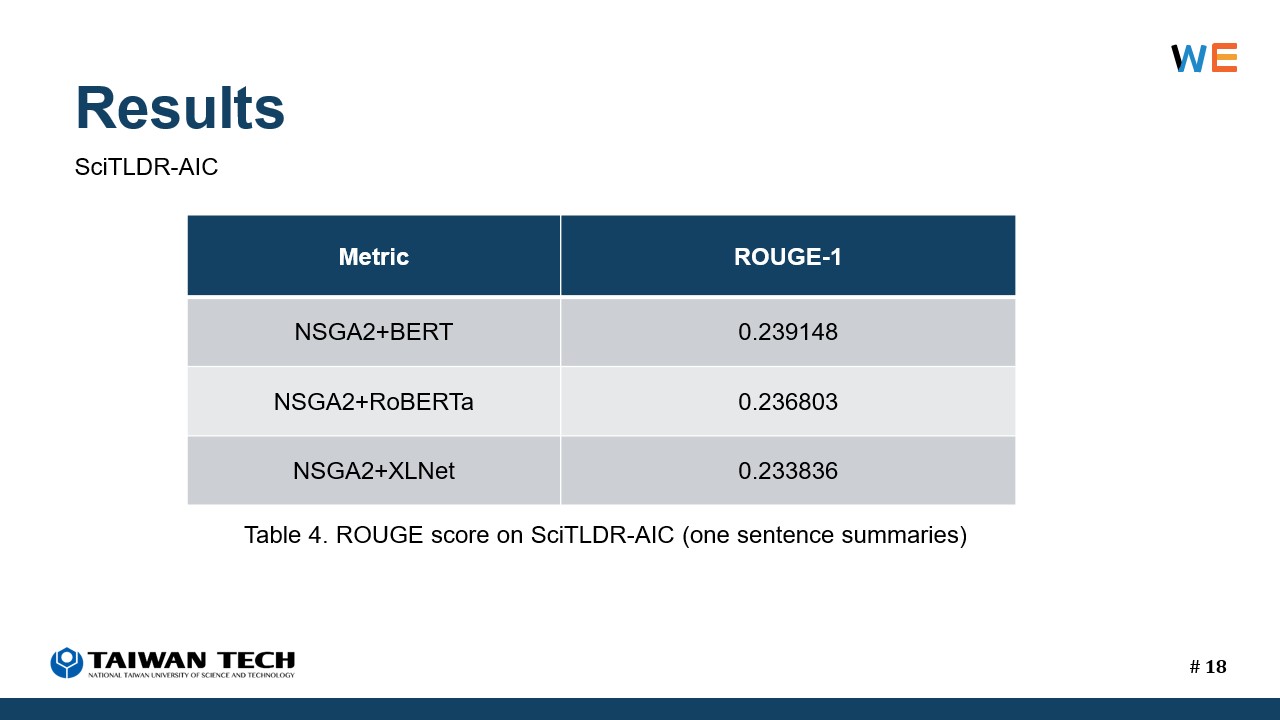 |
We also validated this ensemble approach on the SciTLDR scientific dataset. As shown in Table 4 , our method maintains a stable performance with ROUGE-1 scores around 0.239.
Considering the difficulty of this dataset, these scores are well above the typical average, confirming that our approach adapts well to different domains. |
| ICACT20260145 Slide.19
[Big Slide]
|
Chrome Click!! |
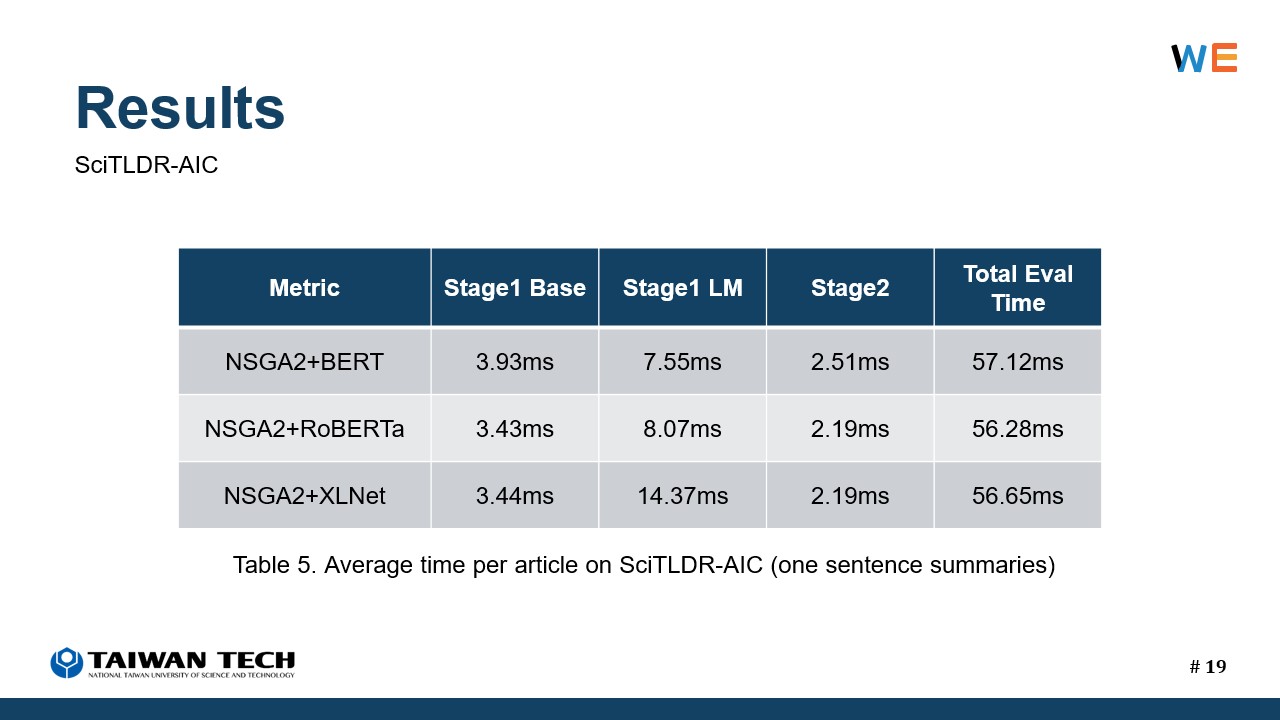 |
Finally, lets look at Table 5, which analyzes the runtime efficiency on the SciTLDR dataset.
The last column, Total Eval Time, shows the total time required per article. It confirms that our ensemble approach is not only accurate but also lightweight. Even with the added complexity of the Language Models, the system remains fast enough for real-time applications in the scientific domain.
|
| ICACT20260145 Slide.20
[Big Slide]
|
Chrome Click!! |
 |
Finally, lets move to the Conclusion. |
| ICACT20260145 Slide.21
[Big Slide]
|
Chrome Click!! |
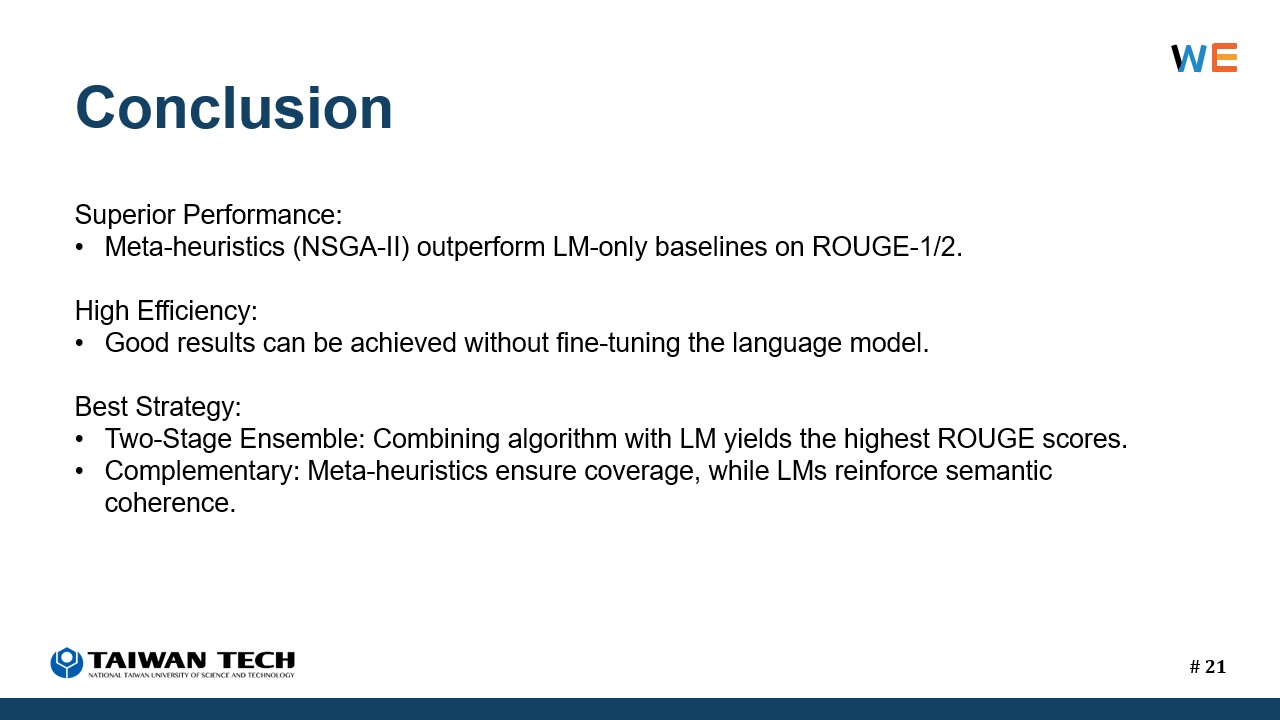 |
To conclude, I’d like to highlight three key takeaways:
Superior Performance: Meta-heuristics like NSGA-II outperform pure LM-based baselines on ROUGE-1 and ROUGE-2 scores.
High Efficiency: We achieved these results with significantly lower computational cost and latency.
Best Strategy: The most effective solution is a Two-Stage Ensemble. Combining the algorithms with LMs yields the best overall performance.
|
| ICACT20260145 Slide.22
[Big Slide]
|
Chrome Click!! |
 |
This conclude our presentation, thank you for your attention. |















