 ICACT20260157 Slide.01
[Big Slide]
[YouTube] |
Chrome  Click!! |
 |
I will present my research titled “Loose Connections for a Co-creative Regional Society: A Framework and an Implementation System.” I am Maho Hoshiai from Chuo University in Japan. Thank you so much. |
| ICACT20260157 Slide.02
[Big Slide]
|
Chrome Click!! |
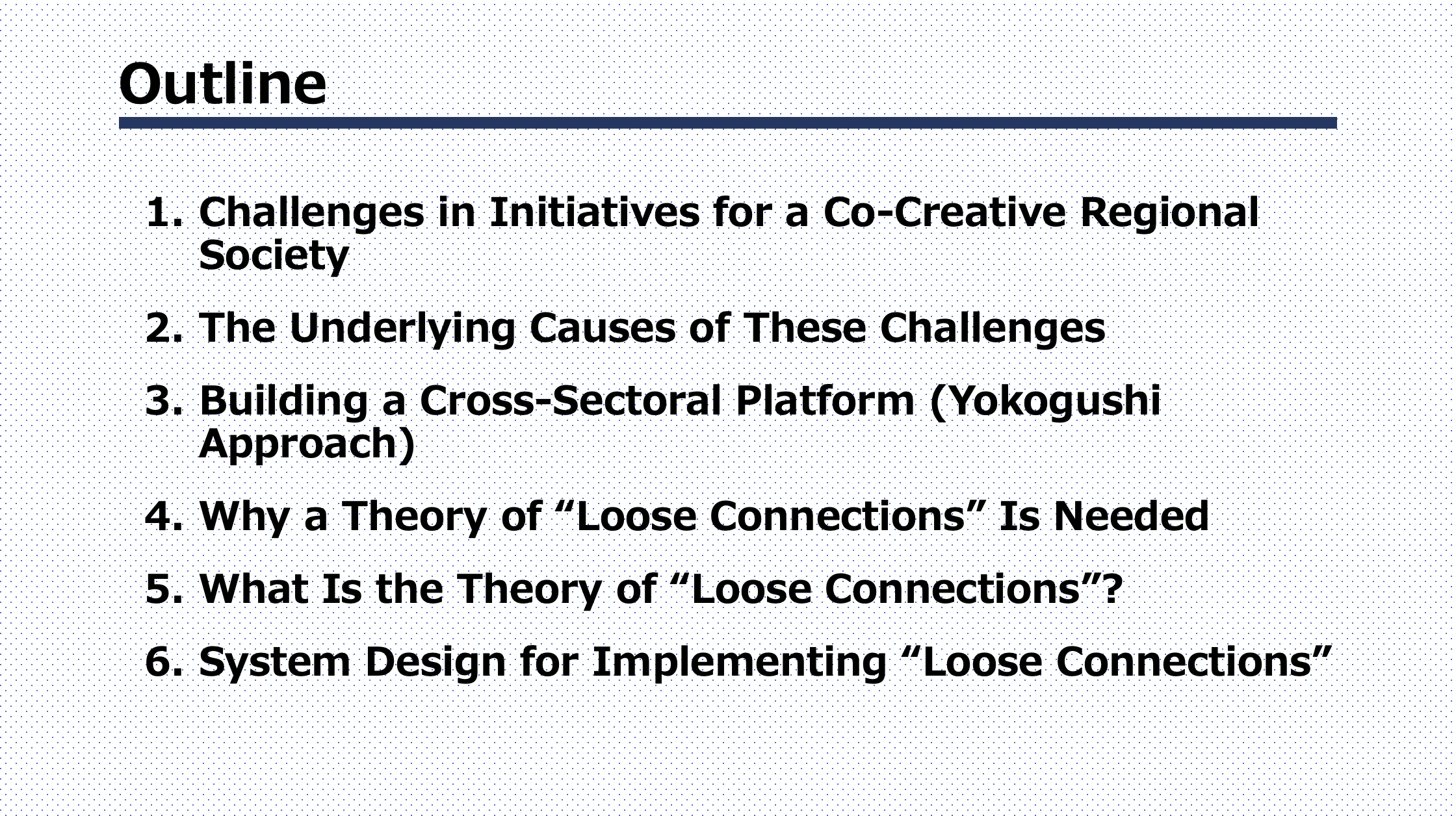 |
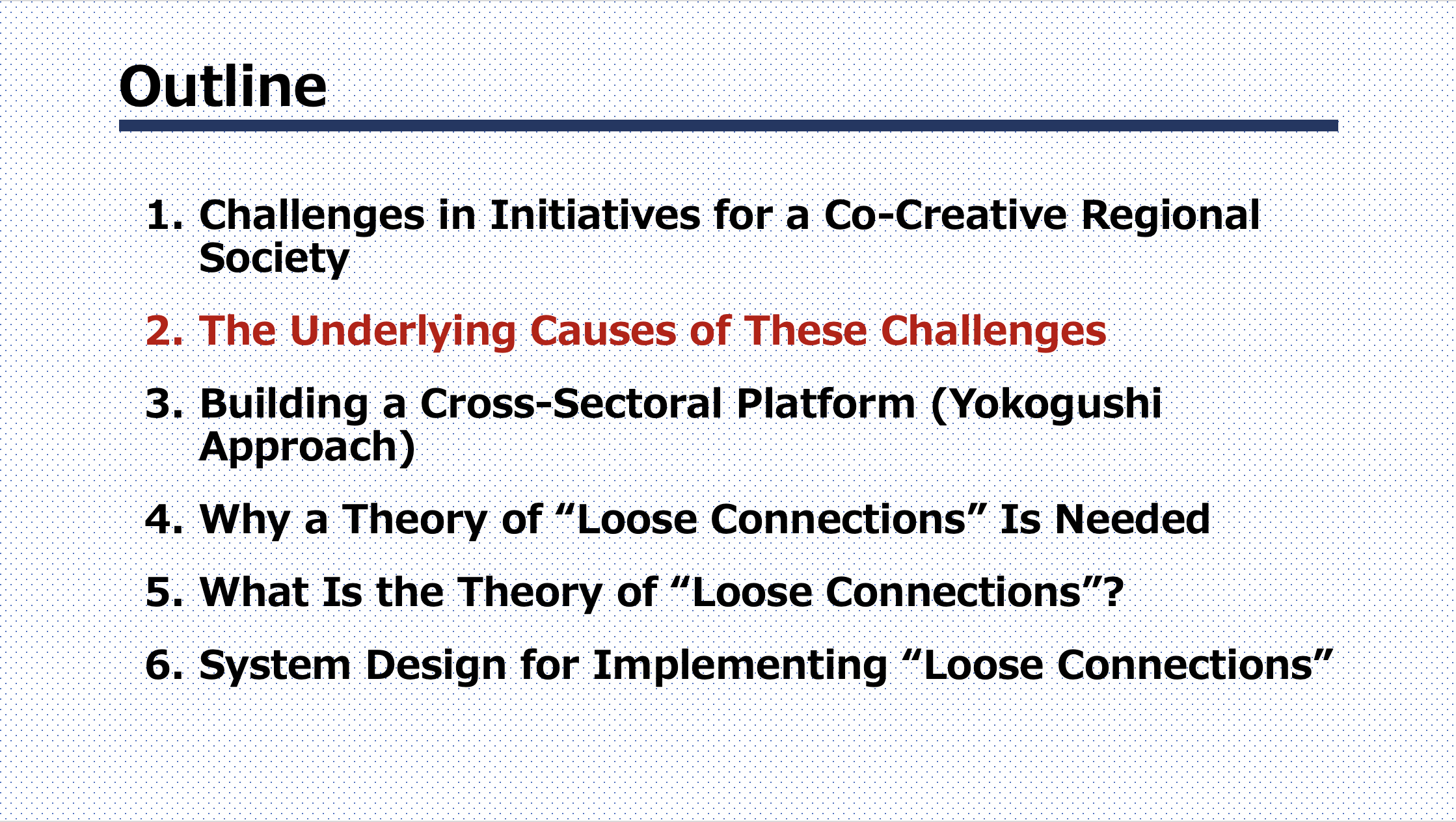
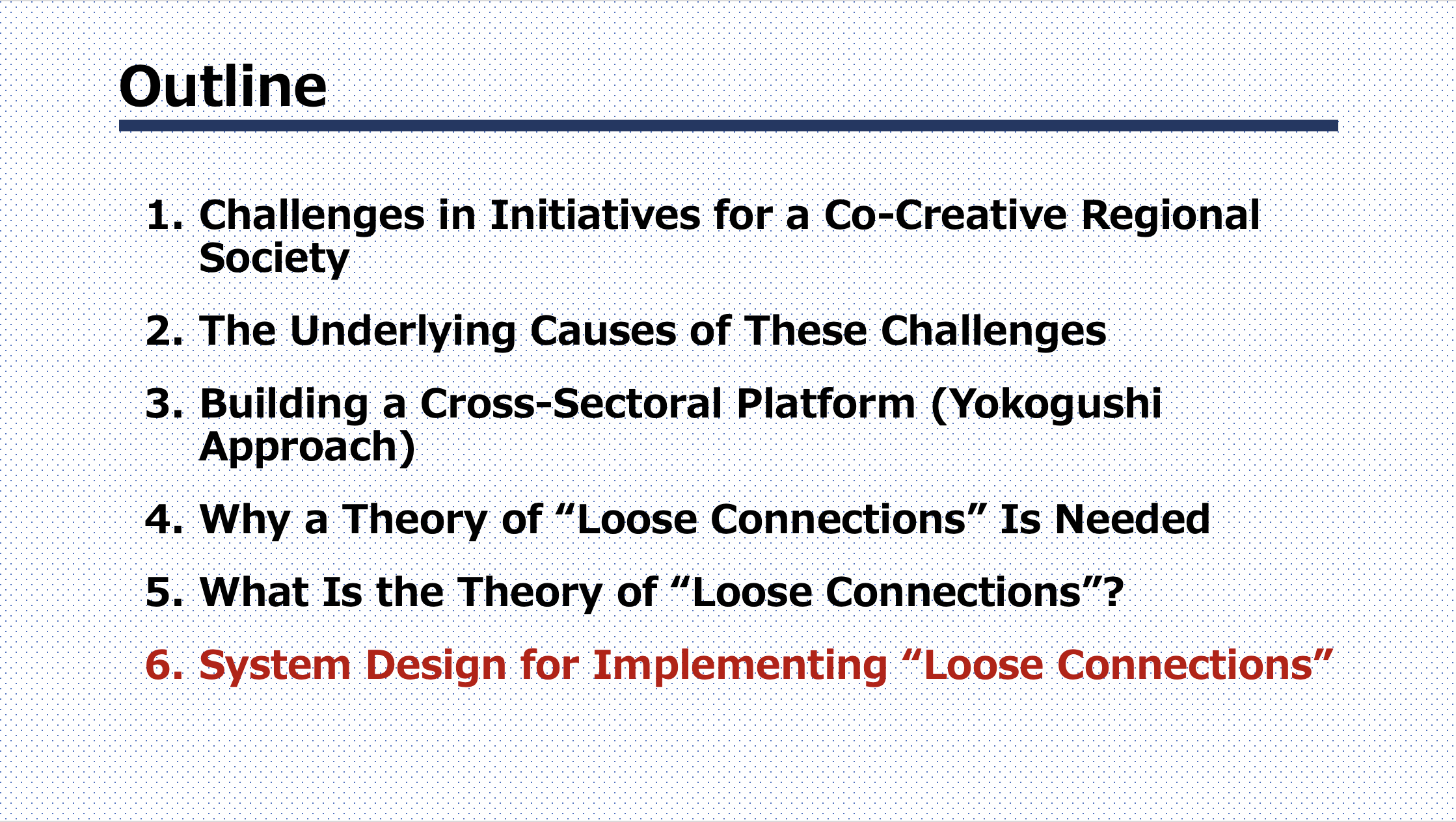
This presentation is structured as follows.
First, I will discuss the challenges in current initiatives for a co-creative regional society.
Second, I will explain the underlying causes of these challenges. These problems stem from an overreliance on the vertical approach, or Tategushi.
Third, I introduce the horizontal approach, known as Yokogushi, which aims to build a cross-sectoral platform.
Fourth, I explain why a theory of “Loose Connections” is needed.
Fifth, I introduce the theory of “Loose Connections.”
Finally, I present a system design for implementing “Loose Connections.”
|
| ICACT20260157 Slide.03
[Big Slide]
|
Chrome Click!! |
 |
First, I would like to explain the challenges in initiatives for a co-creative regional society. |
| ICACT20260157 Slide.04
[Big Slide]
|
Chrome Click!! |
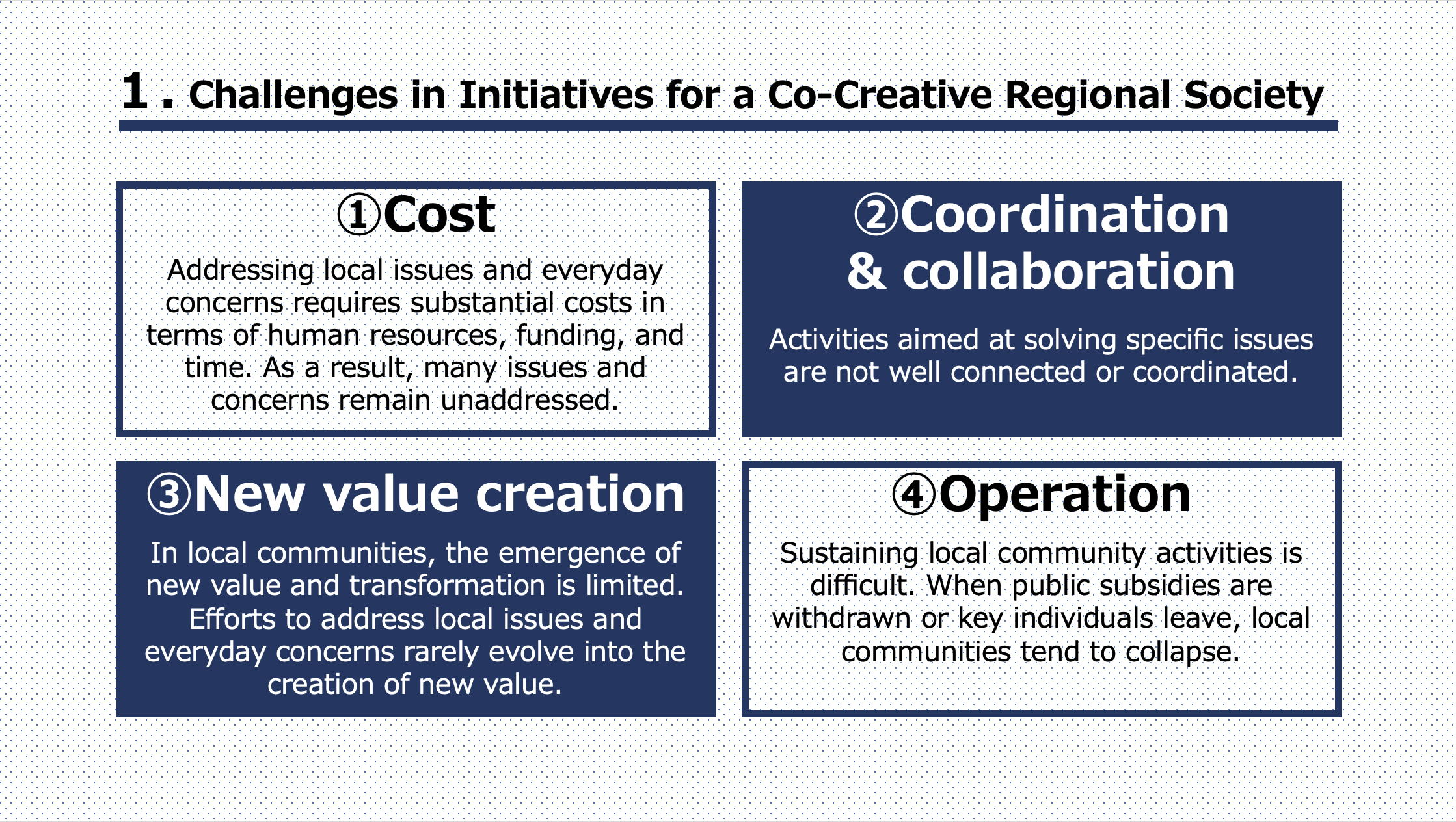 |
These challenges can be summarized into four points. First is cost. Addressing local issues and everyday concerns requires substantial costs in terms of human resources, funding, and time. As a result, many issues and concerns remain unaddressed. Second is coordination and collaboration. Activities aimed at solving specific issues are not well connected or coordinated. Third is new value creation. In local communities, the emergence of new value and transformation is limited. Efforts to address local issues and everyday concerns rarely evolve into the creation of new value. Fourth is sustainability. In local community activities is difficult. When public subsidies are withdrawn or key individuals leave, local communities tend to collapse. |
| ICACT20260157 Slide.05
[Big Slide]
|
Chrome Click!! |
 |
Second, I will explain the underlying causes of these challenges. |
| ICACT20260157 Slide.06
[Big Slide]
|
Chrome Click!! |
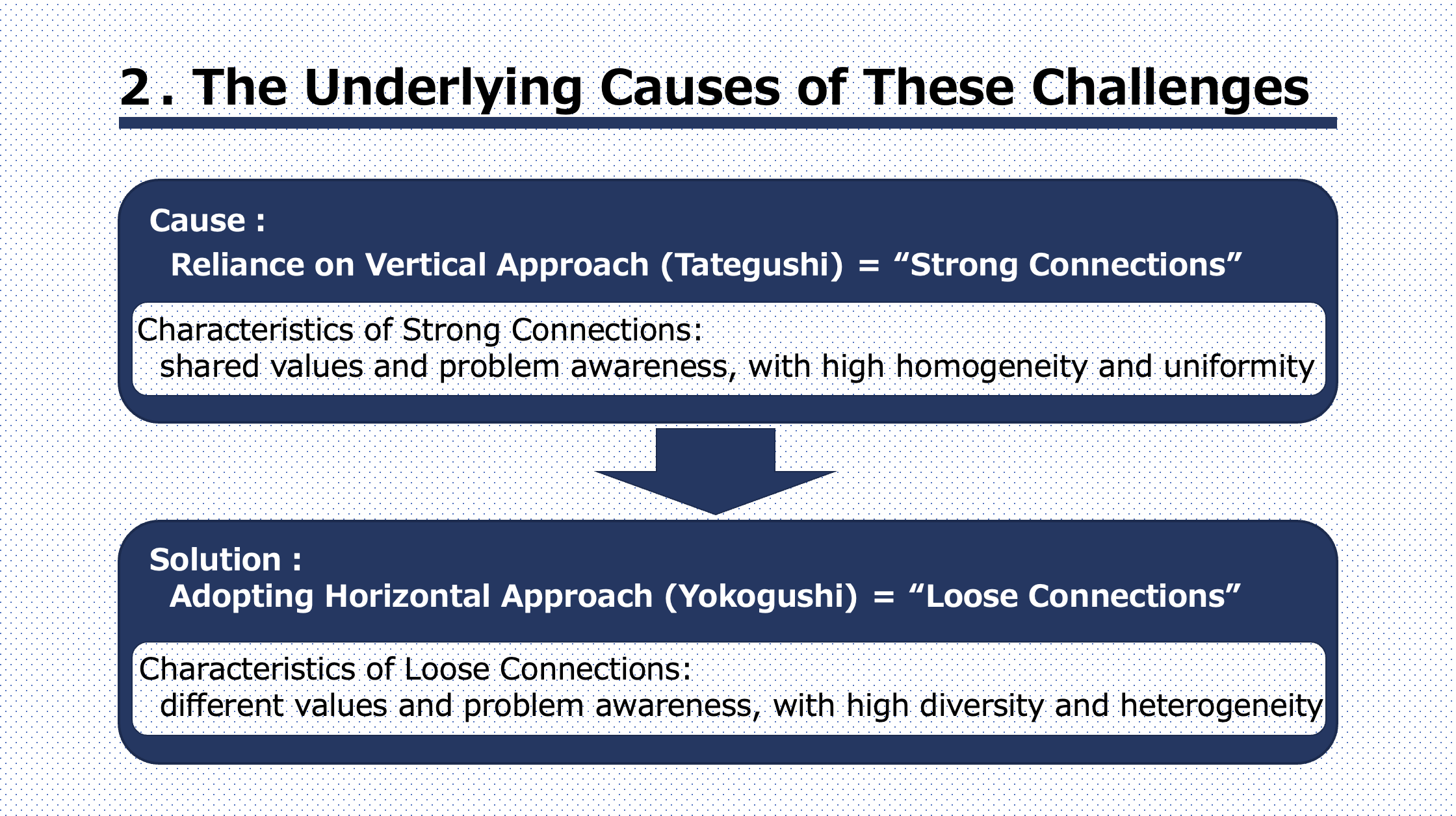 |
The underlying cause of these challenges in building a co-creative regional society is reliance on the vertical approach, known in Japanese as Tategushi. The vertical approach is based on strong connections. These connections are characterized by shared values and shared problem awareness, resulting in high homogeneity and uniformity. In contrast, I propose adopting a horizontal approach, known as Yokogushi, as a solution. The horizontal approach is based on loose connections. These connections involve different values and different problem awareness, leading to high diversity and heterogeneity. |
| ICACT20260157 Slide.07
[Big Slide]
|
Chrome Click!! |
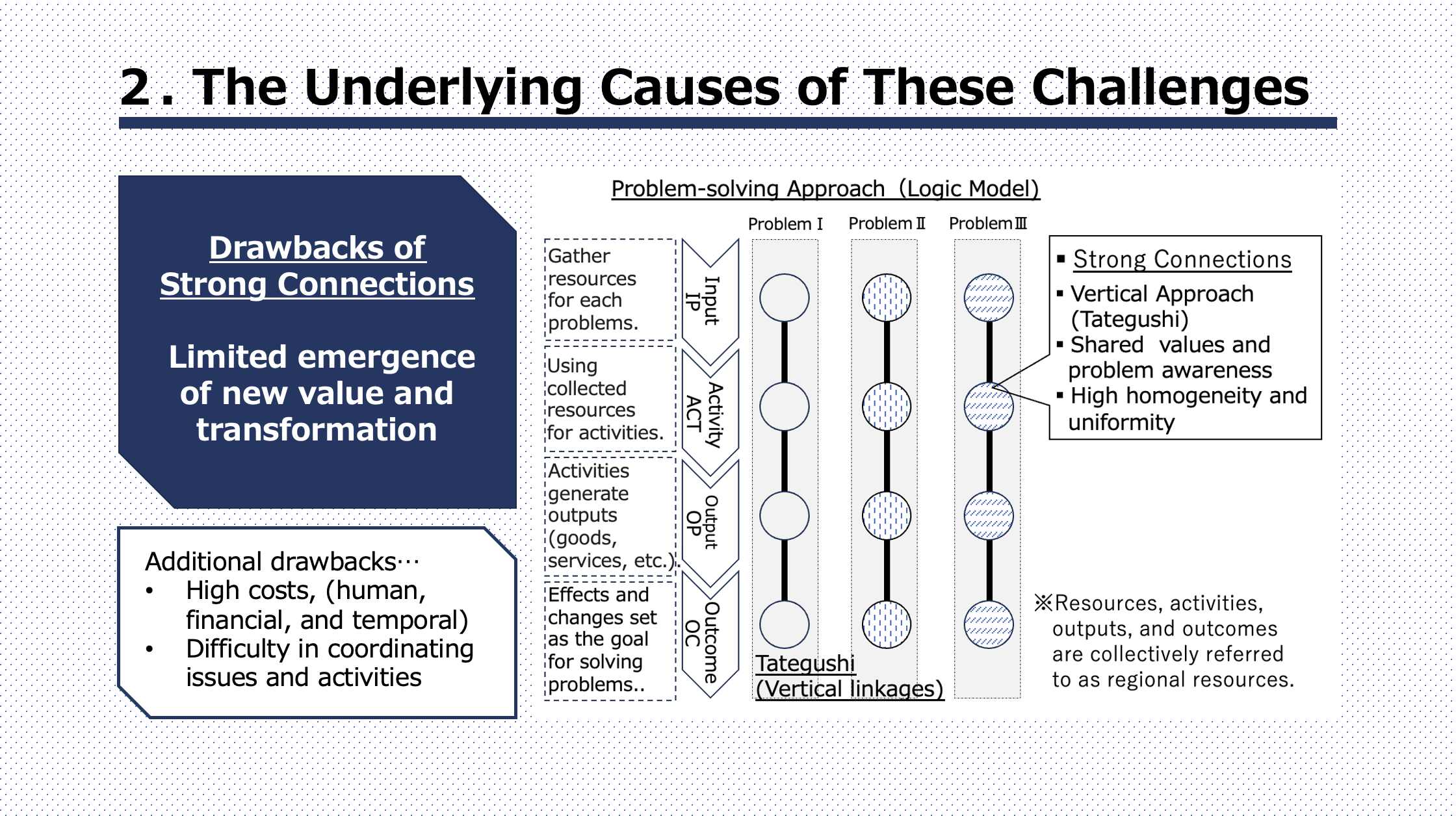 |
First, I will explain the traditional form of connections, known as the vertical approach, or Tategushi, which is based on strong connections. Problem-solving is typically achieved by repeatedly executing a process from the input phase to the outcome phase. This linear and sequential flow is referred to as the vertical approach, or vertical linkages. The vertical approach is based on strong connections. These connections are characterized by shared values and shared problem awareness, resulting in high homogeneity and uniformity. However, it is widely recognized that strong connections are less likely to generate new value or transformative change. In addition, problem-solving approaches based on strong connections require substantial costs, as numerous problems must be addressed one by one from scratch. Moreover, it is difficult to coordinate or link different problems and activities within this approach. |
| ICACT20260157 Slide.08
[Big Slide]
|
Chrome Click!! |
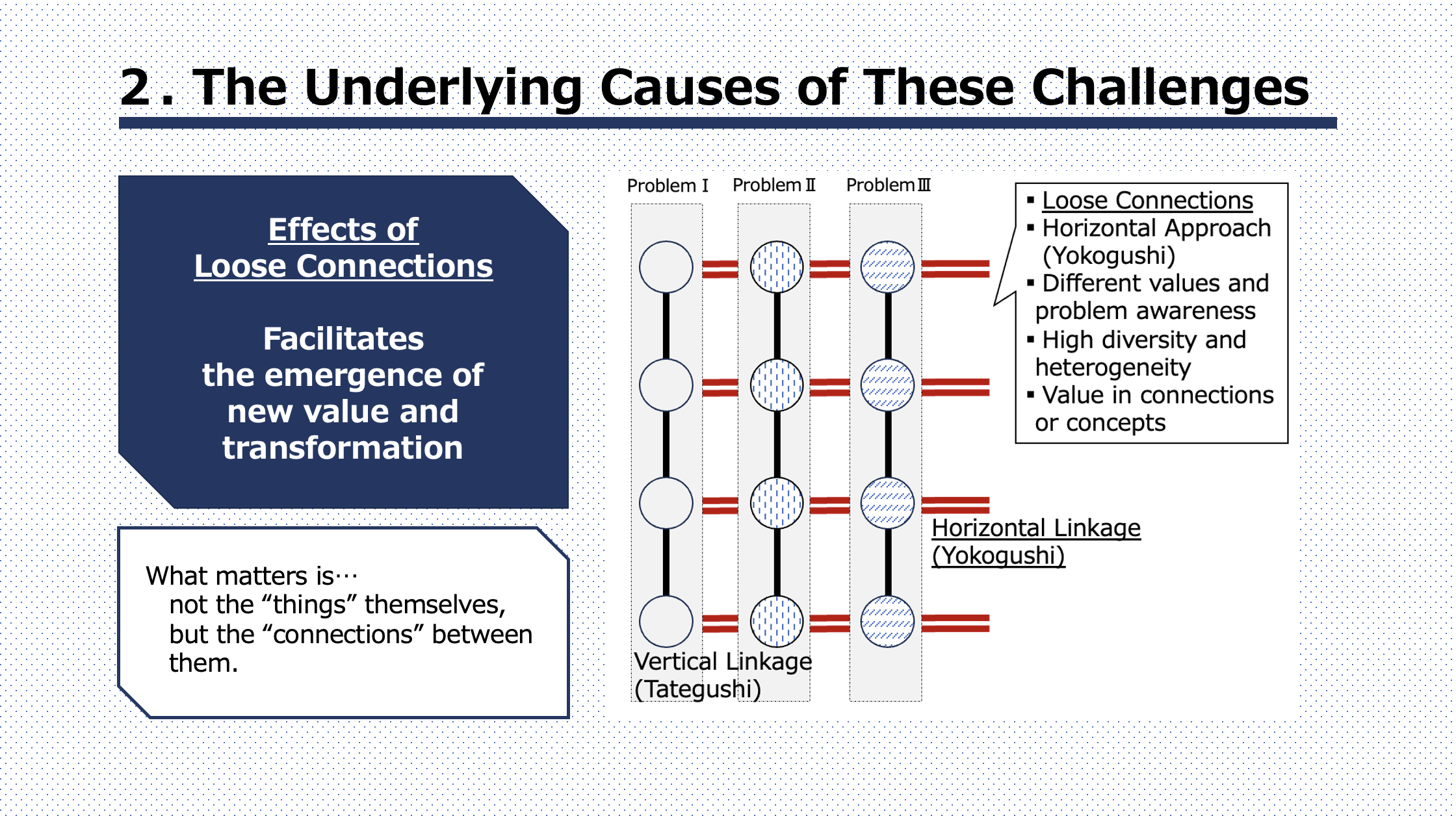 |
The only way to address these challenges is to build horizontal linkages alongside vertical ones—an approach known as Yokogushi in Japanese. Horizontal linkages is based on loose connections characterized by high diversity and heterogeneity, bringing together different values and different understandings of problems. Loose connections place value not on “things” themselves, but on the connections between them. |
| ICACT20260157 Slide.09
[Big Slide]
|
Chrome Click!! |
 |
Third, I introduce the horizontal approach, known as Yokogushi, which aims to build a cross-sectoral platform. |
| ICACT20260157 Slide.10
[Big Slide]
|
Chrome Click!! |
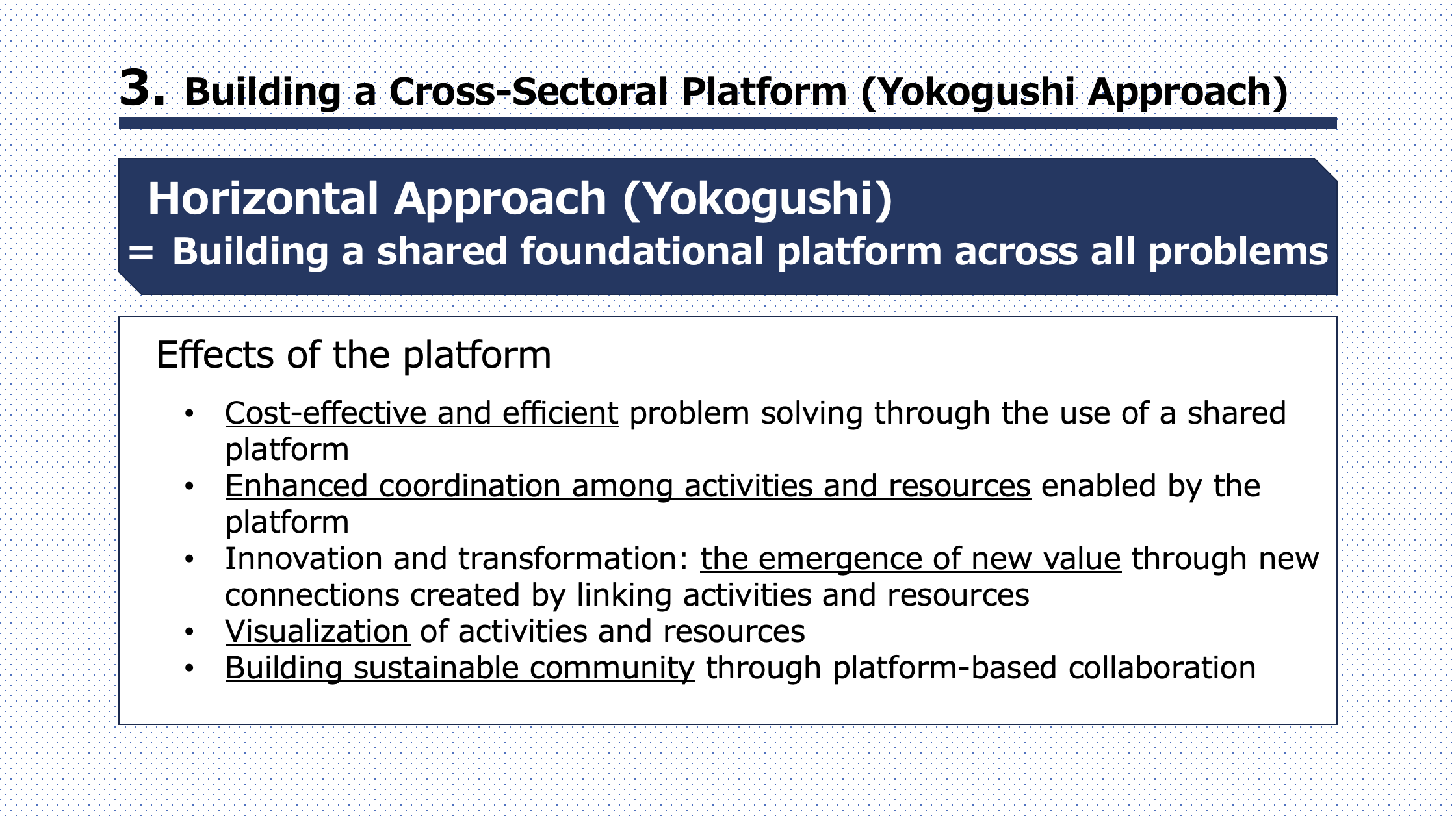 |
The horizontal approach, or Yokogushi, is equivalent to building a shared foundational platform across all problems. For example, operating systems such as Windows and UNIX apply a horizontal layer across all systems. They function as a common platform by providing shared functions such as file management and task management. Likewise, platforms constructed through the horizontal approach across all activities produce the following effects. One, cost-effective and efficient problem solving through the use of a shared platform Second, enhanced coordination among activities and resources enabled by the platform Third, innovation and transformation—the emergence of new value through new connections created by linking activities and resources Forth, visualization of activities and resources Fifth, Building sustainable community through platform-based collaboration |
| ICACT20260157 Slide.11
[Big Slide]
|
Chrome Click!! |
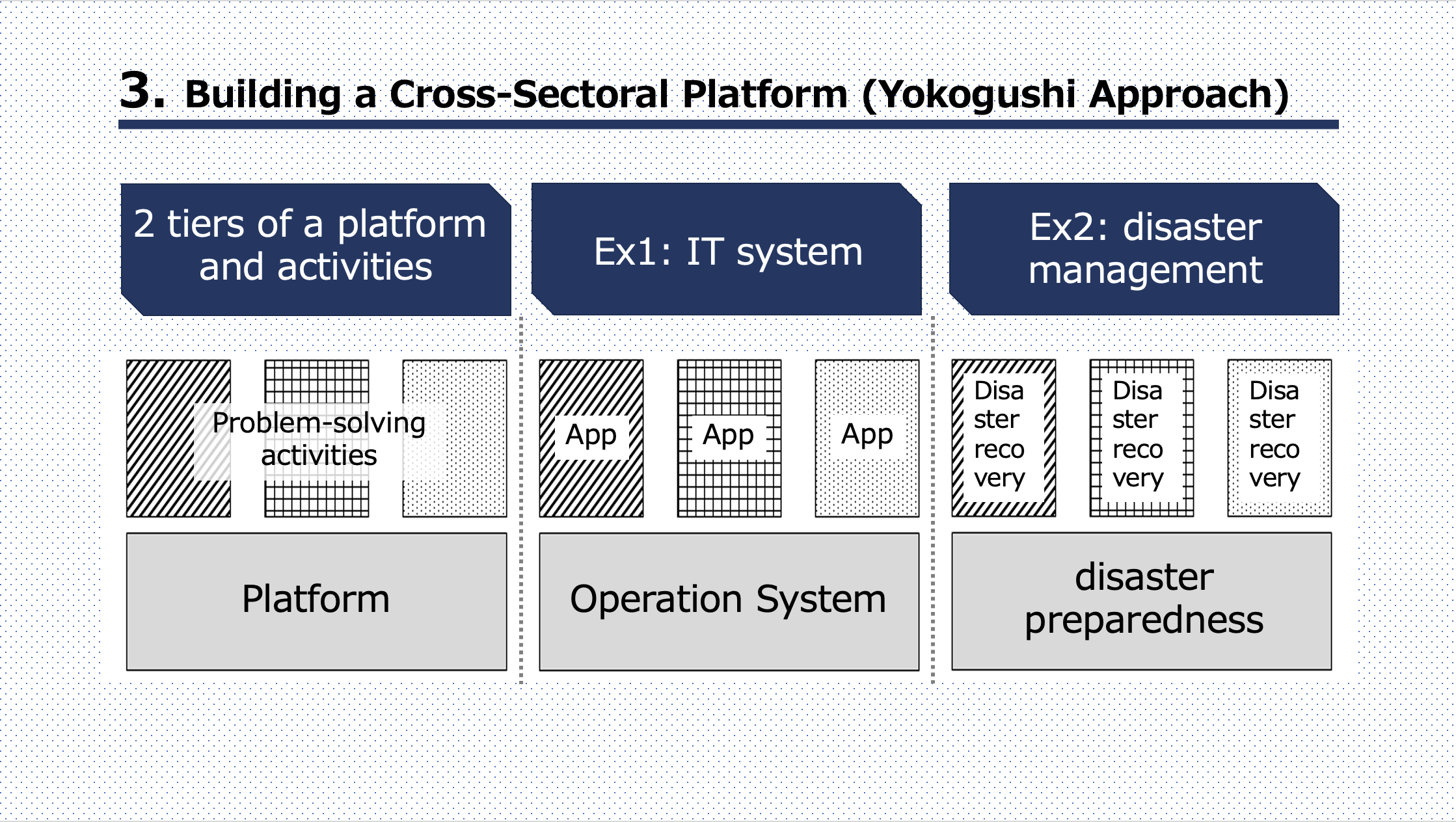 |
This system is structured into two tiers: a platform tier and an activity tier. The platform functions as a shared foundation, while problem-solving activities are placed on top of it. The platform tier corresponds to the operating system in IT systems and to disaster preparedness in disaster management. In contrast, the activity tier corresponds to applications in IT systems and to disaster recovery in disaster management. For example, in IT systems, an operating system alone cannot perform tasks. A system becomes functional only when applications run on top of the operating system. At the same time, having an operating system in place in advance makes it much easier to build and operate systems. The same logic applies to regional co-creative societies. By constructing a shared platform in advance, local initiatives can be implemented more efficiently, and new value can emerge through their interaction. |
| ICACT20260157 Slide.12
[Big Slide]
|
Chrome Click!! |
 |
Fourth, The horizontal approach requires the Theory of Loose Connections as a shared language.
To begin with, I will explain why verbalization is necessary. |
| ICACT20260157 Slide.13
[Big Slide]
|
Chrome Click!! |
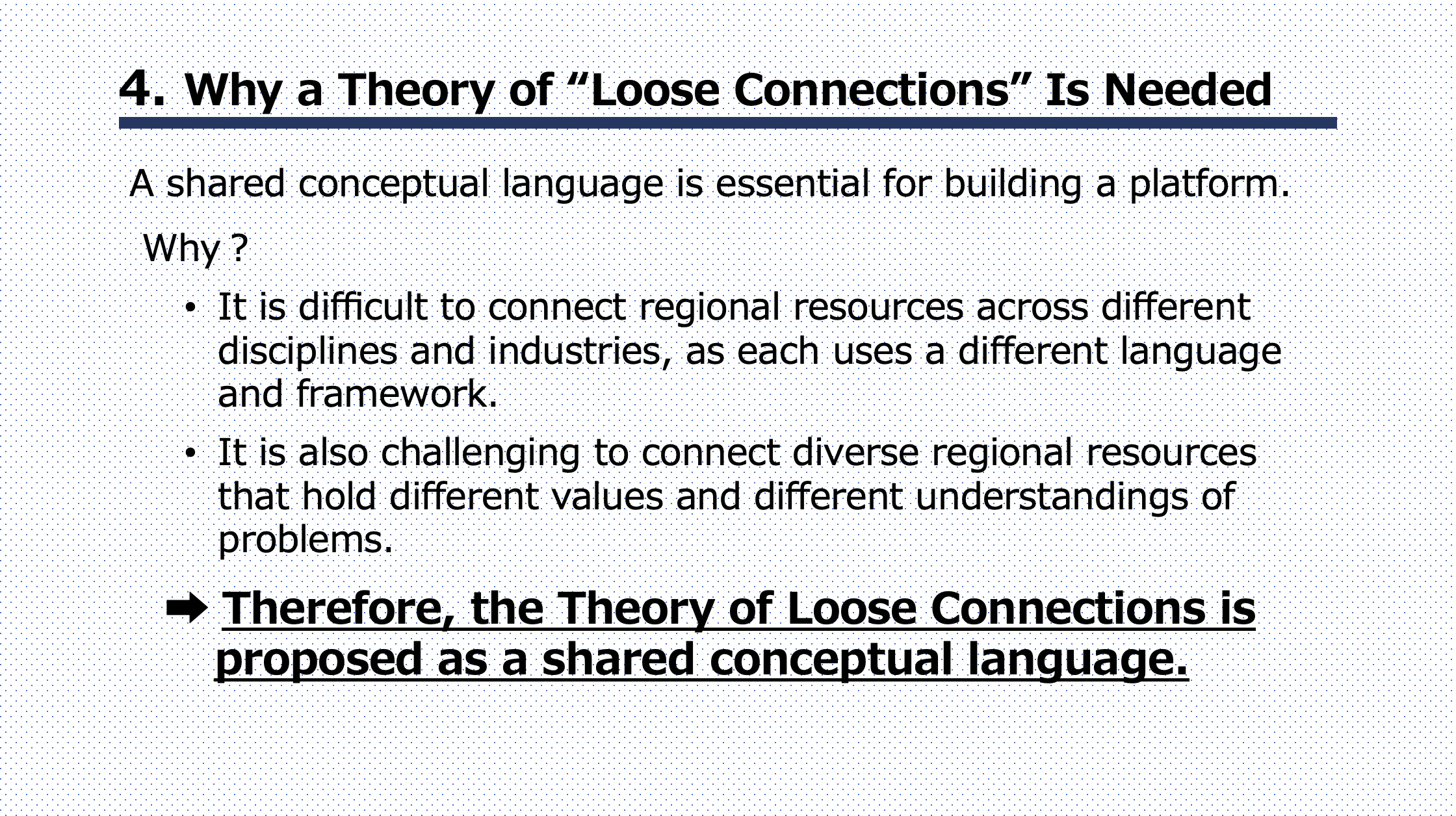 |
To address the challenges in realizing a co-creative regional society, it is necessary to construct a platform by applying a horizontal approach across all regional resources. In this context, a shared conceptual language is essential for building such a platform. This is because connecting regional resources across different disciplines and industries is not easy, as each uses different languages and frameworks. Moreover, it is also challenging to connect diverse regional resources that hold different values and different understandings of problems. This study proposes the Theory of Loose Connections as that shared conceptual language. |
| ICACT20260157 Slide.14
[Big Slide]
|
Chrome Click!! |
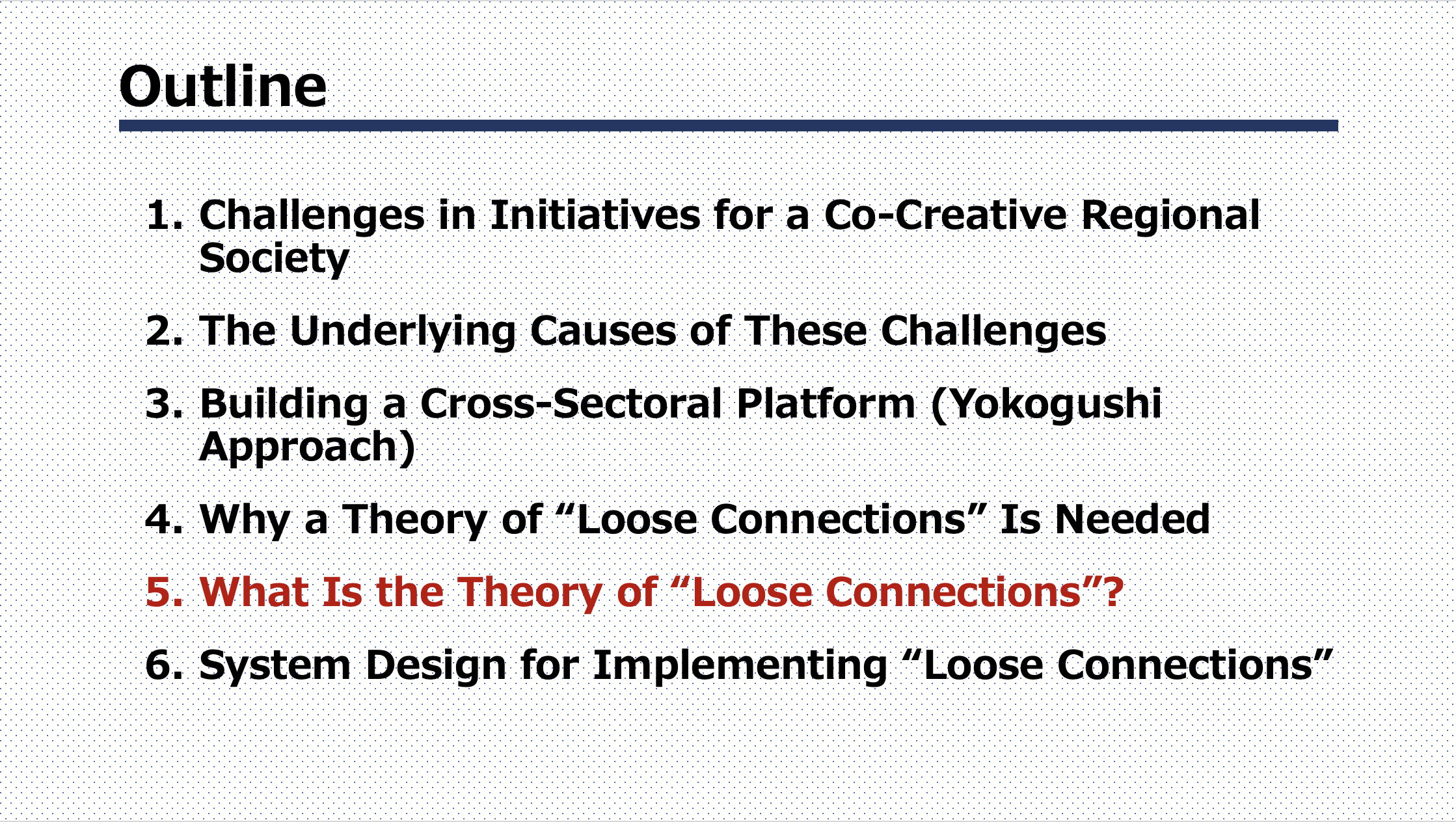 |
Fifth, what Is the Theory of “Loose Connections”? |
| ICACT20260157 Slide.15
[Big Slide]
|
Chrome Click!! |
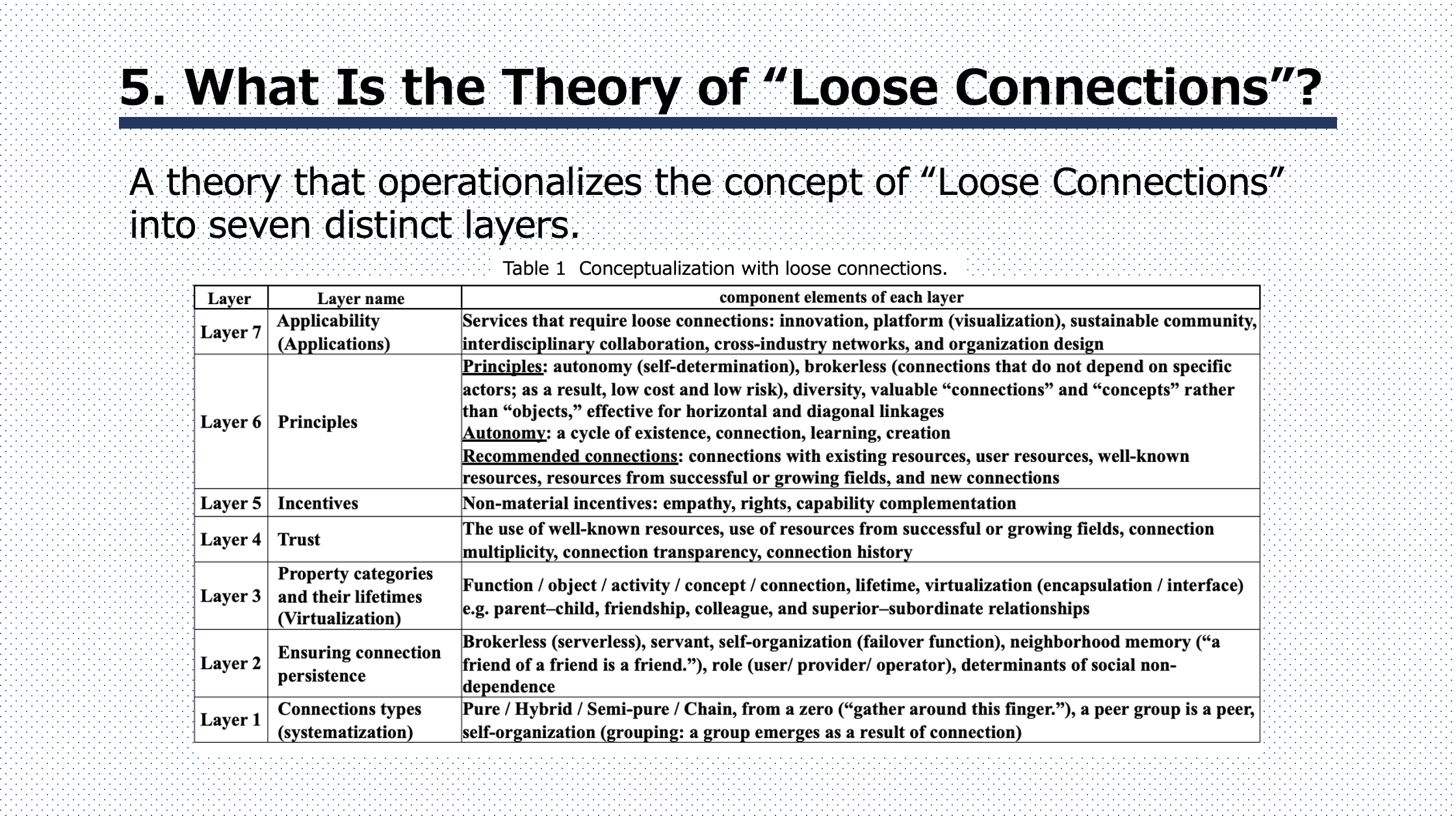 |
This is the Theory of Loose Connections, which operationalizes the concept of “Loose Connections” into seven distinct layers. |
| ICACT20260157 Slide.16
[Big Slide]
|
Chrome Click!! |
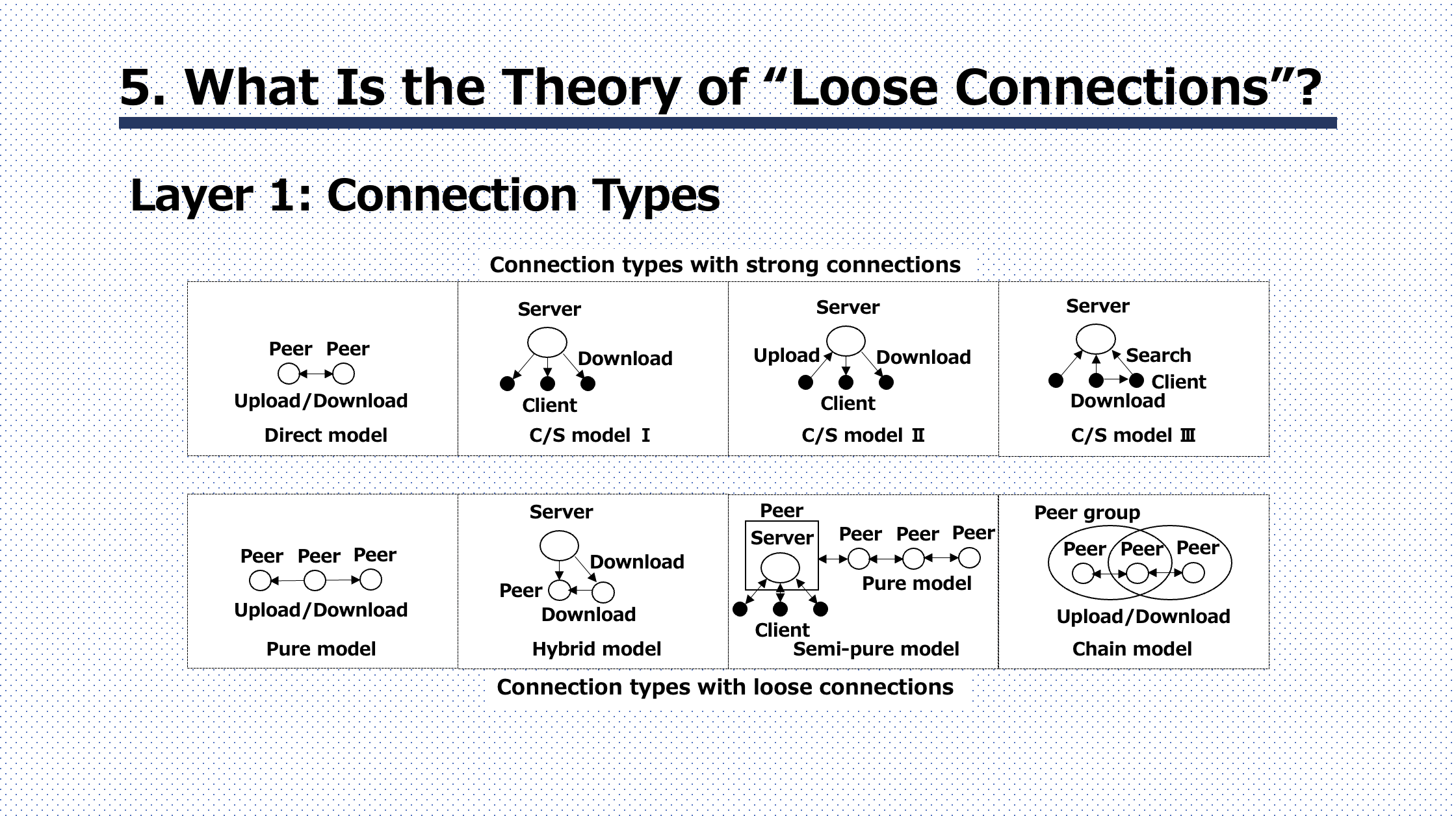 |
Layer 1 addresses connection types. In total, eight types of connections are identified, which are mainly categorized into strong connections and loose connections. Within loose connections, there are four specific connection types. The construction of loose connections requires the deliberate use of these connection types. |
| ICACT20260157 Slide.17
[Big Slide]
|
Chrome Click!! |
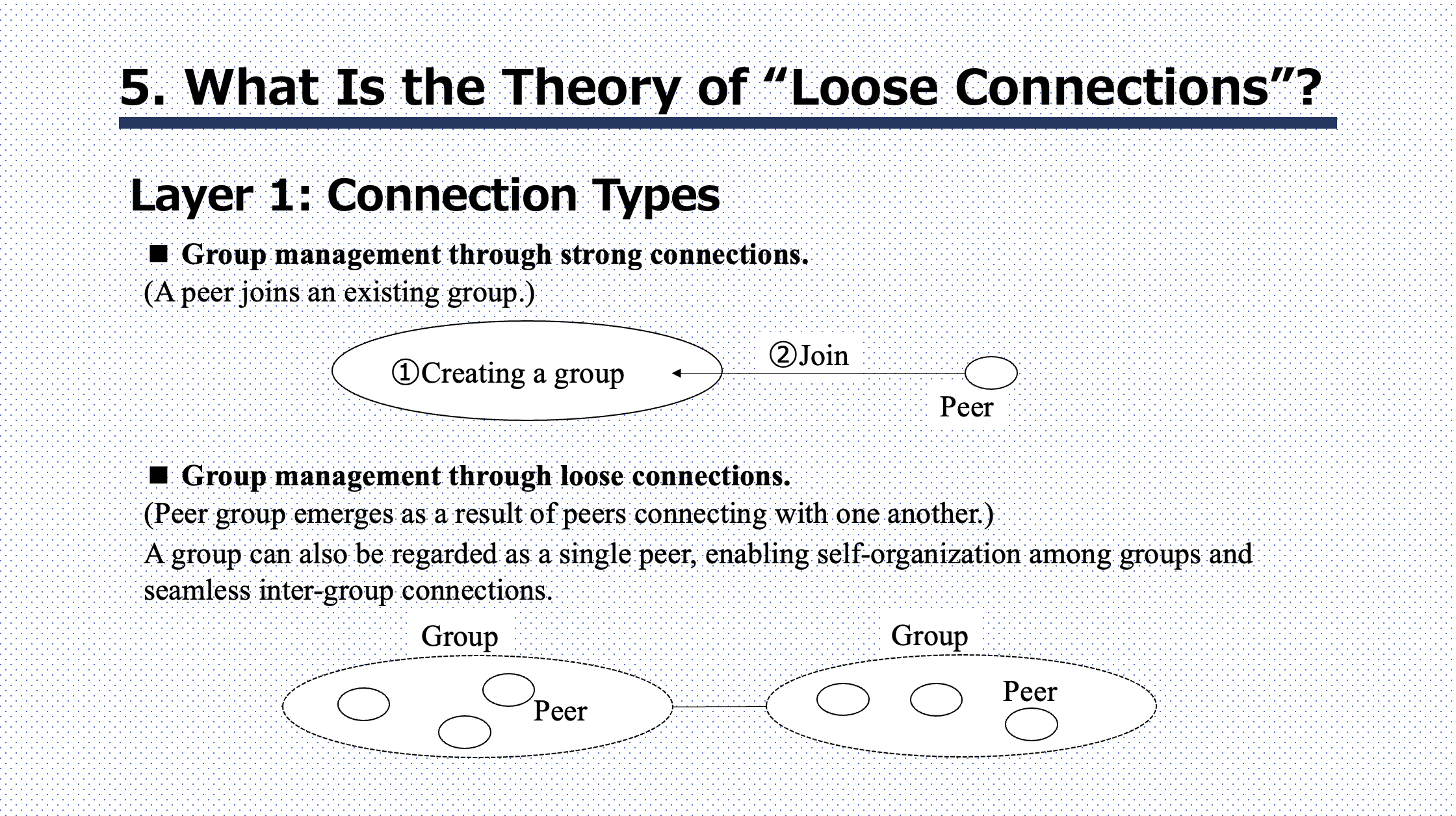 |
In addition, connection types define how groups are formed and managed. In group management through strong connections, a peer joins an existing group. In contrast, in group management through loose connections, a peer group emerges as a result of peers connecting with one another. Furthermore, a group can also be regarded as a single peer. This enables self-organization among groups and seamless inter-group connections. |
| ICACT20260157 Slide.18
[Big Slide]
|
Chrome Click!! |
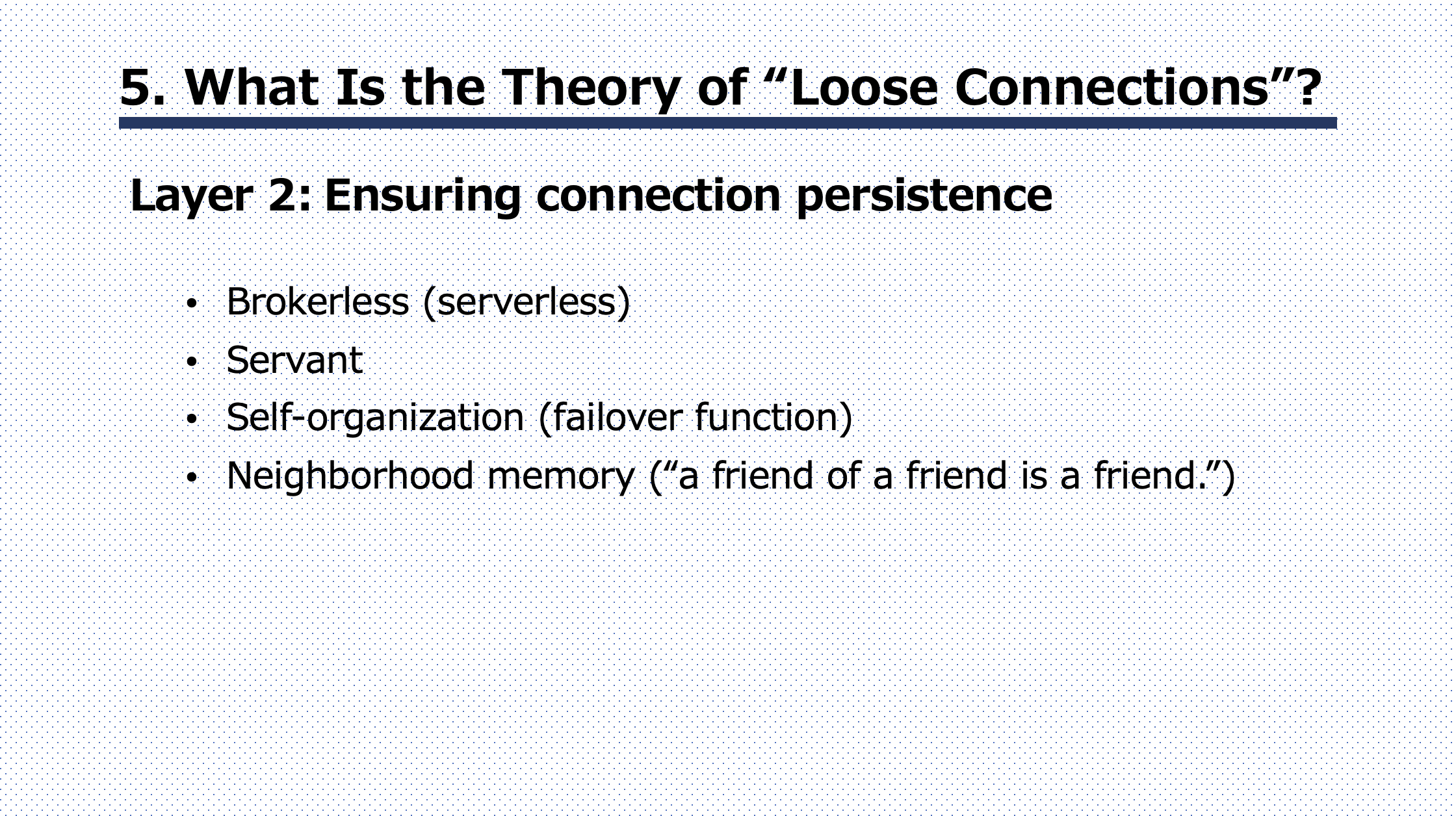 |
Layer 2 defines the components that ensure connection persistence. It specifies brokerless connections, the servant role, self-organization through failover functions, and neighborhood memory. The essence of loose connections lies in constructing brokerless connections that do not depend on specific actors. This design enhances flexibility, reduces risk and cost, and increases scalability. Together, these effects contribute to sustaining connections over time. To realize brokerless connections, each actor assumes both the role of requester and responder. This dual role is referred to as a servant. When a peer withdraws from a connection, other peers self-organize to maintain stability by performing a failover function. For this purpose, peers maintain records of one another—a mechanism referred to as neighborhood memory. |
| ICACT20260157 Slide.19
[Big Slide]
|
Chrome Click!! |
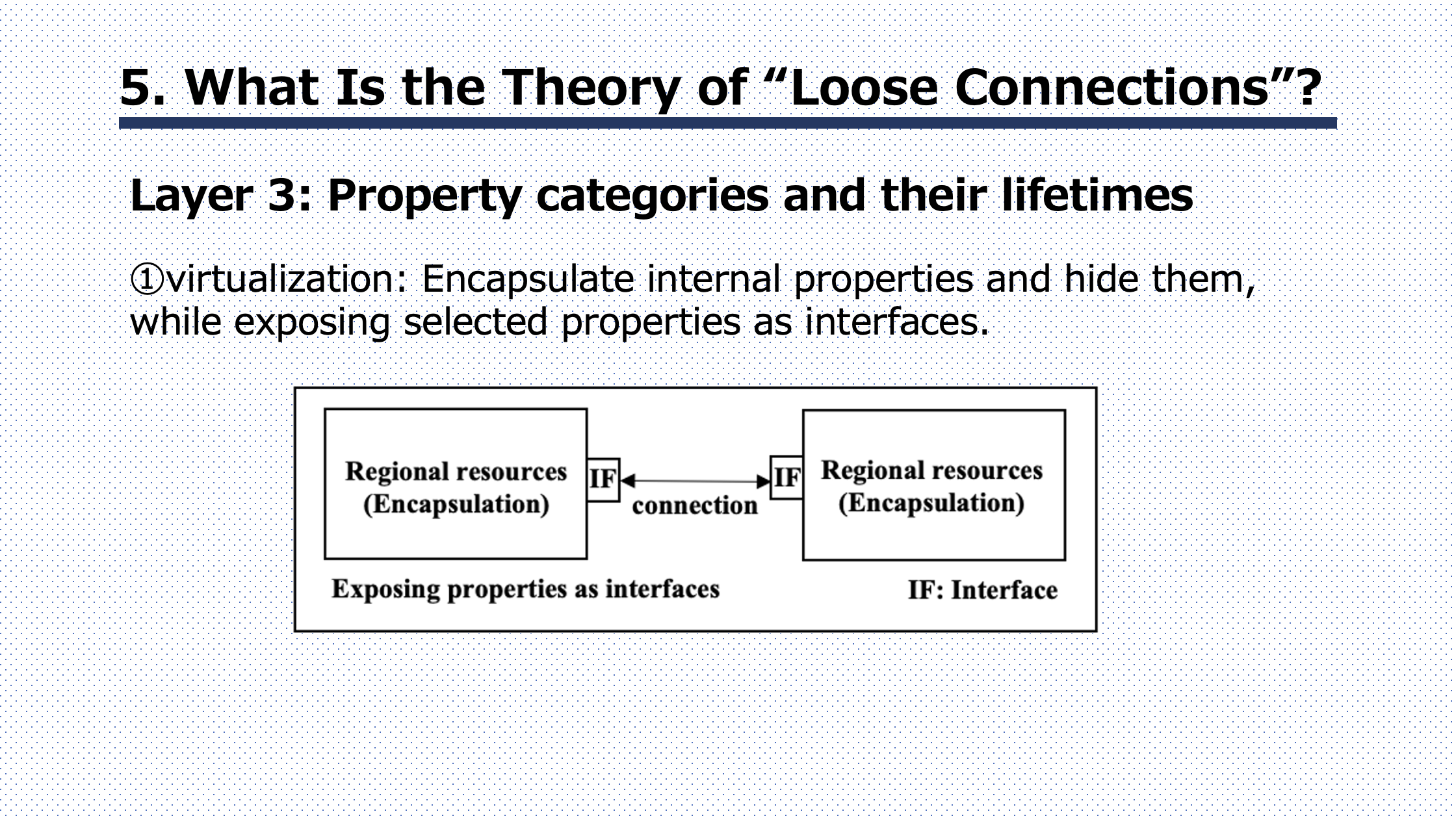 |
Layer 3 specifies interface design based on the virtualization of regional resources, taking into account the lifetimes of properties. First, virtualization. Virtualization involves encapsulating internal properties while exposing only selected properties as interfaces. |
| ICACT20260157 Slide.20
[Big Slide]
|
Chrome Click!! |
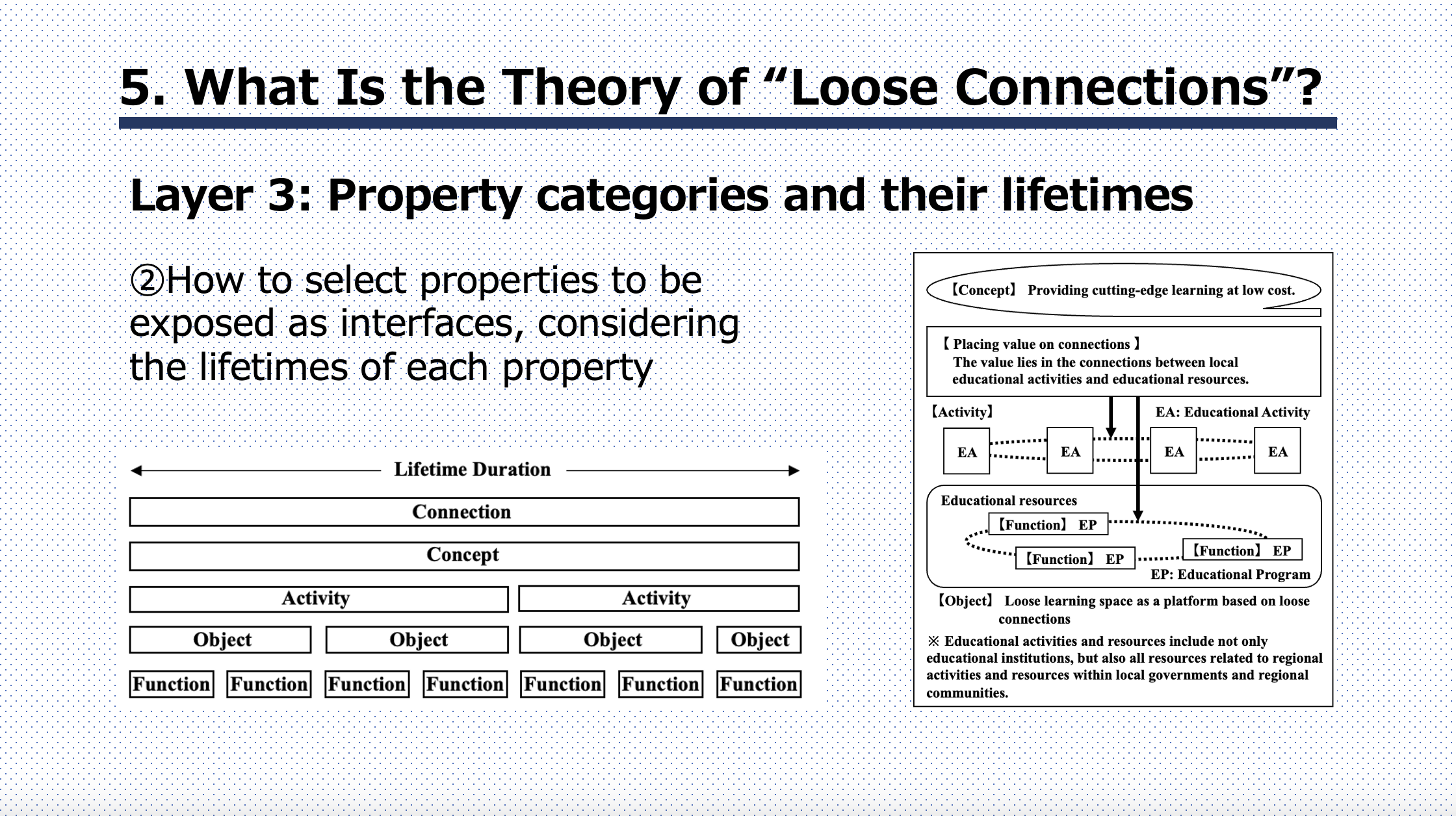 |
At this stage, it is necessary to determine which properties should be exposed as interfaces, taking into account the lifetime of each property. Properties are defined as the metadata of peers and are classified into five categories: functions, objects, activities, concepts, and connections. In general, the higher the level of abstraction, the longer the lifetime of a property. |
| ICACT20260157 Slide.21
[Big Slide]
|
Chrome Click!! |
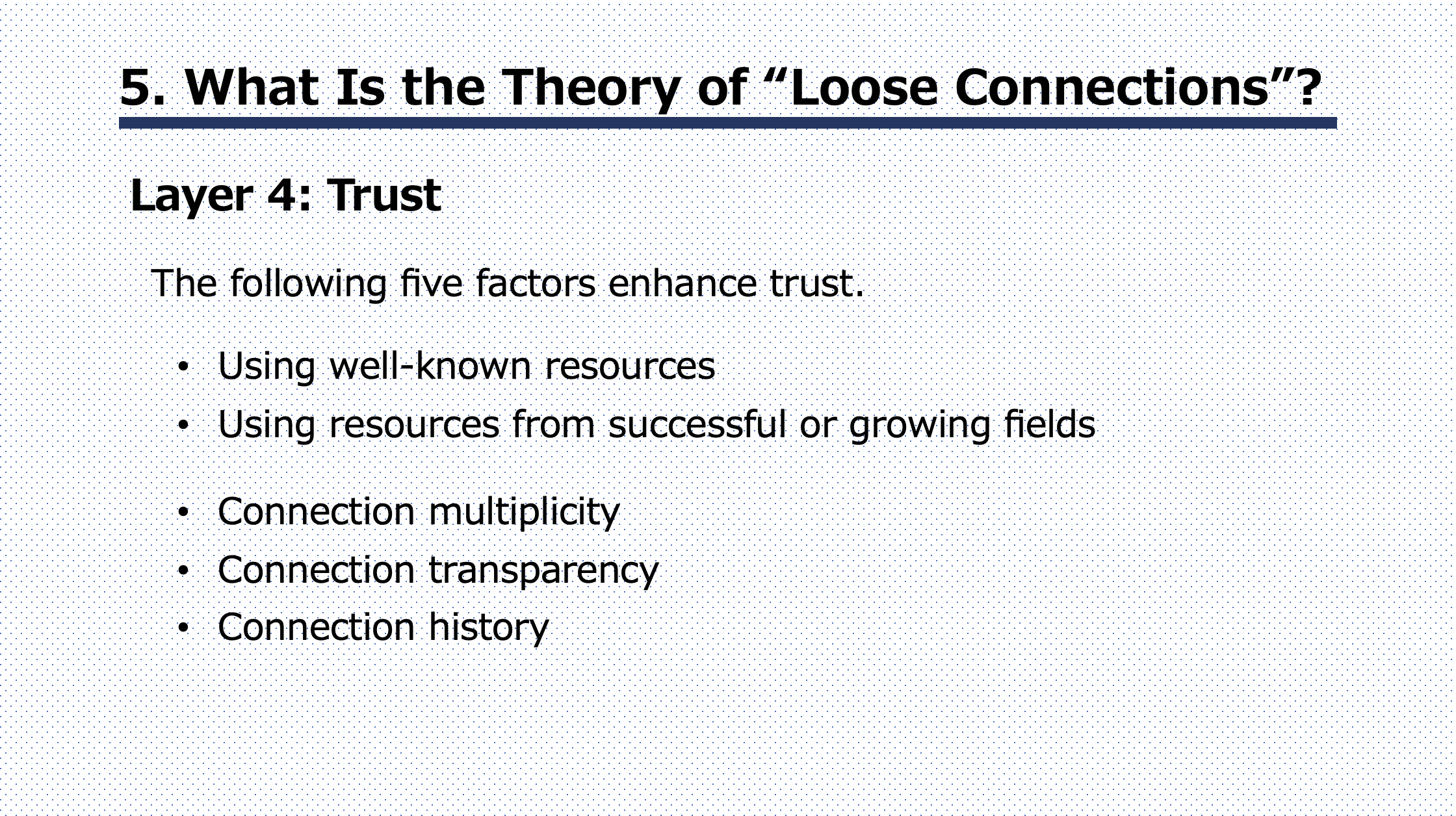 |
Layer 4 focuses on the mechanisms that enhance trust within loose connections. Trust is strengthened through the following five factors: well-established resources, resources associated with successful or expanding domains, multiplicity of connections, transparency of connections, and accumulated connection history. |
| ICACT20260157 Slide.22
[Big Slide]
|
Chrome Click!! |
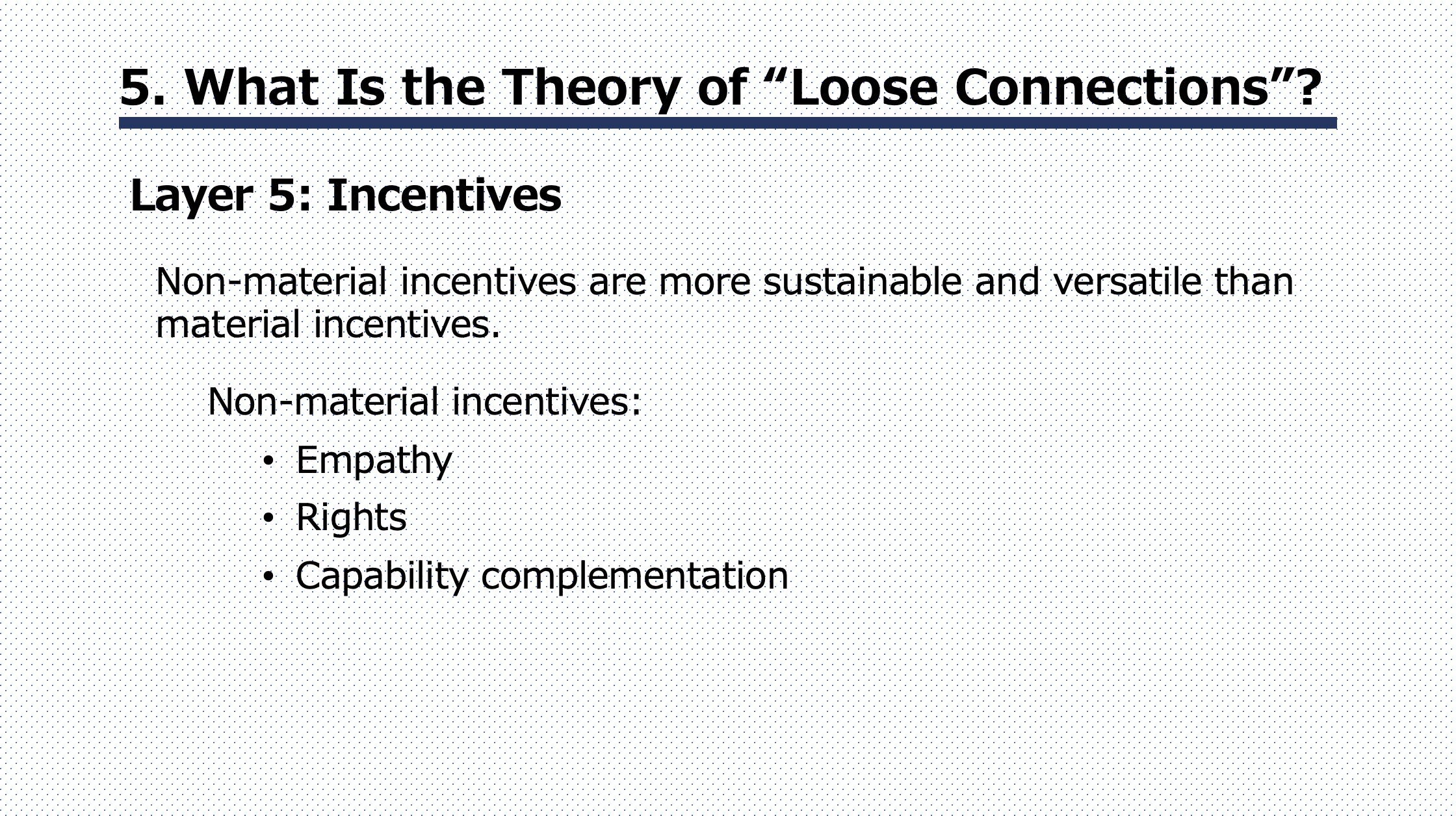 |
Layer 5 focuses on incentives that motivate participation and sustained engagement. In the context of loose connections, non-material incentives are more sustainable and adaptable than material incentives. These non-material incentives include empathy, rights, and capability complementation. The first incentive is empathy. When actors share empathy toward a concept or vision, they connect not for external rewards, but for shared meaning. This enables low-cost yet highly effective connections. As discussed in Layer 3, concepts have longer lifetimes than material properties, which makes empathy-based incentives more sustainable. The second incentive is rights. Granting rights, such as decision-making authority or participation opportunities, fosters actors’ autonomy. These rights support brokerless connections, as discussed in Layer 2. Without such rights, connections tend to become actor-dependent and high-cost. The third incentive is capability complementation. Actors are motivated to connect by complementing each other’s capabilities. For example, a virtual supercomputer achieves high performance by interconnecting distributed resources. |
| ICACT20260157 Slide.23
[Big Slide]
|
Chrome Click!! |
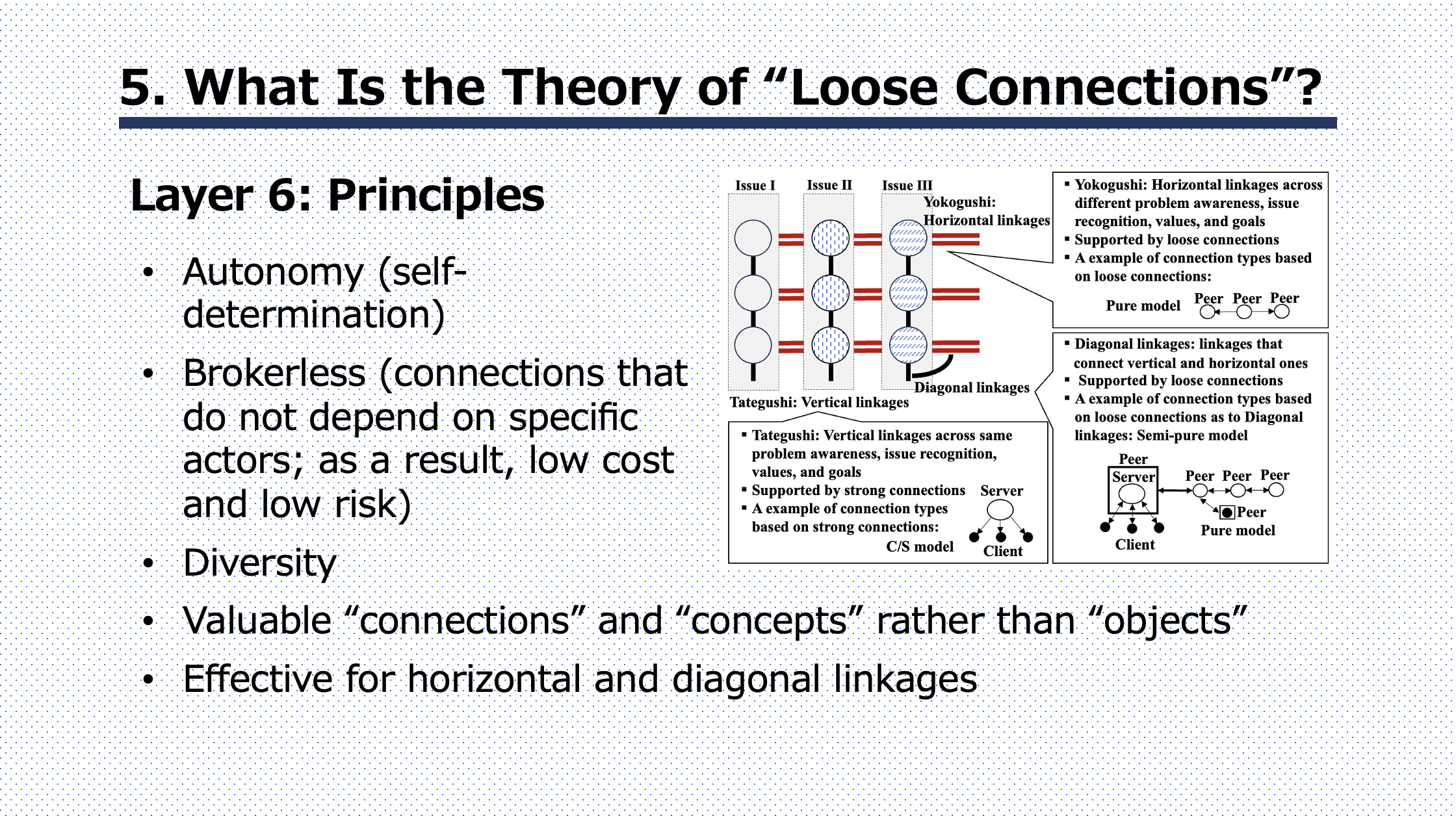 |
Layer 6 defines the core principles that govern loose connections. First, autonomy (self-determination). Actors form autonomous and decentralized cooperative connections based on self-determination. Second, brokerless connections. Connections do not depend on specific actors; as a result, they achieve low cost and low risk. Third, diversity. Loose connections allow diverse values, problem awareness, and goals to coexist. Fourth, valuing “connections” and “concepts” rather than “objects.” Value is placed on relationships and shared concepts instead of material assets. Finally, effectiveness for horizontal and diagonal linkages. Loose connections are effective for horizontal linkages and diagonal linkages that bridge vertical and horizontal structures. |
| ICACT20260157 Slide.24
[Big Slide]
|
Chrome Click!! |
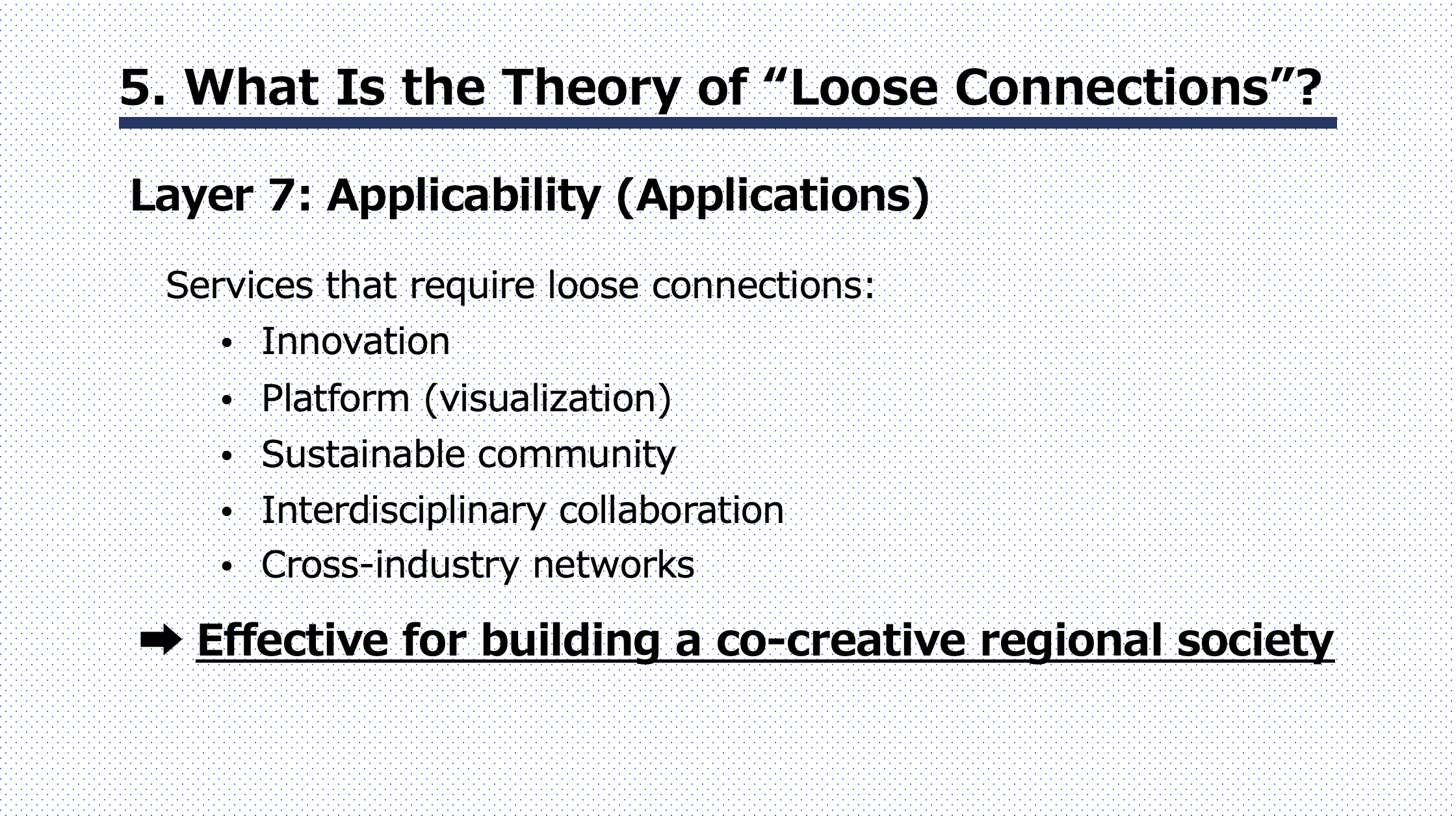 |
Layer 7 presents the areas in which loose connections are particularly effective. Services that require loose connections include innovation, platforms for visualization, sustainable community, interdisciplinary collaboration, and cross-industry networks. Through these applications, loose connections are effective for building a co-creative regional society.
|
| ICACT20260157 Slide.25
[Big Slide]
|
Chrome Click!! |
 |
Finally, this study describes the implementation method of a regional revitalization platform as an example of the social implementation of loose connections.
The platform consists of two core systems:
a regional resource collaboration system, which utilizes Web 3.0 technologies to link regional resources, and
a data interoperability system, which applies AI technologies to promote loose interoperability among data.
Through the integration of these two systems, a regional revitalization platform based on loose connections can be practically implemented. |
| ICACT20260157 Slide.26
[Big Slide]
|
Chrome Click!! |
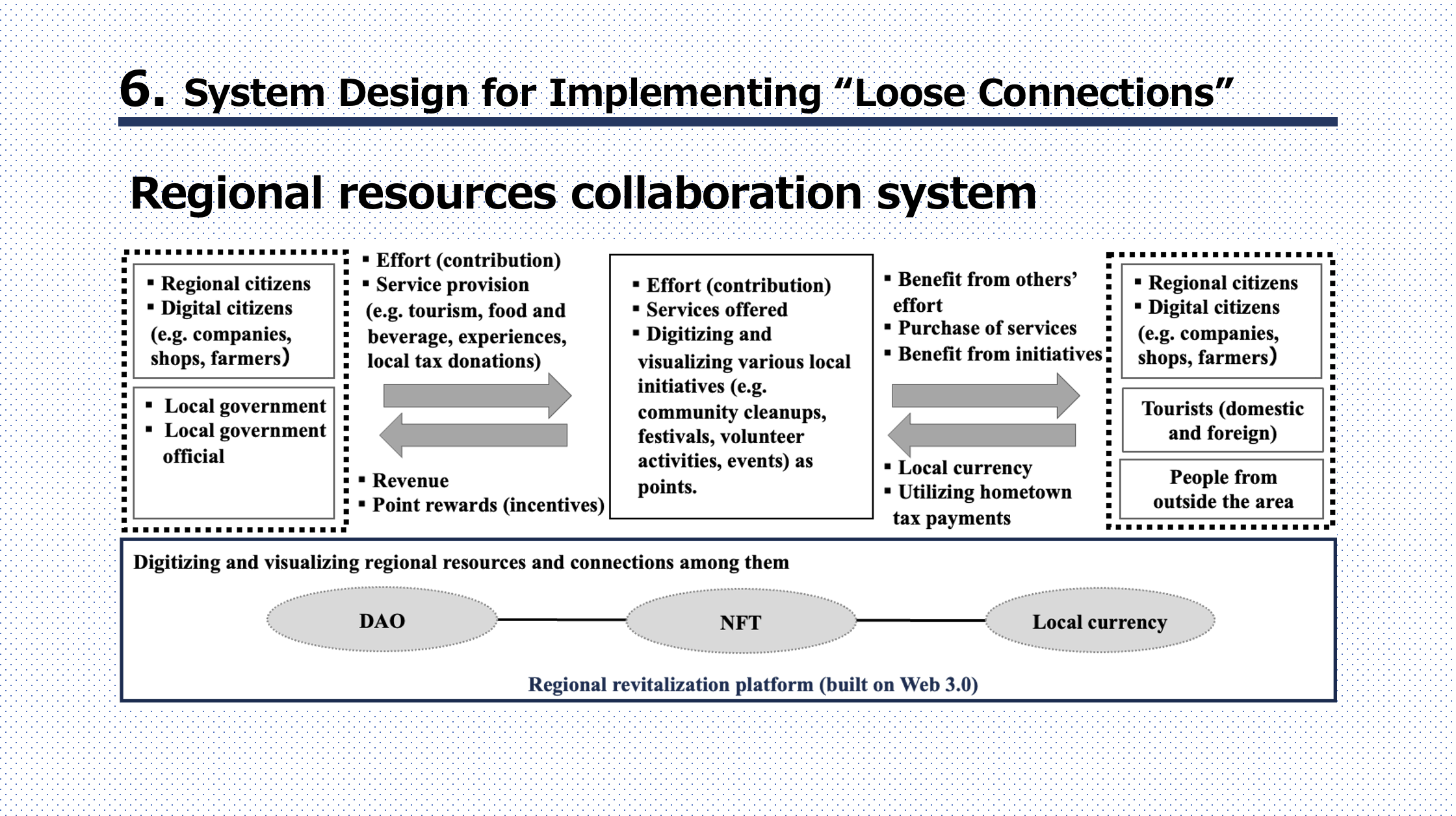 |
The regional resource collaboration system systematizes regional resource collaboration based on Web 3.0 technologies, enabling loose connections among regional resources.
Web 3.0 technologies support decentralized systems built on blockchains, with DAOs, non-fungible tokens (NFTs), regional tokens, and decentralized identifiers (DIDs) as core components.
These technologies are well suited to constructing loose connections because they do not rely on centralized actors.
As a result, this system creates new collaborative environments that engage not only local residents but also external participants, such as visitors, migrants, foreign tourists, and digital citizens. |
| ICACT20260157 Slide.27
[Big Slide]
|
Chrome Click!! |
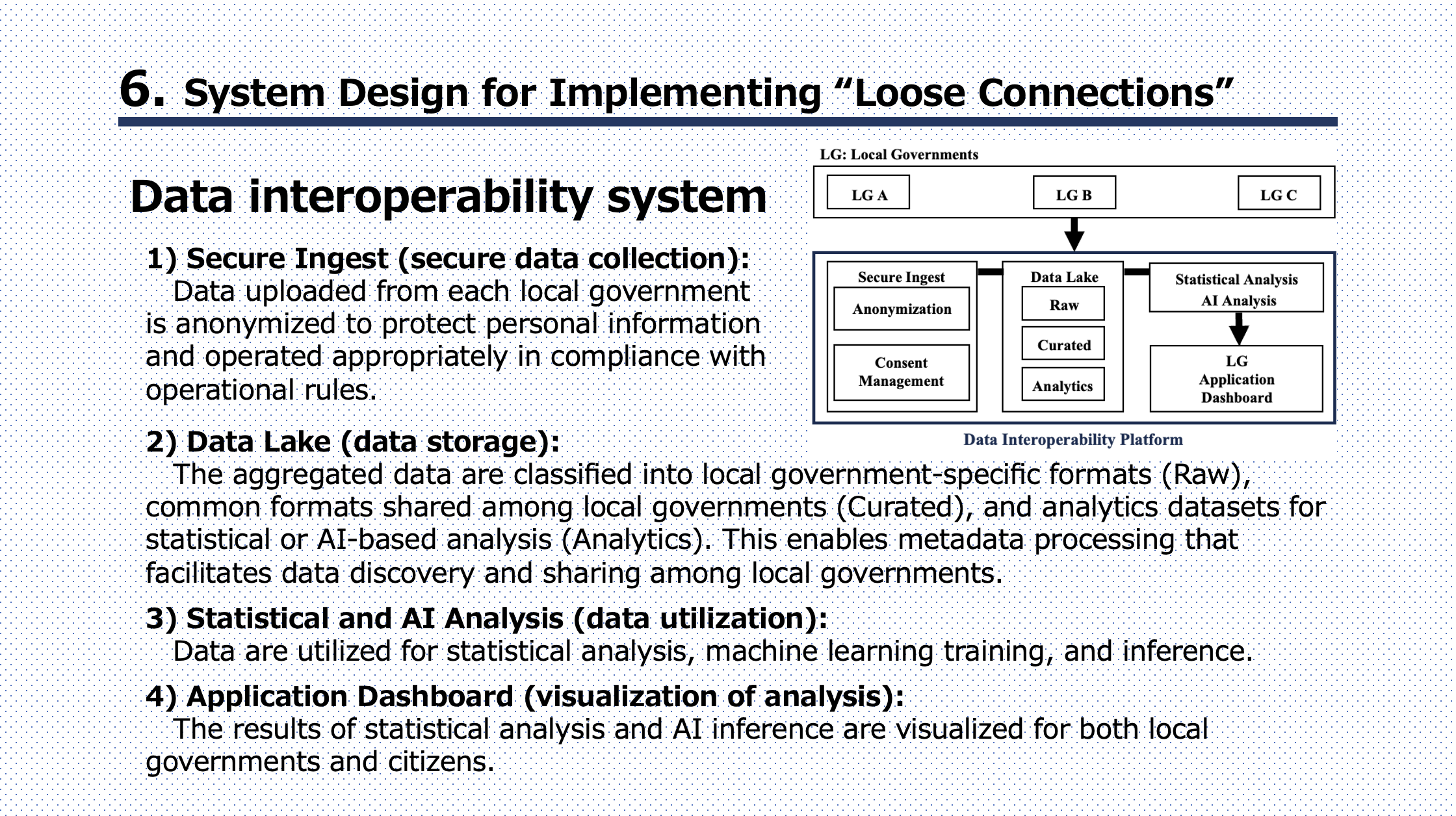 |
The data interoperability system applies AI technologies to promote loose interoperability among data.
It consists of four components.
First, Secure Ingest.
Data uploaded from each local government are anonymized to protect personal information and are managed in accordance with operational rules.
Second, Data Lake.
Aggregated data are classified into three layers: Raw data, Curated data, and Analytics data.
This structure enables efficient metadata processing and facilitates data discovery and sharing.
Third, Statistical and AI Analysis.
The data are used for statistical analysis, machine learning training, and inference.
Finally, Application Dashboard.
The results of statistical analysis and AI inference are visualized and shared with both local governments and citizens. |
| ICACT20260157 Slide.28
[Big Slide]
|
Chrome Click!! |
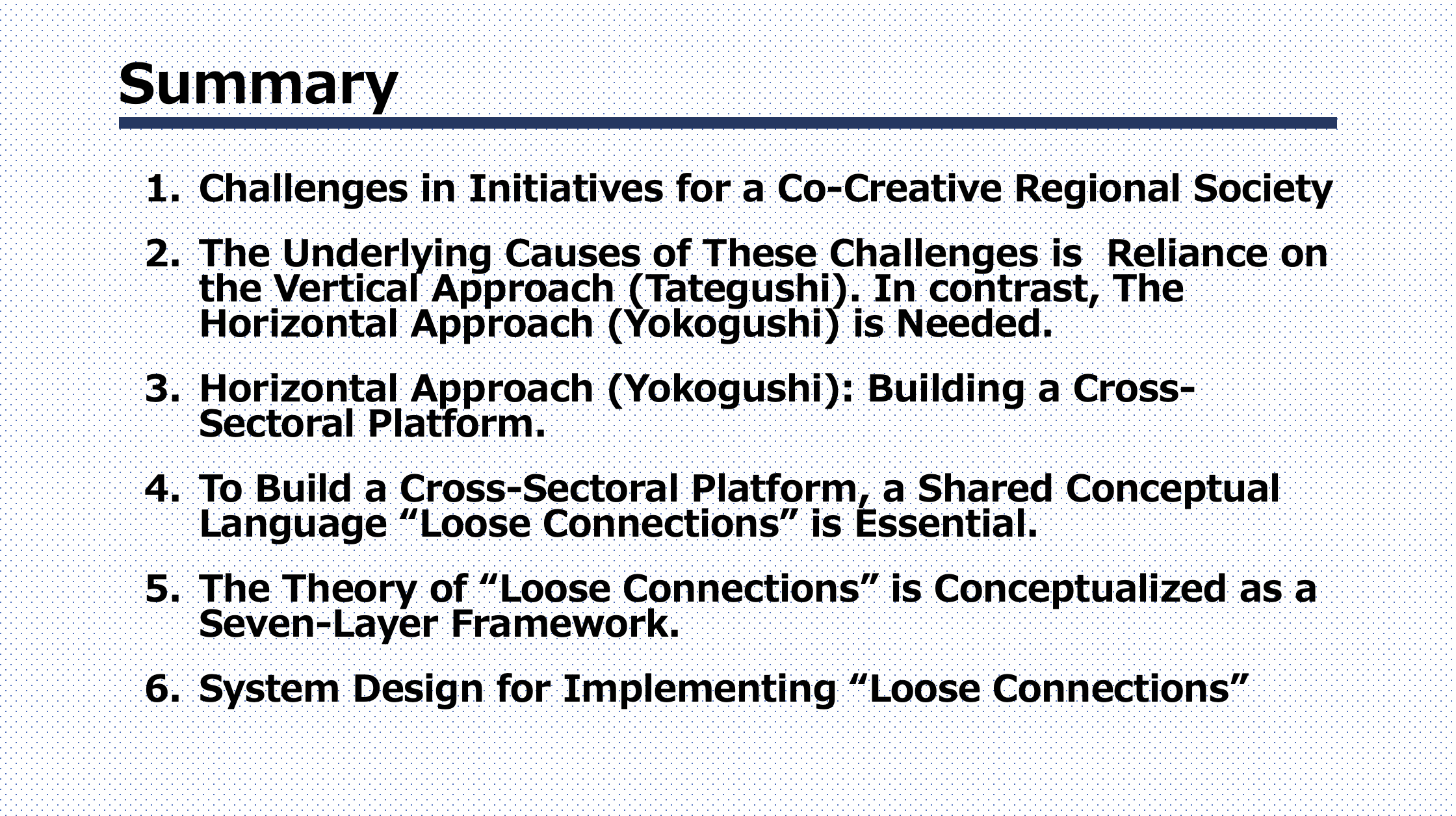 |
In summary, this study presents six key points. First, it identifies challenges in current initiatives for a co-creative regional society. Second, it clarifies that the underlying cause of these challenges is reliance on the vertical approach (Tategushi). Third, it emphasizes the need for a horizontal approach (Yokogushi) to address these challenges. Fourth, it proposes building a cross-sectoral platform through the horizontal approach (Yokogushi), whose essence lies in loose connections as a shared conceptual language. Fifth, it conceptualizes the Theory of Loose Connections as a seven-layer framework. Finally, it proposes system designs for implementing Loose Connections in practice. |
| ICACT20260157 Slide.29
[Big Slide]
|
Chrome Click!! |
 |
Thank you for listening. |















