 ICACT20260196 Slide.01
[Big Slide]
[YouTube] |
Chrome  Click!! |
 |
Paper Topic |
| ICACT20260196 Slide.02
[Big Slide]
|
Chrome Click!! |
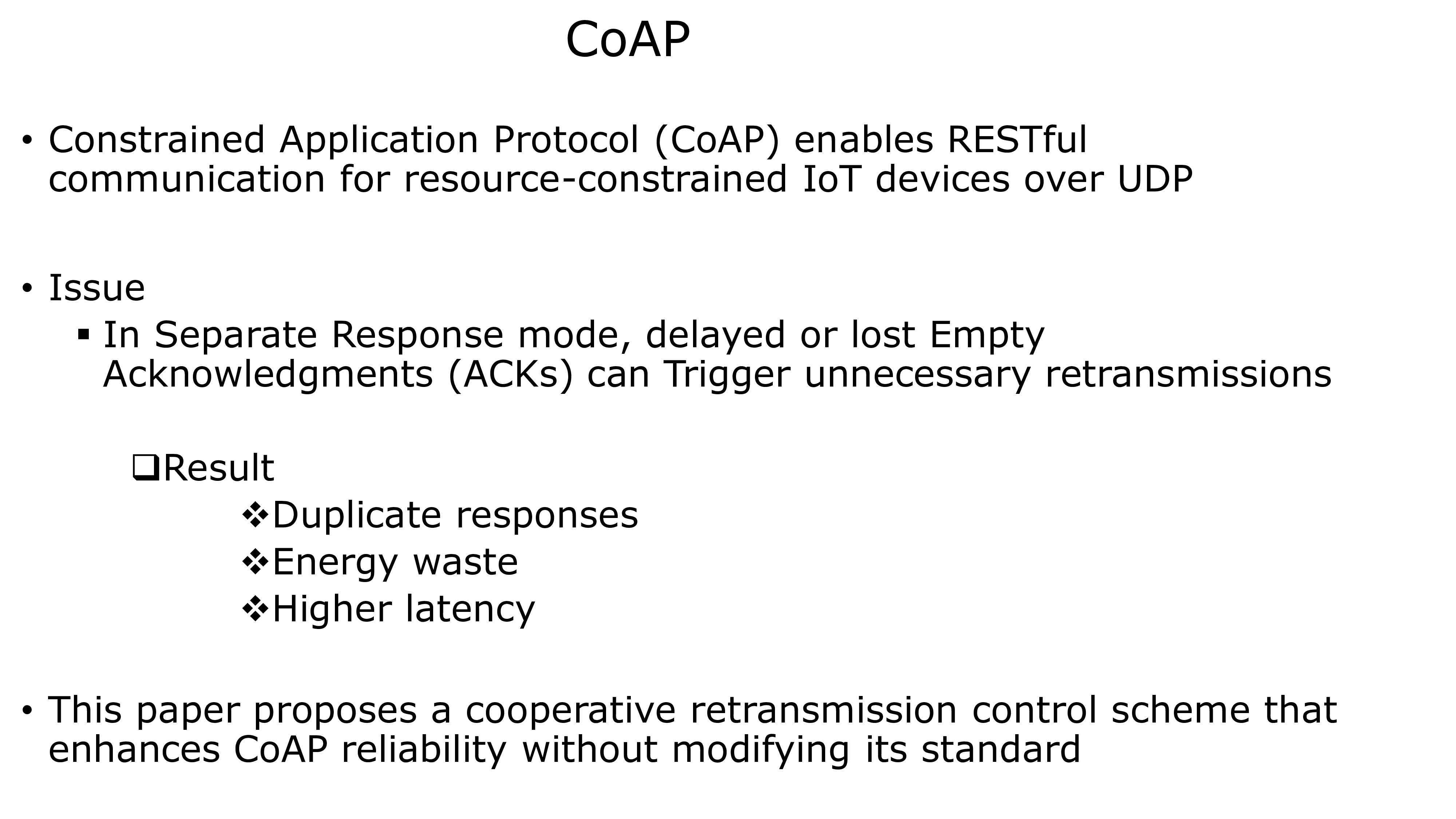 |
Constrained Application Protocol (CoAP) enables RESTful communication for resource-constrained IoT devices over UDP. The issue is that in Separate Response mode, delayed or lost Empty Acknowledgments (ACKs) can Trigger unnecessary retransmissions resulting in duplicate responses, energy waste and higher latency.
This paper proposes a cooperative retransmission control scheme that enhances CoAP reliability without modifying its standard
|
| ICACT20260196 Slide.03
[Big Slide]
|
Chrome Click!! |
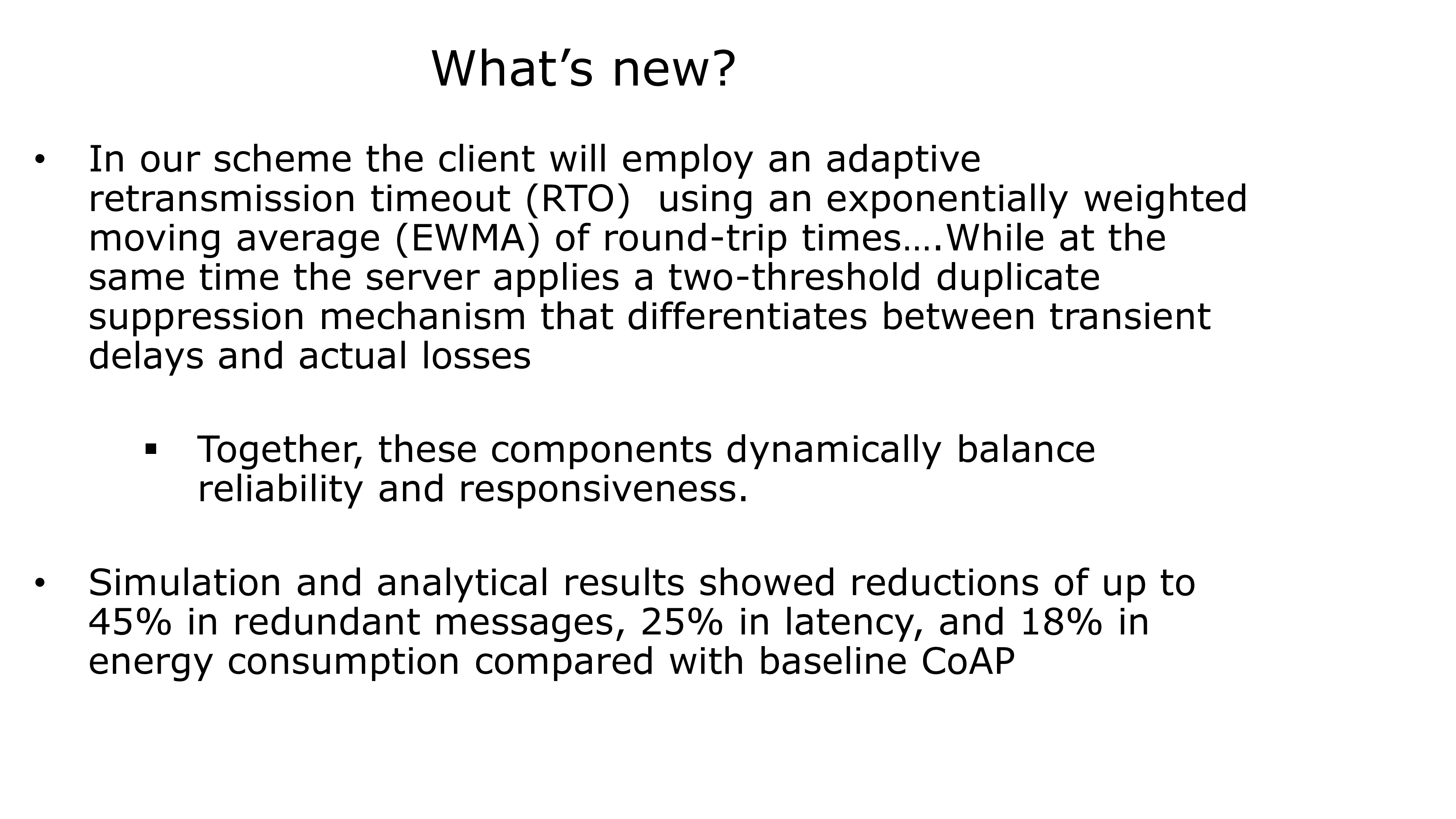 |
In our scheme the client will employ an adaptive retransmission timeout (RTO) using an exponentially weighted moving average (EWMA) of round-trip times….while at the same time the server applies a two-threshold duplicate suppression mechanism that differentiates between transient delays and actual losses.
Together, these components dynamically balance reliability and responsiveness.
Simulation and analytical results showed reductions of up to 45% in redundant messages, 25% in latency, and 18% in energy consumption compared with baseline CoAP
|
| ICACT20260196 Slide.04
[Big Slide]
|
Chrome Click!! |
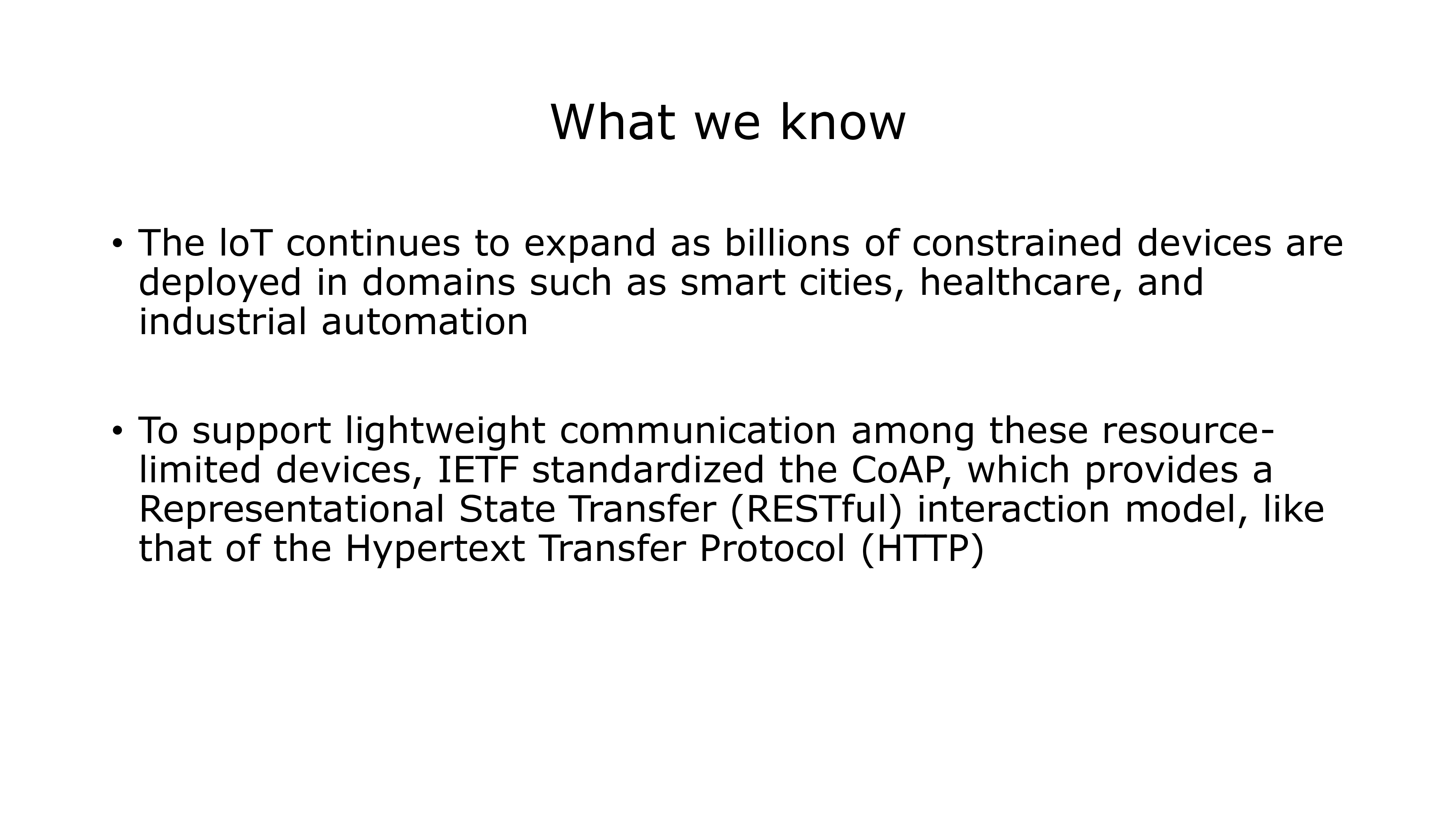 |
The loT continues to expand as billions of constrained devices are deployed in domains such as smart cities, healthcare, and industrial automation. To support lightweight communication among these resource-limited devices, IETF standardized the CoAP, which provides a Representational State Transfer (RESTful) interaction model, like that of the Hypertext Transfer Protocol (HTTP)
|
| ICACT20260196 Slide.05
[Big Slide]
|
Chrome Click!! |
 |
Unlike HTTP, which operates over the reliable Transmission Control Protocol (TCP), CoAP
is designed to run on the User Datagram Protocol (UDP) to minimize overhead in low-power and lossy networks (LLNs).
It ensures reliability through (i) Confirmable (CON) messages (ii) Acknowledgments (ACKs) (iii) A retransmission timeout (RTO) - The duration a sender waits for an ACK before retransmitting a message based on observed round-trip times (RTTs)
|
| ICACT20260196 Slide.06
[Big Slide]
|
Chrome Click!! |
 |
However, we also know that inefficiency in CoAP arises in the separate response mode, where the server replies to a clients CON request with an Empty ACK and later transmits the actual response. In lossy or congested wireless environments, Empty ACK messages may be delayed or lost. This results in clients triggering unnecessary retransmissions. By the time the original response finally arrives, redundant responses have been generated, inflating network latency, increasing energy consumption, and wasting scarce bandwidth resources. These inefficiencies are particularly detrimental in dense IoT deployments, where nodes operate on limited battery power and bandwidth, and deterministic latency is crucial for real-time or mission critical applications
|
| ICACT20260196 Slide.07
[Big Slide]
|
Chrome Click!! |
 |
Existing studies to examine CoAP retransmission mechanisms from various perspectives include
Fixed exponential backoff [4), probabilistic retransmission [5], cross-layer congestion control [6], and Machine-learning-based adaptive schemes [7], as cited in our paper.
However, most of these approaches either lack fine-grained adaptability to dynamically varying network delays or fail to directly address the duplicate-response problem in separate-response communication.
Moreover, most these focus primarily on throughput or fairness, rather than achieving a balanced trade-off between reliability and latency under delay-sensitive loT conditions
|
| ICACT20260196 Slide.08
[Big Slide]
|
Chrome Click!! |
 |
To overcome these limitations, our novel retransmission control scheme introduces two complementary components designed for efficient and reliable operation under dynamic wireless conditions:
(i) Adaptive Client-Side Timer Estimation (ii) Server-Side Duplicate Suppression.
|
| ICACT20260196 Slide.09
[Big Slide]
|
Chrome Click!! |
 |
Adaptive Client-Side Timer Estimation. A lightweight retransmission timeout (RTO) adaptation mechanism based on an exponentially weighted moving average (EWMA) of round-trip time (RTT) samples.
RTT refers to the elapsed time between sending a confirmable (CON) request and receiving the corresponding acknowledgment (ACK) or response.
The proposed adaptation is inspired by the RTO computation in the Transmission Control Protocol (TCP) but optimized for the computational and memory constraints of CoAP end points operating in low-power, lossy loT networks.
|
| ICACT20260196 Slide.10
[Big Slide]
|
Chrome Click!! |
 |
Server-Side Duplicate Suppression.
A two-threshold response control strategy that distinguishes between transient ACK delays and actual packet losses. This approach allows the server to suppress redundant retransmissions while maintaining reliability by dynamically adjusting its wait timer and confirming receipt of spurious retransmissions with an Empty ACK rather than resending the entire payload.
|
| ICACT20260196 Slide.11
[Big Slide]
|
Chrome Click!! |
 |
How COAP Works.
CoAP specifies four message types to support both reliable and non-reliable communication. Confirmable (CON), Non-confirmable (NON), Acknowledgment (ACK), and Reset (RST).
A CON-type message ensures reliability by requiring the receiver to respond with an ACK carrying the same Message ID (MID).
If the receiver encounters an error, it replies with a RST message.
When reliability is not required, such as in periodic sensor updates, a NON-type message is used without ACK.
|
| ICACT20260196 Slide.12
[Big Slide]
|
Chrome Click!! |
 |
A COAP client usually acts as the requester, issuing GET, POST, PUT, or DELETE commands to access or modify a resource identified by a Uniform Resource Identifier (URI) at the server.
Upon receiving a CON-type request, the server may respond using one of two modes: Piggybacked or
Separate Response.
|
| ICACT20260196 Slide.13
[Big Slide]
|
Chrome Click!! |
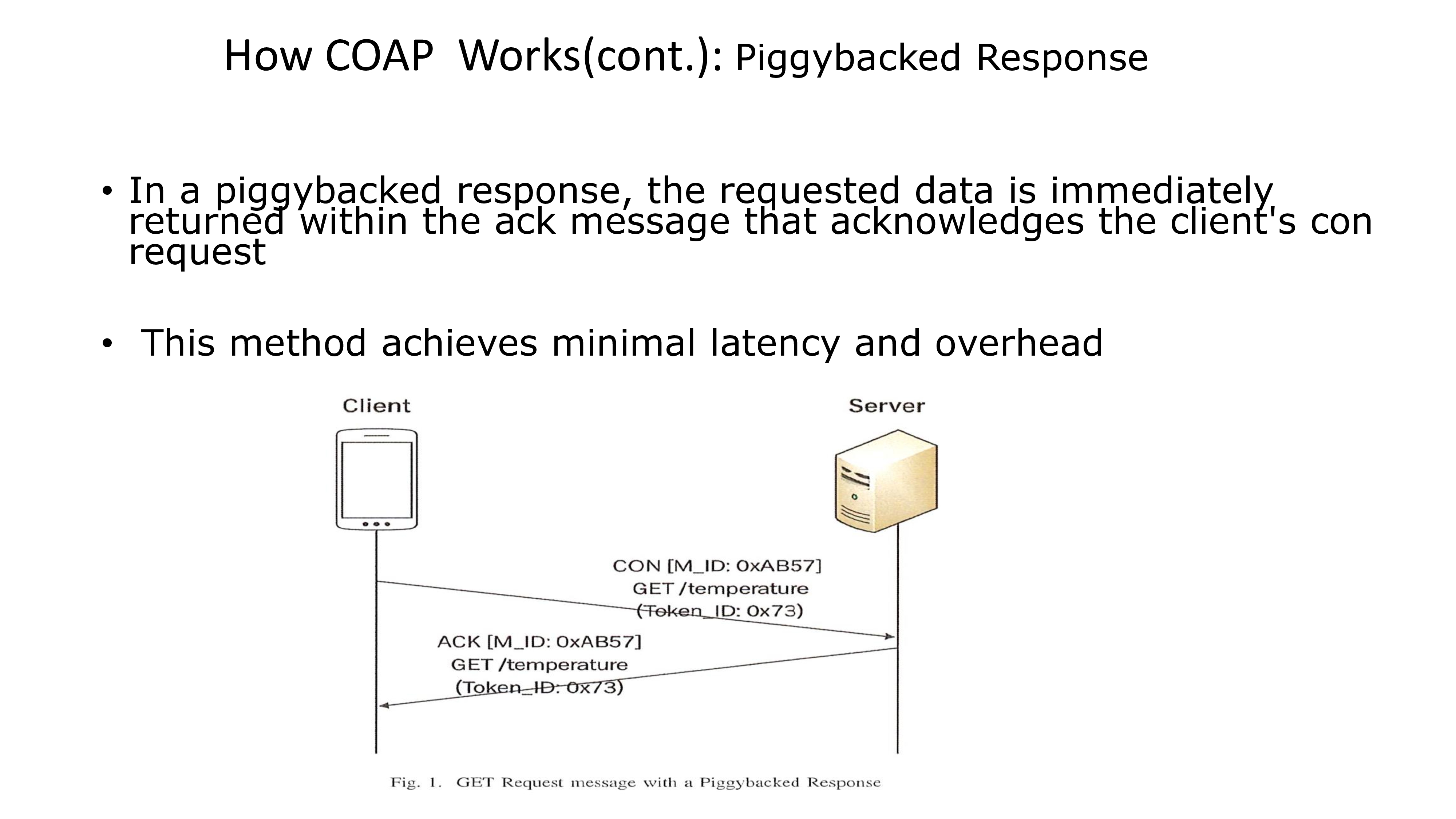 |
In a piggybacked response, the requested data is immediately returned within the ack message that acknowledges the clients con request. This method achieves minimal latency and overhead.
|
| ICACT20260196 Slide.14
[Big Slide]
|
Chrome Click!! |
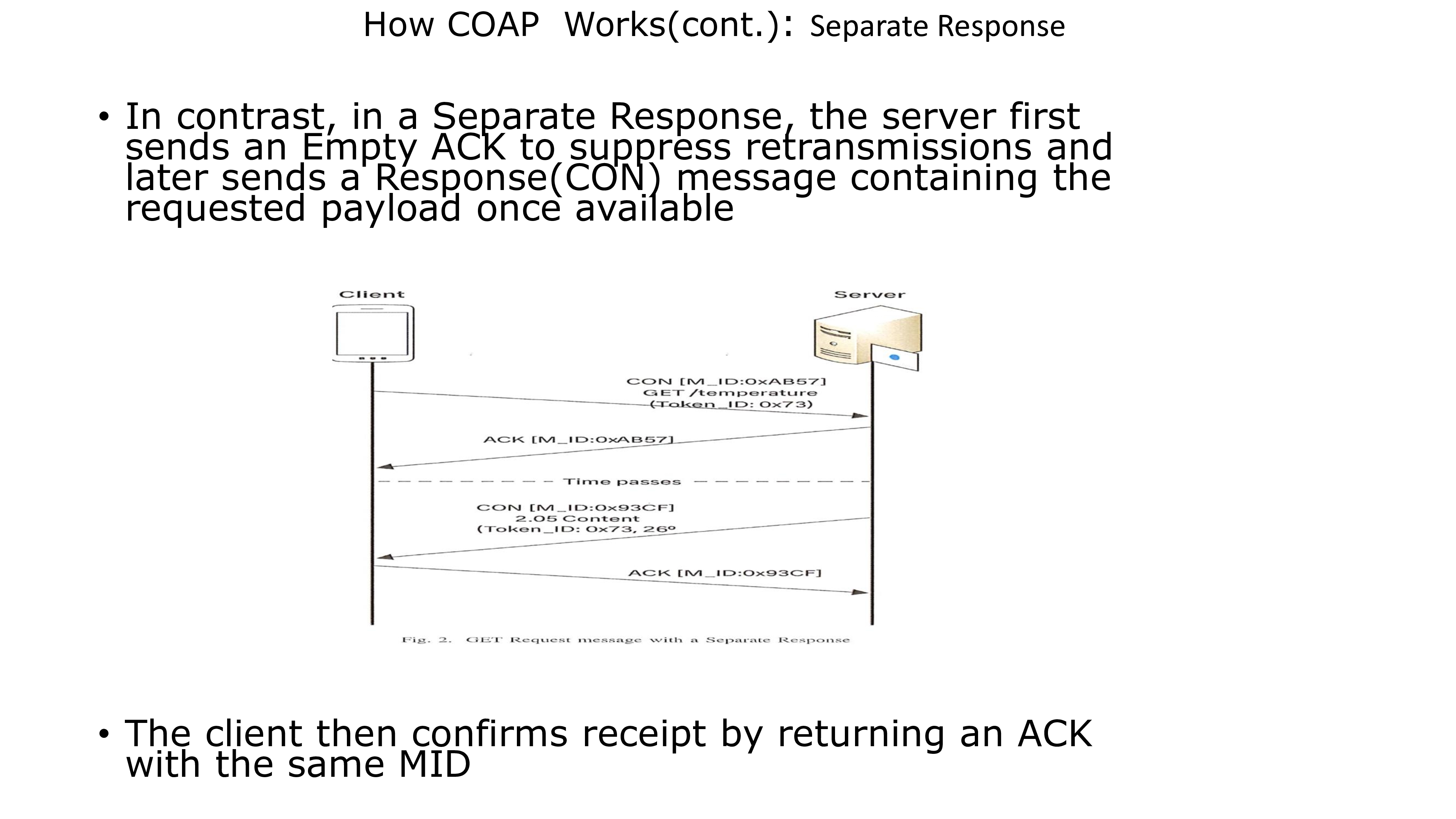 |
In contrast, in a Separate Response, the server first sends an Empty ACK to suppress retransmissions and later sends a Response(CON) message containing the requested payload once available.
The client then confirms receipt by returning an ACK with the same MID.
|
| ICACT20260196 Slide.15
[Big Slide]
|
Chrome Click!! |
 |
Research on CoAP retransmission and reliability control can be broadly classified into several technical directions, each addressing a specific performance aspect but leaving gaps in adaptability and duplication mitigation(Issue or problem not addressed).
Early CoAP implementations static or exponential backoff timers [4], fail to capture variable delay characteristics in dynamic wireless networks.
Later studies adopted adaptive timers based on RTT estimation and variance modeling [1O].
For example, timer calculation was optimized for Low-Power Wide-Area Networks (LPWANs) [11].
However, such approaches impose additional computational overhead and memory requirements that are unsuitable for constrained nodes.
To address this, our approach introduces a single parameter EWMA model that achieves timer adaptability with minimal complexity and bounded RTO limits.
|
| ICACT20260196 Slide.16
[Big Slide]
|
Chrome Click!! |
 |
Research on CoAP retransmission and reliability control can be broadly classified into several technical directions, each addressing a specific performance aspect but leaving gaps in adaptability and duplication mitigation(Issue or problem not addressed).
Early CoAP implementations static or exponential backoff timers [4], fail to capture variable delay characteristics in dynamic wireless networks.
Later studies adopted adaptive timers based on RTT estimation and variance modeling [1O].
For example, timer calculation was optimized for Low-Power Wide-Area Networks (LPWANs) [11]
However, such approaches impose additional computational overhead and memory requirements that are unsuitable for constrained nodes.
To address this, our approach introduces a single parameter EWMA model that achieves timer adaptability with minimal complexity and bounded RTO limits.
|
| ICACT20260196 Slide.17
[Big Slide]
|
Chrome Click!! |
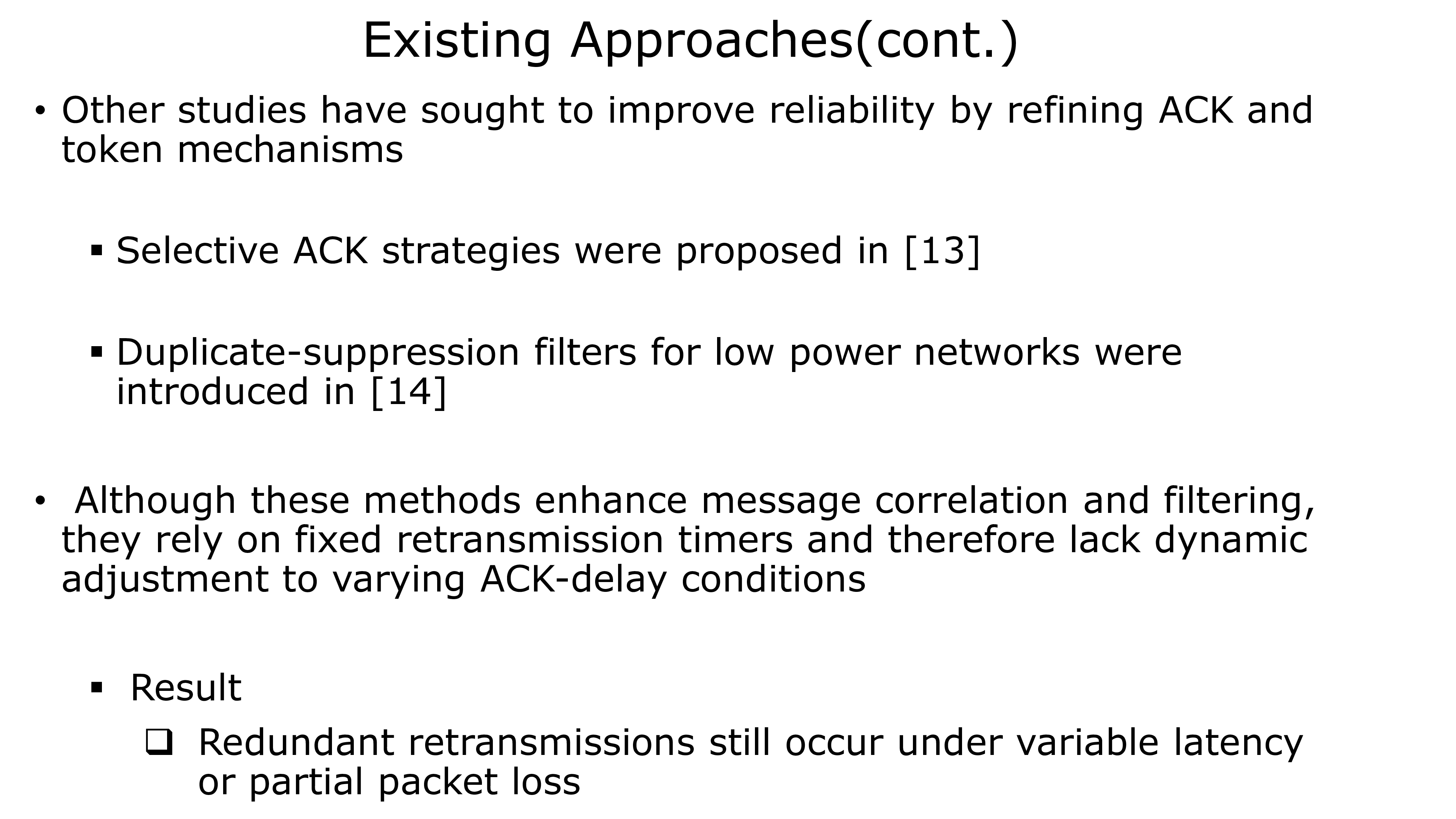 |
Other studies have sought to improve reliability by refining ACK and token mechanisms.
Foe example, Selective ACK strategies were proposed in [13], Duplicate-suppression filters for low power networks were introduced in [14] etc.
Although these methods enhance message correlation and filtering, they rely on fixed retransmission timers and therefore lack dynamic adjustment to varying ACK-delay conditions. Results of these is that
redundant retransmissions still occur under variable latency or partial packet loss.
|
| ICACT20260196 Slide.18
[Big Slide]
|
Chrome Click!! |
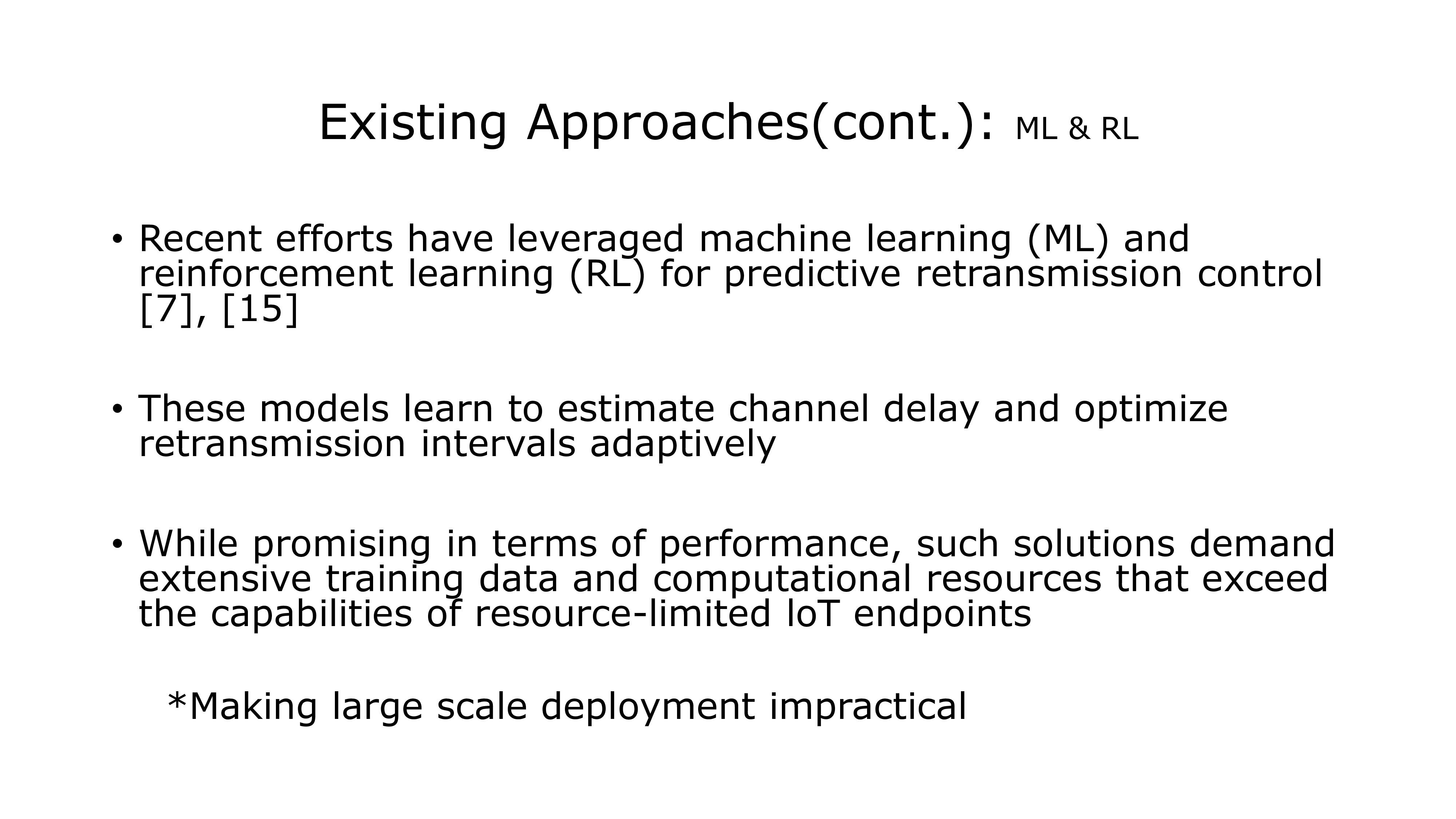 |
Recent efforts have leveraged machine learning (ML) and reinforcement learning (RL) for predictive retransmission control [7], [15].
These models learn to estimate channel delay and optimize retransmission intervals adaptively.
While promising in terms of performance, such solutions demand extensive training data and computational resources that exceed the capabilities of resource-limited loT endpoints, making large scale deployment impractical.
|
| ICACT20260196 Slide.19
[Big Slide]
|
Chrome Click!! |
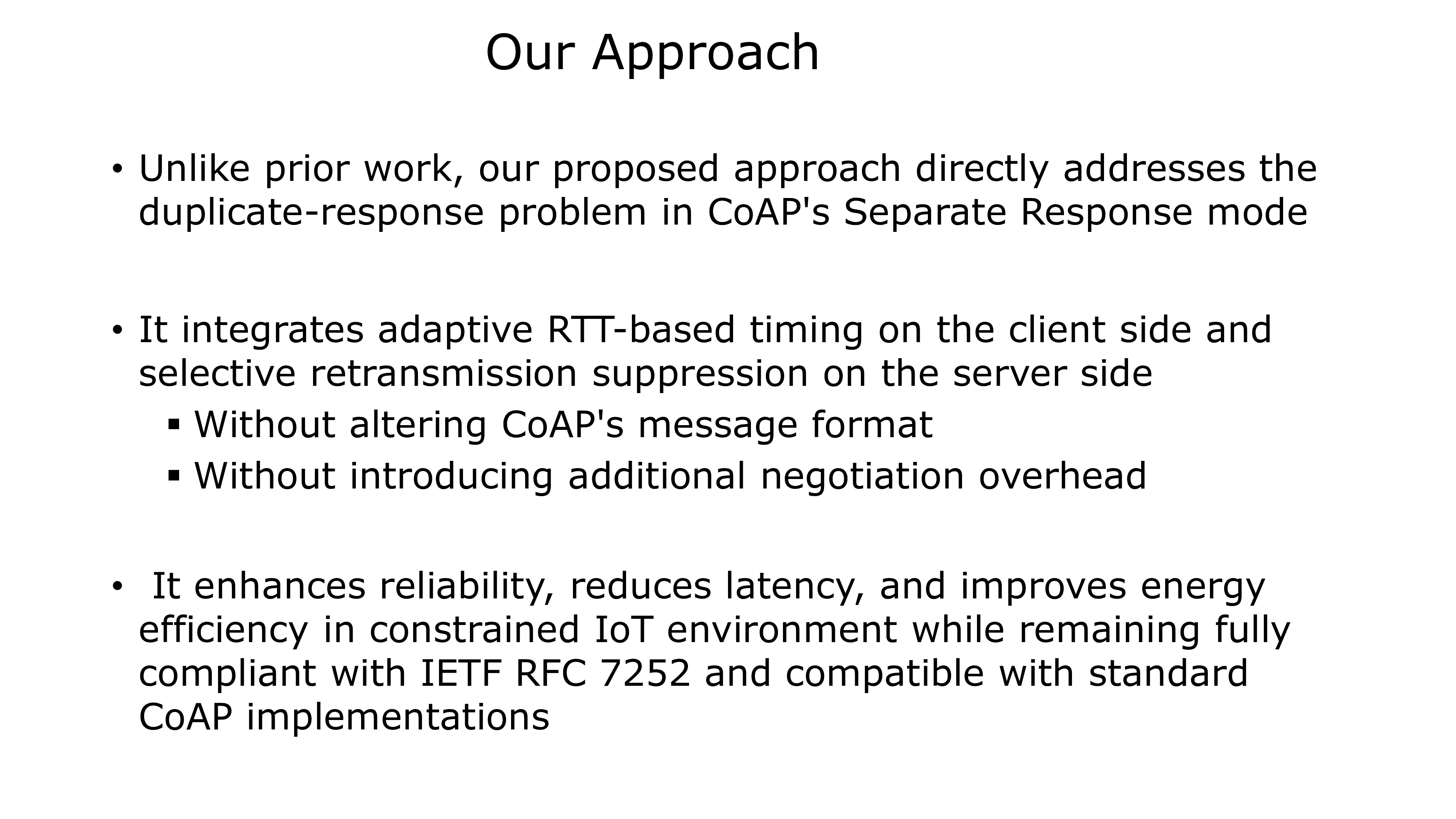 |
Unlike prior work, our proposed approach directly addresses the duplicate-response problem in CoAPs Separate Response mode.
It integrates adaptive RTT-based timing on the client side and selective retransmission suppression on the server side without altering CoAPs message format or introducing additional negotiation overhead.
It enhances reliability, reduces latency, and improves energy efficiency in constrained IoT environment while remaining fully compliant with IETF RFC 7252 and compatible with standard CoAP implementations.
|
| ICACT20260196 Slide.20
[Big Slide]
|
Chrome Click!! |
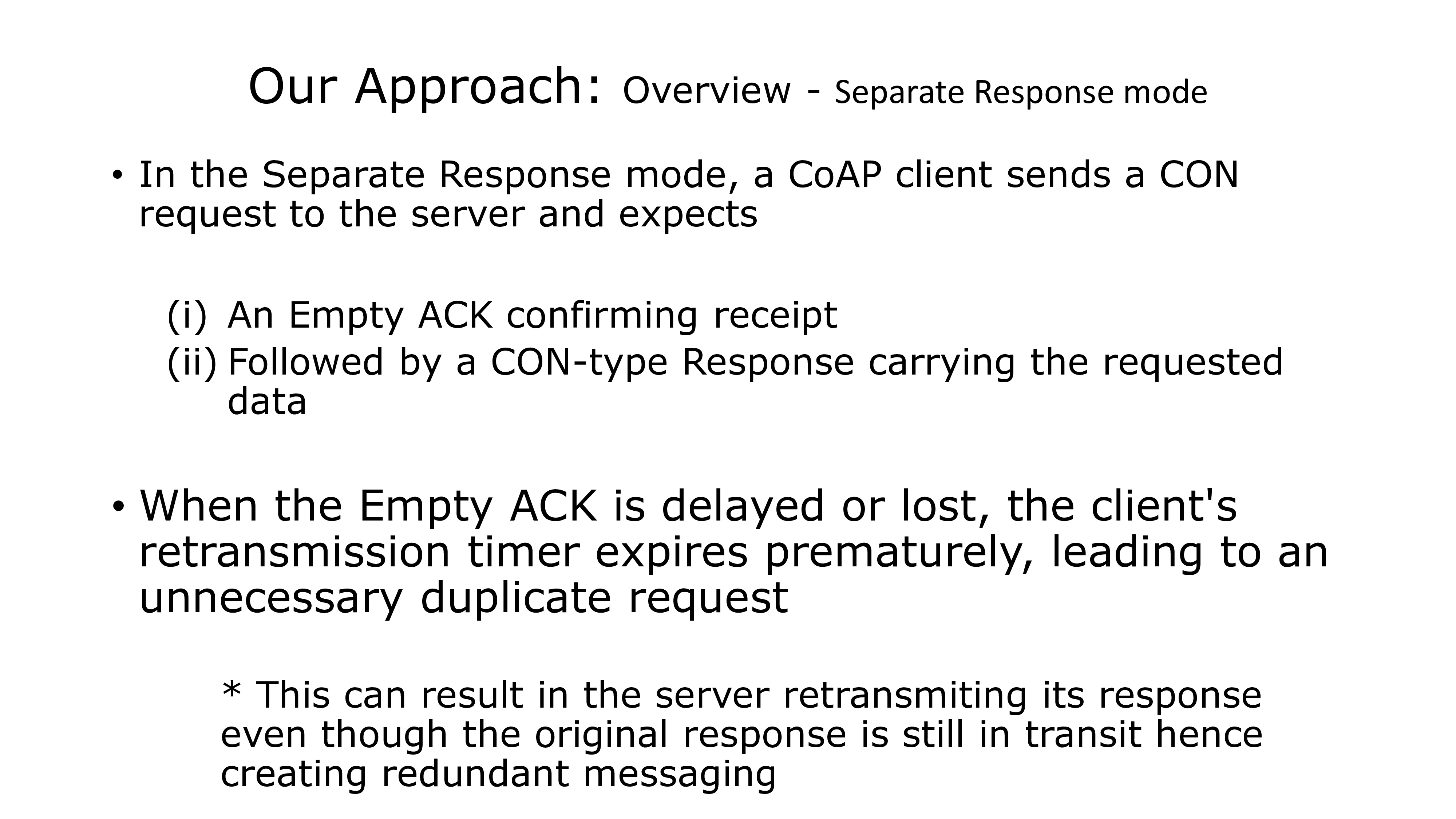 |
In the Separate Response mode, a CoAP client sends a CON request to the server and expects an Empty ACK confirming receipt followed by a CON-type Response carrying the requested data.
When the Empty ACK is delayed or lost, the clients retransmission timer expires prematurely, leading to an unnecessary duplicate request.
This can result in the server retransmiting its response even though the original response is still in transit hence creating redundant messaging.
|
| ICACT20260196 Slide.21
[Big Slide]
|
Chrome Click!! |
 |
In the conventional CoAP specification, the retransmission timeout (RTO) is statically defined or exponentially backed off after each timeout event.
While this approach guarantees delivery, it fails to adapt to dynamic wireless conditions-leading to either premature retransmissions (when the RTO is too short) or prolonged latency (when the RTO is too long).
To overcome these inefficiencies, our scheme introduces an adaptive RTO adjustment mechanism at the client side, inspired by the TCP-style delay estimator but modified for resource-constrained CoAP endpoints operating in lossy and delay-variable networks.
Each client maintains a temporary mapping table that stores information about ongoing transactions.
When a matching ACK or response is received, the client computes the observed round-trip time (RTT).
|
| ICACT20260196 Slide.22
[Big Slide]
|
Chrome Click!! |
 |
This RTT sample reflects both propagation and queuing delays experienced in the network path.
Because IoT links (e.g., IEEE 802.15.4, 6LoWPAN) often exhibit non-stationary latency patterns caused by duty cycling or interference, the algorithm continuously updates its timing estimate after every transaction rather than relying on static intervals.
To obtain a stable, yet responsive estimate, two key metrics are maintained
(i)Smoothed Round-Trip Time (SRTT) - a weighted moving average of recent RTT samples and (ii) RTT Variance (RTTVAR) - an estimate of network delay fluctuation.
Both recursively and probabilistically computed with some pre-established 𝛼, 𝛽, and 𝜅 values for stability, reactivity, and confidence margin respectively.
|
| ICACT20260196 Slide.23
[Big Slide]
|
Chrome Click!! |
 |
A higher 𝛼 increases sensitivity to short-term fluctuations but risks instability, while a larger 𝜅 provides a conservative buffer against sudden latency spikes.
These parameters were selected to balance stability and responsiveness, matching the processing capacity of low-power CoAP clients.
This exponentially weighted moving average (EWMA) based estimator enables the client to predict the most likely ACK delay without maintaining large historical datasets or performing heavy computations.
In lossy networks, delayed responses can arrive after the clients retransmission timer expires.
In such cases, the default CoAP behavior would treat the delay as a packet loss, leading to redundant retransmissions and duplicate responses.
|
| ICACT20260196 Slide.24
[Big Slide]
|
Chrome Click!! |
 |
To mitigate this, our scheme interprets delayed arrivals as temporary delay variation and compensates the timer multiplicatively.
This controlled backoff temporarily increases the waiting time, allowing the client to absorb transient latency peaks due to channel congestion or MAC-layer backoffs.
When several consecutive responses are received within the expected interval, the network is considered stable.
In this state, the RTO is gradually reduced to improve responsiveness and shorten future transaction delays.
|
| ICACT20260196 Slide.25
[Big Slide]
|
Chrome Click!! |
 |
This downward adjustment helps the client return quickly to optimal performance levels after congestion subsides.
By continuously refining the timer in both directions(expansion under delay and contraction under stability) the algorithm self-tunes to varying network dynamics without explicit feed-back or cross-layer signaling.
|
| ICACT20260196 Slide.26
[Big Slide]
|
Chrome Click!! |
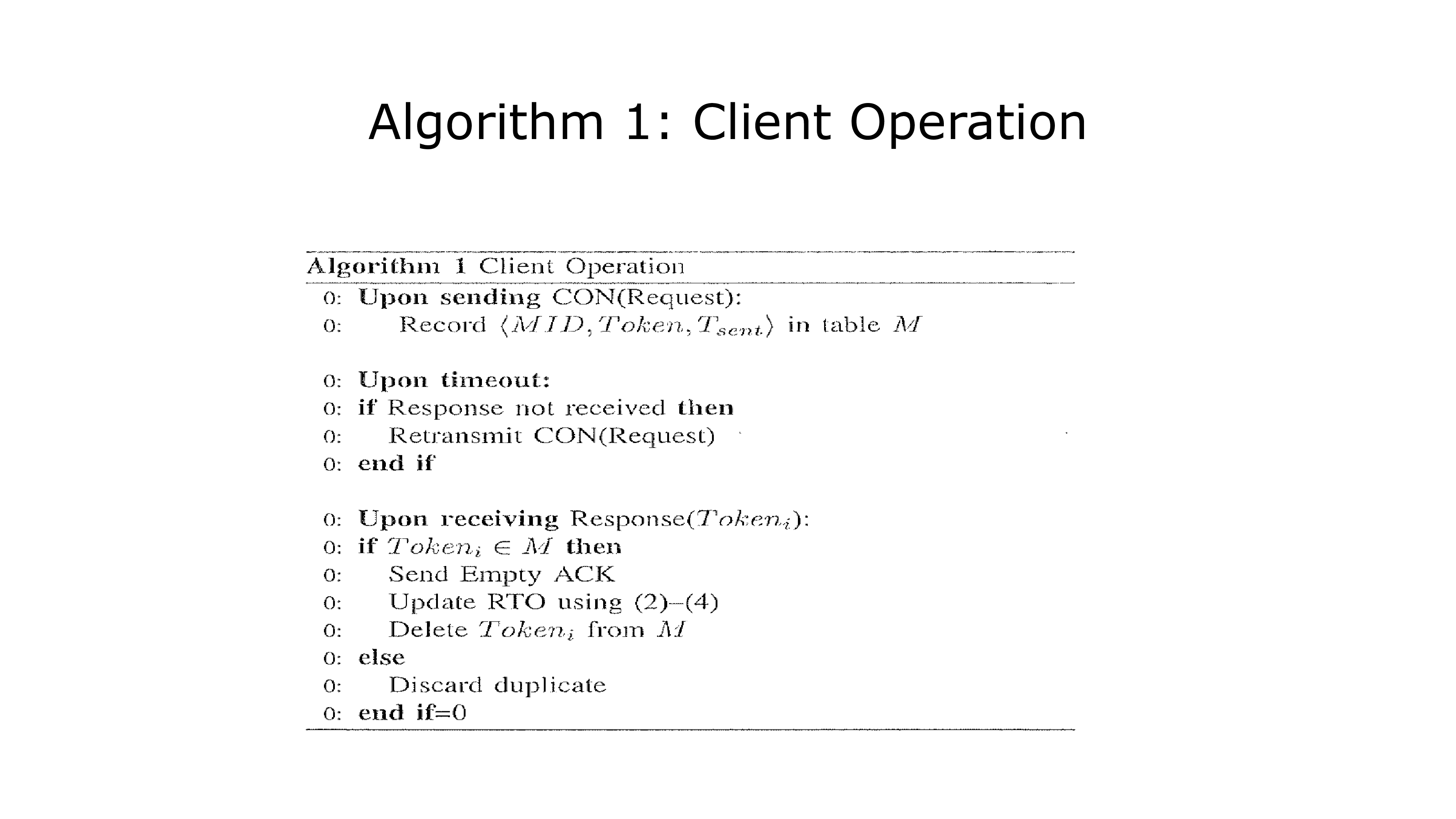 |
What we see here is the client operation algorithm.
Apon sending a CON request, the message ID, Token, and time tamp are recorded into the table.
Upon timeout, if response not yet received, retransmit a CON request.
Upon receiving response with token, if token is the correct one, send an EMPTY ACK and update RTO
then delete the token from table. else discard duplicate.
|
| ICACT20260196 Slide.27
[Big Slide]
|
Chrome Click!! |
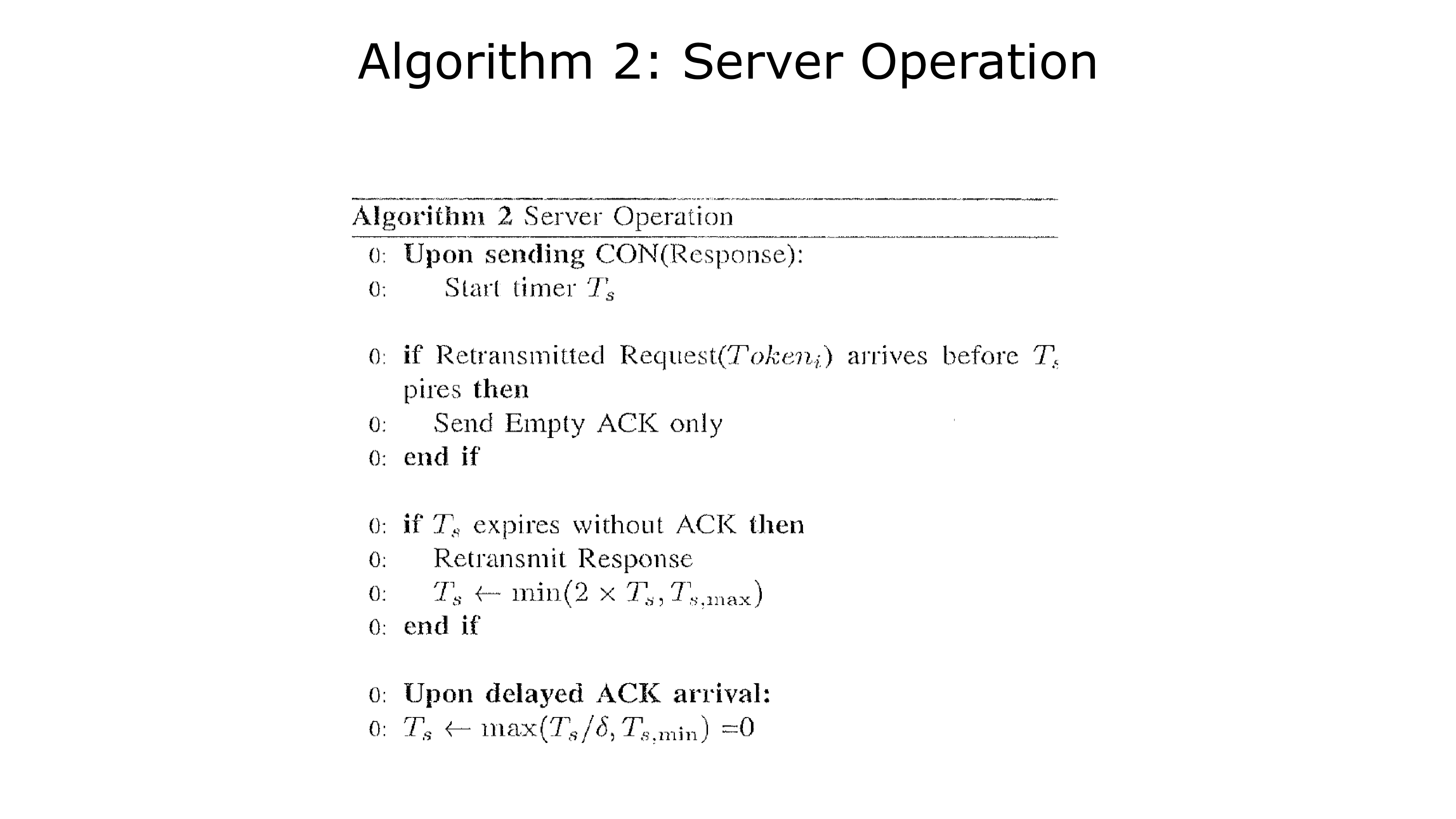 |
This is the Server Operation algorithm.
Upon sending CON response, start the timer.
if retransmitted request token arrives before the expiry of the slotted time,
then send EMPTY ACK only.
if the set time expires with no ACK, retransmit response and calibrate the timer downwards
upon delayed ACK arrival, calibrate the timer upward.
|
| ICACT20260196 Slide.28
[Big Slide]
|
Chrome Click!! |
 |
Server-Side Duplicate Suppression.
While the adaptive client timer reduces most premature retransmissions, network asymmetry and stochastic delay still cause duplicate client requests to reach the server.
These occur when the clients retransmission timer expires before the original response arrives, prompting a second CON request with the same Token ID.
Without proper control, the server may treat this as a new transaction and resend the full payload, thereby wasting bandwidth and energy.
To mitigate this, our scheme introduces a server side duplicate-response suppression mechanism, ensuring that only one valid response is transmitted for each logical request.
Upon sending a CON-type Response, the server inserts an entry into its transaction table each record storing the identifiers and the time at which the response was transmitted, together with a waiting timer.
|
| ICACT20260196 Slide.29
[Big Slide]
|
Chrome Click!! |
 |
If another request with the same Token arrives before the set time interval expires, the server classifies it as spurious (a consequence of delayed ACK rather than a true loss) and responds only with an Empty ACK
This decision prevents retransmission of the payload while still confirming that the server is active and aware of the transaction.
When no ACK is received within the current waiting interval, the server concludes that either the response or its ACK has been lost. In this case, the response must be retransmitted to ensure reliability.
To avoid congestion caused by frequent retries, the timer is exponentially increased with some pre-set formular – (some upper-threshold adaptation to guarantee that the retransmission interval grows conservatively, limiting network load while maintaining delivery assurance).
If an ACK finally arrives after a retransmission has occurred, the server infers that the loss was transient and the channel condition has improved, hence it calibrates its timer downwards.
|
| ICACT20260196 Slide.30
[Big Slide]
|
Chrome Click!! |
 |
This lower-threshold adaptation gradually restores responsiveness by shortening the waiting period for future transactions.
Together with the clients adaptive RTO control, the server side suppression mechanism creates a bidirectional timing equilibrium.
This cooperative timing adjustment ensures that both end points gradually converge toward an optimal retransmission interval matching current network conditions, minimizing redundant traffic and preserving energy efficiency.
|
| ICACT20260196 Slide.31
[Big Slide]
|
Chrome Click!! |
 |
To verify the effectiveness of the proposed cooperative retransmission control scheme, both simulation and analytical evaluations were conducted.
The experiments aimed to quantify improvements in message reliability, latency, and energy efficiency compared with the baseline CoAP implementation.
|
| ICACT20260196 Slide.32
[Big Slide]
|
Chrome Click!! |
 |
The simulations were implemented in the Cooja/Contiki platform, modeling IEEE 802.15.4 networks with a star topology of 20 nodes, one CoAP server, and multiple clients transmitting periodic GET requests.
Each node operated with a 2.4 GHz radio at 250 kbps and a duty-cycled MAC layer with a 25m transmission range.
The channel introduced random packet losses varying from 0% to 20%.
Each simulation ran for 300s, and all results were averaged over 20 independent runs.
Baseline CoAP used the standard retransmission setup with a two-second acknowledgment timeout and up to four retransmissions.
The proposed scheme employed the adaptive client RTO estimator [Eqs. (2)-(4)] and the server duplicate suppression mechanism [Eqs. (5)-(6)] formulas as established in our work.
|
| ICACT20260196 Slide.33
[Big Slide]
|
Chrome Click!! |
 |
Performance metrics were measured as follows:
Duplicate Message Ratio (DMR)-proportion of redundant request/response pairs over total transactions.
Average Latency - time between initial request and final valid response.
Energy Consumption - mean energy per node computed from radio on-time and CPU activity.
|
| ICACT20260196 Slide.34
[Big Slide]
|
Chrome Click!! |
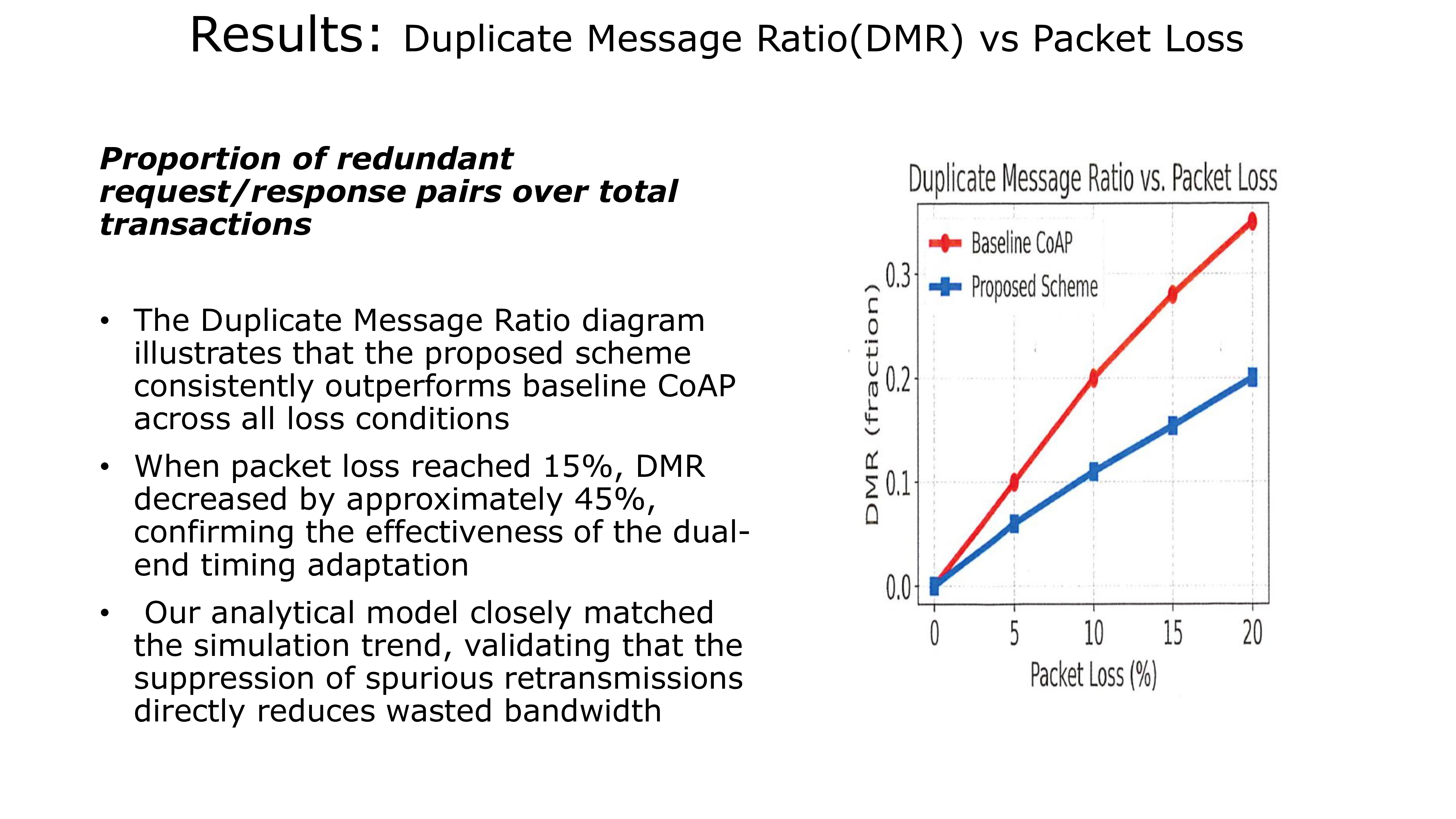 |
The Duplicate Message Ratio diagram illustrates that the proposed scheme consistently outperforms baseline CoAP across all loss conditions.
When packet loss reached 15%, DMR decreased by approximately 45%, confirming the effectiveness of the dual-end timing adaptation.
Our analytical model closely matched the simulation trend, validating that the suppression of spurious retransmissions directly reduces wasted bandwidth.
|
| ICACT20260196 Slide.35
[Big Slide]
|
Chrome Click!! |
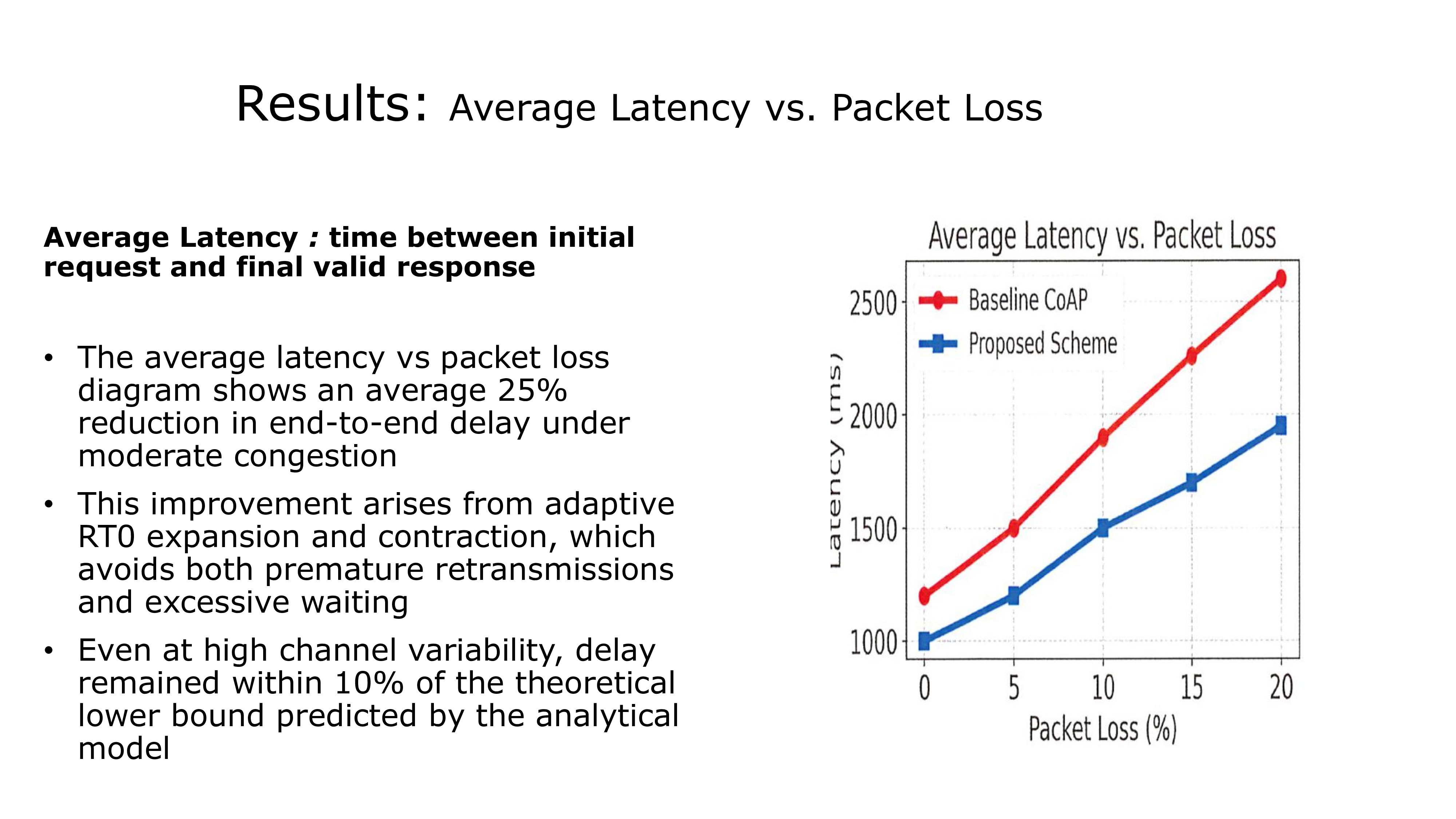 |
The average latency vs packet loss diagram shows an average 25% reduction in end-to-end delay under moderate congestion.
This improvement arises from adaptive RT0 expansion and contraction, which avoids both premature retransmissions and excessive waiting.
Even at high channel variability, delay remained within 10% of the theoretical lower bound predicted by the analytical model.
|
| ICACT20260196 Slide.36
[Big Slide]
|
Chrome Click!! |
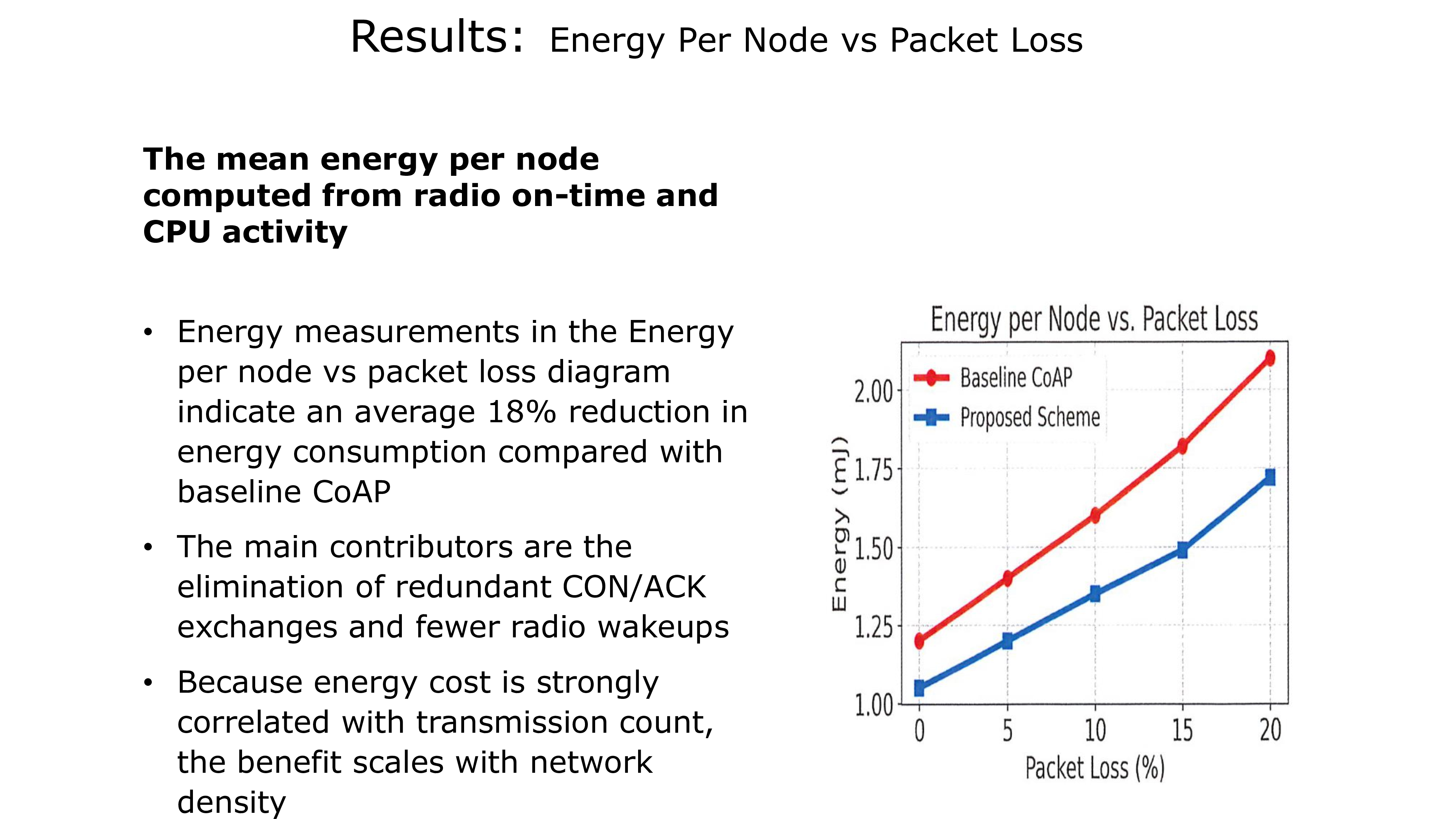 |
Energy measurements in the Energy per node vs packet loss diagram indicate an average 18% reduction in energy consumption compared with baseline CoAP.
The main contributors are the elimination of redundant CON/ACK exchanges and fewer radio wakeups.
Because energy cost is strongly correlated with transmission count, the benefit scales with network density.
|
| ICACT20260196 Slide.37
[Big Slide]
|
Chrome Click!! |
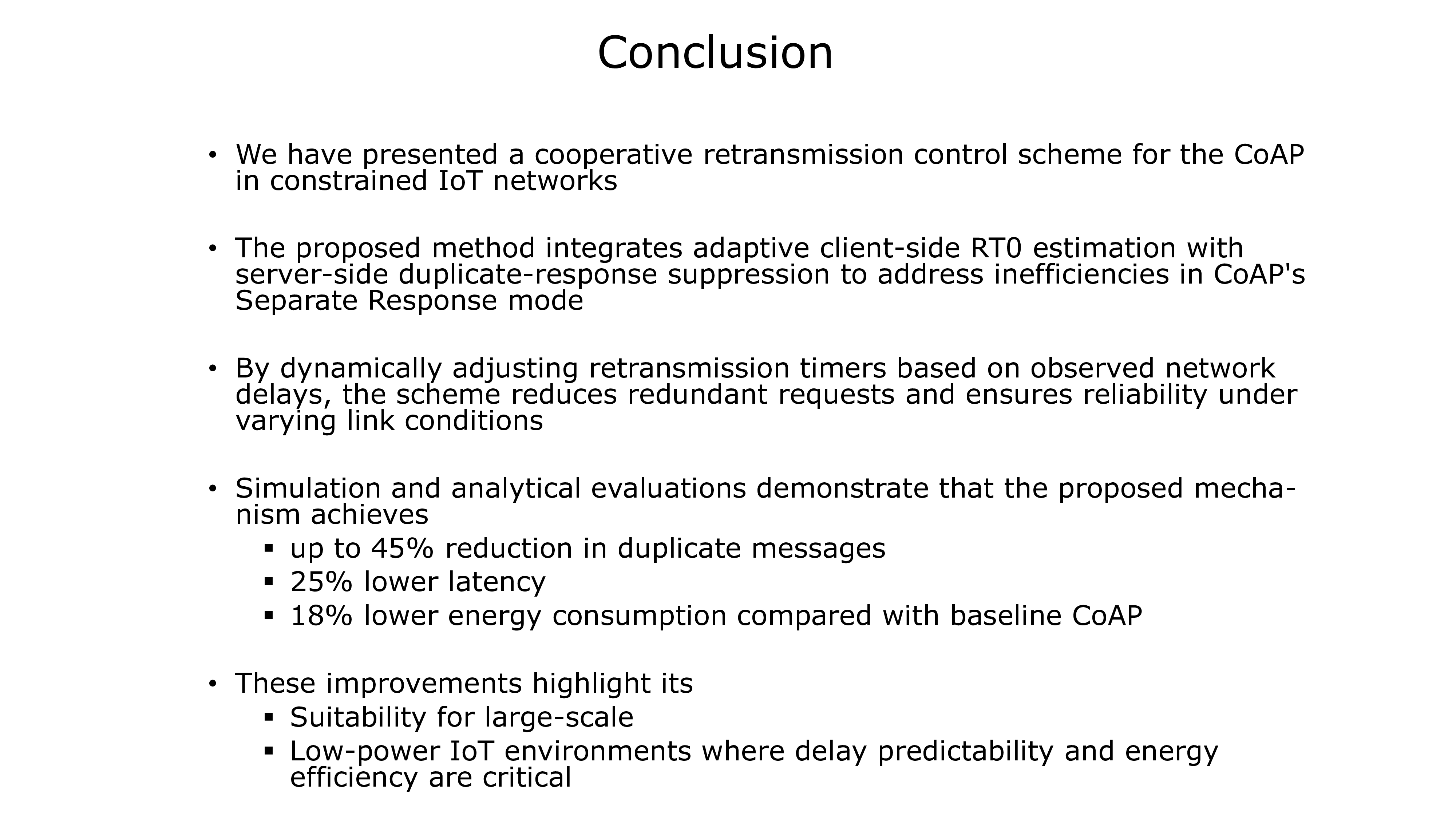 |
In conclusion,we have presented a cooperative retransmission control scheme for the CoAP in constrained IoT networks.
The proposed method integrates adaptive client-side RT0 estimation with server-side duplicate-response suppression to address inefficiencies in CoAPs Separate Response mode.
By dynamically adjusting retransmission timers based on observed network delays, the scheme reduces redundant requests and ensures reliability under varying link conditions.
Simulation and analytical evaluations demonstrate that the proposed mechanism achieves
up to 45% reduction in duplicate messages, 25% lower latency, and 18% lower energy consumption compared with baseline CoAP.
These improvements highlight its Suitability for large-scale,Low-power IoT environments where delay predictability and energy efficiency are critical.
|
| ICACT20260196 Slide.38
[Big Slide]
|
Chrome Click!! |
 |
Our future work will focus on extending this cooperative timing framework to multi-hop and cross-layer CoAP deployments, incorporating reinforcement learning and edge-assisted intelligence for real time adaptation in heterogeneous IoT systems. |
| ICACT20260196 Slide.39
[Big Slide]
|
Chrome Click!! |
 |
Please use the QR code provided for any questions,comments or discussions. |















