 ICACT20260202 Slide.01
[Big Slide] |
Chrome  Click!! |
 |
Good afternoon everyone. My name is Gabin Heo from Ewha Womans University.
Today, I would like to present our paper titled “Bockchain-based Data Management System Exploiting Consistent Hashing for Data Privacy in Urban Computing” |
| ICACT20260202 Slide.02
[Big Slide]
|
Chrome Click!! |
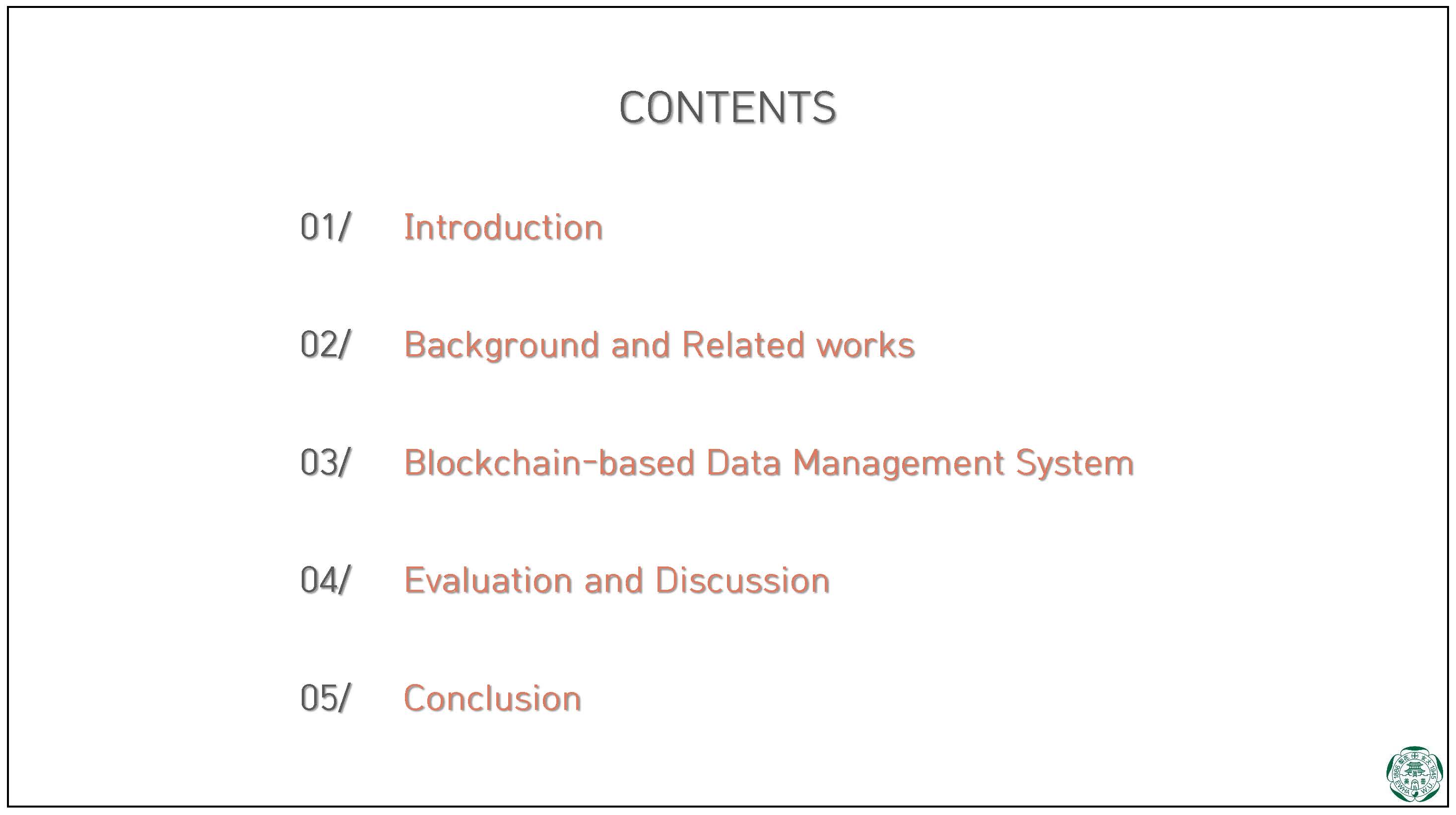 |
This is the overall flow. |
| ICACT20260202 Slide.03
[Big Slide]
|
Chrome Click!! |
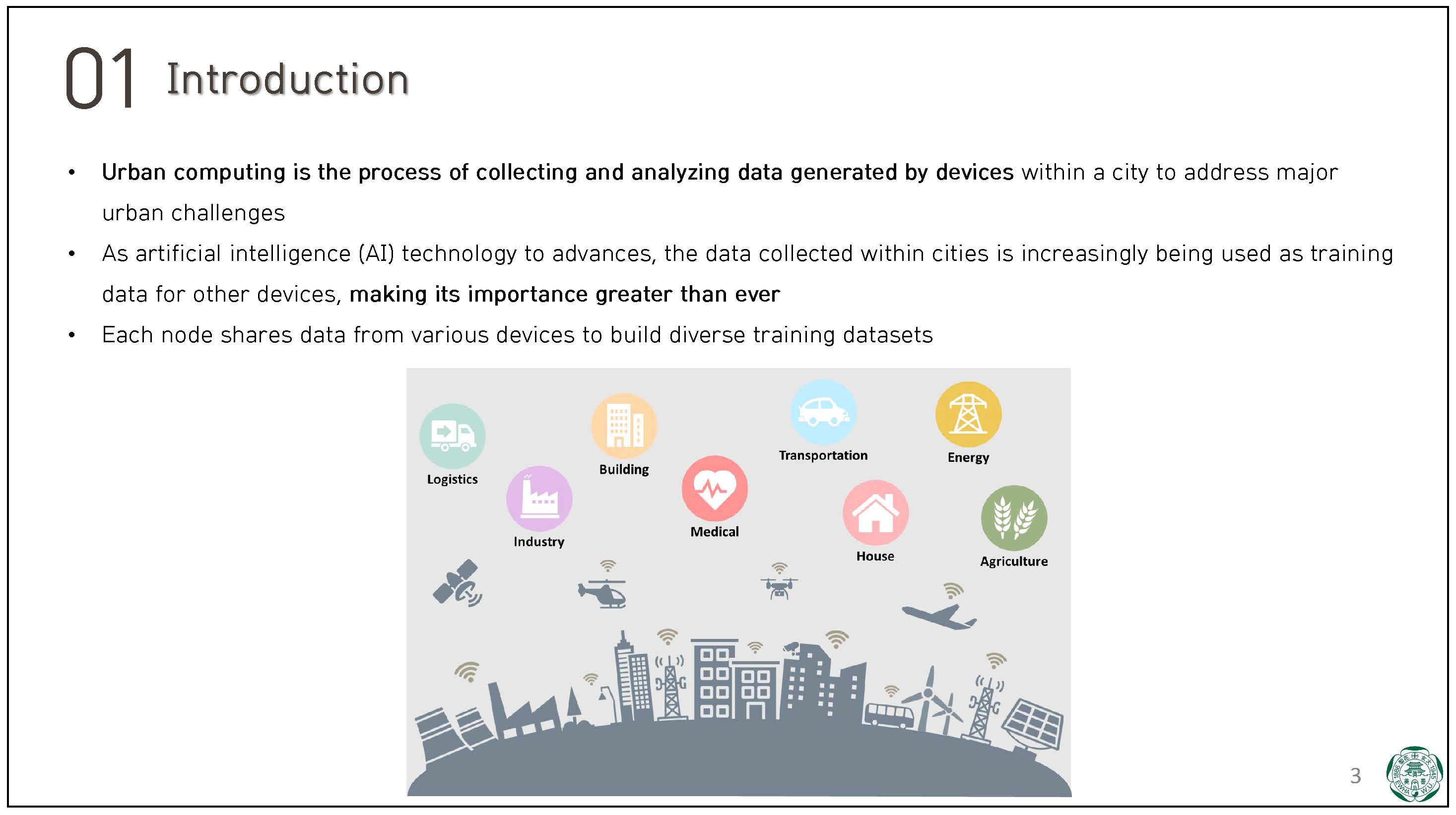 |
First, let me briefly explain what urban computing is.�Urban computing is the process of collecting and analyzing data generated by devices within a city to address major urban challenges.
As artificial intelligence technology continues to advance, the data collected within cities is increasingly being used as training data for other devices, making its importance greater than ever.
In this environment, each node shares data from various devices to build diverse training datasets.
|
| ICACT20260202 Slide.04
[Big Slide]
|
Chrome Click!! |
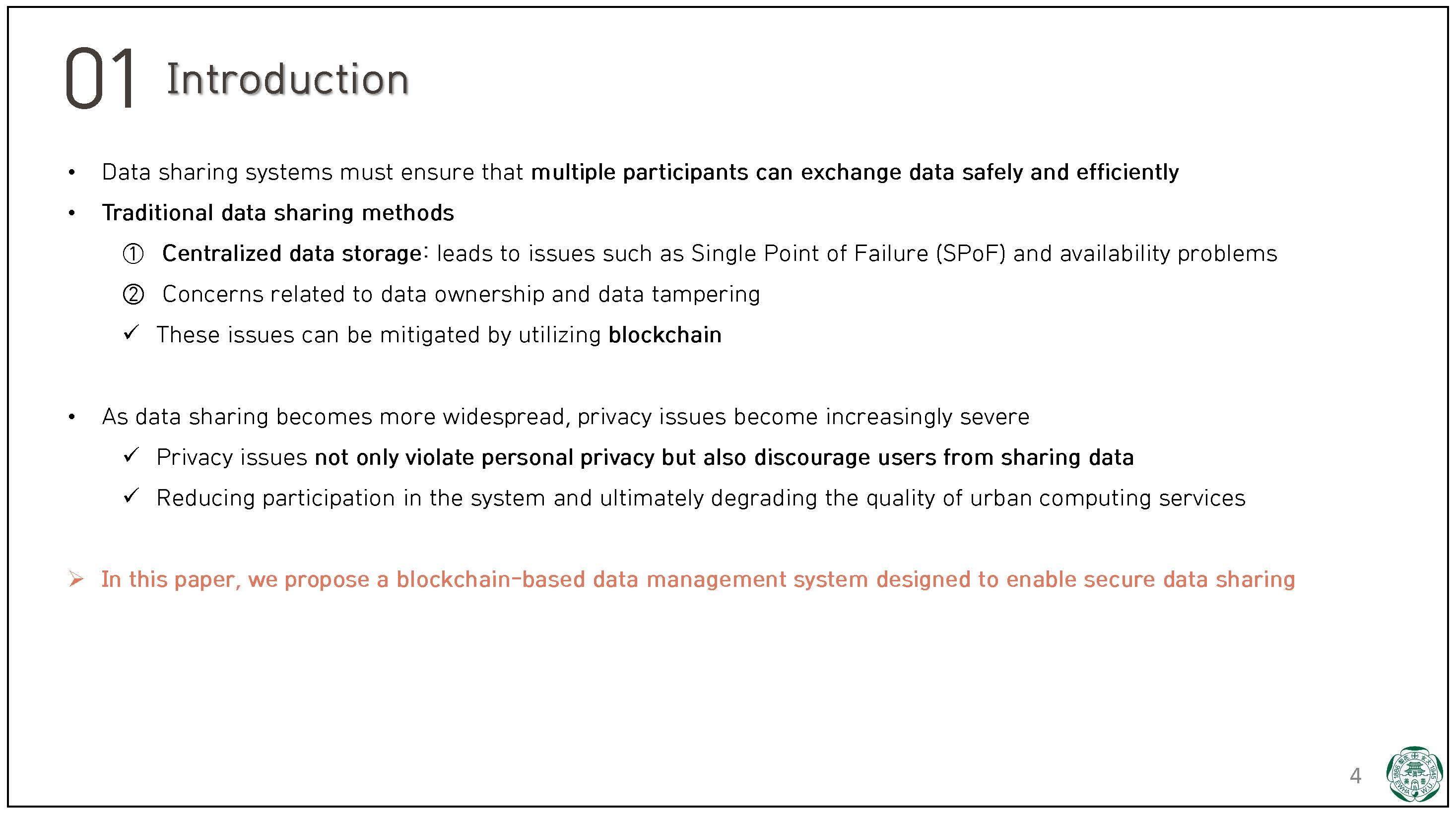 |
Data sharing systems must ensure that multiple participants can exchange data safely and efficiently.
However, traditional data sharing methods rely on centralized data storage, which leads to issues such as a single point of failure and availability problems
And concerns related to data ownership and data tampering.
Although these issues can be mitigated by blockchain technology, data privacy issues still remain.
As data sharing becomes more widespread, privacy issues become increasingly severe.
Privacy issues not only violate personal privacy but also discourage users from sharing data
And reducing participation in the system and ultimately degrading the quality of urban computing services.
Therefore, in this paper, we propose a blockchain-based data management system designed to enable secure data sharing.
|
| ICACT20260202 Slide.05
[Big Slide]
|
Chrome Click!! |
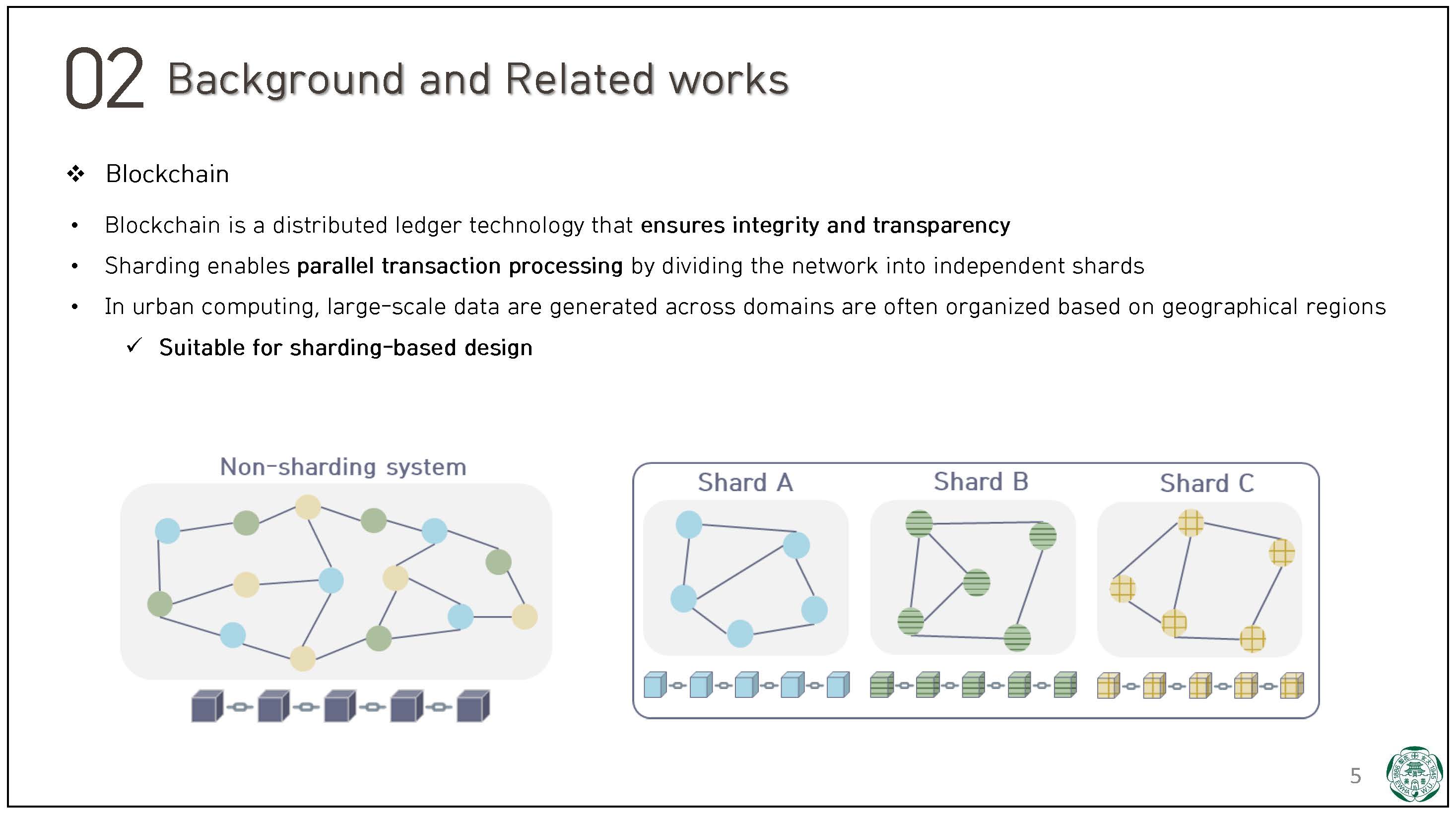 |
Blockchain is a distributed ledger technology that ensures integrity and transparency.
To improve scalability, sharding enables parallel transaction processing by dividing the network into independent shards.
In urban computing, large-scale data are generated across domains like transportation, environment, and energy and, are often organized based on geographical regions.
Because of these characteristics, urban computing environments are suitable for a sharding-based design.
|
| ICACT20260202 Slide.06
[Big Slide]
|
Chrome Click!! |
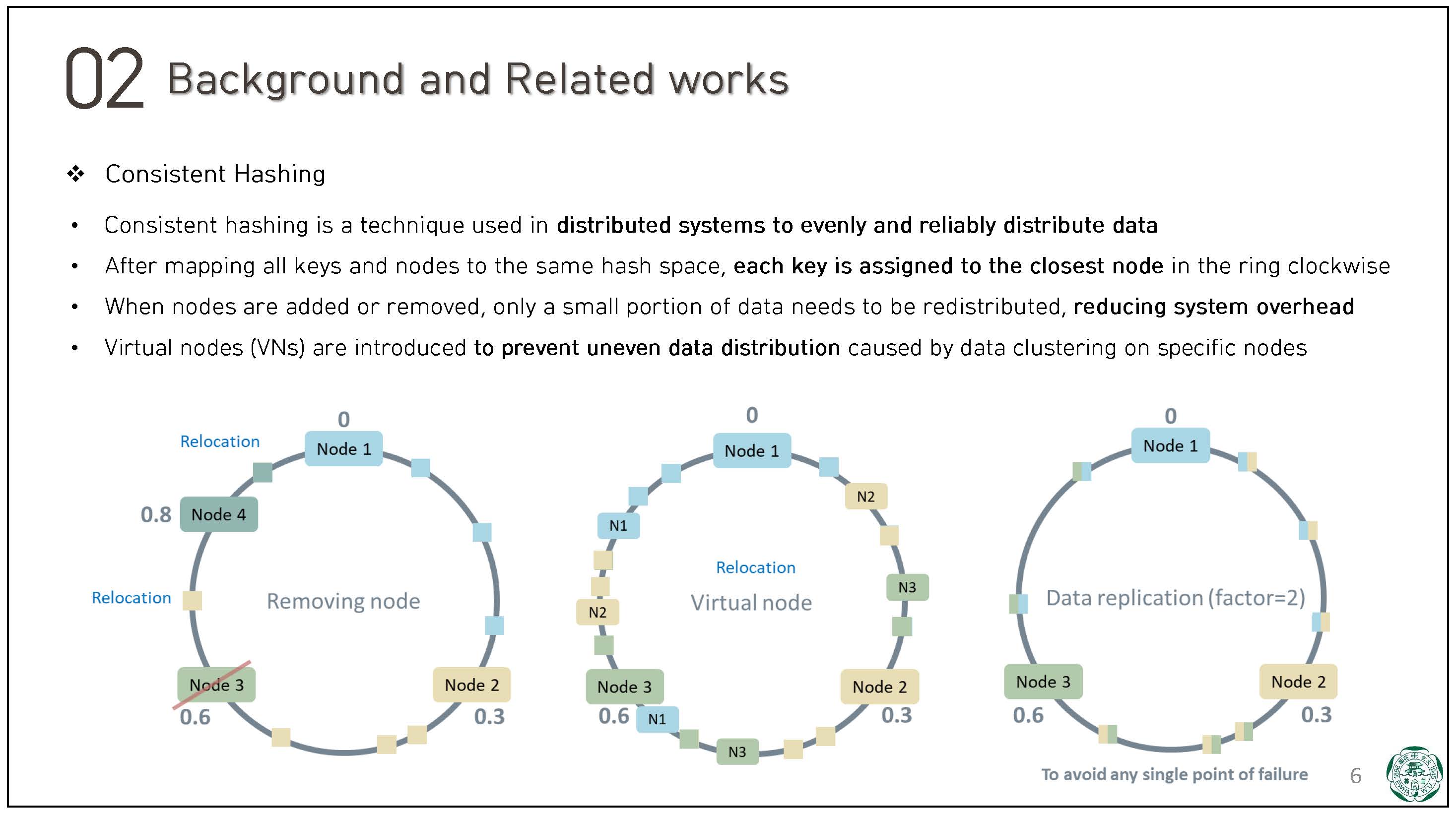 |
Consistent hashing is a technique used in distributed systems to evenly and reliably distribute data.
In this approach, after mapping all keys and nodes to the same hash space, each key is assigned to the closest node in the ring clockwise.
As a result, when nodes are added or removed, only a small portion of data needs to be redistributed, reducing system overhead.
To further improve load balancing, virtual nodes are introduced to prevent uneven data distribution caused by data clustering on specific nodes. |
| ICACT20260202 Slide.07
[Big Slide]
|
Chrome Click!! |
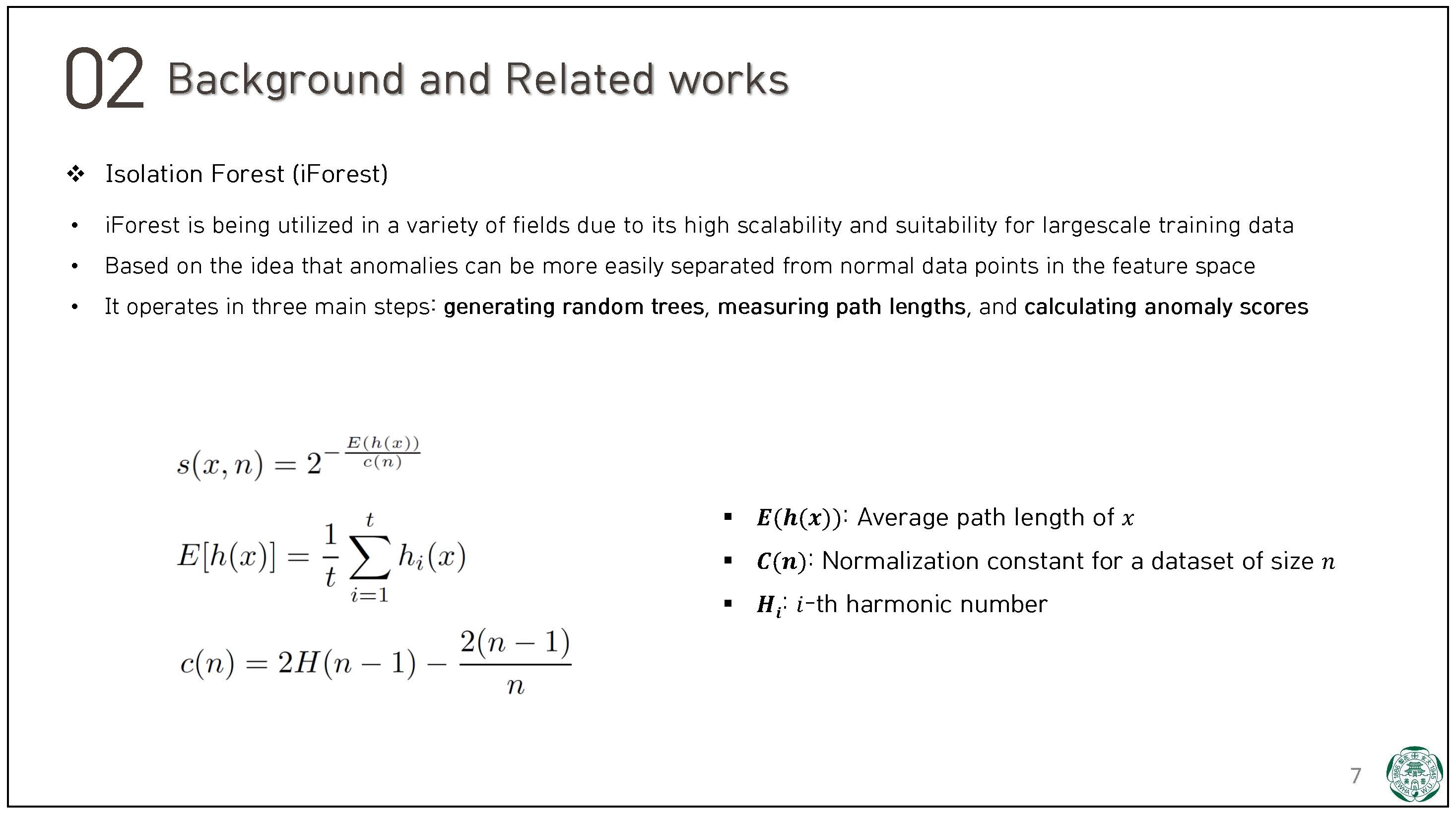 |
Isolation forest is being utilized in a variety of fields due to its high scalability and suitability for large-scale training data.
It is based on the idea that anomalies can be more easily separated from normal data points in the feature space.
Following this concept, it operates in three main steps: generating random trees, measuring path lengths, and calculating anomaly scores.
|
| ICACT20260202 Slide.08
[Big Slide]
|
Chrome Click!! |
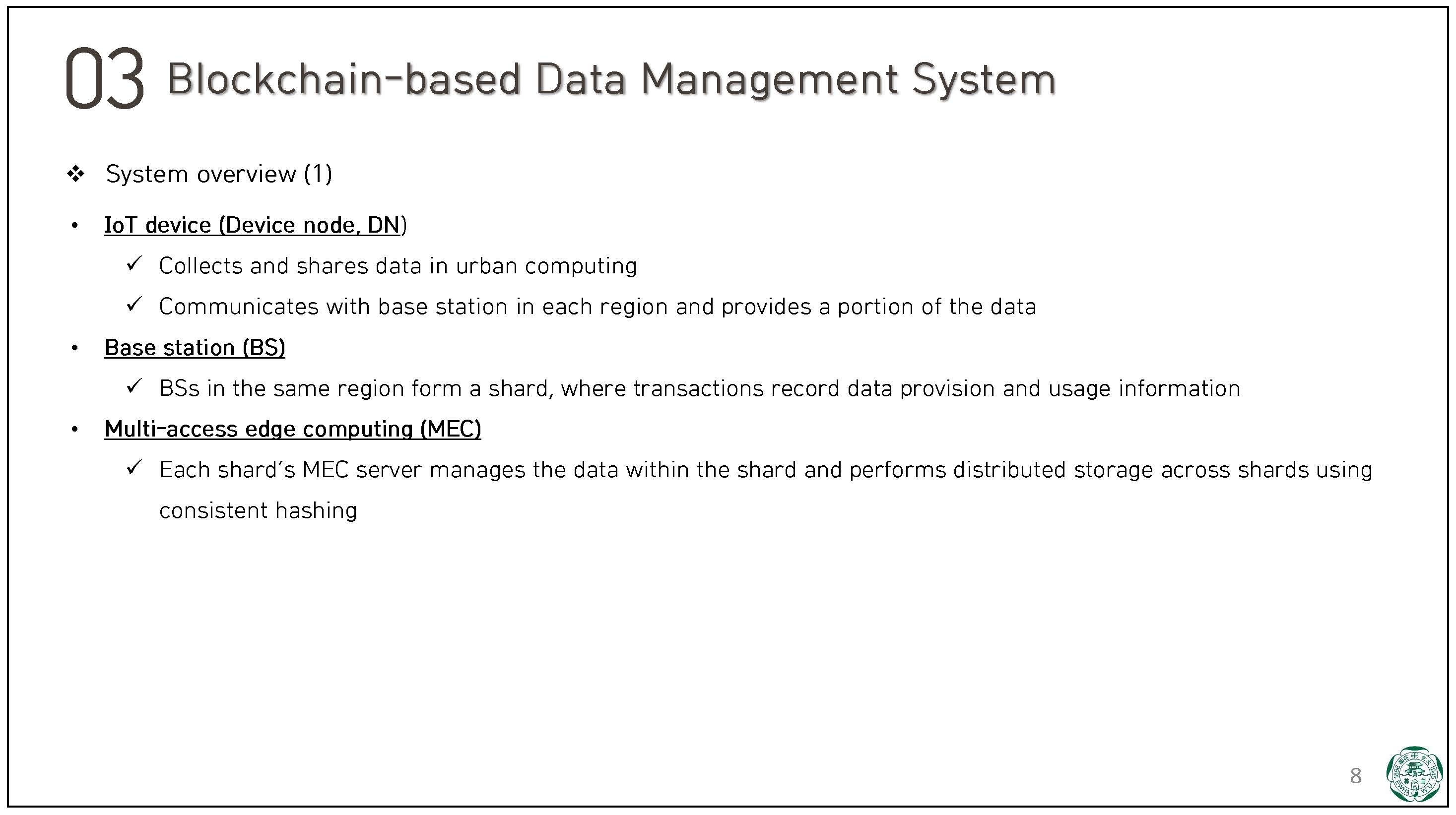 |
Before explaining our system in detail, I will first introduce the main entities in our system.
The first entity is the IoT device, also referred to as the device node, or DN.�It collects and shares data in urban computing, and communicates with the base station in each region to provide a portion of the collected data.
The second entity is the base station.�Base stations in the same region form a shard, where transactions record data provision and usage information.
Final entity is multi-access edge computing server, or MEC.�Each shard’s MEC server manages the data within the shard and performs distributed storage across shards using consistent hashing.
|
| ICACT20260202 Slide.09
[Big Slide]
|
Chrome Click!! |
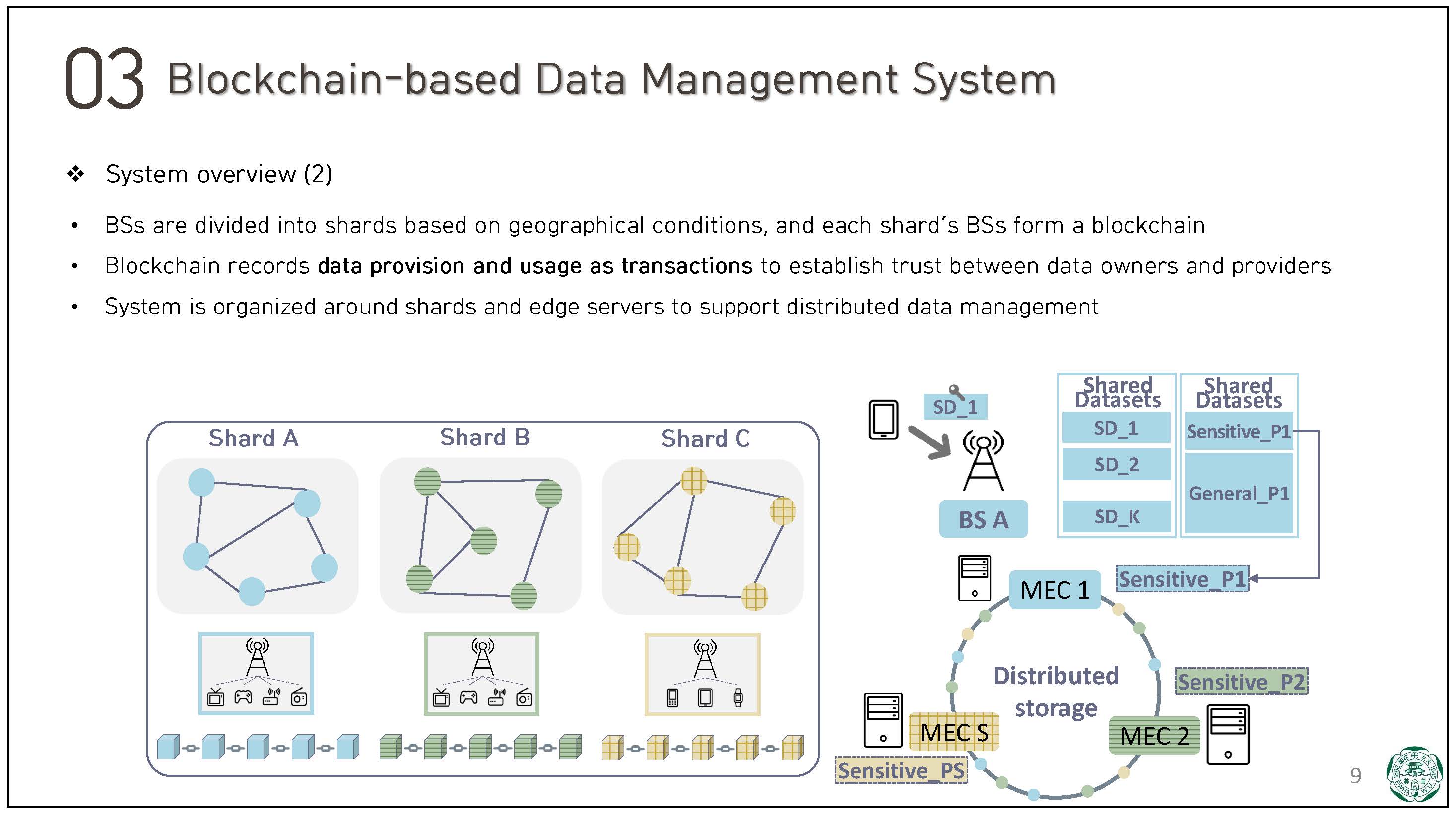 |
Now, I will explain our system overview.
Base stations are divided into shards based on geographical conditions, and each shard’s base stations form a blockchain.
Blockchain records data provision and usage as transactions to establish trust between data owners and providers.
As shown in this figure, the system is organized around shards and edge servers to support distributed data management.
|
| ICACT20260202 Slide.10
[Big Slide]
|
Chrome Click!! |
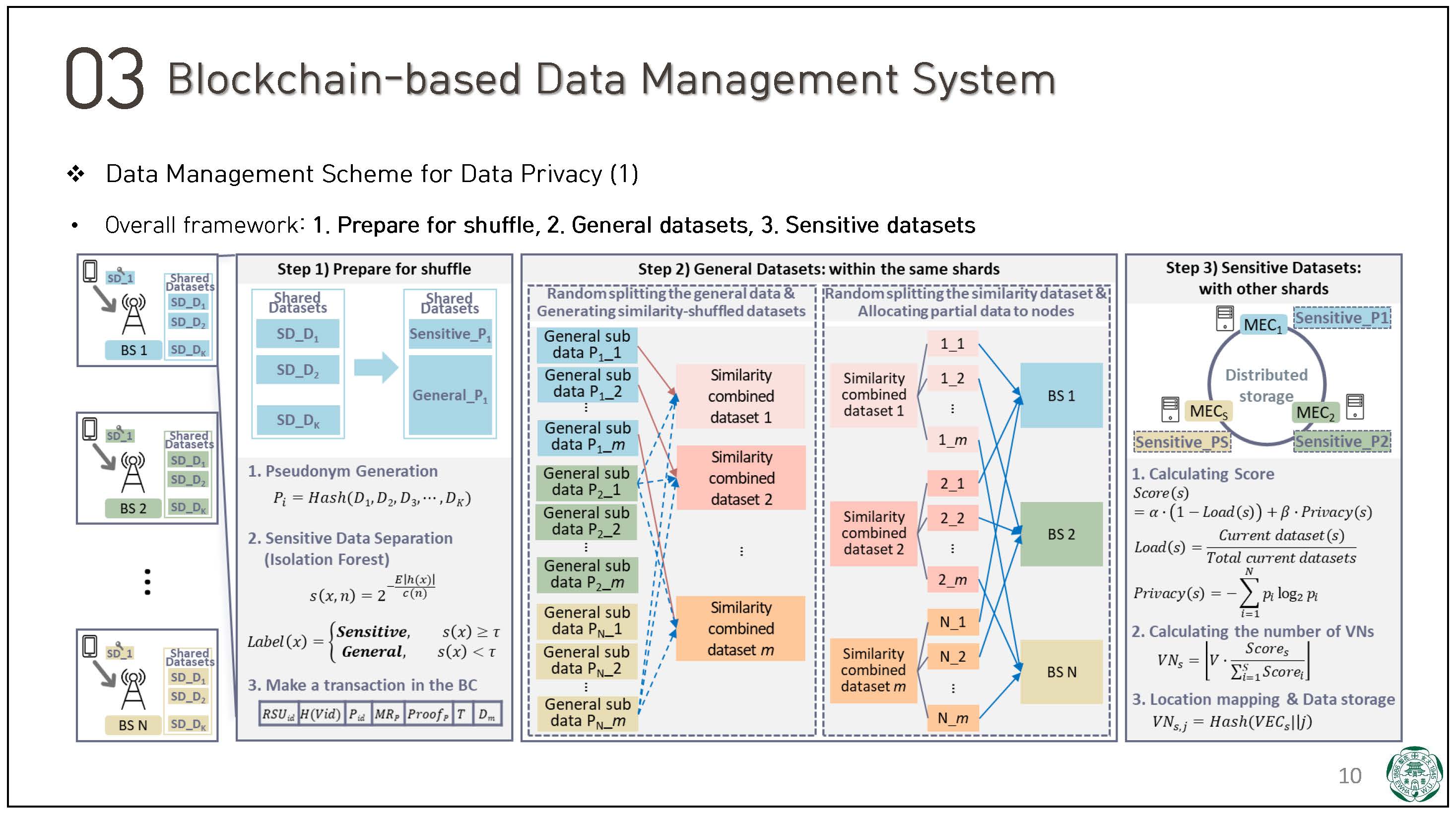 |
This is overall framework of our system.
As shown in this figure, the overall framework consists of three steps: prepare for shuffle, general datasets, and sensitive datasets.
Next, I will explain each step in detail.
|
| ICACT20260202 Slide.11
[Big Slide]
|
Chrome Click!! |
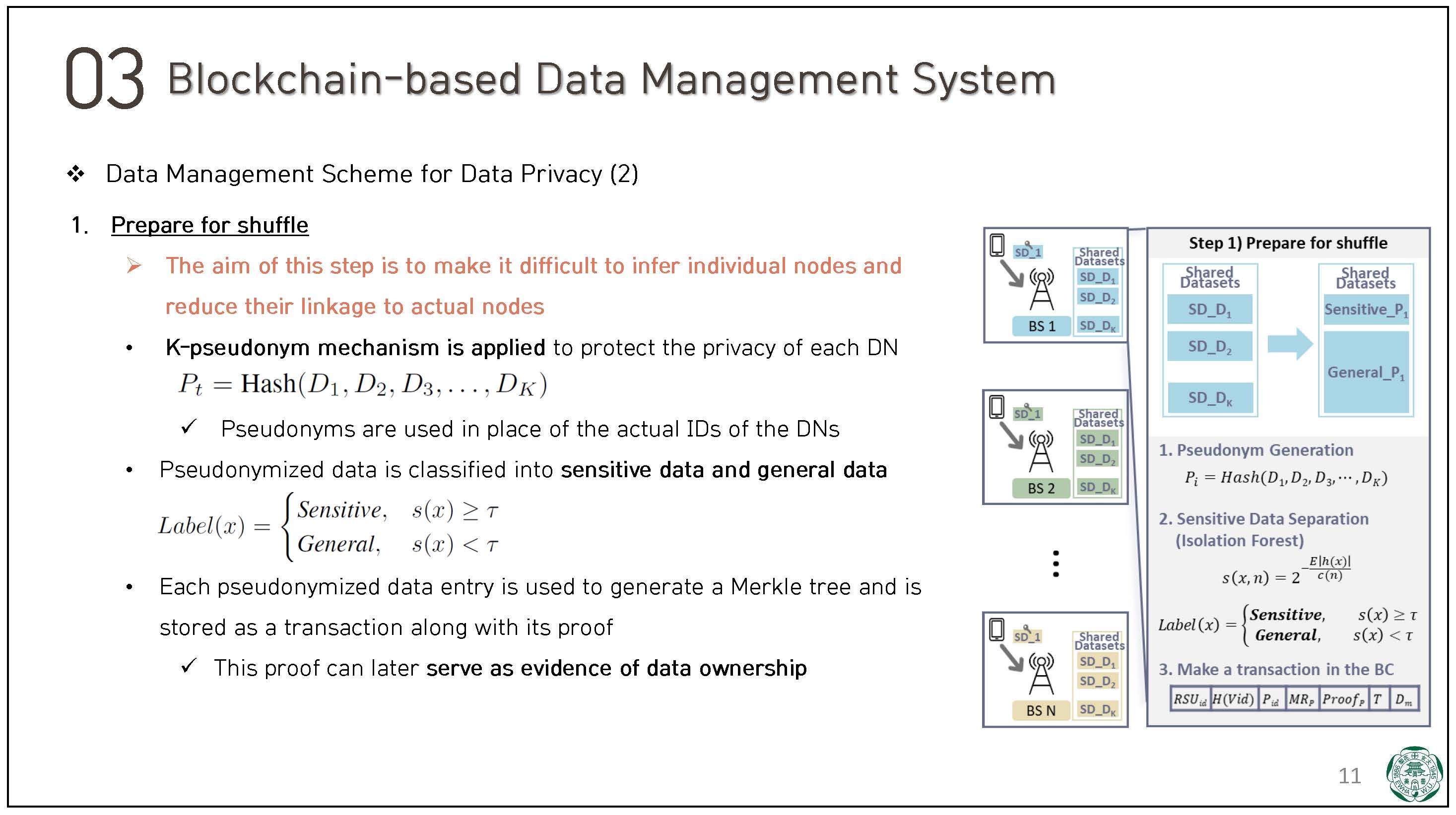 |
First, this is prepare for shuffle step.
The aim of this step is to make it difficult to infer individual nodes and reduce their linkage to actual nodes.
A K-pseudonym mechanism is applied to protect the privacy of each device node.
Pseudonyms are used in place of the actual IDs of the device nodes.
Then, Pseudonymized data is classified into sensitive data and general data.
Each pseudonymized data entry is used to generate a Merkle tree and is stored as a transaction along with its proof.
This proof can later serve as evidence of data ownership. |
| ICACT20260202 Slide.12
[Big Slide]
|
Chrome Click!! |
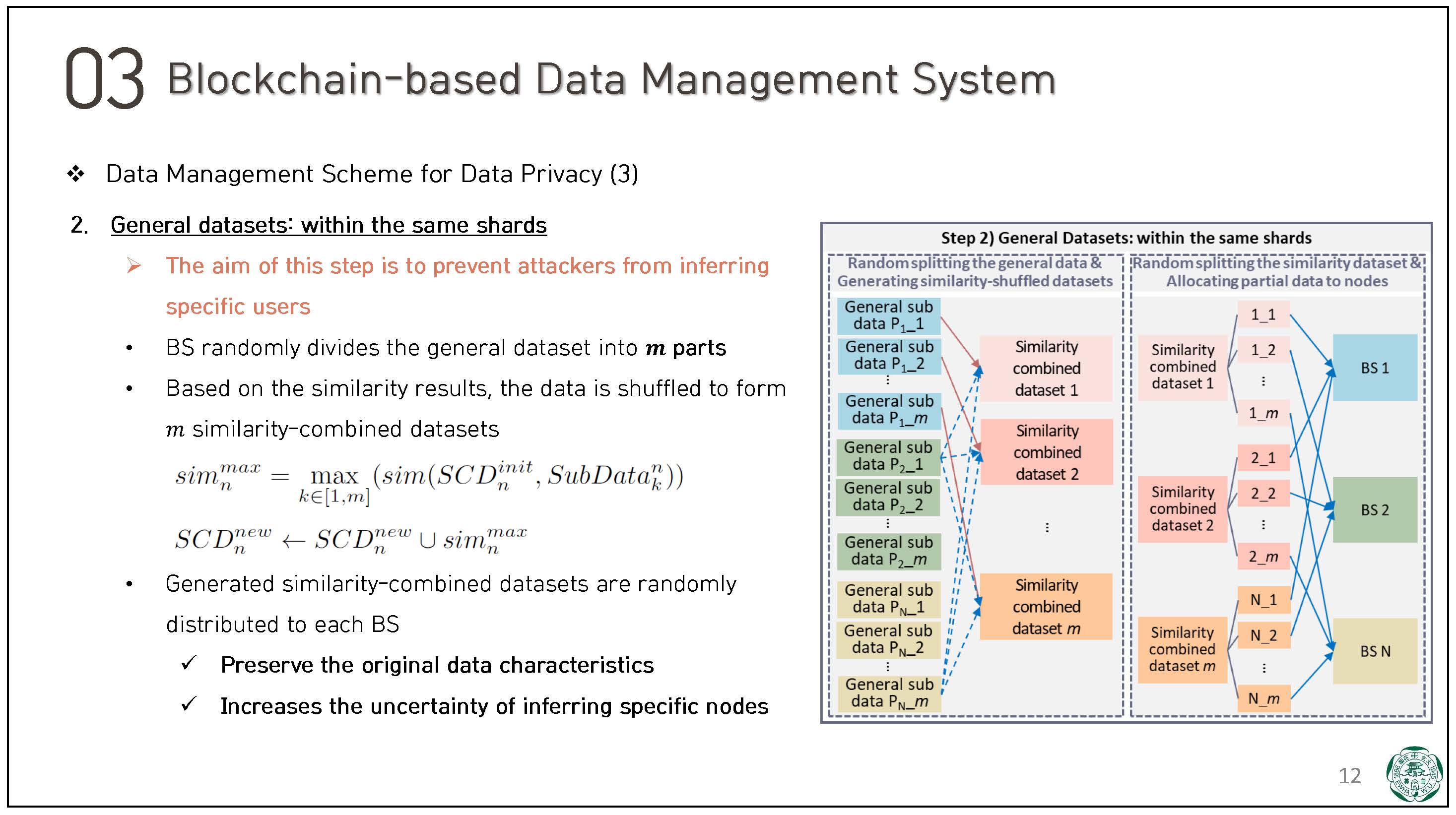 |
This is general datasets processing step.
The aim of this step is to prevent attackers from inferring specific users.
Base stations randomly divide the general dataset into m parts.
Based on the similarity results, the data is shuffled to form m similarity-combined datasets.
Here, similarity is calculated between the initial similarity-combined dataset and each sub-dataset.
In our implementation, this initial SCD is formed by randomly selecting samples.
Then, the generated similarity-combined datasets are randomly distributed to each base station.
This process helps preserve the original data characteristics and increases the uncertainty of inferring specific nodes.
|
| ICACT20260202 Slide.13
[Big Slide]
|
Chrome Click!! |
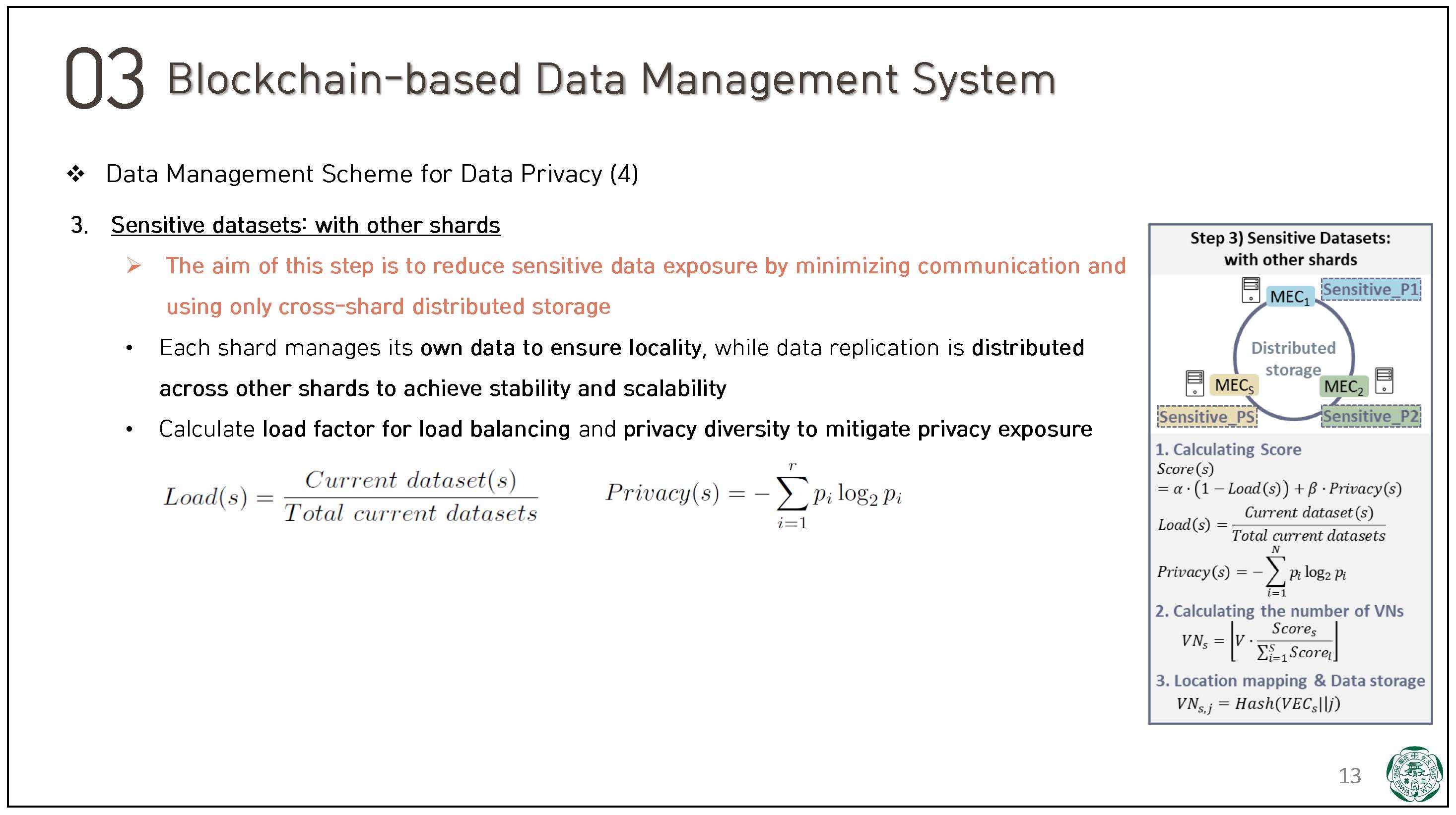 |
Finally, This is sensitive datasets processing step.
The aim of this step is to reduce sensitive data exposure by minimizing communication and using only cross-shard distributed storage.
Each shard manages its own data to ensure locality, while data replication is distributed across other shards to achieve stability and scalability.
Calculate load factor for load balancing and privacy diversity to mitigate privacy exposure.
|
| ICACT20260202 Slide.14
[Big Slide]
|
Chrome Click!! |
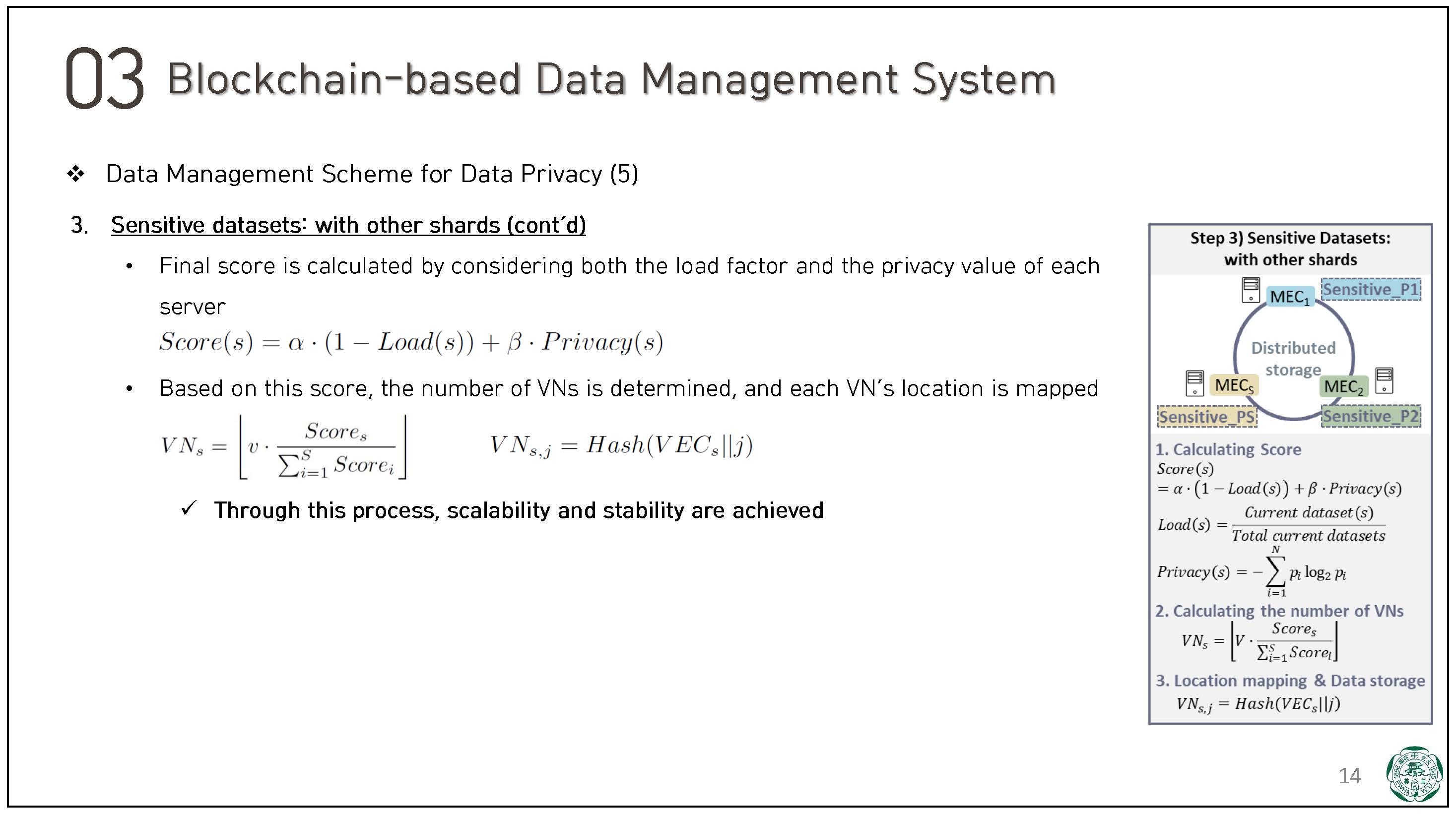 |
Following the previous slide, Final score is calculated by considering both the load factor and the privacy value of each server.
Based on this score, the number of virtual nodes is determined, and each virtual node’s location is mapped.
Through this process, scalability and stability are achieved.
|
| ICACT20260202 Slide.15
[Big Slide]
|
Chrome Click!! |
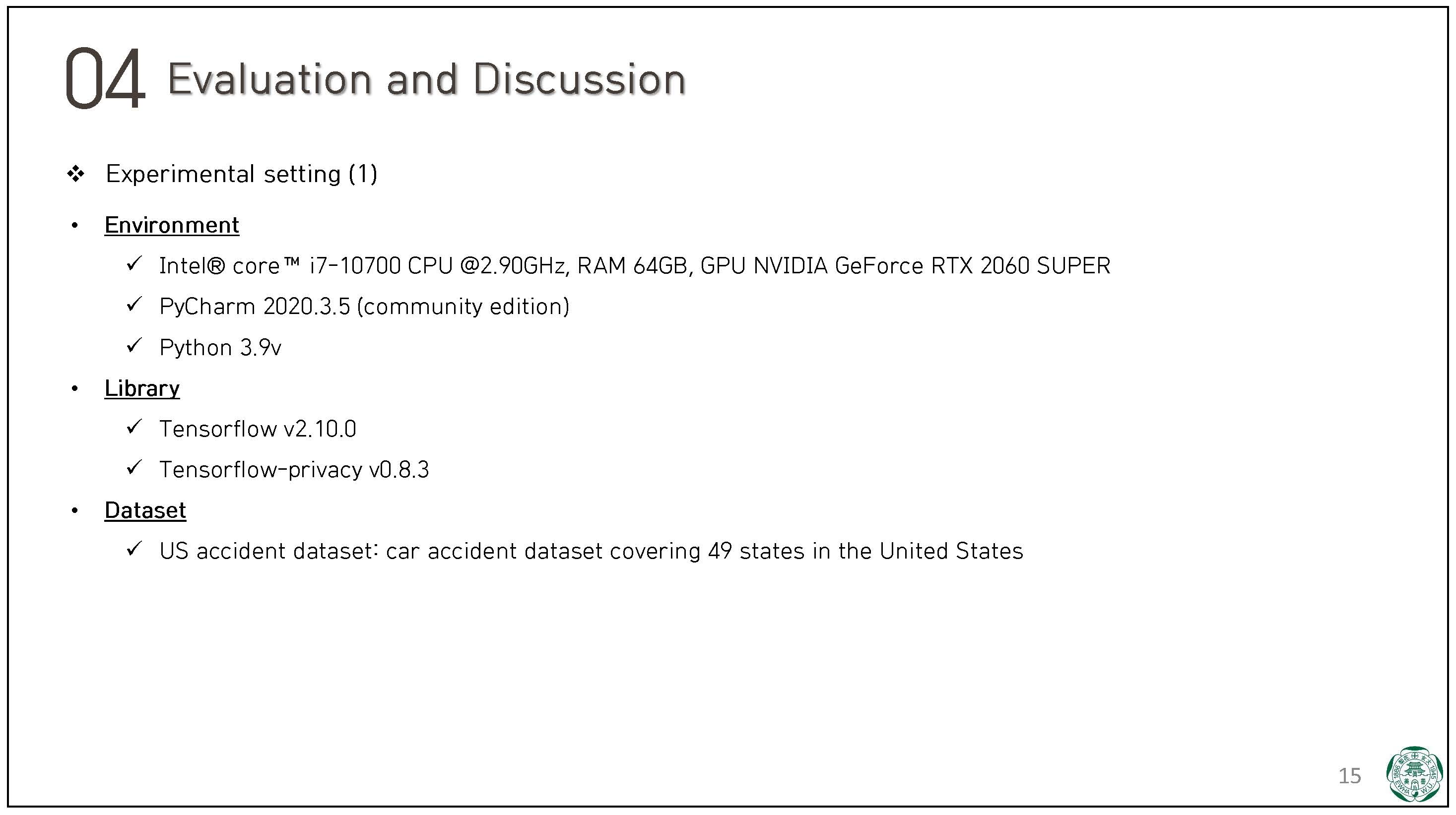 |
The experimental environment is summarized in this slide.
|
| ICACT20260202 Slide.16
[Big Slide]
|
Chrome Click!! |
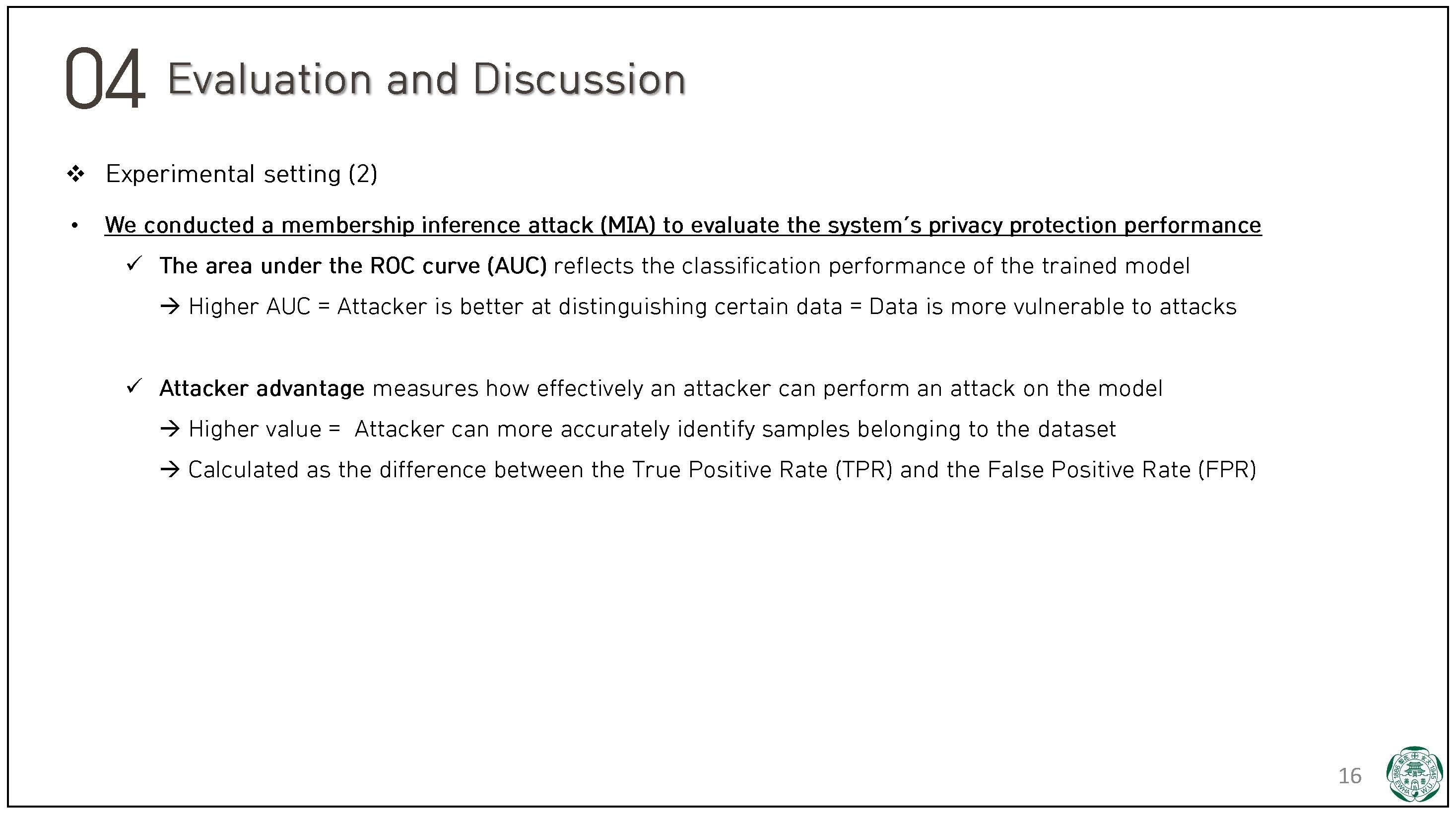 |
To evaluate the privacy protection performance of our system, we conducted a membership inference attack.
The AUC reflects the classification performance of the trained model.
In this context, a higher AUC means that the attacker is better at distinguishing certain data, which indicates that the data is more vulnerable to attacks.
The attacker advantage measures how effectively an attacker can perform an attack on the model.
Similarly, a higher attacker advantage means that the attacker can more accurately identify samples belonging to the dataset. |
| ICACT20260202 Slide.17
[Big Slide]
|
Chrome Click!! |
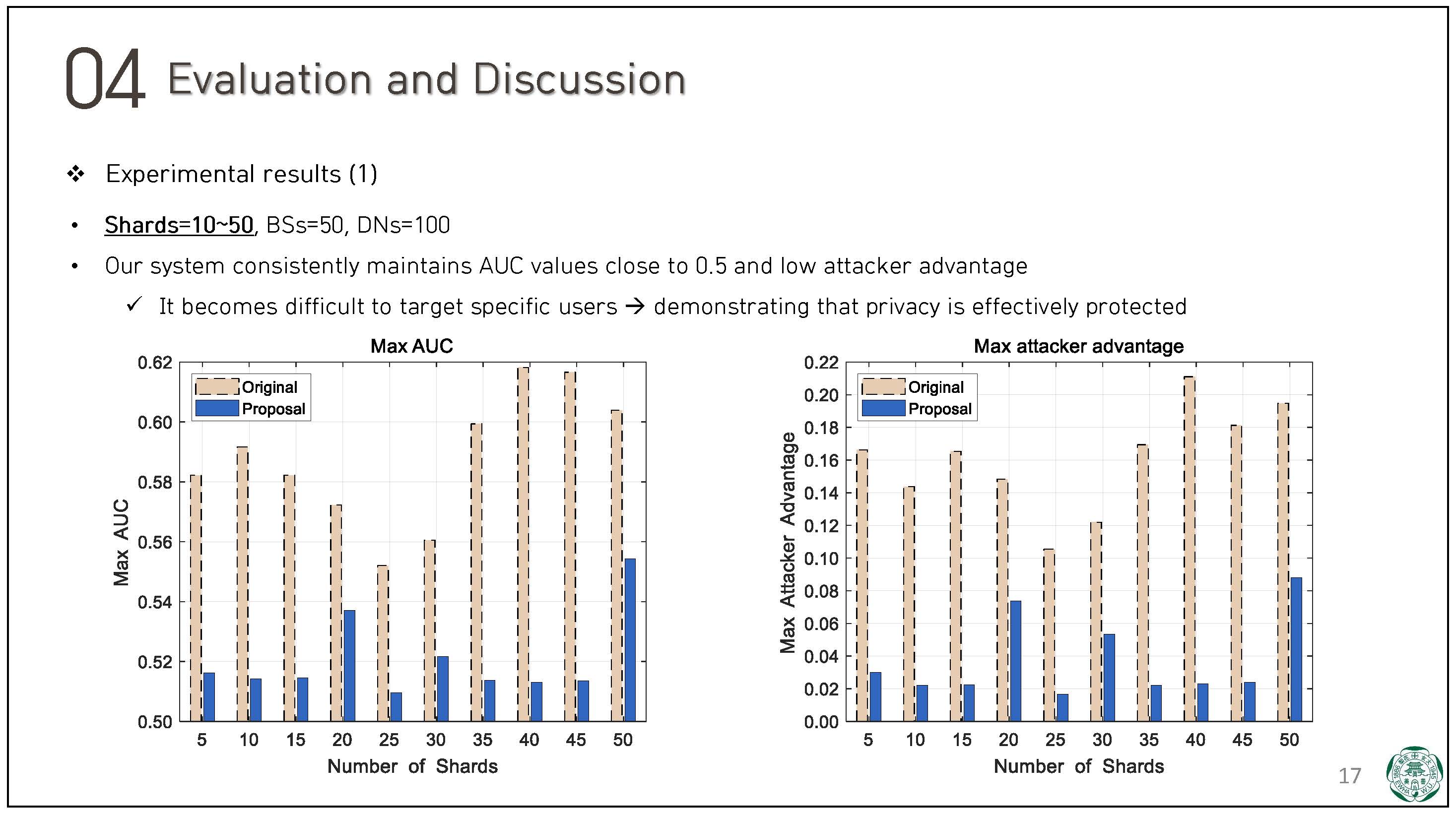 |
This slide shows the experimental results obtained by increasing the number of shards.
Our system consistently maintains AUC values close to 0.5 and low attacker advantage.
It becomes difficult to target specific users, demonstrating that privacy is effectively protected. |
| ICACT20260202 Slide.18
[Big Slide]
|
Chrome Click!! |
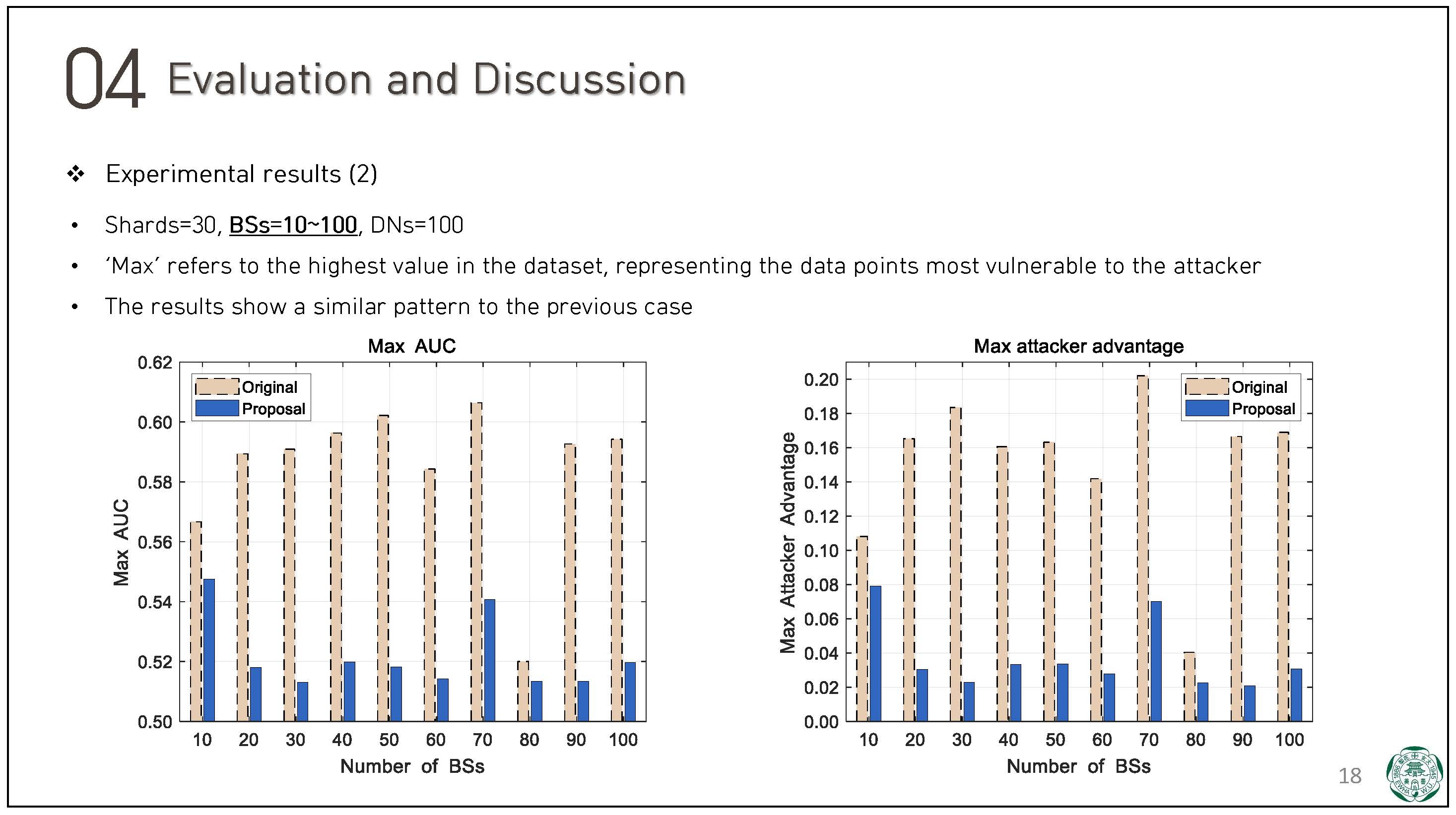 |
This is the results with an increasing number of base stations.
The results show a similar pattern to the previous case.
|
| ICACT20260202 Slide.19
[Big Slide]
|
Chrome Click!! |
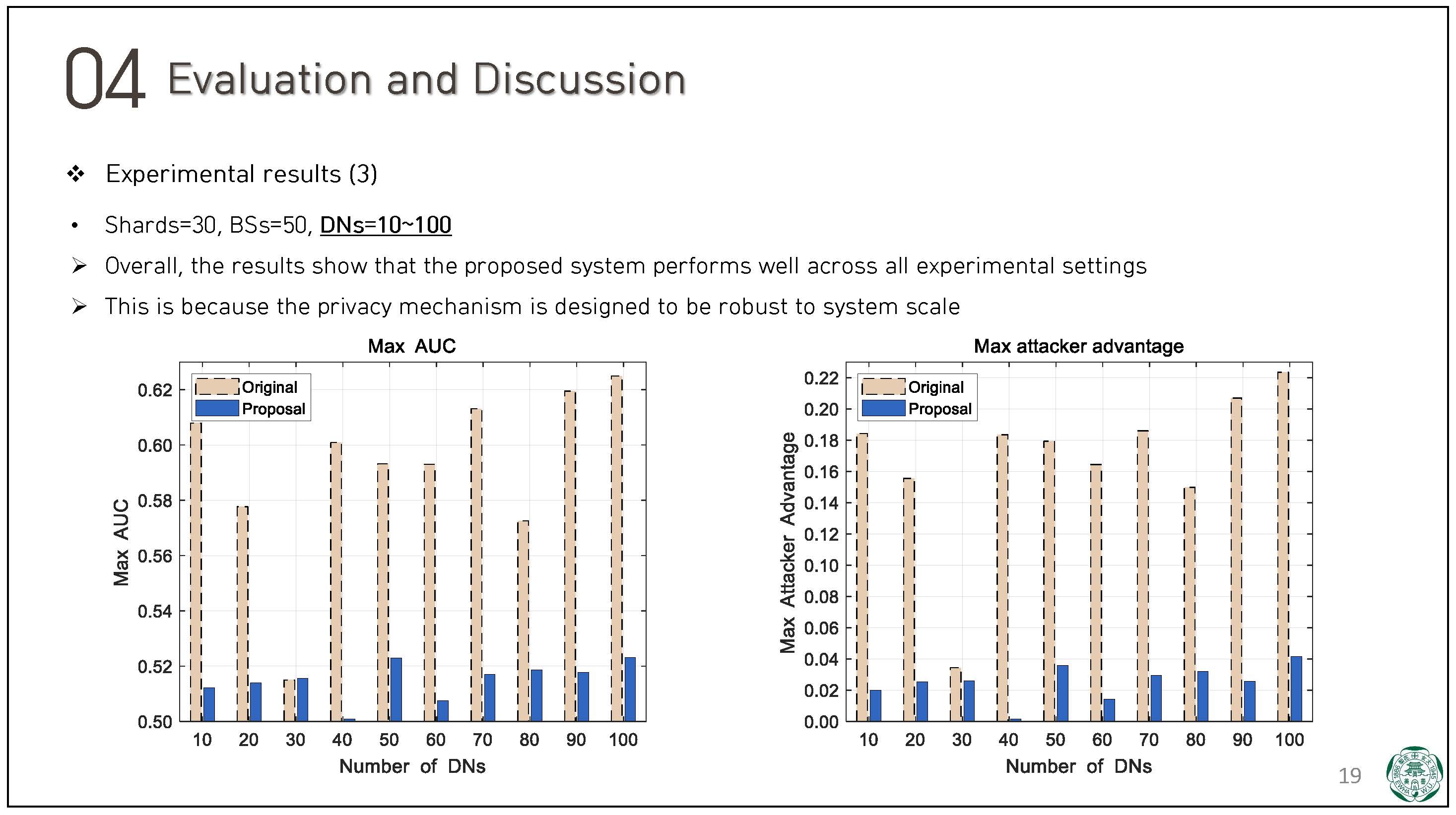 |
This is results with an increasing the number of device nodes.
Overall, the results show that the proposed system performs well across all experimental settings.
This is because the privacy mechanism is designed to be robust to system scale.
|
| ICACT20260202 Slide.20
[Big Slide]
|
Chrome Click!! |
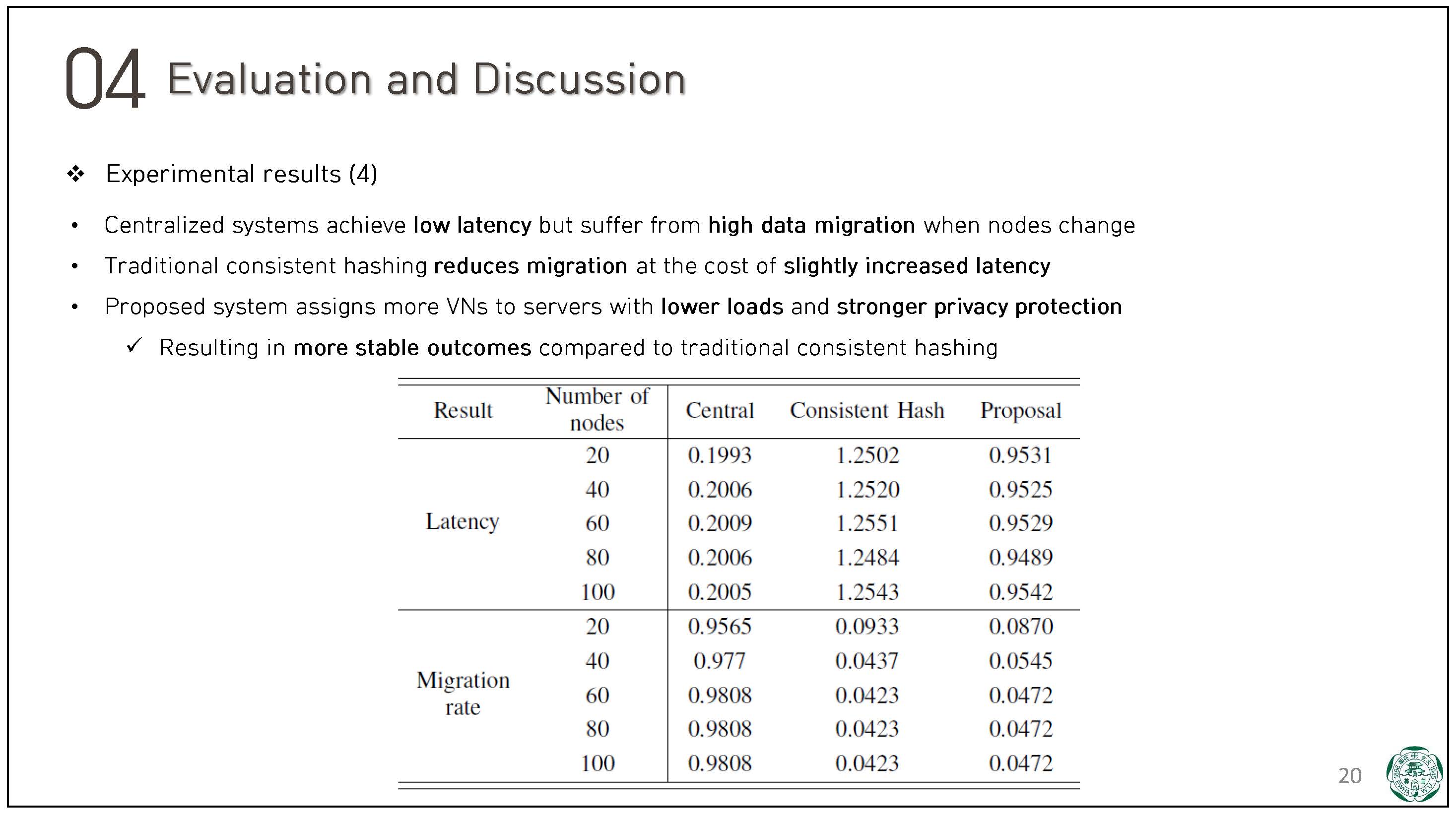 |
Finally, these are results for latency and migration rate.
Centralized systems achieve low latency but suffer from high data migration when nodes change.
In contrast, Traditional consistent hashing reduces migration at the cost of slightly increased latency.
In particular, the proposed system assigns more VNs to servers with lower loads and stronger privacy protection, resulting in more stable outcomes compared to traditional consistent hashing.
|
| ICACT20260202 Slide.21
[Big Slide]
|
Chrome Click!! |
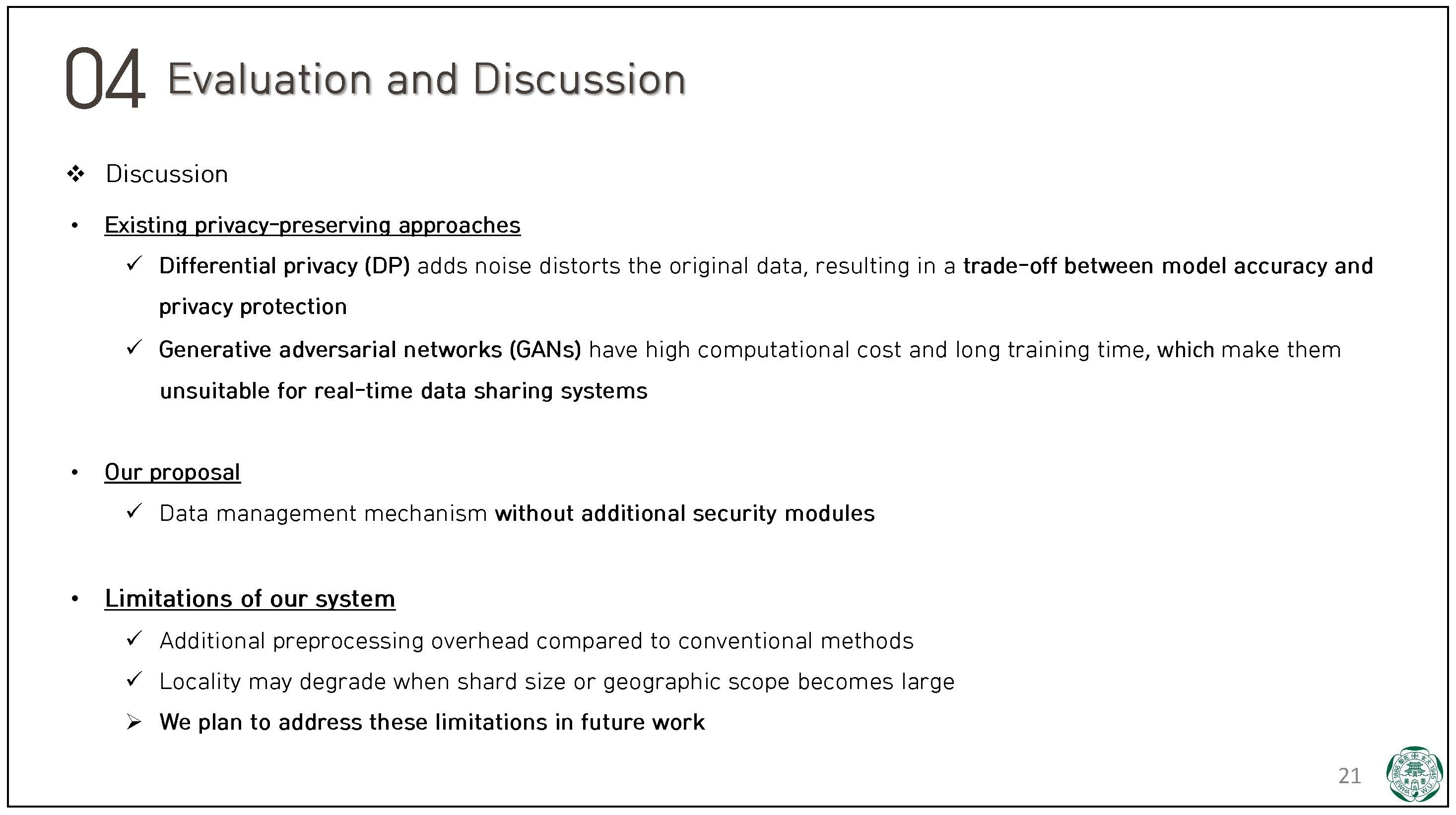 |
Finally, It’s discussion part.
Existing privacy-preserving approaches include differential privacy and GAN-based methods.
Differential privacy adds noise distorts the original data, resulting in a trade-off between model accuracy and privacy protection.
GAN-based approaches have high computational cost and long training time, which make them unsuitable for real-time data sharing systems.
In contrast, our proposal focuses on a data management mechanism without additional security modules.
However, our system has some limitations.
Specifically, it incurs additional preprocessing overhead compared to conventional methods.
In addition, locality may degrade when the shard size or geographical scope becomes large.
So, we plan to address these limitations in future work.
|
| ICACT20260202 Slide.22
[Big Slide]
|
Chrome Click!! |
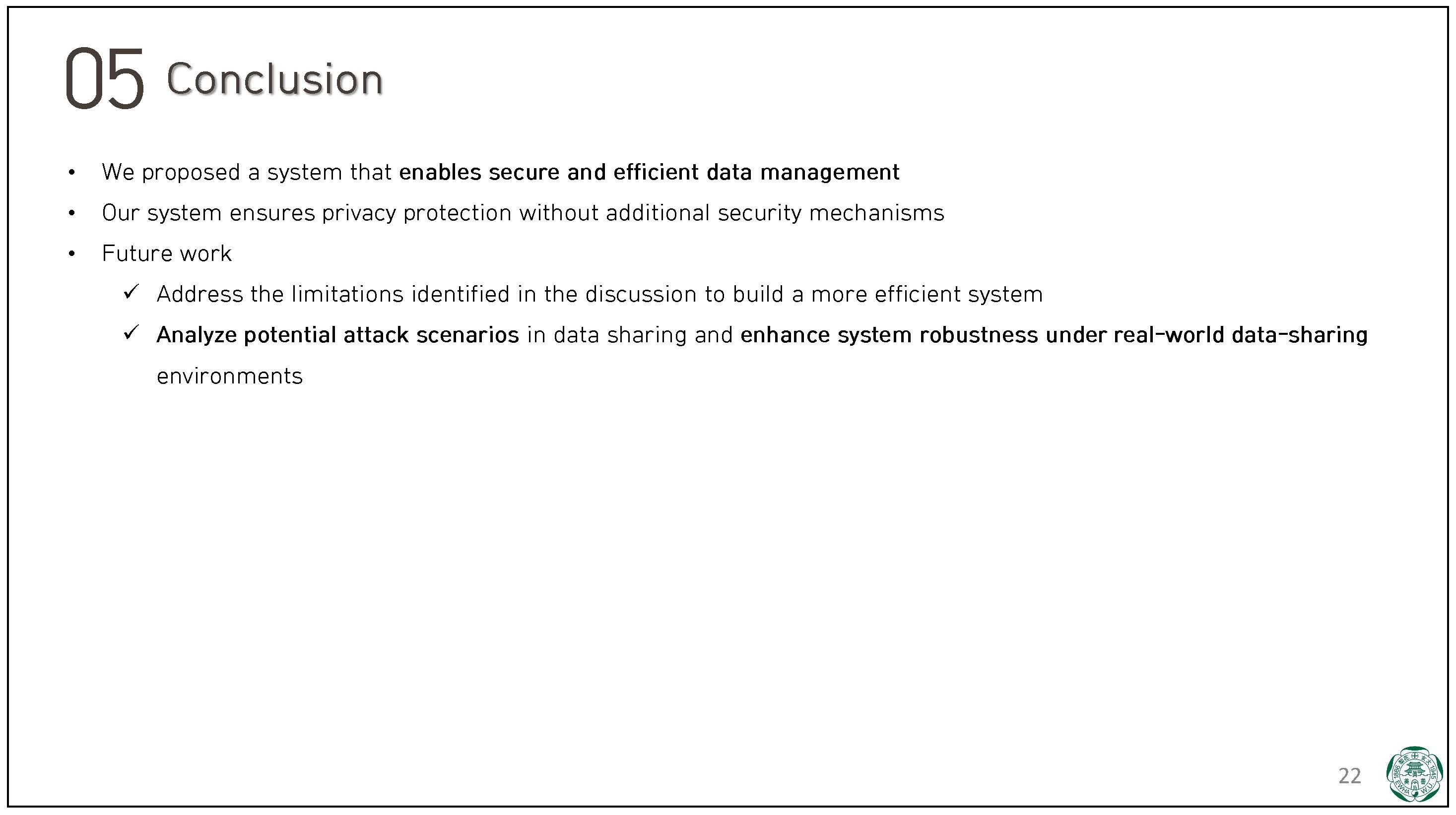 |
In this work, we proposed a system that enables secure and efficient data management.
Our system ensures privacy protection without additional security mechanisms.
Regarding future work, we plan to address the limitations identified in the discussion to build a more efficient system.
We also aim to analyze potential attack scenarios in data sharing and enhance system robustness under real-world data-sharing environments.
|
| ICACT20260202 Slide.23
[Big Slide]
|
Chrome Click!! |
 |
Thank you for your attention. |















