 ICACT20260211 Slide.01
[Big Slide]
[YouTube] |
Chrome  Click!! |
 |
Hello everyone, greetings to all the esteemed professors, researchers, and my fellow students present at the conference. My name is Md. Taherul Islam Shawon from Changan University. Eight of us worked on this paper together. Today, the topic of our presentation is ‘Macro Texture Detection Method for Road Surface Based on Machine Vision.’ |
| ICACT20260211 Slide.02
[Big Slide]
[YouTube] |
Chrome Click!! |
 |
In todays presentation, I have divided it into six parts of content. That is
1. Background
2. Machine Vision in Pavement Texture Detection
3. Machine Learning and Deep Learning Approaches
4. Proposed method
5. Expected results
6. Conclusion
|
| ICACT20260211 Slide.03
[Big Slide]
[YouTube] |
Chrome Click!! |
 |
First, I discuss the background. |
| ICACT20260211 Slide.04
[Big Slide]
[YouTube] |
Chrome Click!! |
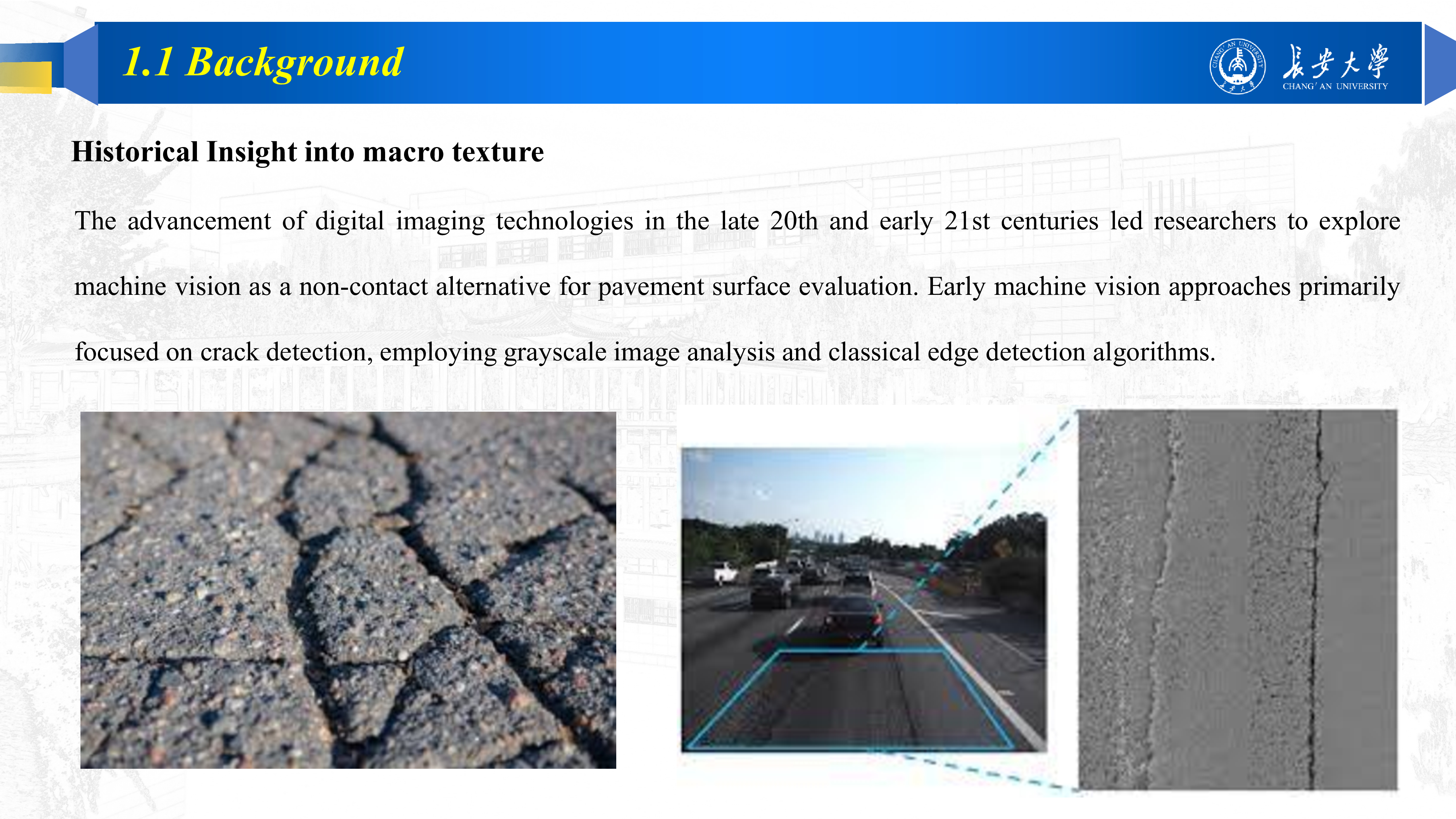 |
Historical Insight into macro texture
The advancement of digital imaging technologies in the late 20th and early 21st centuries led researchers to explore machine vision as a non-contact alternative for pavement surface evaluation. Early machine vision approaches primarily focused on crack detection, employing grayscale image analysis and classical edge detection algorithms.
|
| ICACT20260211 Slide.05
[Big Slide]
[YouTube] |
Chrome Click!! |
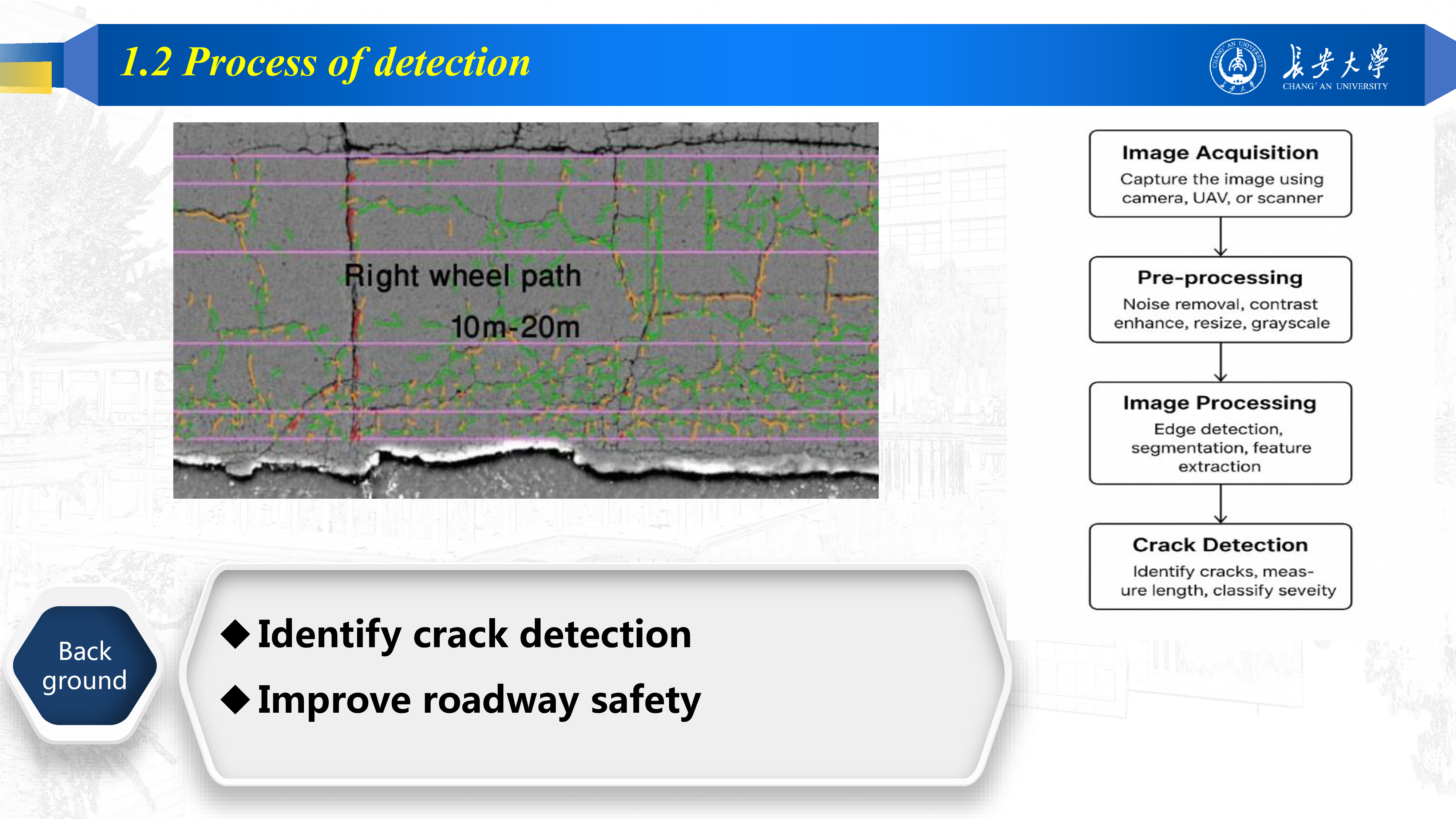 |
As you all see, here is a flowchart of the entire process of crack detection. After image acquisition, pre-processing, image processing, we can do crack detection. Some specific tasks of each step are mentioned in the chart. The main aim here is to discuss how crack detection and road safety can be improved. |
| ICACT20260211 Slide.06
[Big Slide]
[YouTube] |
Chrome Click!! |
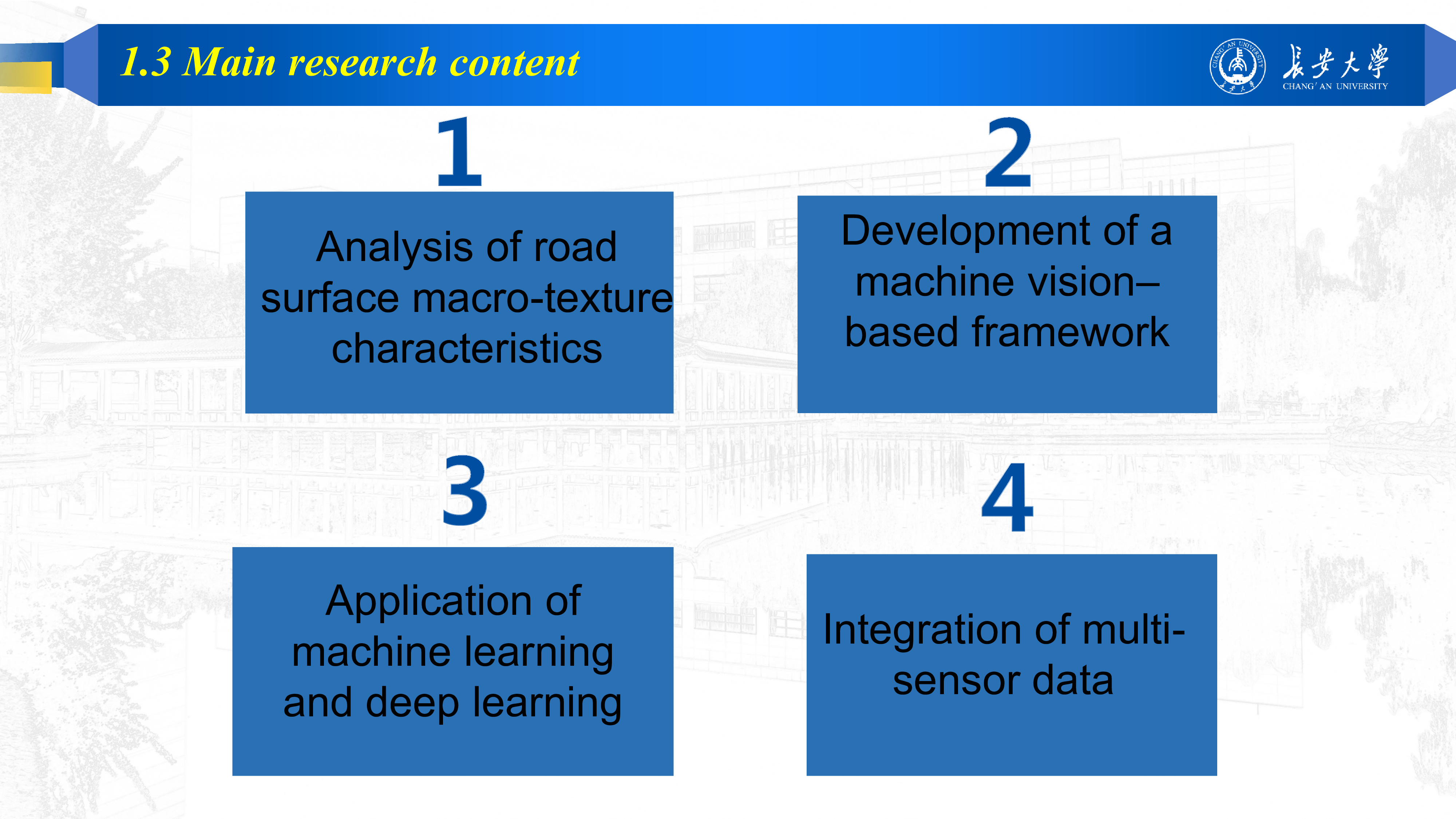 |
The main content of our research is:
1. Analysis of road surface macro-texture characteristics
2. Development of a machine vision–based framework
3. Application of machine learning and deep learning
4. Integration of multi-sensor data
|
| ICACT20260211 Slide.07
[Big Slide]
[YouTube] |
Chrome Click!! |
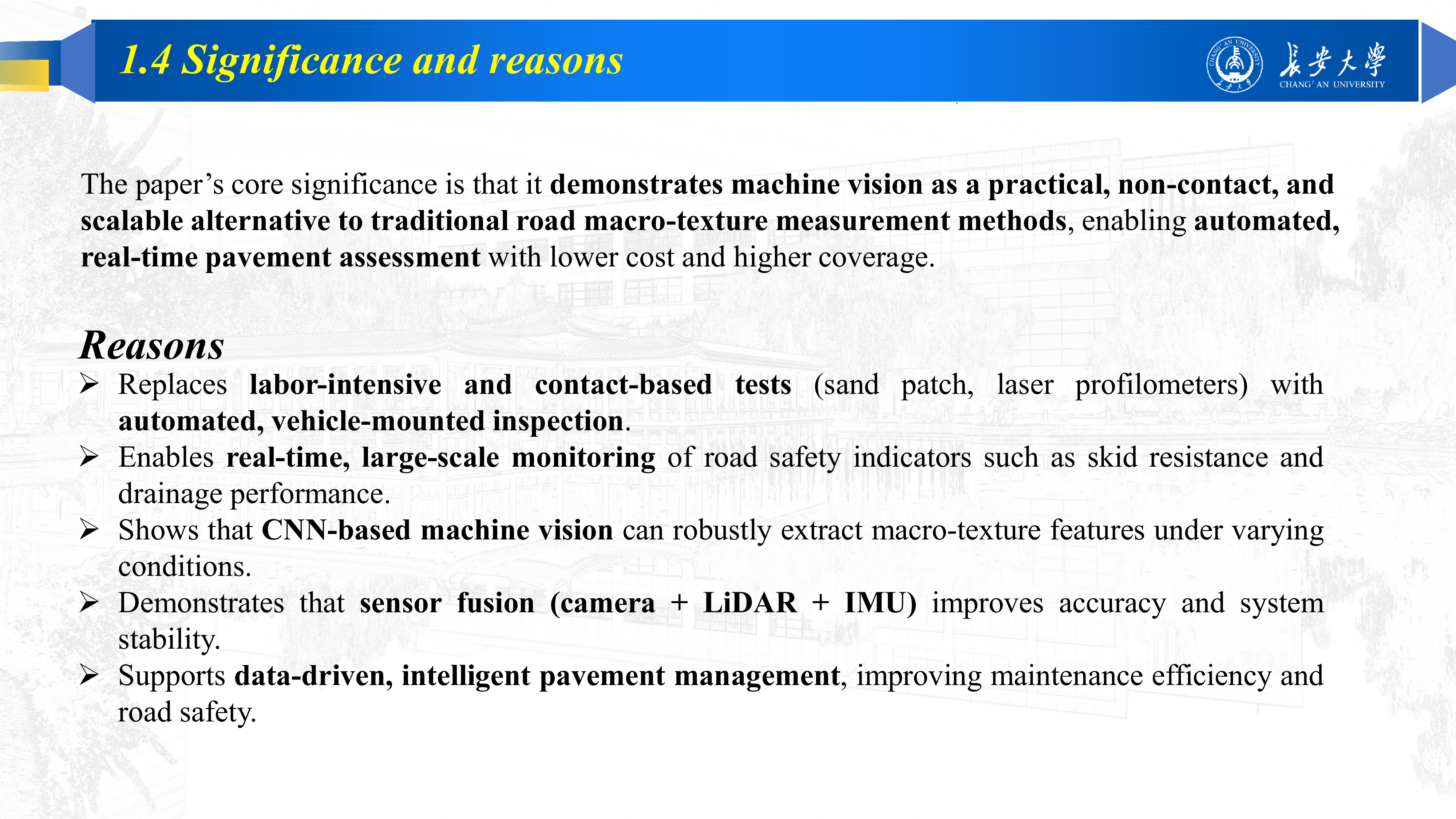 |
The paper’s core significance is that it demonstrates machine vision as a practical, non-contact, and scalable alternative to traditional road macro-texture measurement methods.
1. Replaces labor-intensive and contact-based tests.
2. Enables real-time, large-scale monitoring
3. CNN-based machine vision can robustly extract macro-texture features under varying conditions.
4. Demonstrates sensor fusion
5. Supports data-driven, intelligent pavement management.
|
| ICACT20260211 Slide.08
[Big Slide]
[YouTube] |
Chrome Click!! |
 |
In part two, I talk about Machine Vision in Pavement Texture Detection. The main contents include technical objectives, technical challenges, and expected effects. |
| ICACT20260211 Slide.09
[Big Slide]
[YouTube] |
Chrome Click!! |
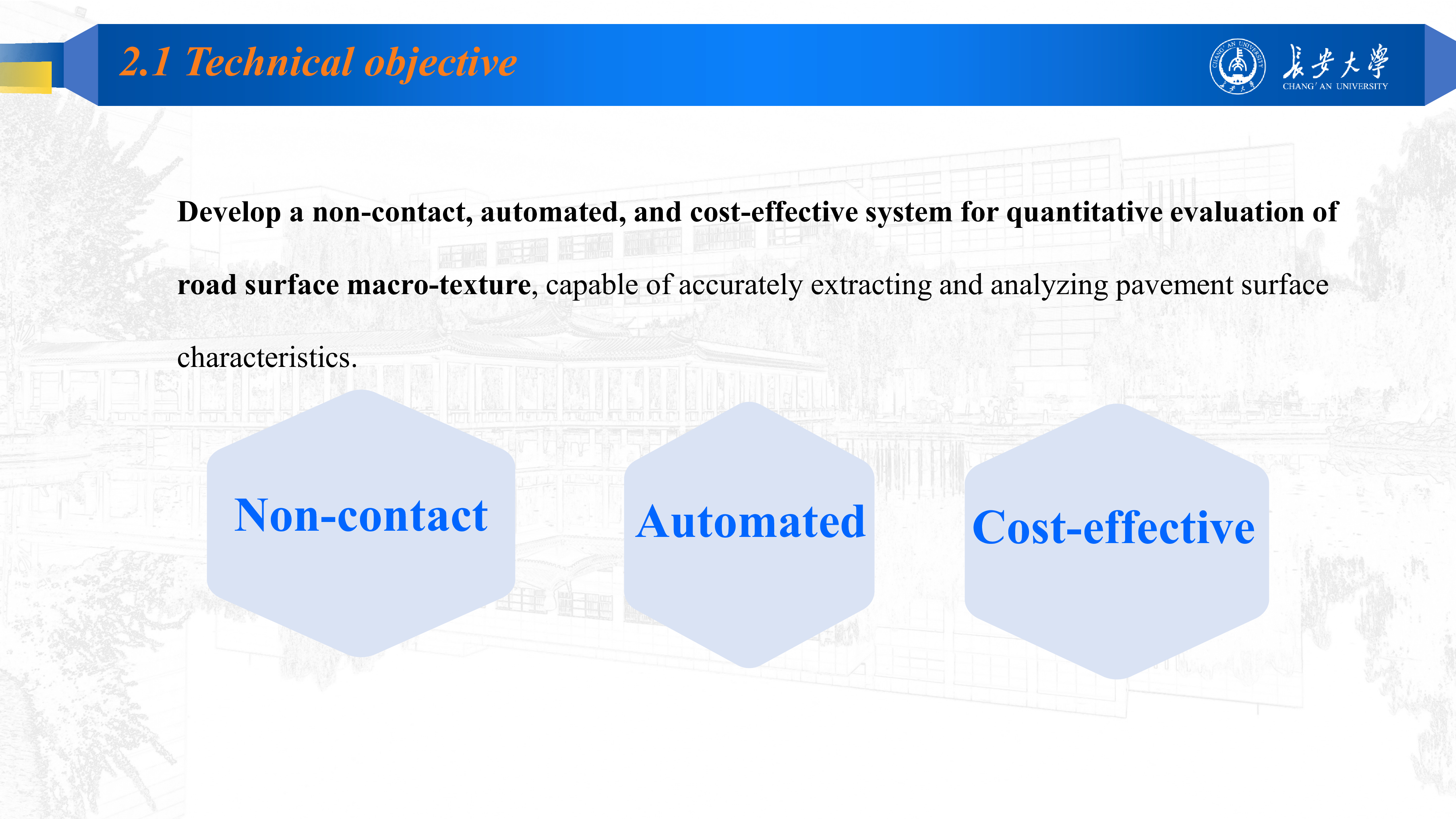 |
Develop a non-contact, automated, and cost-effective system for quantitative evaluation of road surface macro-texture, capable of accurately extracting and analyzing pavement surface characteristics. |
| ICACT20260211 Slide.10
[Big Slide]
[YouTube] |
Chrome Click!! |
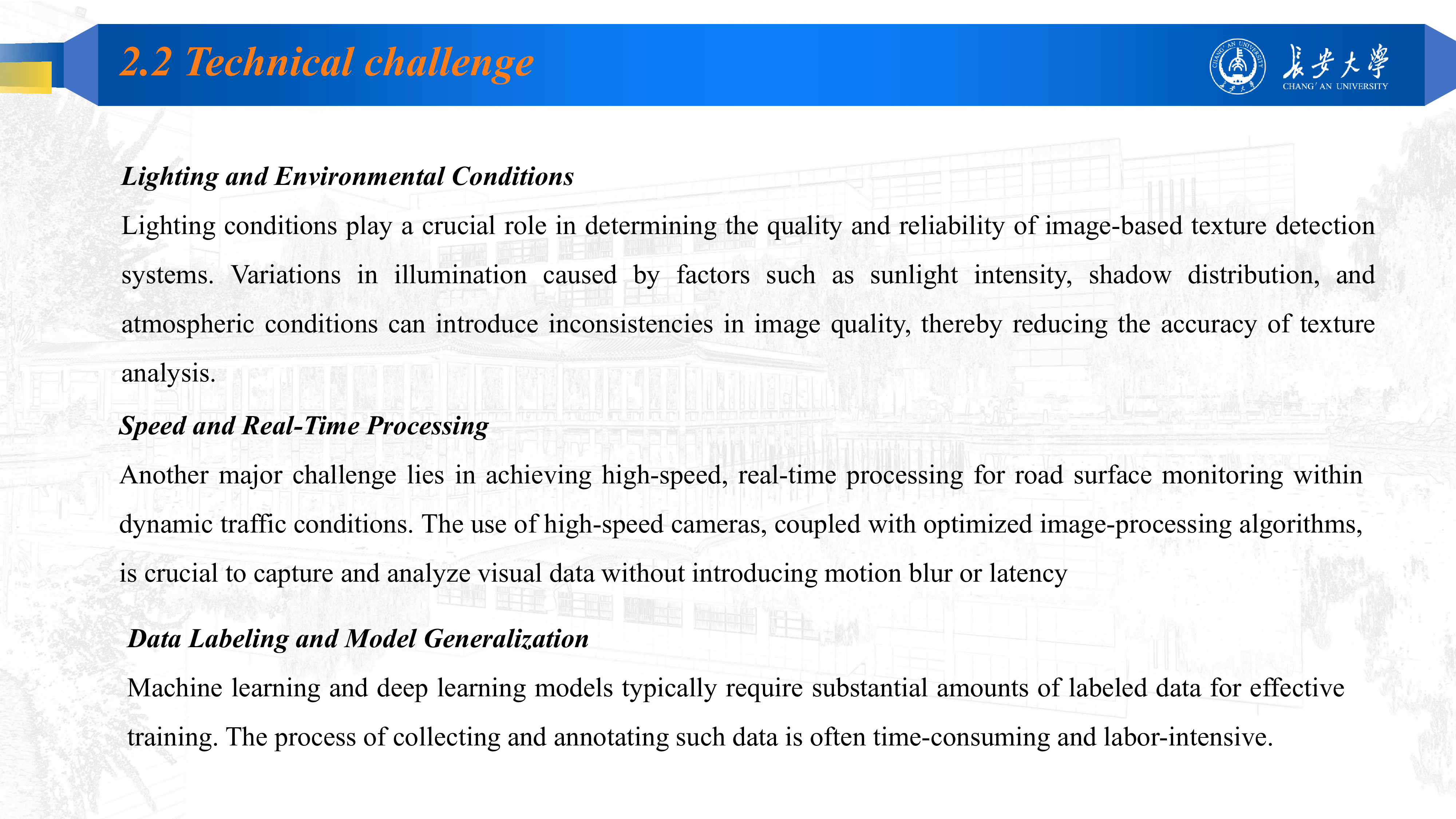 |
The technical challenges of machine vision in pavement construction are:
Lighting and Environmental Conditions:
Lighting conditions play a crucial role in determining the quality and reliability of image-based texture detection systems.
Speed and Real-Time Processing:
Another major challenge lies in achieving high-speed, real-time processing for road surface monitoring within dynamic traffic conditions.
Data Labeling and Model Generalization:
Machine learning and deep learning models typically require substantial amounts of labeled data for effective training.
|
| ICACT20260211 Slide.11
[Big Slide]
[YouTube] |
Chrome Click!! |
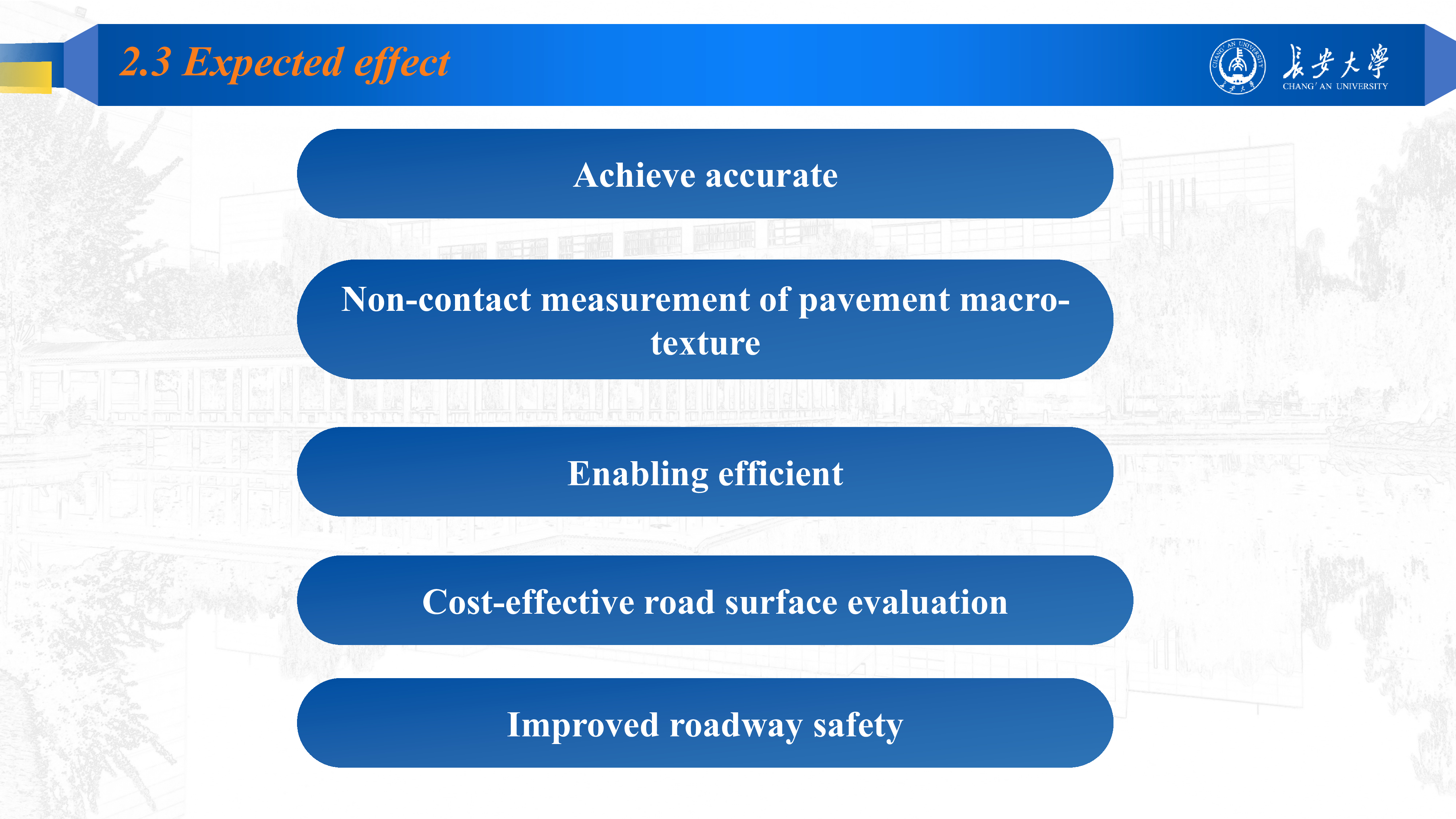 |
If the entire process of machine vision is well completed, we can expect some effects such as: Achieve accurate, Non-contact measurement of pavement macro-texture, enabling efficient, Cost-effective road surface evaluation, and improved roadway safety.
|
| ICACT20260211 Slide.12
[Big Slide]
[YouTube] |
Chrome Click!! |
 |
In part two, I talk about Machine Learning and Deep Learning Approaches. The main contents include Deep Learning and Convolutional Neural Networks, Hybrid Models, and Data Fusion. |
| ICACT20260211 Slide.13
[Big Slide]
[YouTube] |
Chrome Click!! |
 |
Deep learning methodologies, particularly convolutional neural networks (CNNs), have achieved remarkable progress in the analysis of road surface textures owing to their capability to capture and learn hierarchical image features. |
| ICACT20260211 Slide.14
[Big Slide]
[YouTube] |
Chrome Click!! |
 |
Recent research has increasingly focused on hybrid approaches that integrate convolutional neural networks (CNNs) with auxiliary sensing technologies, such as laser scanners and inertial measurement units (IMUs), to enhance the accuracy and robustness of texture detection. The fusion of visual and complementary sensor data enables a more holistic understanding of road surface conditions. |
| ICACT20260211 Slide.15
[Big Slide]
[YouTube] |
Chrome Click!! |
 |
In Part Four, we proposed a methodology for the entire research. |
| ICACT20260211 Slide.16
[Big Slide]
[YouTube] |
Chrome Click!! |
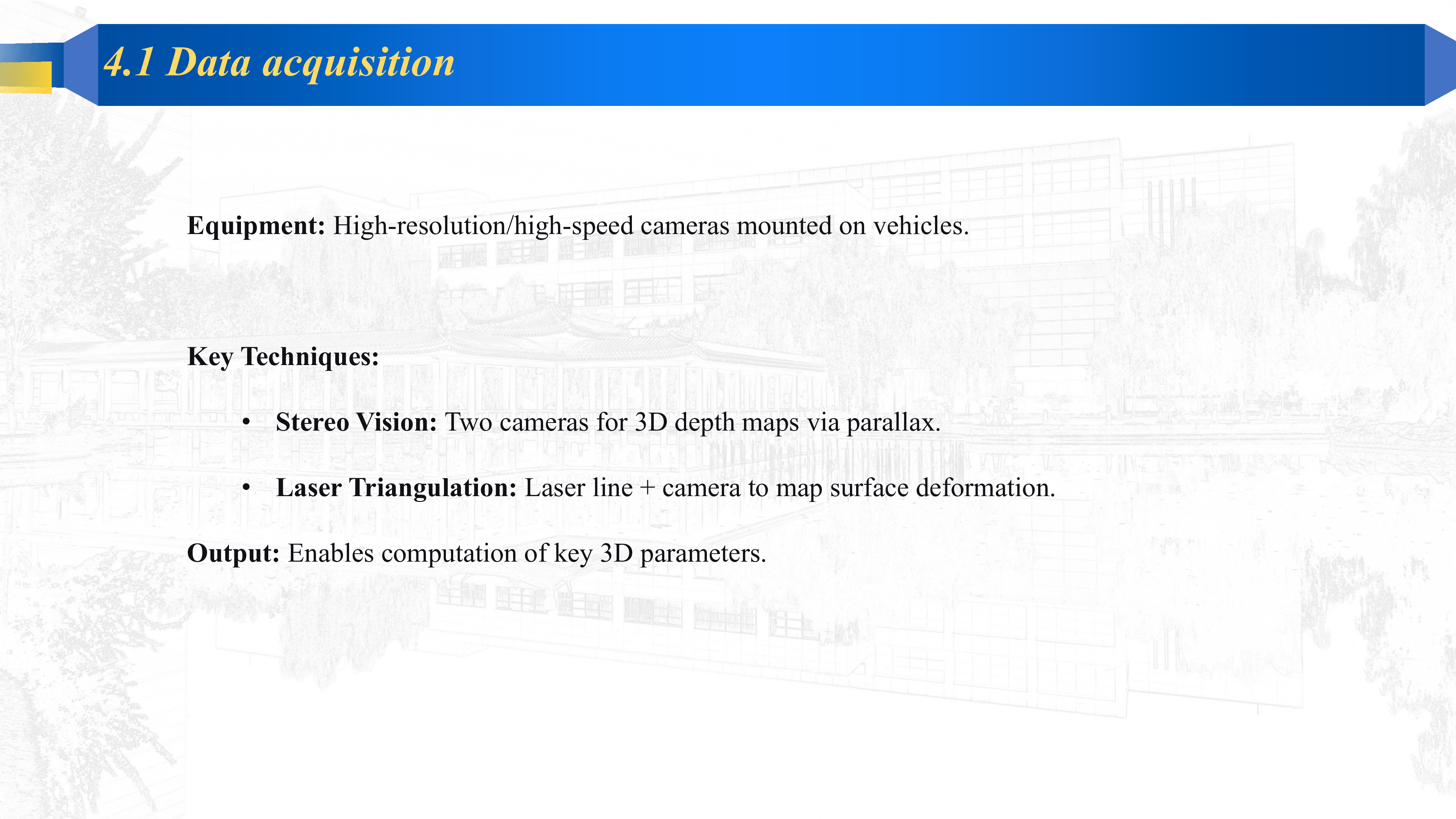 |
Our work begins with data acquisition, where high-resolution cameras mounted on a vehicle are used to capture road surface images. This setup allows efficient data collection over long distances while maintaining a stable view of the pavement texture.
To ensure clear images at normal driving speeds, high-frame-rate cameras are employed to minimize motion blur and capture fine surface details. For accurate depth measurement, we use either stereo vision or laser triangulation techniques. Stereo vision estimates surface depth by analyzing image pairs from different viewpoints, while laser triangulation reconstructs surface irregularities using a projected laser line.
|
| ICACT20260211 Slide.17
[Big Slide]
[YouTube] |
Chrome Click!! |
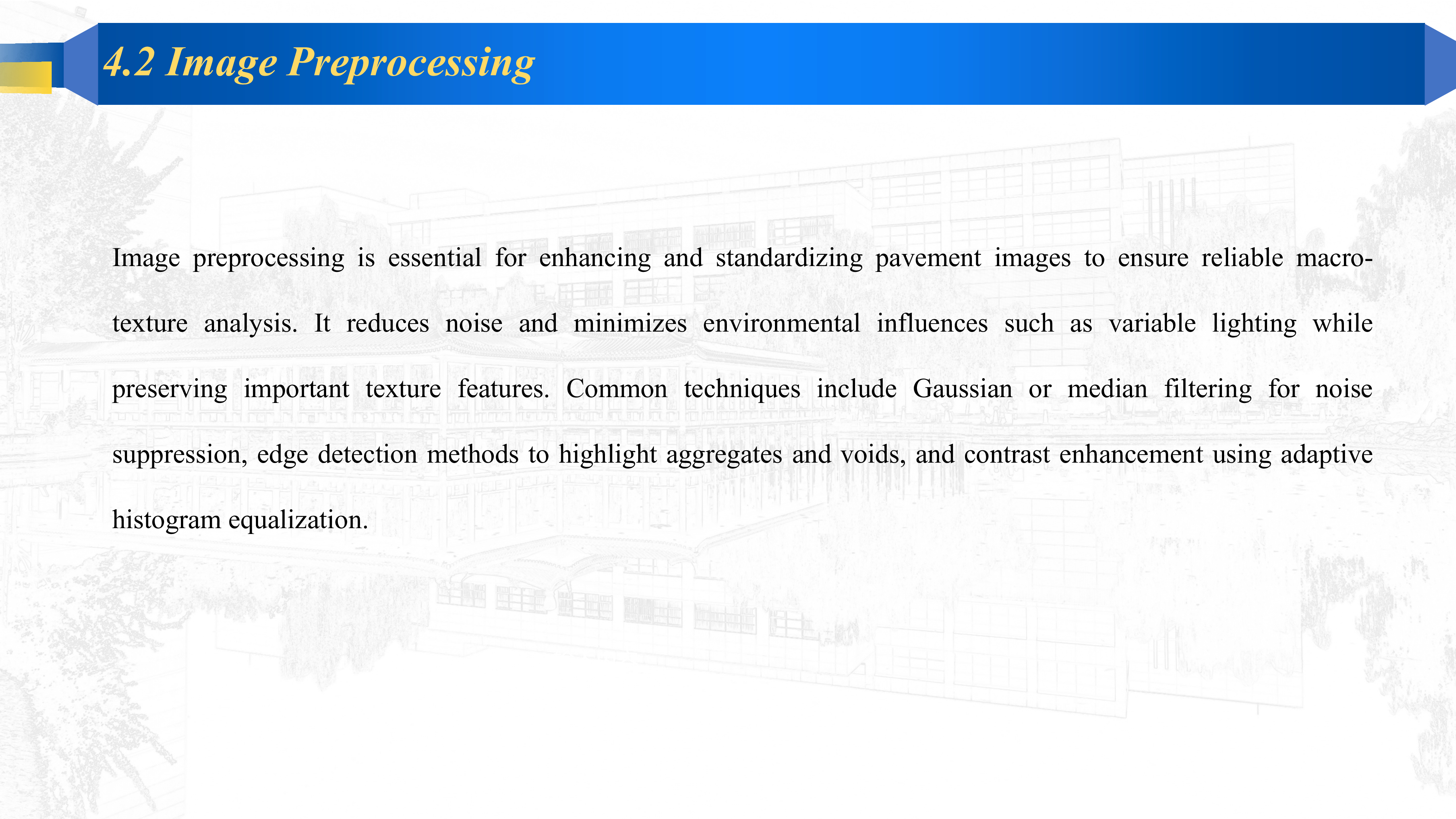 |
Image preprocessing is essential for standardizing road images and enhancing texture details while minimizing the effects of varying lighting conditions. Noise-reduction filters, such as Gaussian or median filters, are first applied to suppress high-frequency noise while preserving important edges. Edge detection techniques are used to highlight key texture features such as aggregates and surface voids. Contrast enhancement, for example, through adaptive histogram equalization, improves feature visibility under different illumination conditions. Finally, normalization and shadow-removal methods address lighting inconsistencies, resulting in a more uniform and reliable representation of the road surface for further analysis. |
| ICACT20260211 Slide.18
[Big Slide]
[YouTube] |
Chrome Click!! |
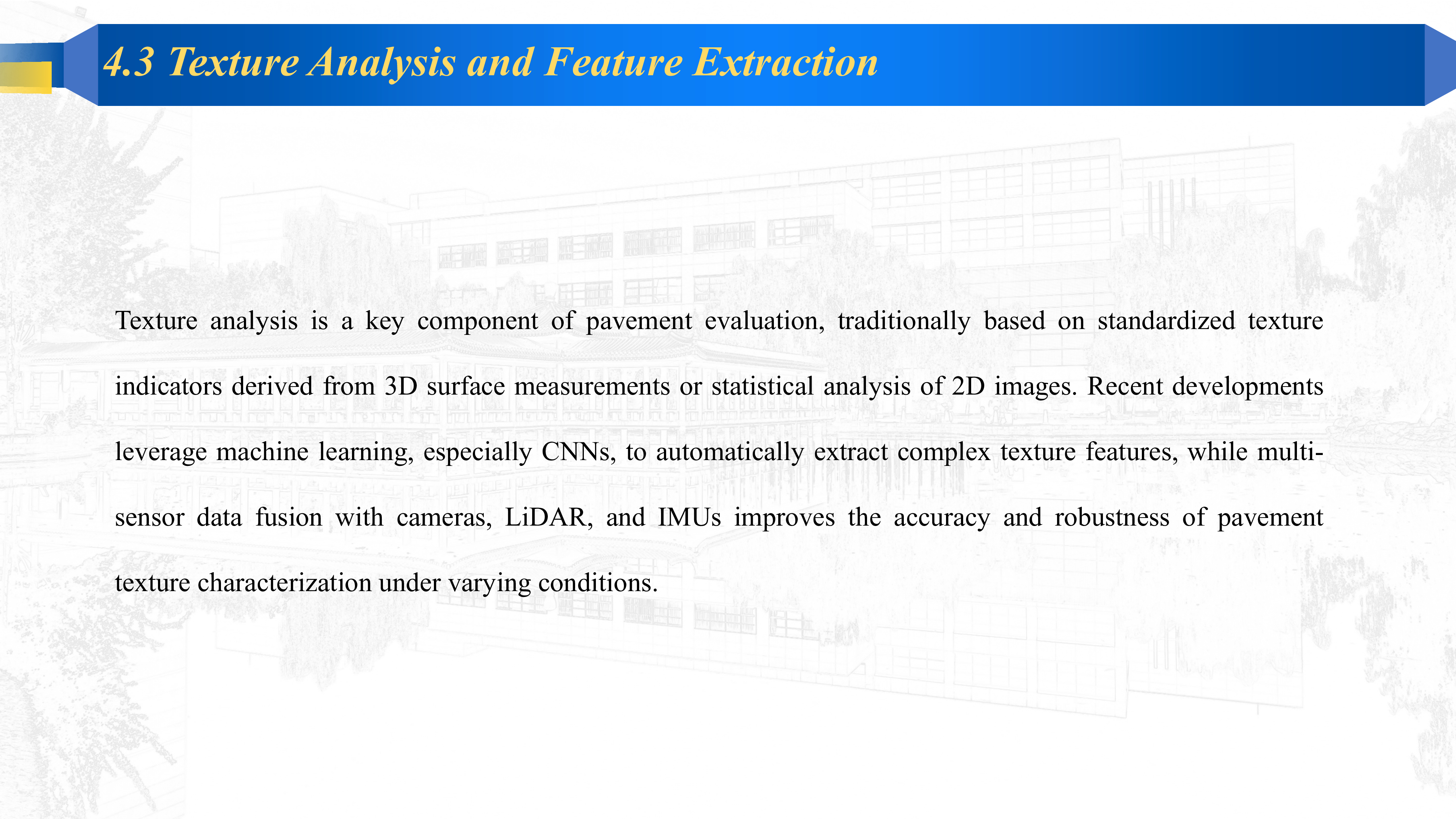 |
Texture analysis is a fundamental aspect of pavement evaluation and has traditionally relied on standardized texture indicators obtained from 3D surface measurements or statistical analysis of 2D images. More recently, machine learning approaches, particularly convolutional neural networks, have been used to automatically learn complex texture features. In addition, fusing data from multiple sensors such as cameras, LiDAR, and IMUs further enhances the accuracy and robustness of pavement texture characterization under varying operating conditions. |
| ICACT20260211 Slide.19
[Big Slide]
[YouTube] |
Chrome Click!! |
 |
After the entire research work is completed, we can get some outstanding results, which will be discussed in this part. |
| ICACT20260211 Slide.20
[Big Slide]
[YouTube] |
Chrome Click!! |
 |
By analyzing these parameters, the system can assess surface roughness, providing a comprehensive understanding of texture variations that influence skid resistance and water drainage factors that are critical for vehicle safety. |
| ICACT20260211 Slide.21
[Big Slide]
[YouTube] |
Chrome Click!! |
 |
CNNs can differentiate between different surface roughness levels and texture types when trained on representative and diverse datasets. This computerized classification makes it easier to identify pavement areas that need care, which eliminates the need for manual examination and drastically cuts down on evaluation time. |
| ICACT20260211 Slide.22
[Big Slide]
[YouTube] |
Chrome Click!! |
 |
The system must be capable of processing images in real time, facilitating deployment on moving vehicles at typical road inspection speeds. This functionality allows for continuous monitoring of extensive road networks without disrupting traffic or necessitating road closures, representing a substantial improvement over conventional contact-based inspection methods. |
| ICACT20260211 Slide.23
[Big Slide]
[YouTube] |
Chrome Click!! |
 |
Machine vision systems frequently encounter performance limitations due to environmental variations, including changes in lighting and adverse weather conditions. To address these challenges, robust operation under diverse conditions can be achieved through adaptive preprocessing strategies, such as contrast enhancement and illumination normalization. |
| ICACT20260211 Slide.24
[Big Slide]
[YouTube] |
Chrome Click!! |
 |
By minimizing the need for direct physical contact with the pavement and leveraging rapid data processing capabilities, the system can substantially reduce operational costs, thereby enabling practical implementation for routine road maintenance and safety evaluations. |
| ICACT20260211 Slide.25
[Big Slide]
[YouTube] |
Chrome Click!! |
 |
Lastly, I discuss future work. What can we do for the future? |
| ICACT20260211 Slide.26
[Big Slide]
[YouTube] |
Chrome Click!! |
 |
Machine vision offers a transformative, efficient, and scalable solution for data-driven road texture assessment, enhancing safety and maintenance. |
| ICACT20260211 Slide.27
[Big Slide]
[YouTube] |
Chrome Click!! |
 |
• Advanced multi-sensor fusion (LiDAR, IR, RGB).
• Edge computing for real-time processing.
• Federated learning for privacy-preserving, large-scale model training.
• Integration with autonomous vehicle fleets for continuous monitoring.
|
| ICACT20260211 Slide.28
[Big Slide]
[YouTube] |
Chrome Click!! |
 |
Thank you very much for patiently watching and observing my work. |
| ICACT20260211 Slide.29
[Big Slide]
[YouTube] |
Chrome Click!! |
 |
If you have any advice for me or would like to know any information about my work, please let me know. |















