 ICACT20260220 Slide.01
[Big Slide] |
Chrome  Click!! |
 |
Good monirnig everyone.
It’s my pleasure to present our recent work titled “Low-Complexity Metaheuristic Design for STAR-RIS Assisted Secure NOMA-ISAC Networks.”
This work was carried out at Viettel High Technology Industries Corporation.
Today, I’ll walk you through the motivation, our proposed framework, and simulation results showing how STAR-RIS and NOMA can jointly improve secure integrated sensing and communication systems. |
| ICACT20260220 Slide.02
[Big Slide]
|
Chrome Click!! |
 |
Outline
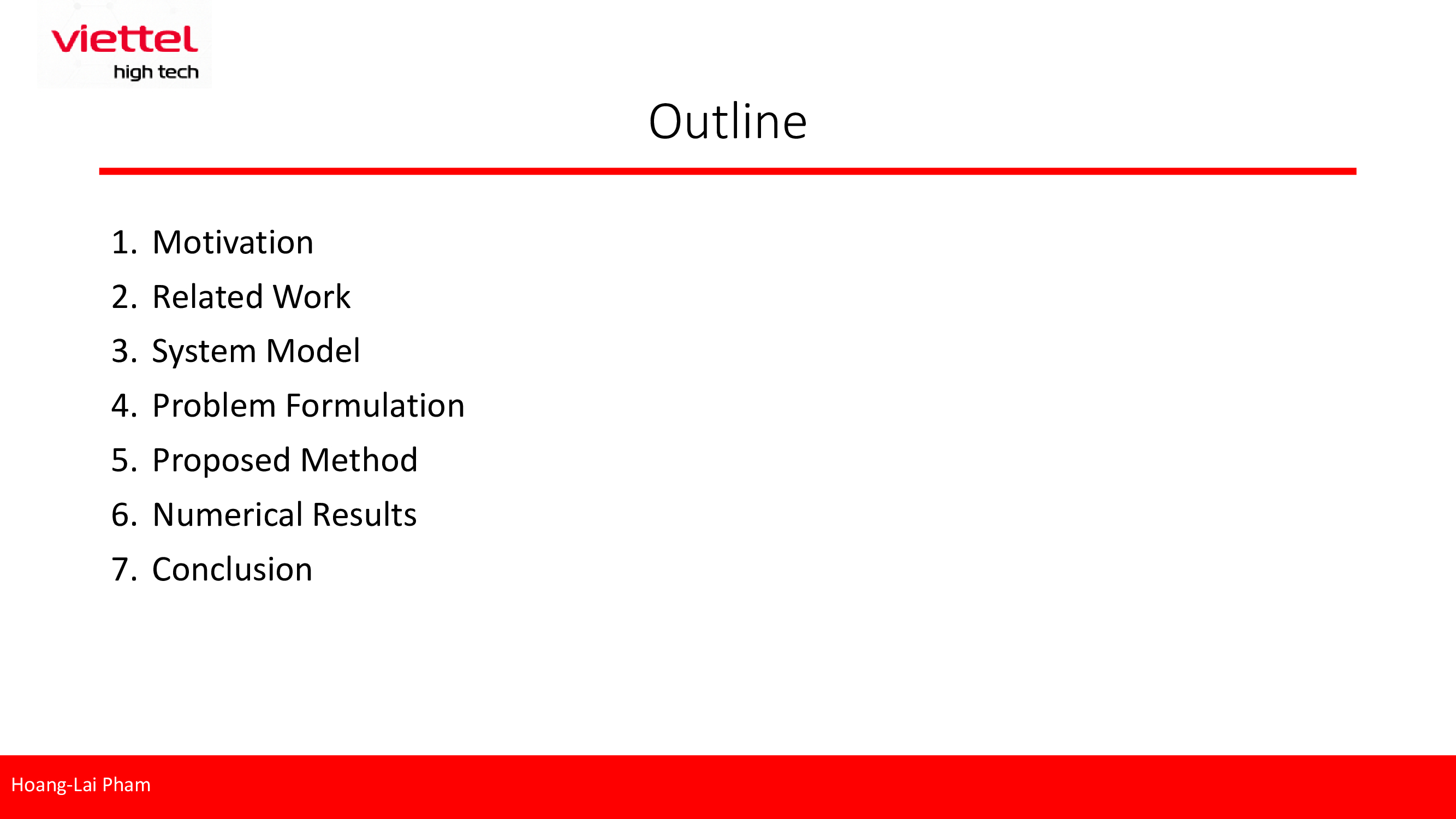
“First, I will introduce the motivation and related work.
Then, I present the system model and problem formulation.
Next, I explain the proposed WOA-based optimization method.
After that, numerical results are discussed.
Finally, I conclude the paper.”
|
| ICACT20260220 Slide.03
[Big Slide]
|
Chrome Click!! |
 |
Motivation
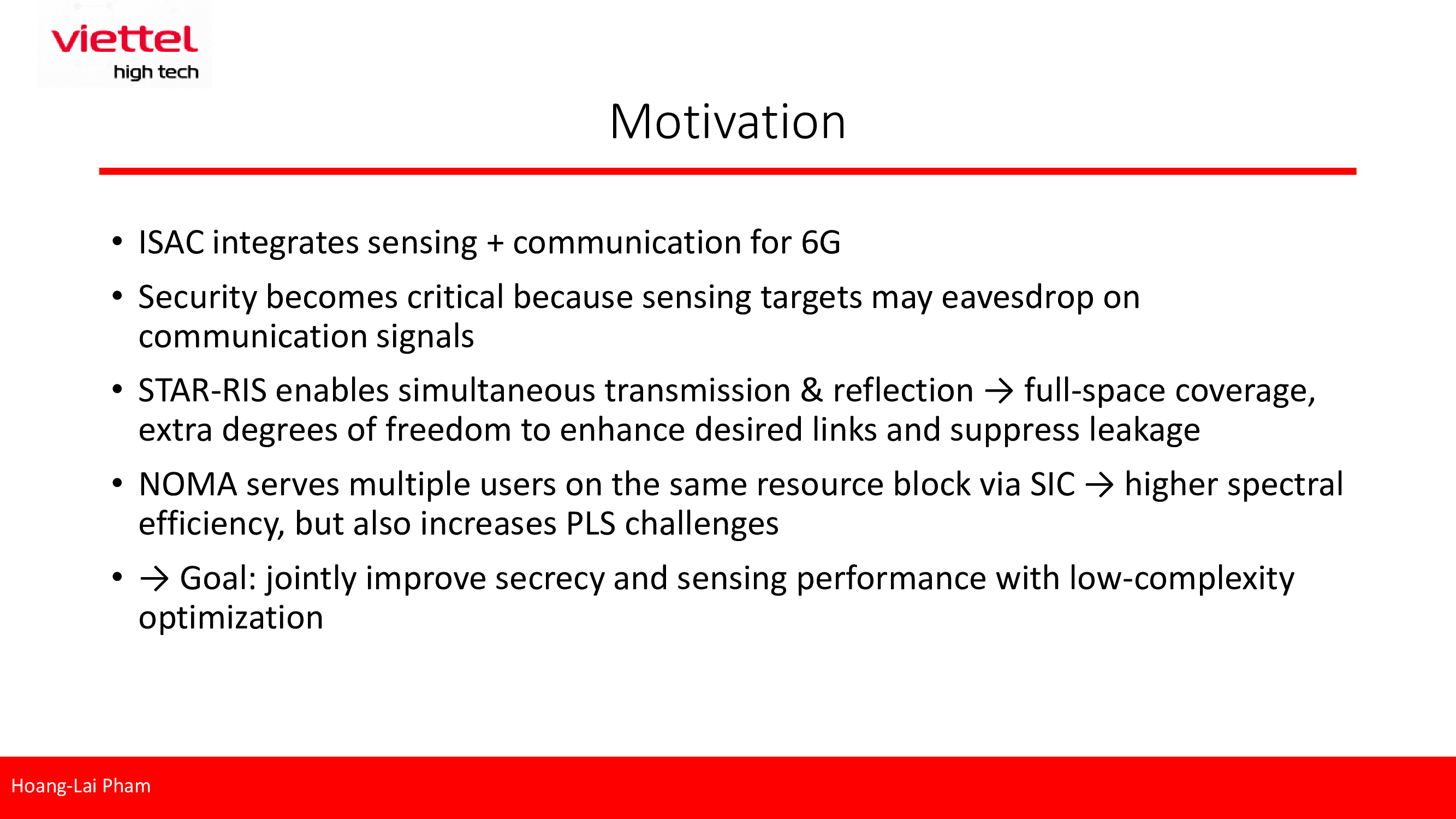
“Integrated sensing and communication, or ISAC, is considered a key enabling technology for future 6G networks, since sensing and communication share spectrum, hardware, and energy resources.
However, this integration introduces new security challenges, because sensing targets may also eavesdrop on confidential communication signals.
To address this issue, we consider STAR-RIS, which supports simultaneous transmission and reflection, enabling full-space coverage and providing additional degrees of freedom to enhance desired links while suppressing information leakage.
At the same time, NOMA allows multiple users to share the same resource block through SIC, which improves spectral efficiency but also increases physical-layer security challenges.
Therefore, our goal is to jointly improve secrecy and sensing performance with a low-complexity optimization framework.” |
| ICACT20260220 Slide.04
[Big Slide]
|
Chrome Click!! |
 |
Related Work
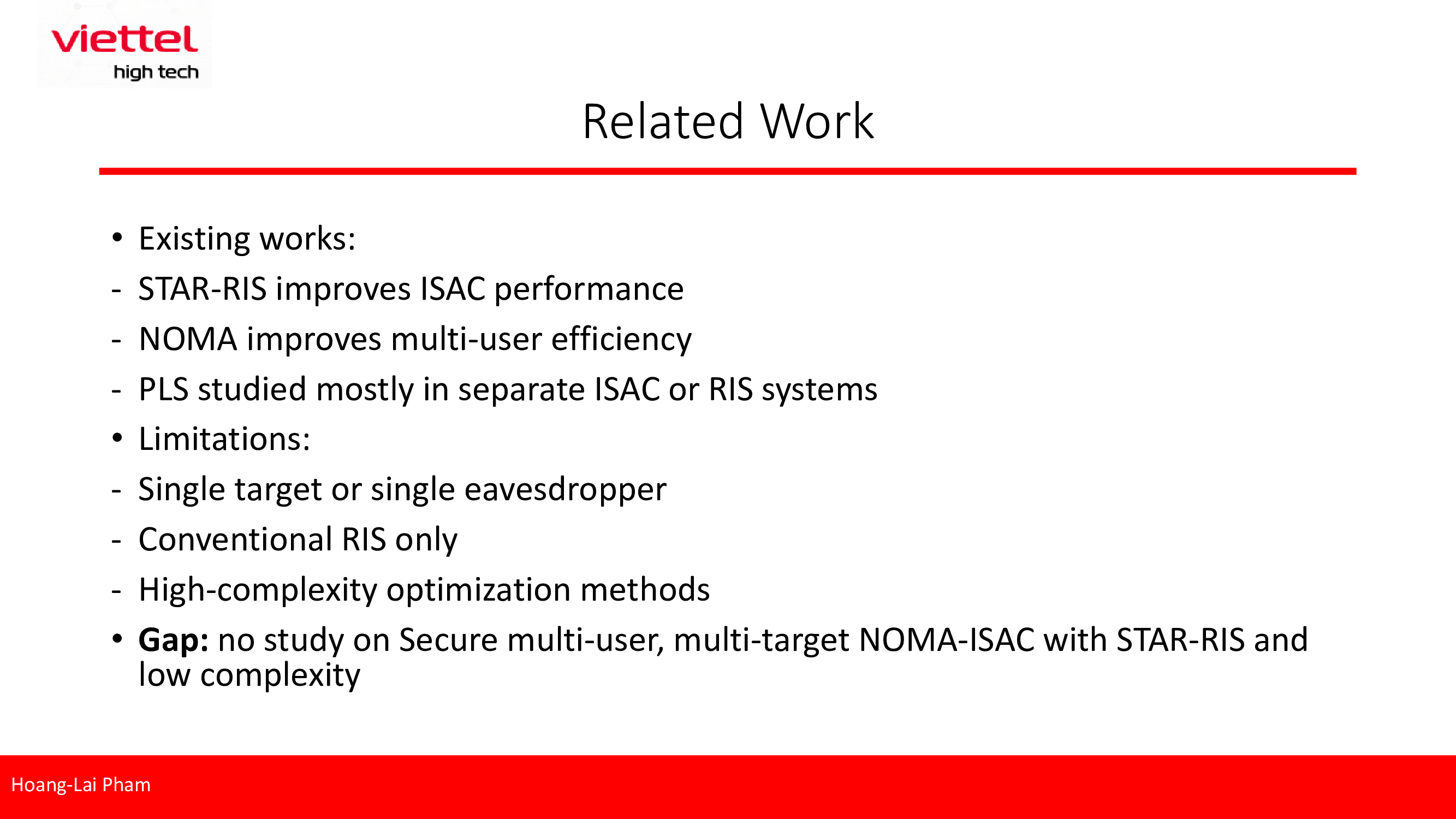
“Several existing works have shown that STAR-RIS can significantly improve ISAC performance, while NOMA enhances multi-user efficiency.
Physical-layer security has also been studied, but mostly in separate ISAC or RIS-based systems.
However, most existing studies focus on single targets or single eavesdroppers, rely on conventional RIS architectures, or adopt high-complexity optimization methods.
To the best of our knowledge, there is no existing work addressing secure multi-user, multi-target NOMA-ISAC systems empowered by STAR-RIS with low computational complexity.
This gap motivates our work.” |
| ICACT20260220 Slide.05
[Big Slide]
|
Chrome Click!! |
 |
System Model
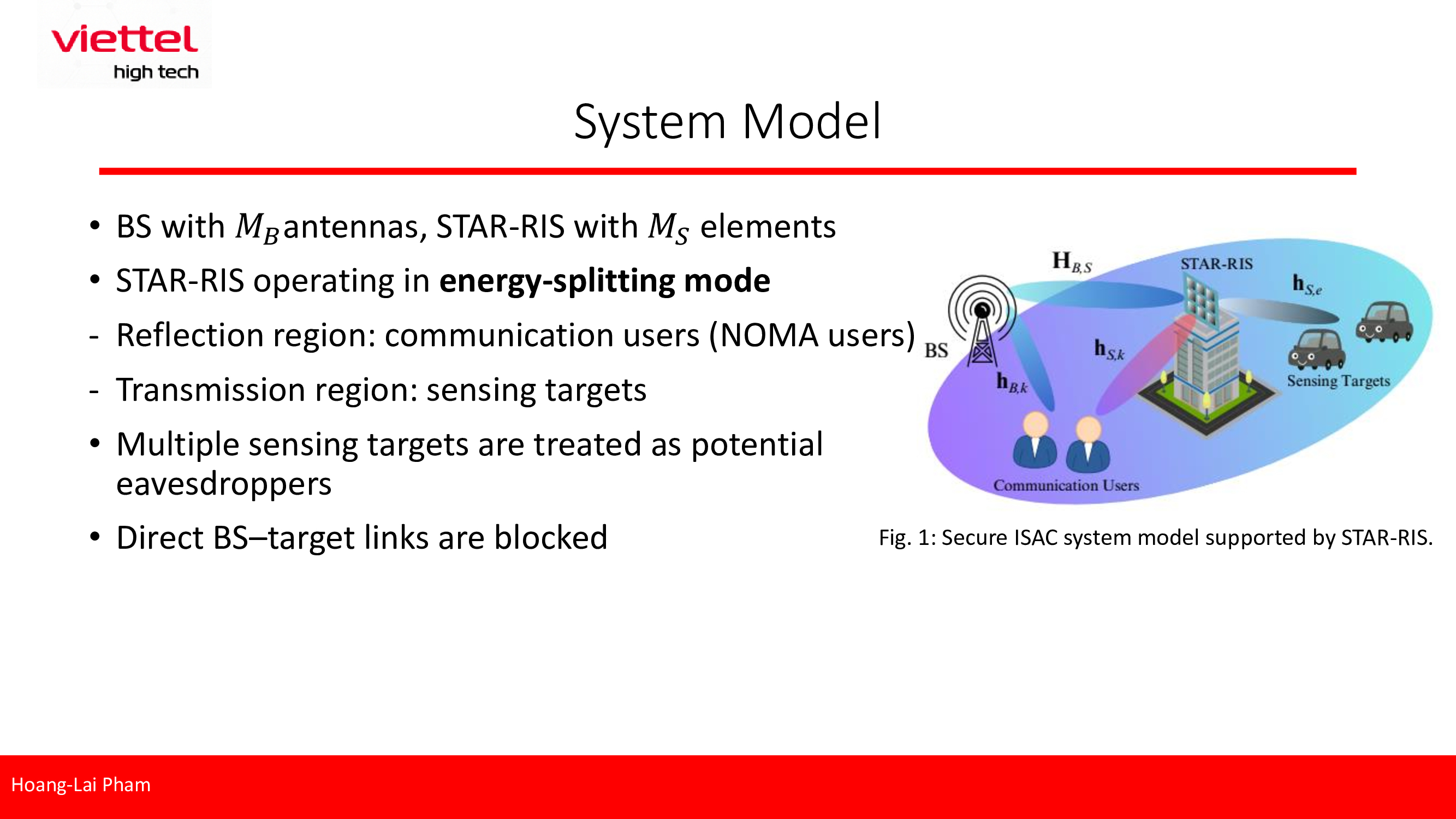
“This slide illustrates the considered system model.
We have a multi-antenna base station and a STAR-RIS operating in energy-splitting mode.
NOMA communication users are located in the reflection region, while sensing targets are located in the transmission region.
Due to blockage, the direct links between the base station and sensing targets are ignored.
Importantly, sensing targets are treated as potential eavesdroppers, which motivates the secure transmission design.” |
| ICACT20260220 Slide.06
[Big Slide]
|
Chrome Click!! |
 |
Signal Transmission
“At the base station, the transmitted signal consists of two parts: information signals for NOMA users and artificial noise for security enhancement.
The STAR-RIS dynamically adjusts its transmission and reflection coefficients to control signal propagation.
At the receiver side, NOMA users decode their signals using successive interference cancellation, following the predefined SIC decoding order.”
|
| ICACT20260220 Slide.07
[Big Slide]
|
Chrome Click!! |
 |
Communication & Security Model
“We define the SINR for legitimate NOMA users when decoding their intended signals, as well as for sensing targets acting as eavesdroppers.
The secrecy rate is defined as the difference between the achievable rate at legitimate users and the maximum rate at any eavesdropper.
Our objective is to guarantee reliable communication for legitimate users while effectively suppressing information leakage toward sensing targets.” |
| ICACT20260220 Slide.08
[Big Slide]
|
Chrome Click!! |
 |
Sensing Model
“For sensing performance, we adopt the beampattern gain toward sensing targets as the metric.
A minimum beampattern gain constraint is imposed to ensure reliable sensing.
This naturally introduces a trade-off: allocating more resources for sensing generally reduces the achievable secrecy performance.” |
| ICACT20260220 Slide.09
[Big Slide]
|
Chrome Click!! |
 |
Problem Formulation
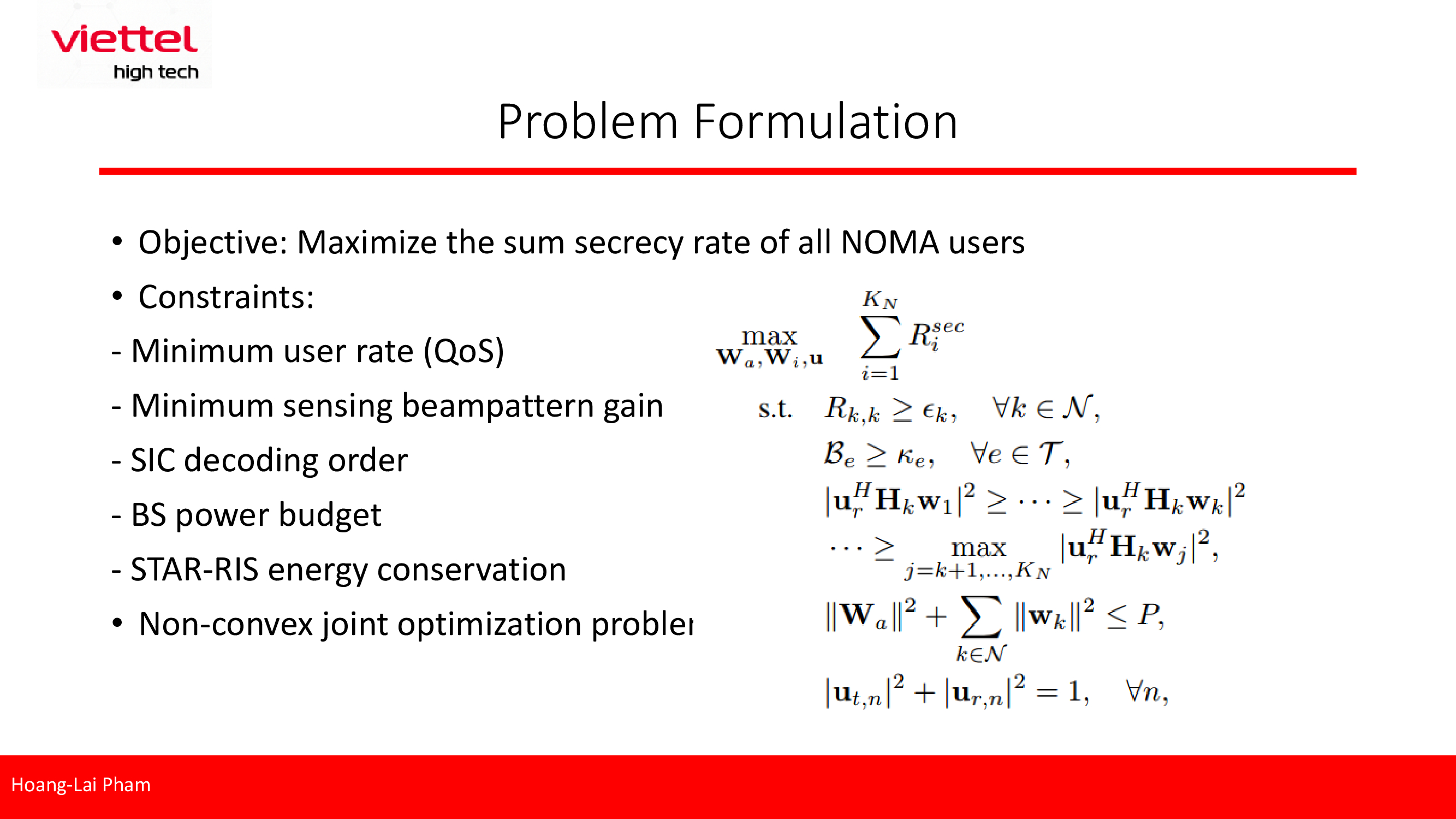
“We formulate a joint optimization problem with the objective of maximizing the sum secrecy rate of all NOMA users.
The constraints include minimum user QoS, minimum sensing beampattern gain, SIC decoding order, base station power budget, and STAR-RIS energy conservation.
Due to the strong coupling among variables and the unit-modulus constraints, the resulting problem is highly non-convex.” |
| ICACT20260220 Slide.10
[Big Slide]
|
Chrome Click!! |
 |
“The main challenges come from the strong coupling among base station beamforming, artificial noise, and STAR-RIS coefficients.
In addition, unit-modulus constraints and SIC conditions further complicate the problem.
Conventional optimization techniques usually result in high computational complexity and are difficult to scale, especially for large STAR-RIS systems.” |
| ICACT20260220 Slide.11
[Big Slide]
|
Chrome Click!! |
 |
Proposed Method
“To overcome these challenges, we adopt a metaheuristic optimization framework based on the Whale Optimization Algorithm, or WOA.
WOA does not require gradient information, has strong global search capability, and features low computational complexity.
These properties make it suitable for solving the considered non-convex optimization problem in a practical manner.” |
| ICACT20260220 Slide.12
[Big Slide]
|
Chrome Click!! |
 |
WOA-Based Optimization Framework
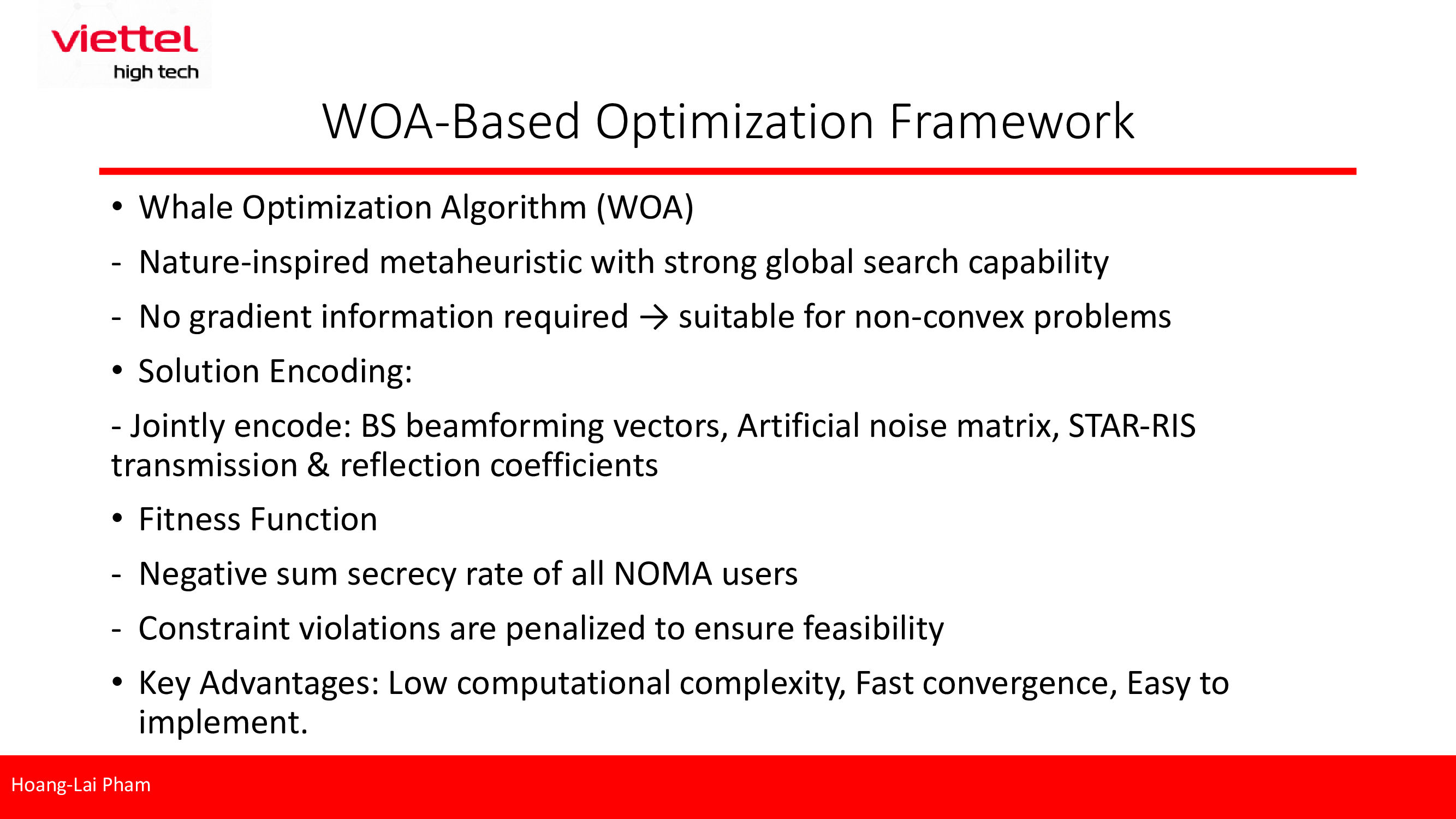
“In the WOA-based framework, all optimization variables, including beamforming vectors, artificial noise, and STAR-RIS transmission and reflection coefficients, are jointly encoded into a solution vector.
The fitness function is defined as the negative sum secrecy rate, and constraint violations are penalized to ensure feasibility.
Overall, this approach achieves fast convergence, low complexity, and is easy to implement for large-scale systems.” |
| ICACT20260220 Slide.13
[Big Slide]
|
Chrome Click!! |
 |
Algorithm Complexity
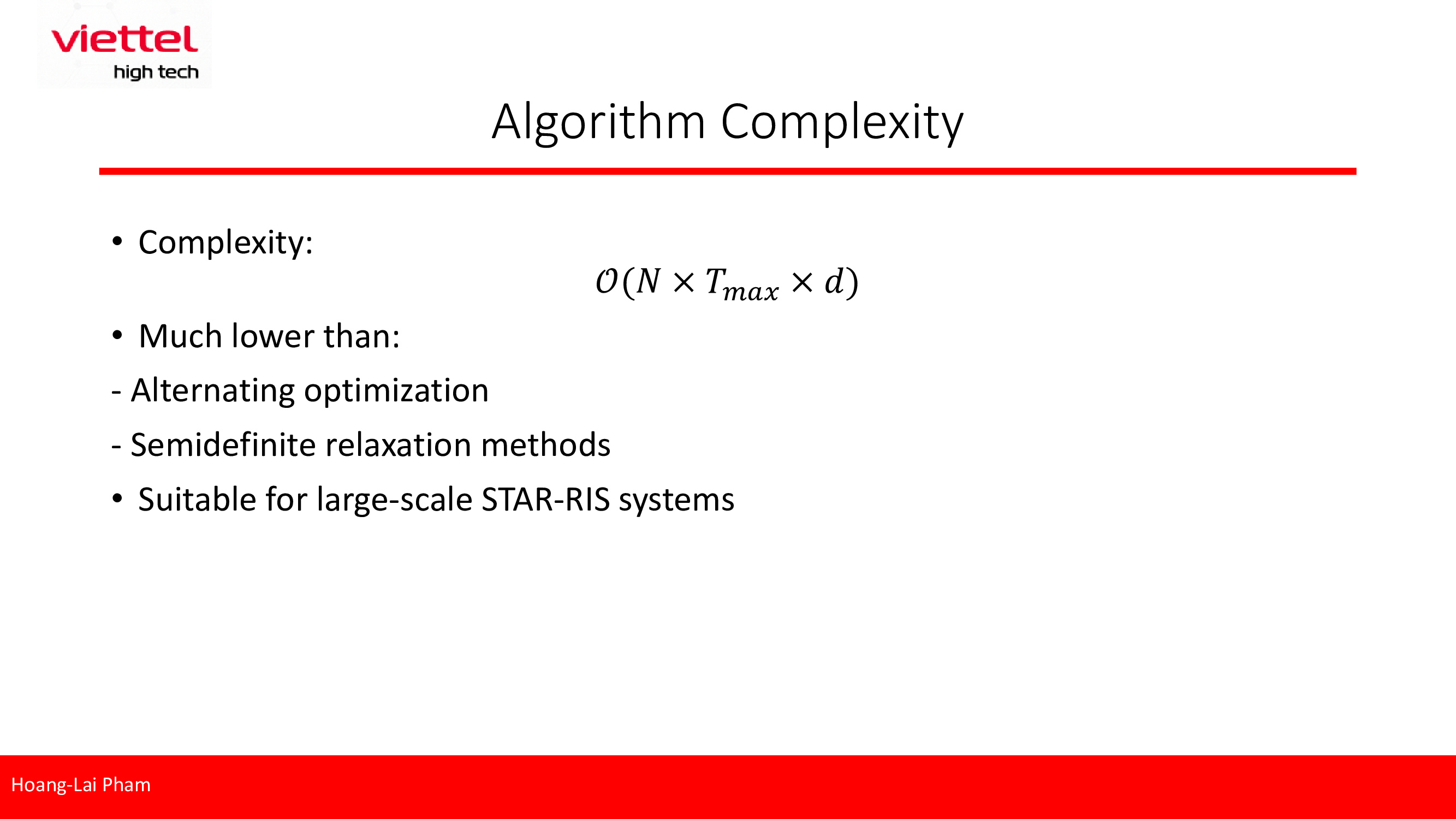
“The computational complexity of the proposed algorithm scales linearly with the population size, the maximum number of iterations, and the problem dimension.
Compared with conventional alternating optimization or convex-approximation-based methods, the proposed approach has significantly lower complexity, making it more suitable for practical implementations.”
|
| ICACT20260220 Slide.14
[Big Slide]
|
Chrome Click!! |
 |
Numerical Results: Convergence
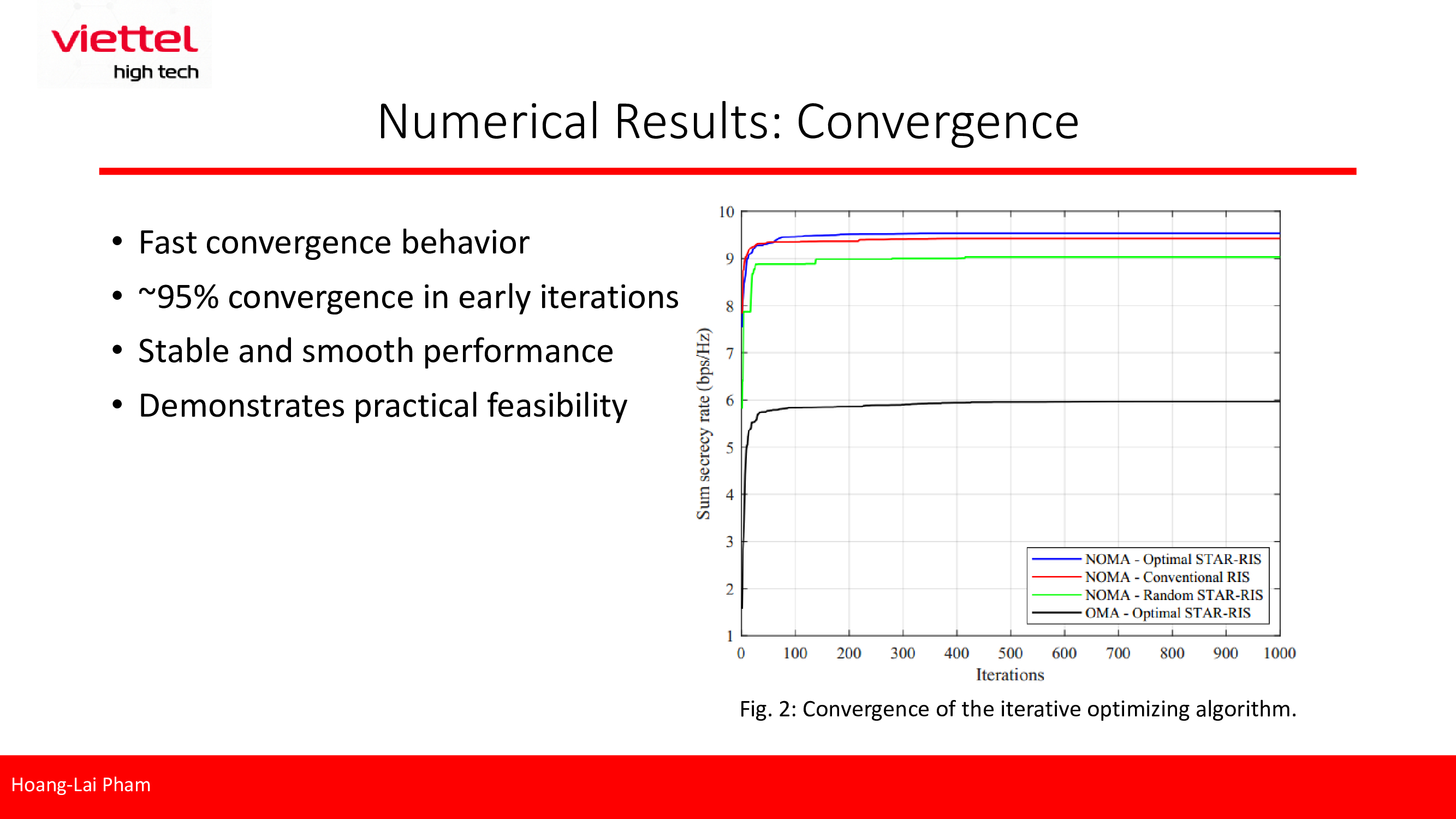
“This figure shows the convergence behavior of the proposed algorithm.
We observe fast convergence, with about 95 percent of convergence achieved in the early iterations.
The algorithm is stable and smooth, which demonstrates its practical feasibility for secure STAR-RIS assisted NOMA-ISAC systems.” |
| ICACT20260220 Slide.15
[Big Slide]
|
Chrome Click!! |
 |
Numerical Results: Impact of STAR-RIS Elements
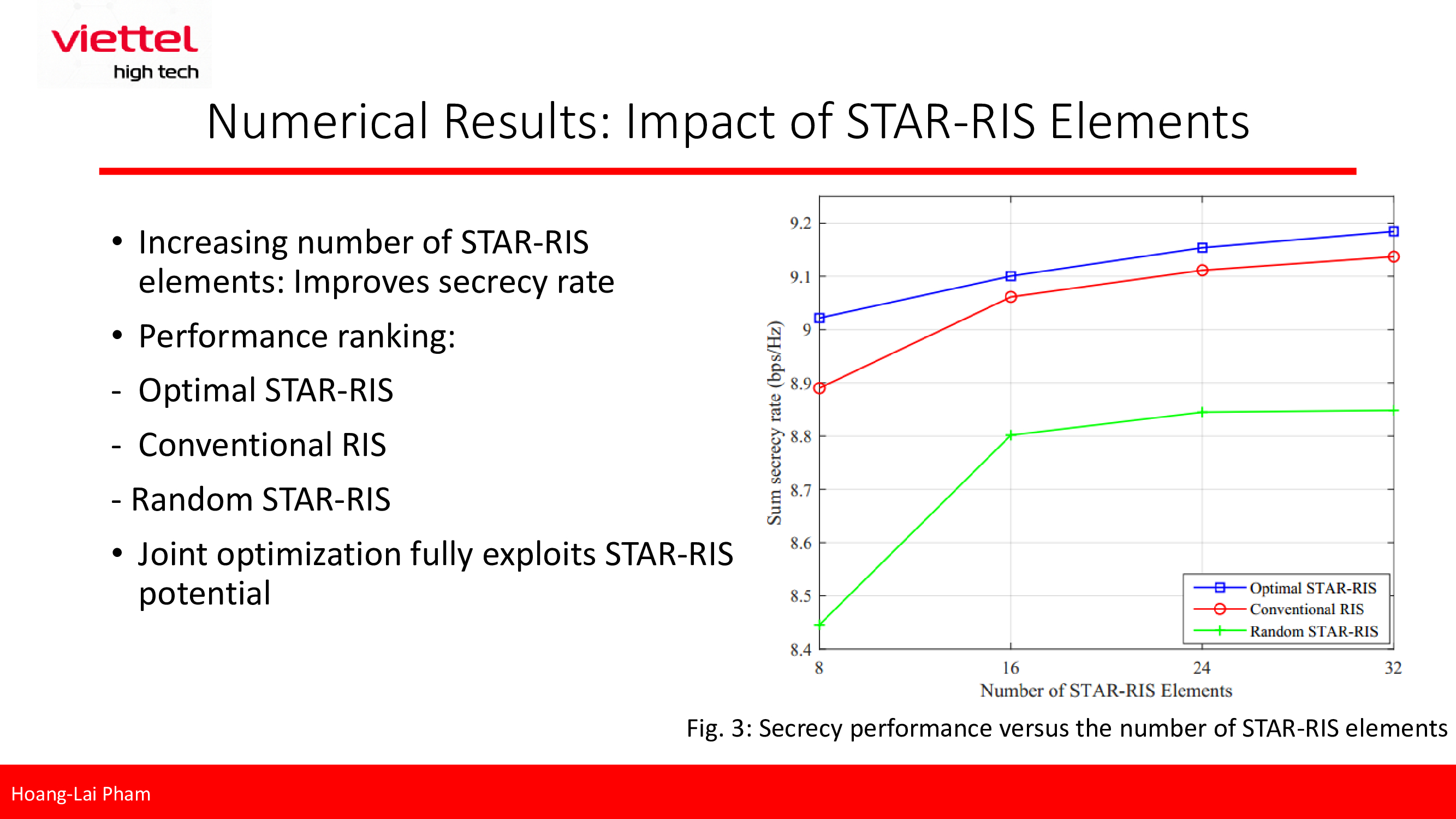
“This figure illustrates the impact of the number of STAR-RIS elements on the sum secrecy rate.
As the number of elements increases, the secrecy rate improves due to higher spatial degrees of freedom.
The optimal STAR-RIS configuration clearly outperforms conventional RIS and random STAR-RIS, confirming the importance of joint optimization.” |
| ICACT20260220 Slide.16
[Big Slide]
|
Chrome Click!! |
 |
Numerical Results: Impact of BS Power Budget
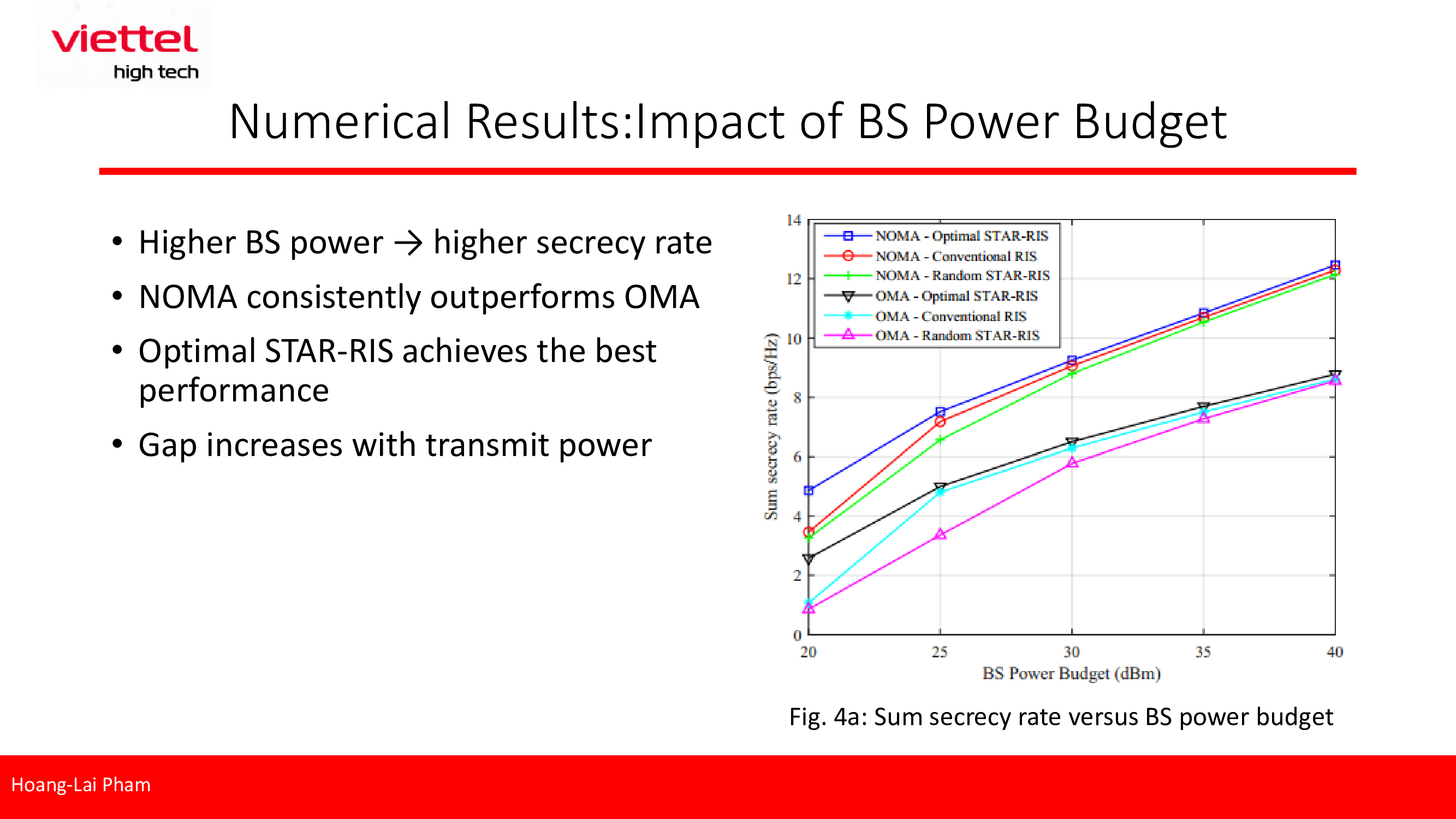
“Here, we show the sum secrecy rate versus the base station transmit power.
As expected, higher transmit power leads to higher secrecy rates.
NOMA consistently outperforms OMA under all RIS configurations, and the optimal STAR-RIS design achieves the best performance, with the gap increasing as transmit power grows.” |
| ICACT20260220 Slide.17
[Big Slide]
|
Chrome Click!! |
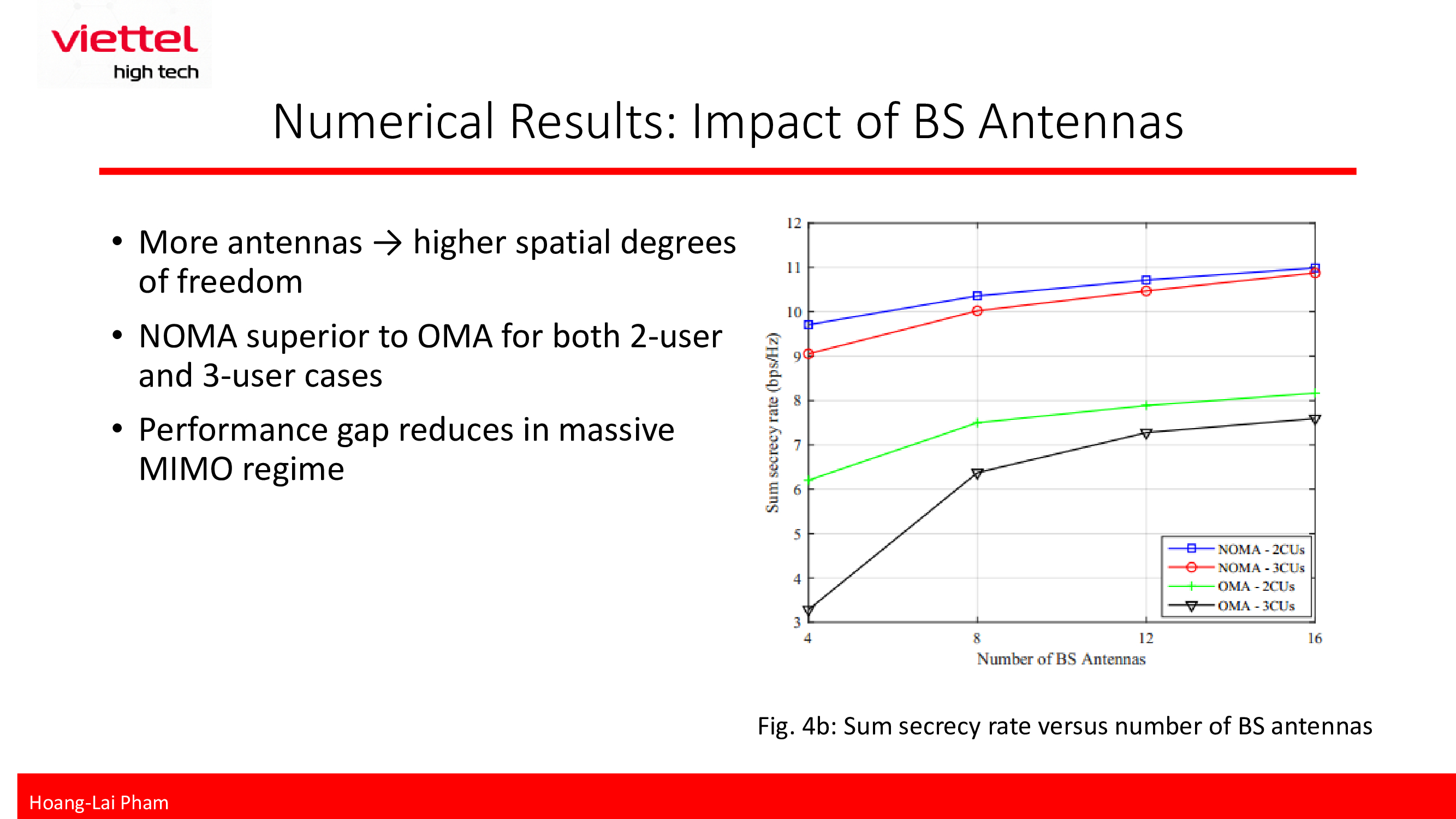 |
Numerical Results: Impact of BS Antennas
“This figure shows the impact of the number of base station antennas.
More antennas provide higher spatial degrees of freedom, resulting in improved secrecy performance.
NOMA outperforms OMA for both two-user and three-user cases, although the performance gap decreases in the massive MIMO regime.” |
| ICACT20260220 Slide.18
[Big Slide]
|
Chrome Click!! |
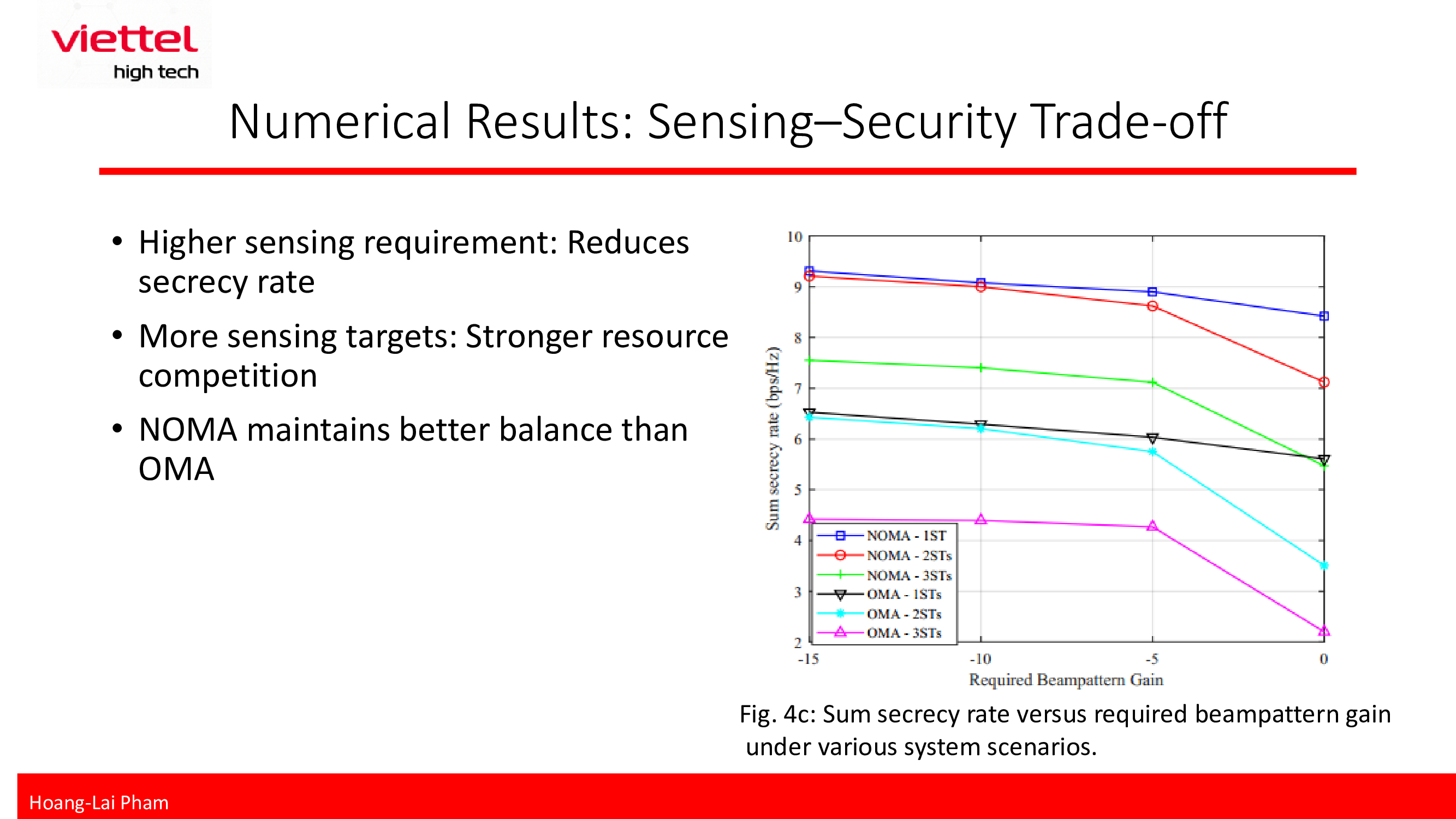 |
Numerical Results: Sensing–Security Trade-off
“This slide illustrates the trade-off between sensing and security.
As the required sensing beampattern gain increases, the achievable secrecy rate decreases.
When more sensing targets are present, resource competition becomes stronger.
Nevertheless, NOMA maintains a better balance between sensing and security compared to OMA.” |
| ICACT20260220 Slide.19
[Big Slide]
|
Chrome Click!! |
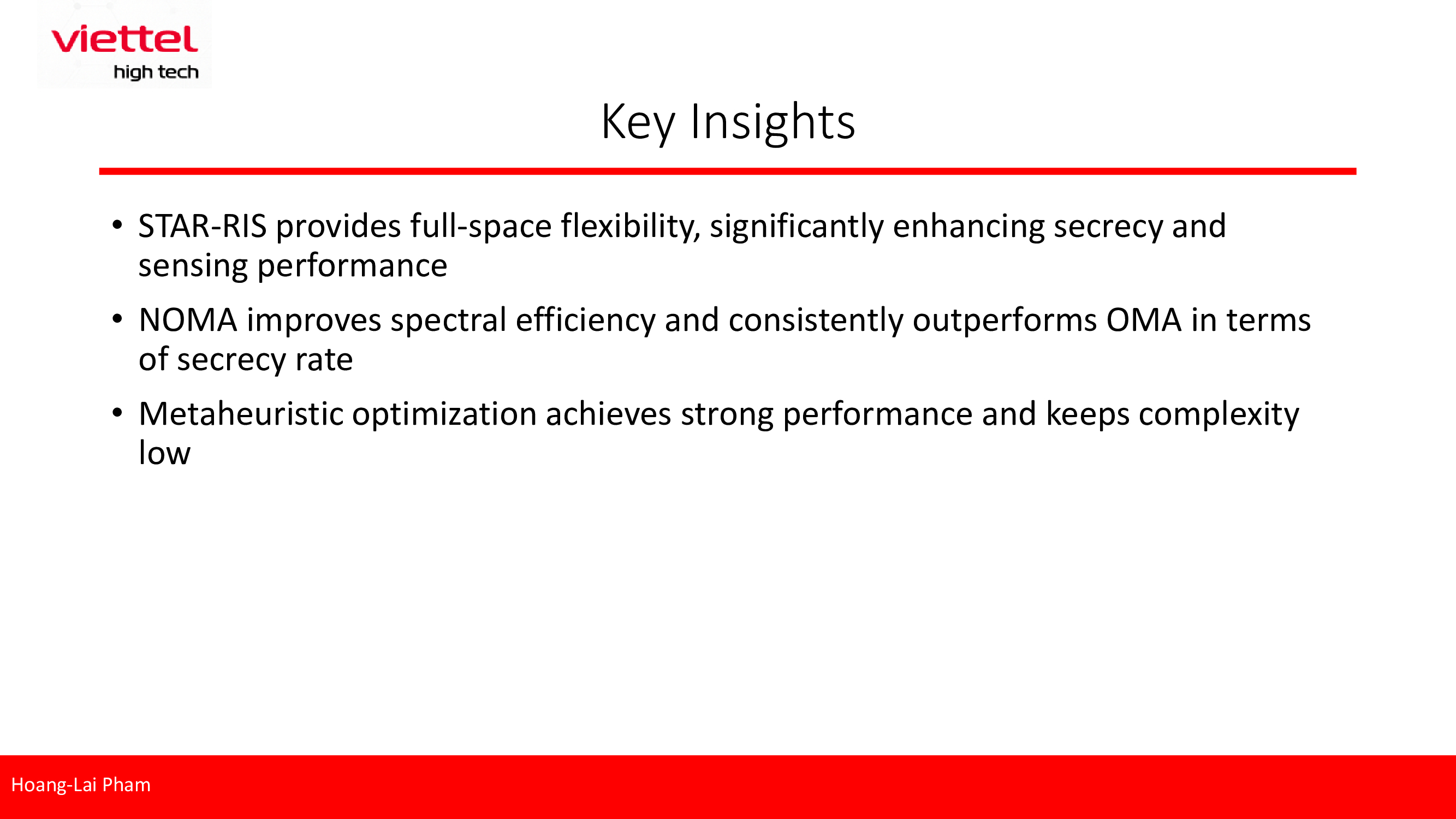 |
Key Insights
“From the numerical results, several important insights can be observed.
First, STAR-RIS provides full-space flexibility through simultaneous transmission and reflection, which significantly enhances both secrecy and sensing performance compared to conventional RIS architectures.
Second, NOMA consistently outperforms OMA in terms of secrecy rate, thanks to its higher spectral efficiency and more effective use of power-domain multiplexing.
Finally, the metaheuristic optimization approach achieves strong performance while keeping the computational complexity low, demonstrating that near-optimal secrecy gains can be obtained without relying on heavy convex optimization techniques.” |
| ICACT20260220 Slide.20
[Big Slide]
|
Chrome Click!! |
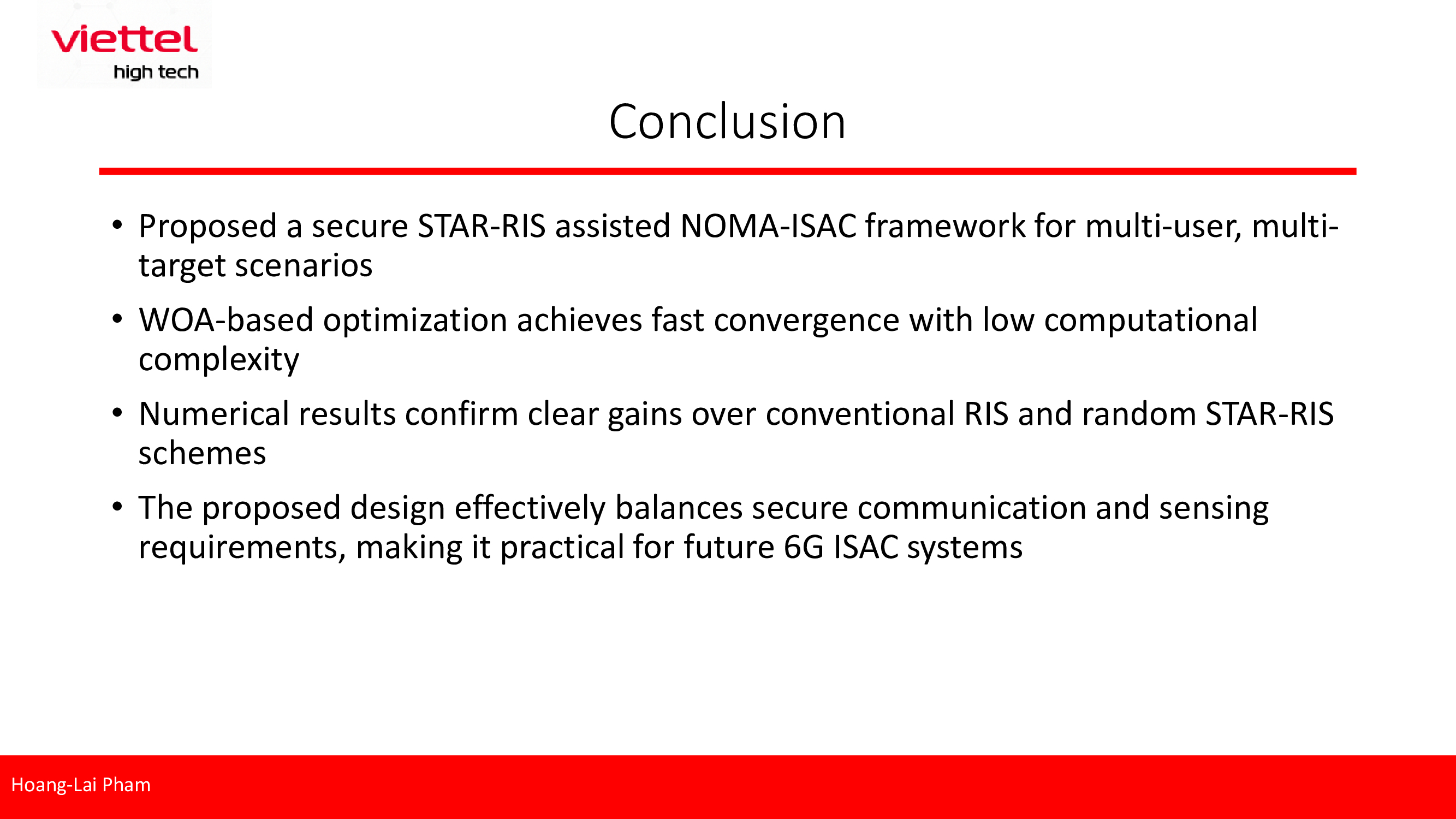 |
Conclusion
“In this paper, we proposed a secure STAR-RIS assisted NOMA-ISAC framework for multi-user and multi-target scenarios.
By jointly optimizing base station beamforming, artificial noise, and STAR-RIS coefficients, the proposed design effectively enhances physical-layer security while satisfying sensing requirements.
To handle the resulting non-convex problem, a WOA-based metaheuristic optimization method was adopted, achieving fast convergence with low computational complexity.
Simulation results confirm clear secrecy performance gains over conventional RIS and random STAR-RIS schemes.
Overall, the proposed framework provides a practical and scalable solution for secure ISAC systems in future 6G networks.” |
| ICACT20260220 Slide.21
[Big Slide]
|
Chrome Click!! |
 |
Thank You
“Thank you very much for your attention.
I am happy to take any questions.” |















