 ICACT20260223 Slide.01
[Big Slide] |
Chrome  Click!! |
 |
Good morning/afternoon, distinguished chairs, respected researchers, and ladies and gentlemen.
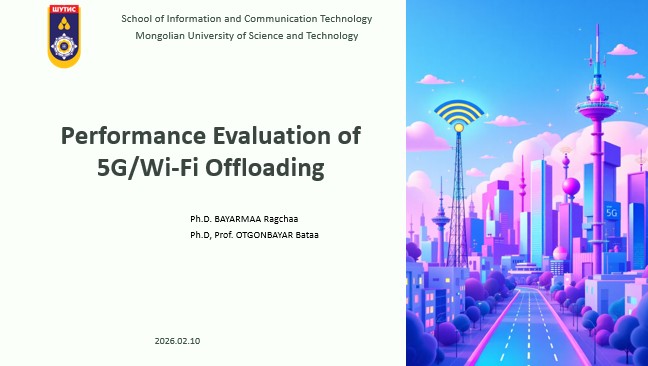
My name is Bayarmaa Ragchaa, and I am pleased to present our research entitled “Performance Evaluation of 5G/Wi-Fi Offloading Mechanisms in High-Traffic Urban Environments.”
This study focuses on evaluating how 5G and Wi-Fi offloading mechanisms perform under dense urban traffic conditions, with particular attention to network efficiency, quality of service, and user experience.
|
| ICACT20260223 Slide.02
[Big Slide]
|
Chrome Click!! |
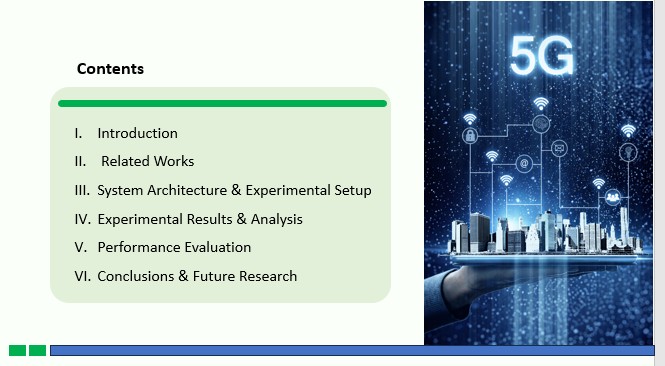 |
This presentation consists of six main parts.
It begins with an introduction, followed by a review of related works.
Next, the system architecture and experimental setup are presented.
Then, experimental results and comparative analysis are discussed.
After that, performance evaluation is provided.
Finally, the presentation concludes with future research directions.
|
| ICACT20260223 Slide.03
[Big Slide]
|
Chrome Click!! |
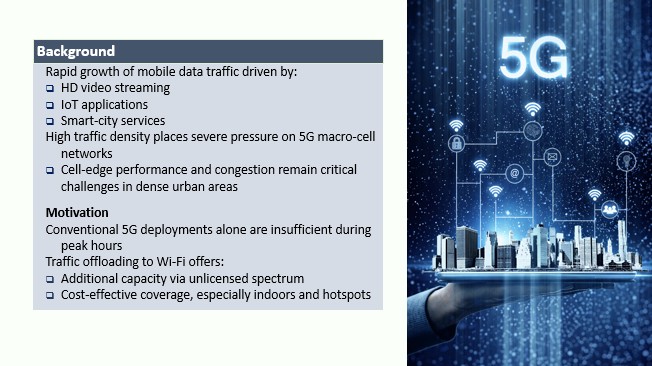 |
Mobile data traffic is rapidly increasing due to HD video streaming, IoT applications, and smart-city services, placing significant pressure on 5G macro-cell networks, especially in dense urban areas. As a result, offloading traffic to Wi-Fi during peak hours provides additional capacity through unlicensed spectrum and enables cost-effective coverage, particularly for indoor environments and hotspots.
|
| ICACT20260223 Slide.04
[Big Slide]
|
Chrome Click!! |
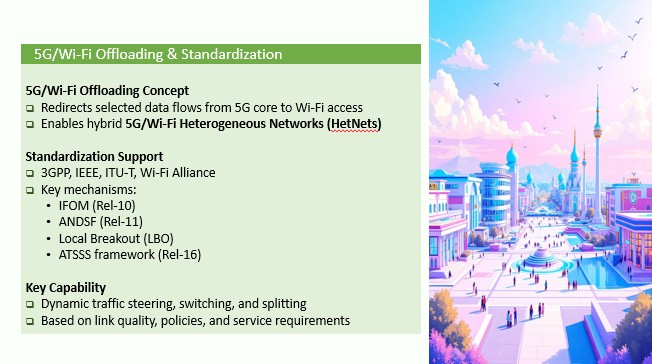 |
5G/Wi-Fi offloading redirects selected data traffic from the 5G core to Wi-Fi, enabling hybrid heterogeneous networks that improve overall capacity and user experience. Supported by standards from 3GPP, IEEE, and the Wi-Fi Alliance, mechanisms such as IFOM, ANDSF, and ATSSS allow dynamic traffic steering and splitting based on link quality, policies, and service requirements.
|
| ICACT20260223 Slide.05
[Big Slide]
|
Chrome Click!! |
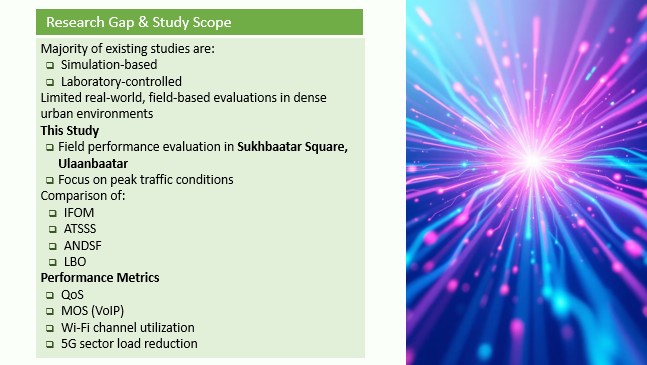 |
Most existing studies rely on simulations or controlled laboratory experiments, with limited real-world field evaluations in dense urban environments. This study addresses that gap by conducting field-based performance measurements at Sukhbaatar Square in Ulaanbaatar during peak traffic hours, comparing IFOM, ATSSS, ANDSF, and LBO using QoS, VoIP MOS, Wi-Fi channel utilization, and 5G sector load reduction metrics.
|
| ICACT20260223 Slide.06
[Big Slide]
|
Chrome Click!! |
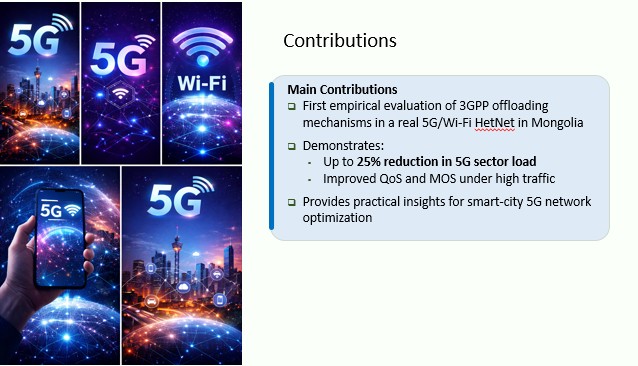 |
This study presents the first real-world evaluation of 3GPP 5G/Wi-Fi offloading mechanisms in Mongolia, demonstrating up to a 25% reduction in 5G sector load while improving QoS and MOS under high-traffic conditions.
|
| ICACT20260223 Slide.07
[Big Slide]
|
Chrome Click!! |
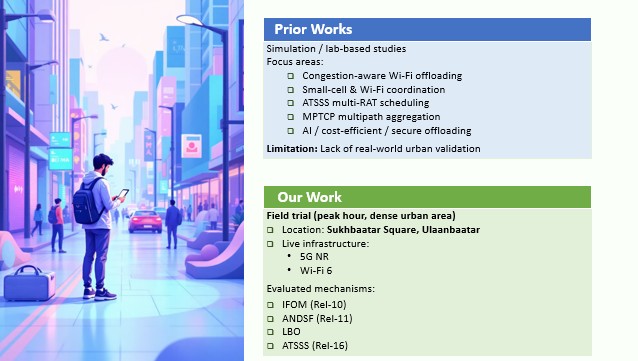 |
Prior studies on 5G/Wi-Fi offloading are mainly simulation- or lab-based, focusing on congestion-aware strategies, small-cell coordination, and advanced multipath techniques, but they lack real-world urban validation. In contrast, our work conducts peak-hour field trials at Sukhbaatar Square in Ulaanbaatar using live 5G NR and Wi-Fi 6 infrastructure to evaluate IFOM, ANDSF, LBO, and ATSSS mechanisms.
|
| ICACT20260223 Slide.08
[Big Slide]
|
Chrome Click!! |
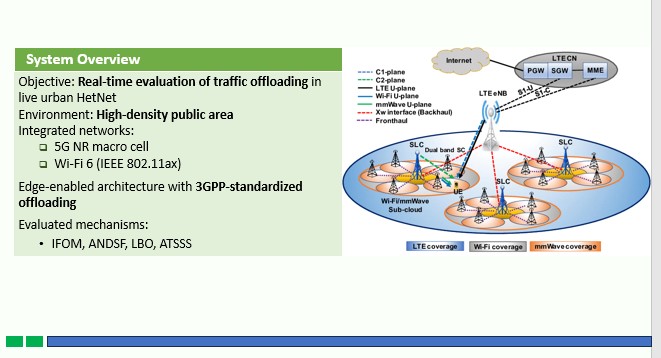 |
This system evaluates real-time 5G/Wi-Fi traffic offloading in a high-density urban HetNet by integrating 5G NR macro cells and Wi-Fi 6 with edge-enabled, 3GPP-standardized mechanisms including IFOM, ANDSF, LBO, and ATSSS.
|
| ICACT20260223 Slide.09
[Big Slide]
|
Chrome Click!! |
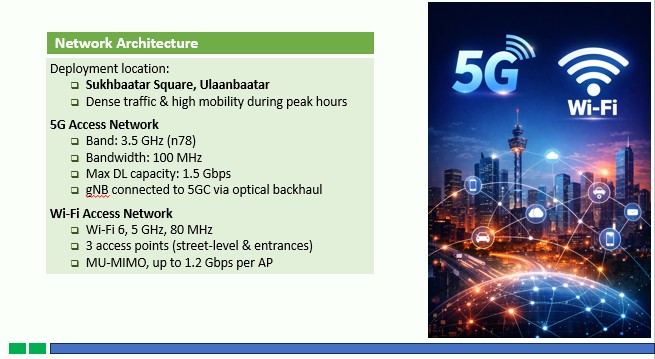 |
The network was deployed at Sukhbaatar Square in Ulaanbaatar, a dense urban area with high traffic demand and user mobility during peak hours. It integrates a 5G NR access network operating at 3.5 GHz with 100 MHz bandwidth and a Wi-Fi 6 access network using multiple MU-MIMO access points to provide high-capacity connectivity.
|
| ICACT20260223 Slide.10
[Big Slide]
|
Chrome Click!! |
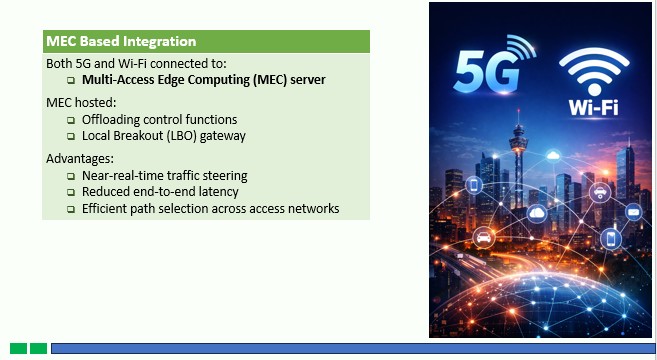 |
Both 5G and Wi-Fi access networks are connected to a Multi-Access Edge Computing (MEC) server that hosts offloading control functions and the Local Breakout gateway. This edge-based integration enables near real-time traffic steering, reduces end-to-end latency, and ensures efficient path selection across heterogeneous access networks.
|
| ICACT20260223 Slide.11
[Big Slide]
|
Chrome Click!! |
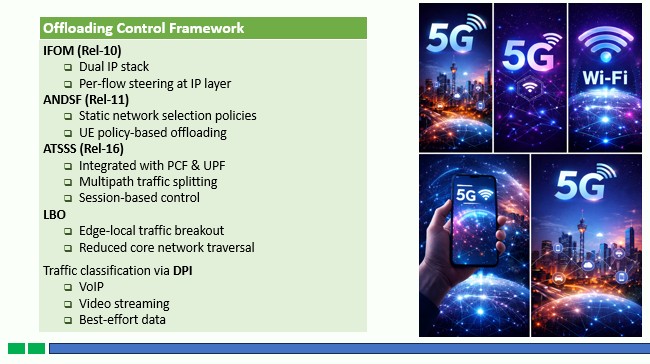 |
Building on the MEC-based integration shown earlier, this control framework uses standardized 3GPP mechanisms to intelligently steer and split different types of traffic—such as voice, video, and best-effort data—between 5G and Wi-Fi in real time.
|
| ICACT20260223 Slide.12
[Big Slide]
|
Chrome Click!! |
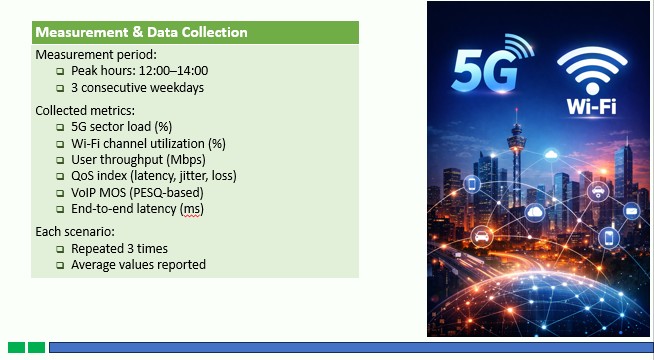 |
Using this offloading control framework, we collected real-world performance data during peak hours from 12:00 to 14:00 over three consecutive weekdays. We measured key indicators such as 5G sector load, Wi-Fi utilization, user throughput, QoS, VoIP MOS, and end-to-end latency, repeating each scenario three times and reporting average results.
|
| ICACT20260223 Slide.13
[Big Slide]
|
Chrome Click!! |
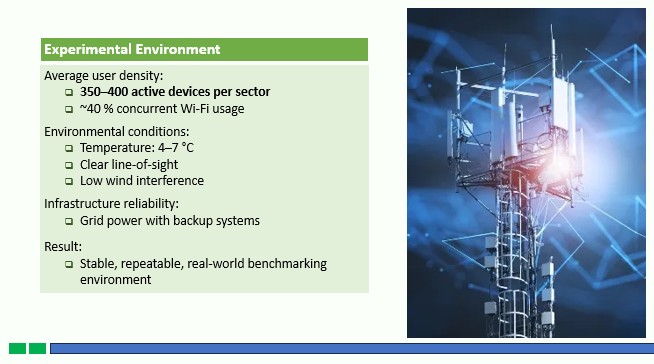 |
During the measurements, the environment reflected real peak-hour conditions, with around 350 to 400 active users per sector and about 40 percent of them simultaneously using Wi-Fi. The tests were conducted under stable environmental and infrastructure conditions, ensuring reliable and repeatable real-world performance benchmarking.
|
| ICACT20260223 Slide.14
[Big Slide]
|
Chrome Click!! |
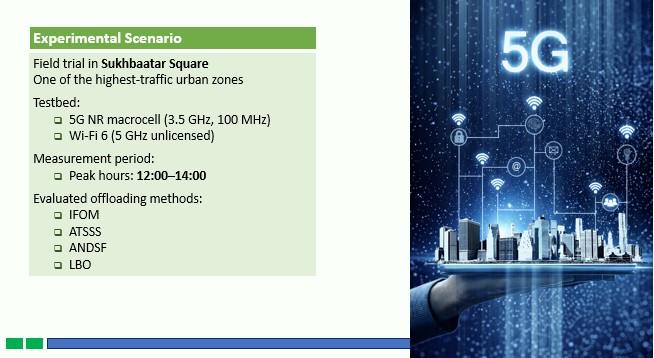 |
Based on this stable experimental environment, we conducted field trials at Sukhbaatar Square, one of the busiest urban areas, using a 5G NR macrocell at 3.5 GHz and a Wi-Fi 6 network in the unlicensed band. All measurements were performed during peak hours from 12:00 to 14:00, where we evaluated IFOM, ATSSS, ANDSF, and LBO under the same traffic conditions.
|
| ICACT20260223 Slide.15
[Big Slide]
|
Chrome Click!! |
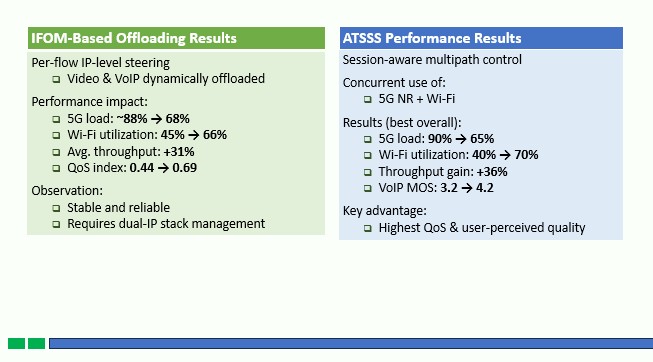 |
With IFOM, video and VoIP traffic were dynamically offloaded at the flow level, reducing 5G load and improving throughput and QoS, though it requires dual-IP stack management. ATSSS further enhanced performance by using 5G and Wi-Fi simultaneously at the session level, achieving the largest load reduction, higher Wi-Fi utilization, and the best user-perceived quality in terms of QoS and VoIP MOS.
|
| ICACT20260223 Slide.16
[Big Slide]
|
Chrome Click!! |
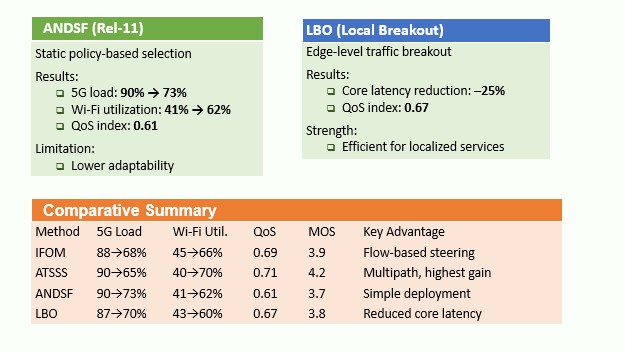 |
ANDSF applies static, policy-based offloading, which reduces 5G load and improves Wi-Fi usage, but its adaptability is limited under dynamic traffic conditions. LBO focuses on edge-level traffic breakout, significantly reducing core network latency and making it well suited for localized services. Overall, the comparison shows that while IFOM and ATSSS deliver the strongest performance gains, ATSSS provides the best balance of load reduction, QoS, and user-perceived quality.
|
| ICACT20260223 Slide.17
[Big Slide]
|
Chrome Click!! |
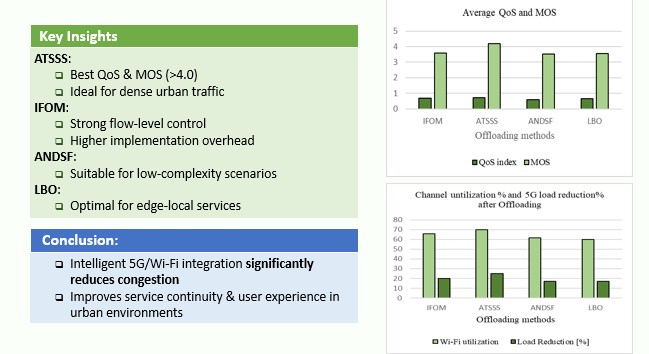 |
The results show that ATSSS delivers the best overall performance, achieving the highest QoS and MOS and making it ideal for dense urban traffic conditions. IFOM provides strong flow-level control but comes with higher implementation overhead, while ANDSF and LBO remain effective options for simpler or edge-localized use cases. Overall, intelligent 5G/Wi-Fi integration significantly reduces network congestion and improves service continuity and user experience in urban environments.
|
| ICACT20260223 Slide.18
[Big Slide]
|
Chrome Click!! |
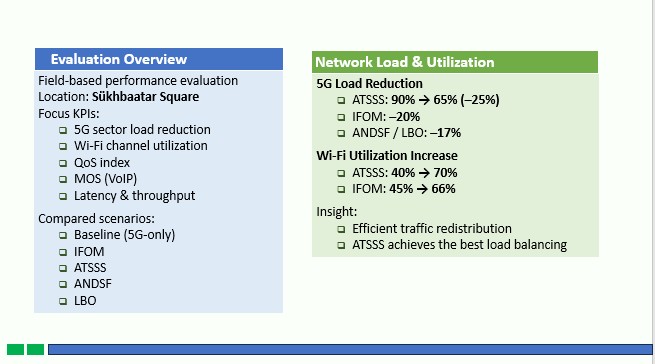 |
This slide summarizes the field-based evaluation conducted at Sukhbaatar Square, focusing on key performance indicators such as 5G sector load, Wi-Fi utilization, QoS, MOS, latency, and throughput. Compared with the 5G-only baseline, all offloading methods reduce network load, with ATSSS achieving the largest 5G load reduction and the highest increase in Wi-Fi utilization. These results highlight efficient traffic redistribution across access networks, where ATSSS provides the best overall load balancing performance.
|
| ICACT20260223 Slide.19
[Big Slide]
|
Chrome Click!! |
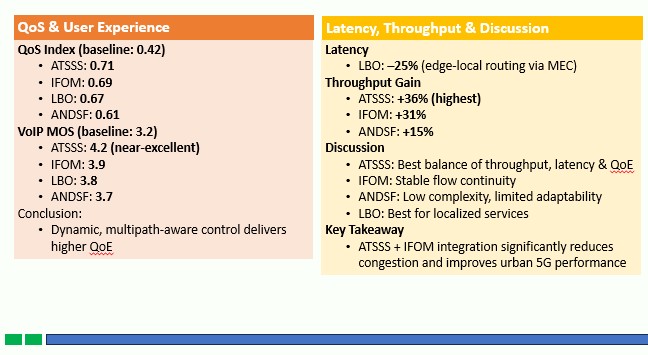 |
In terms of user experience, ATSSS achieves the highest QoS and near-excellent VoIP MOS, while IFOM and LBO also show solid improvements compared to the baseline. Overall, ATSSS offers the best balance of latency reduction, throughput gain, and quality of experience, demonstrating that intelligent 5G/Wi-Fi integration can significantly reduce congestion and enhance urban network performance.
|
| ICACT20260223 Slide.20
[Big Slide]
|
Chrome Click!! |
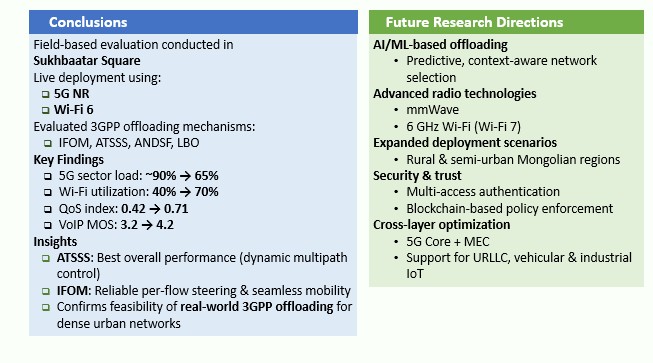 |
In conclusion, we tested 5G/Wi-Fi offloading in a real urban environment at Sukhbaatar Square using live 5G NR and Wi-Fi 6 networks. The results clearly show that ATSSS performs the best, significantly reducing 5G load while improving Wi-Fi usage, QoS, and voice quality. In future work, we plan to explore AI-based offloading, newer radio technologies, and wider deployments to further improve 5G performance in urban and regional areas.
|
| ICACT20260223 Slide.21
[Big Slide]
|
Chrome Click!! |
 |
Thank you for your attention, and I’ll be happy to take any questions.
|















