Now 5095 visitors
Today:0 Yesterday:0
Total: 147110
212S 50P 4R
2026-10-20, Week 43 |
| Member Login |
| TACT Journal Homepage |
| Call for Paper |
| Committee |
| Find My Paper |
| Author Homepage |
| Statistics & History |
| Welcome Message |
| Paper Procedure |
| FAQ |
| Paper Archives |
| Outstanding Papers |
| Author Homepage |
| - Paper Procedure |
| - Journal Procedure |
| - Presentation Tips |
|
| Program & Proceedings |
| Program with Papers |
| Plenary Session |
| Tutorial Session |
|
| Presentation Platform |
| Hotel & Travel Info |
| About Korea |
| Accommodation |
| Transportation |
| VISA |
| Other Infomation |
|
| Photo Gallery |
| Scheduler Login |
| Seminar |
| Archives Login |
|
| Sponsors |

|

|

|

|

|

|

|

|

|

|
|
|
|
|
 ICACT20260275 Slide.01
[Big Slide]
[YouTube] |
Chrome  Click!! |
 |
Hello everybody. My name is Nguyen Thi Yen, Im a lecturer at the Banking Academy of Vietnam and also a graduate student at the Posts and Telecommunications Institute of Technology. Today, I am honored to present our research on "HiSeR: Hybrid Item Encoding for Transformer-based Sequential Recommendation." This research was conducted in collaboration with my Professor Tu Minh Phuong. |
| ICACT20260275 Slide.02
[Big Slide]
|
Chrome Click!! |
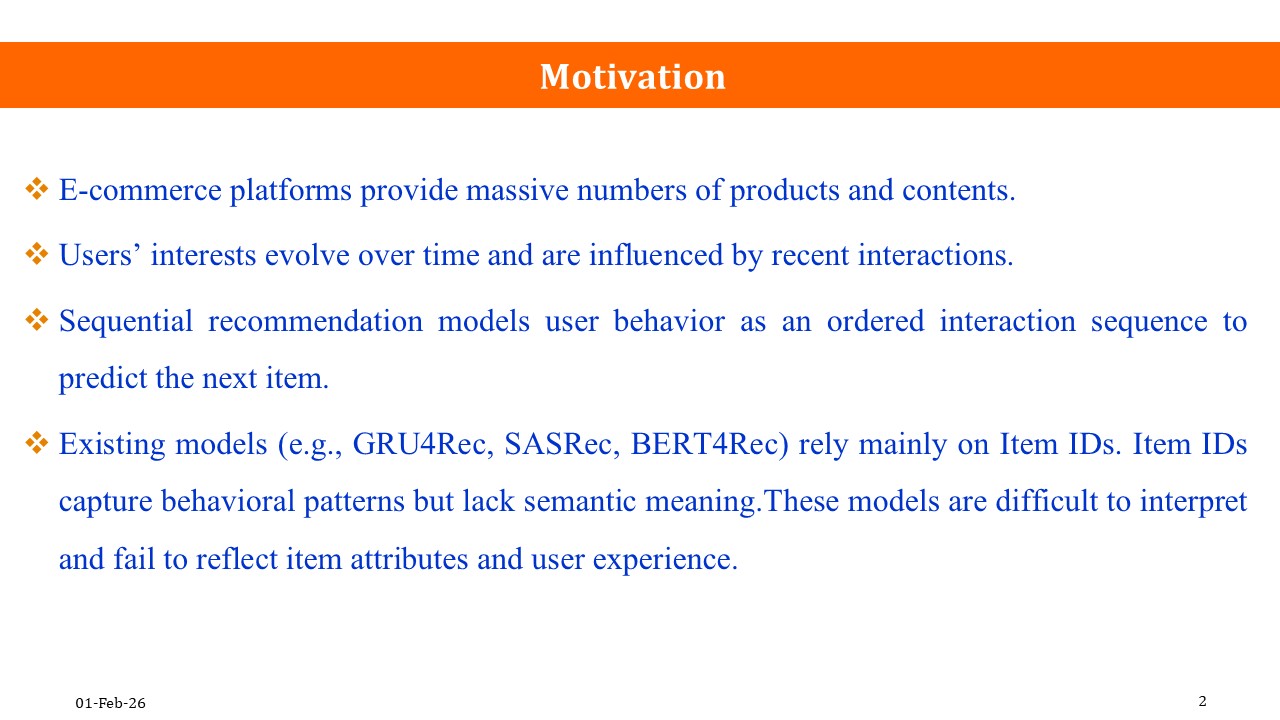 |
With the rapid growth of e-commerce platforms, users are exposed to an overwhelming number of products and contents.
In this context, recommender systems play a crucial role in helping users quickly find relevant items based on their historical interactions, while also improving sales and customer retention for businesses.
User preferences are not static; instead, they are strongly influenced by recent interactions. To capture this dynamic nature, sequential recommendation models represent user behavior as an ordered sequence of item interactions and aim to predict the next item a user is likely to interact with.
Existing sequential models such as GRU4Rec, SASRec, and BERT4Rec have shown strong performance by modeling short-term and long-term dependencies. However, these approaches rely mainly on item IDs. While item IDs are effective for capturing behavioral patterns, they lack semantic meaning, making the models difficult to interpret and unable to reflect item attributes or user experience expressed in reviews.
|
| ICACT20260275 Slide.03
[Big Slide]
|
Chrome Click!! |
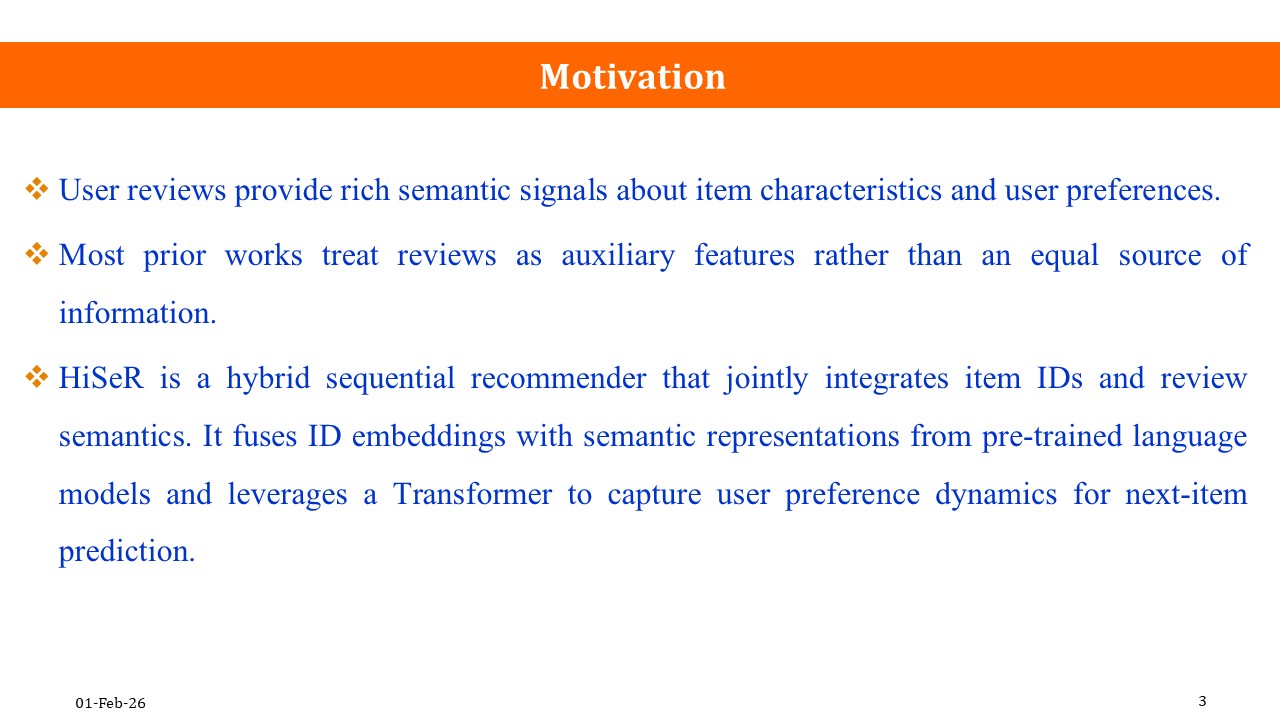 |
In contrast to item IDs, user reviews contain rich semantic information about item characteristics and user experiences.�Reviews explicitly describe aspects such as functionality, quality, and user satisfaction, which are crucial for understanding user preferences but cannot be captured by item identifiers alone.
Although several prior studies have explored incorporating review text into sequential recommendation, most of them treat reviews as auxiliary features rather than as an equal source of information. As a result, the joint modeling of behavioral signals and semantic signals within a unified sequential framework remains underexplored.
To address this gap, we propose HiSeR, a hybrid sequential recommender that jointly integrates item IDs and review semantics. HiSeR fuses ID embeddings with semantic representations extracted from pre-trained language models, and leverages a Transformer-based sequential encoder to capture user preference dynamics for next-item prediction.
|
| ICACT20260275 Slide.04
[Big Slide]
|
Chrome Click!! |
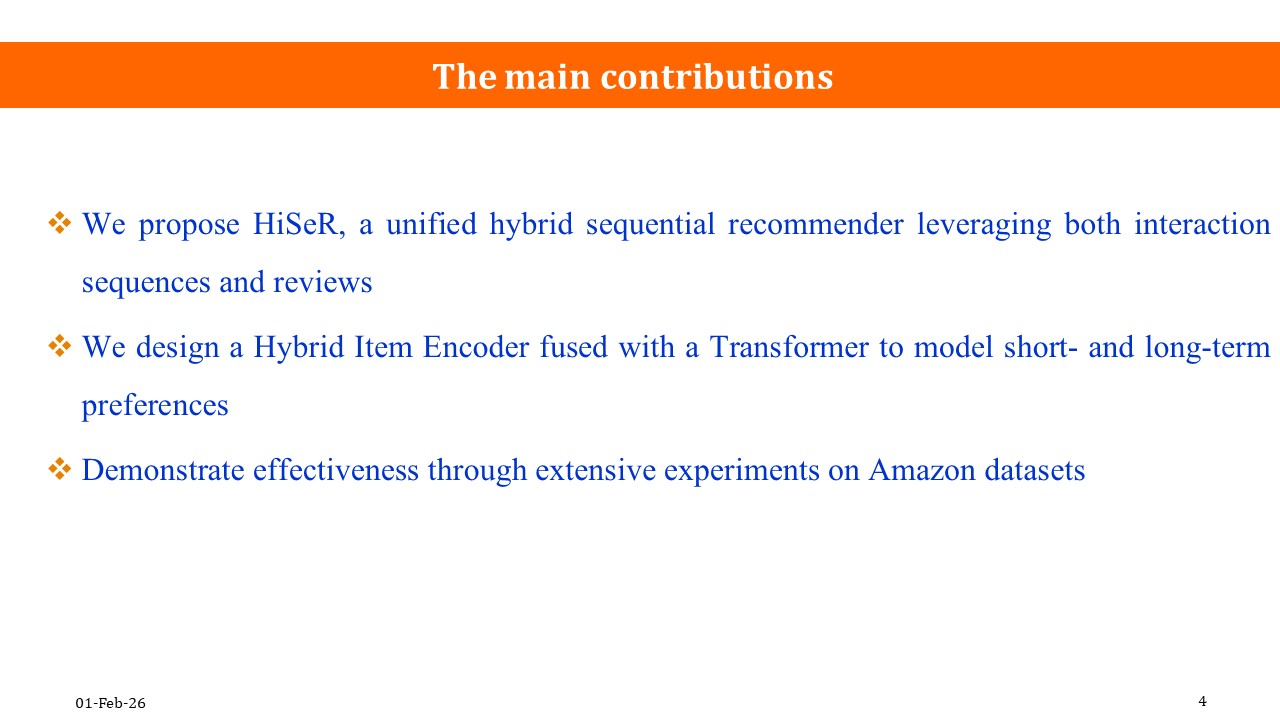 |
Based on these observations, in this paper We introduce HiSeR, a unified hybrid sequential recommendation framework that jointly leverages user interaction sequences and textual reviews within a single model.
• We design a Hybrid Item Encoder that fuses item ID with semantic representations from pre-trained language models, and integrate these enriched item embeddings into a Transformer-based sequential encoder to effectively capture both short-term transitions and global contextual dependencies in user preference dynamics.
• We conducted extensive experiments on two Amazon Re view datasets to validate the effectiveness and robustness of HiSeR, showing consistent performance improvements in multiple evaluation metrics.
|
| ICACT20260275 Slide.05
[Big Slide]
|
Chrome Click!! |
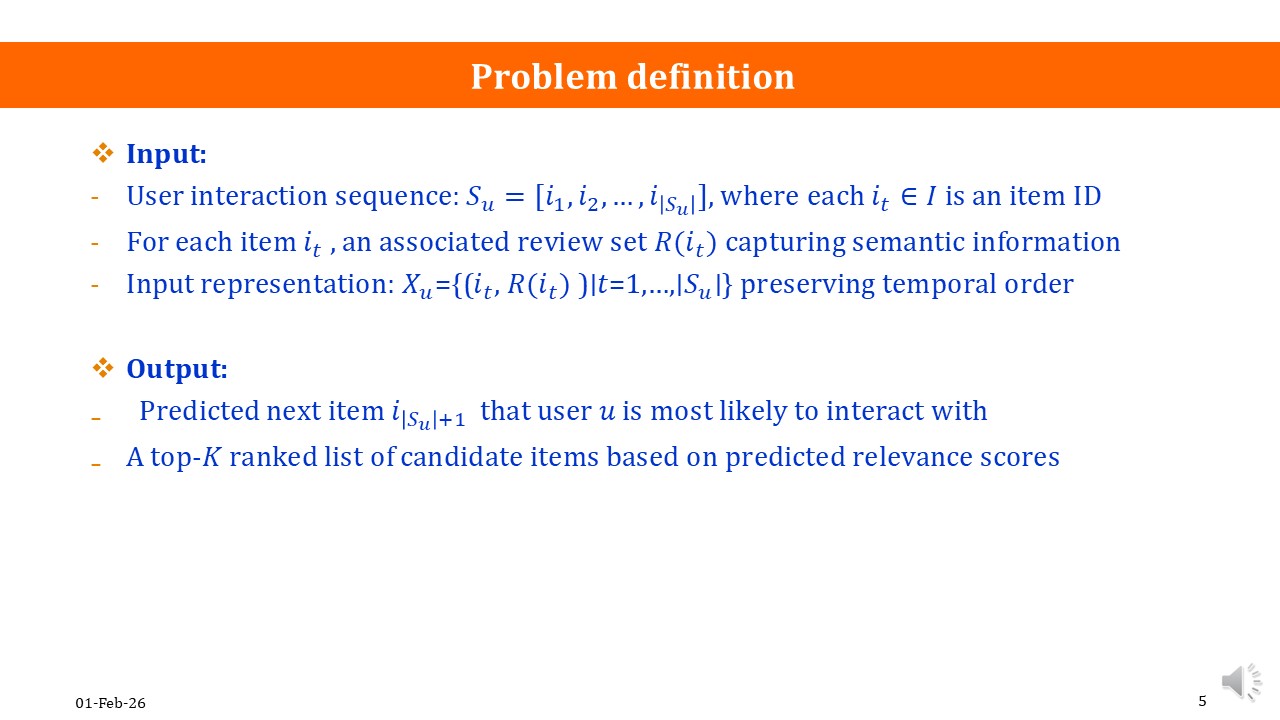 |
In this work, we consider a sequential recommendation setting with a user set U and an item set III.�Each user u∈U is associated with a chronological interaction sequence Su=[i1,i2,…,i∣Su∣], where each iti_tit denotes an item that the user has interacted with, such as viewing, purchasing, or reviewing. This sequence captures the temporal evolution of user preferences.
Unlike ID-only approaches, our input not only includes item identifiers but also semantic information from textual reviews. For each item it, we associate a review set R(it), which contains user-generated reviews describing item characteristics and user experiences.
Therefore, the input for user uuu is represented as an ordered sequence of item–review pairs, preserving temporal dependencies. The goal is to predict the next item i∣Su∣+1 that the user is most likely to interact with, and to rank candidate items to produce a top-K recommendation list based on predicted relevance scores.
|
| ICACT20260275 Slide.06
[Big Slide]
|
Chrome Click!! |
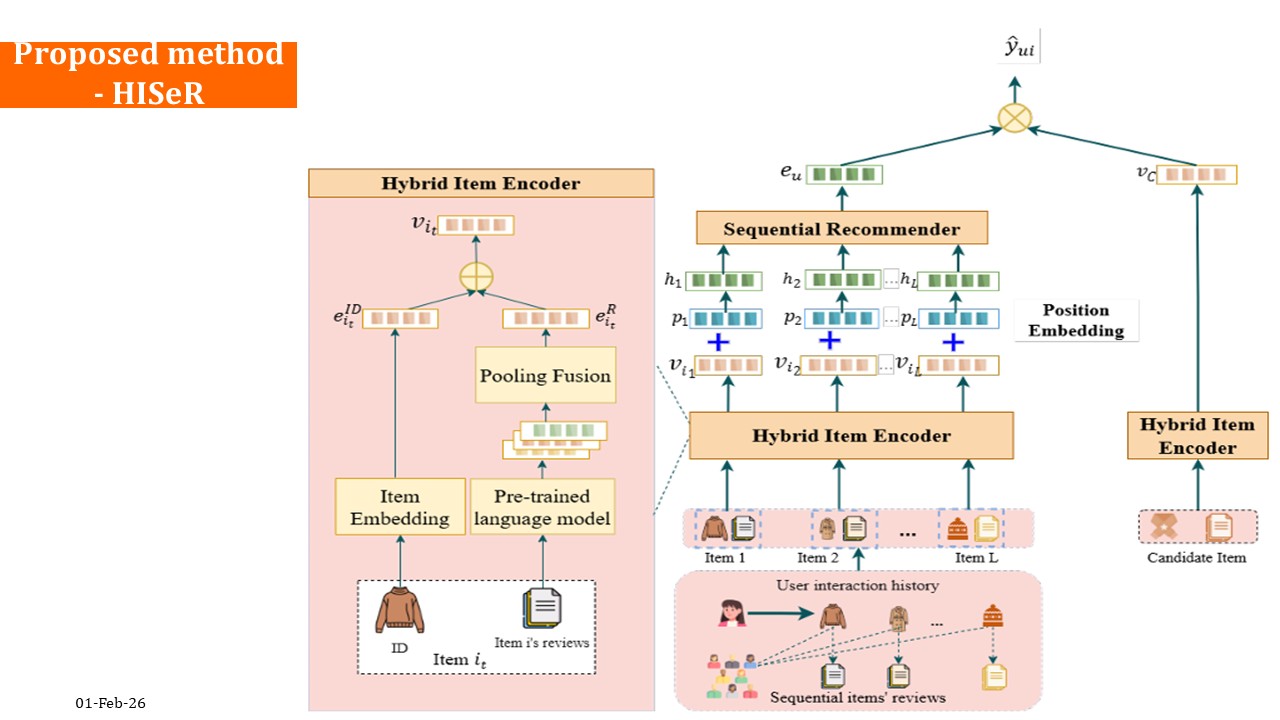 |
This is the overall architecture of the proposed HiSeR (Hybrid Item Encoding for Transformer-based Sequen tial Recommendation) model. The main objective of HiSeR is to jointly integrate two complementary types of information: behavioral signals from sequential item IDs interactions and semantic signals extracted from textual reviews. By combining these modalities, the model can more accurately capture the temporal evolution of user preferences. Each item in a user’s interaction sequence is first encoded by the Hybrid Item Encoder (HIE), which serves as the core component of HiSeR. The HIE consists of two parallel branches: (1) an ID-based branch, which transforms the item identifier into a dense embedding vector that reflects collaborative behavioral patterns; and (2) a review-based branch, which encodes textual reviews associated with the item using a pre-trained language model to extract semantic representations. The two embeddings are then fused to form a unified hybrid item representation that preserves both collaborative and semantic characteristics. Next, positional embeddings are added to these hybrid item representations to encode the order and temporal relationships among user interactions. The ordered sequence is then fed into a Transformer-based Sequential Encoder, which captures dependencies between items and learns a dynamic user rep representation that reflects the user’s current intent within the interaction context. For each candidate item, HiSeR also applies the same Hybrid Item Encoder to obtain its corresponding representation. The model then computes the similarity between the user representation and each candidate item embedding to estimate the relevance score. Items with the highest scores are returned as recommendations.
|
| ICACT20260275 Slide.07
[Big Slide]
|
Chrome Click!! |
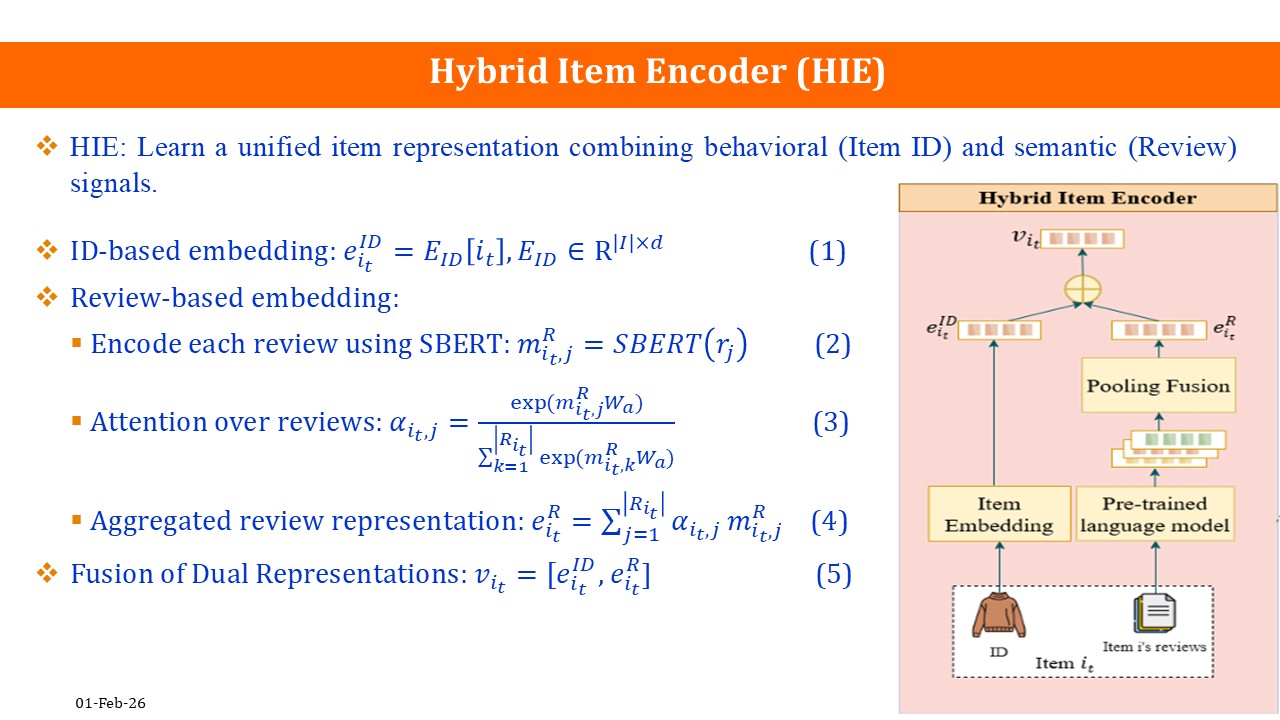 |
In this slide, I introduce the Hybrid Item Encoder, or HIE, which is the core component of the HiSeR model.” The goal of HIE is to learn one unified representation for each item by combining two complementary sources of information: behavioral signals from item IDs and semantic signals from user reviews.
First, ID-based representation. As shown in Equation (1), each item ID is mapped to a learnable embedding vector from the item embedding matrix. This representation captures collaborative behavioral patterns learned from user–item interaction histories.
Second, review-based representation. Each item is associated with multiple user reviews. As described in Equation (2), each review is encoded into a semantic vector using Sentence-BERT.
However, not all reviews are equally informative. Some reviews are generic, while others describe important product characteristics. To address this, HIE applies an attention mechanism over reviews. In Equation (3), an attention weight is assigned to each review to measure its importance.
Then, as shown in Equation (4), the final review-based representation of the item is computed as a weighted sum of all review embeddings. This allows the model to emphasize semantically meaningful reviews and reduce the impact of less relevant ones.
Finally, fusion of dual representations.�As shown in Equation (5), the ID-based embedding and the review-based embedding are concatenated to form the final hybrid item representation. This hybrid embedding jointly preserves collaborative knowledge from interactions and semantic knowledge from reviews, and is used as the item representation for subsequent sequential modeling.
|
| ICACT20260275 Slide.08
[Big Slide]
|
Chrome Click!! |
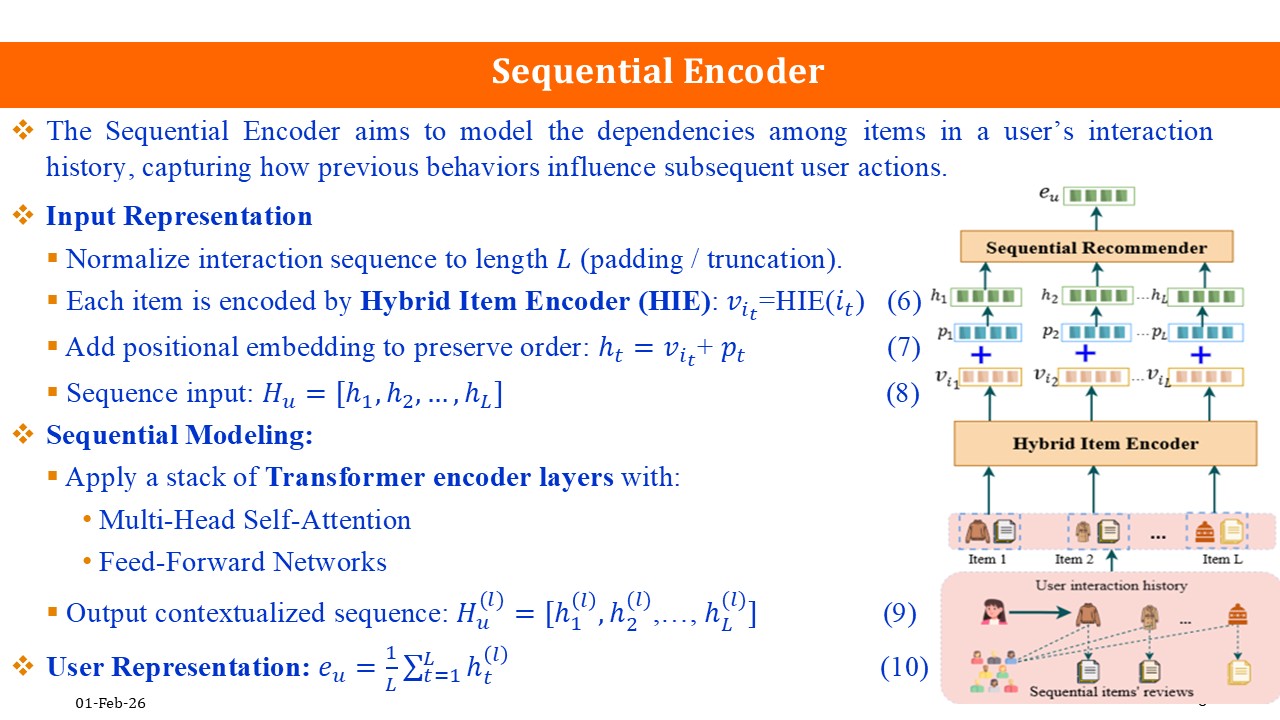 |
The goal of the Sequential Encoder is to capture how previous user behaviors influence subsequent actions by modeling item dependencies within the interaction sequence.
Because users have interaction histories of different lengths, all sequences are normalized to a fixed length L. Shorter sequences are padded at the beginning, while longer sequences keep only the most recent L items. Next, each item in the sequence is represented using the Hybrid Item Encoder. As shown in Equation (6), this step produces a unified embedding that combines ID-based and review-based information. Since the Transformer cannot model order by itself, positional information is explicitly added.�In Equation (7), a positional embedding is added to each item representation to form a position-aware vector. Finally, as defined in Equation (8), these vectors are stacked to form the input sequence for the sequential encoder.
With the input sequence prepared, we now model sequential dependencies. HiSeR adopts a Transformer-based encoder to capture user sequential behavior. The input sequence is processed through a stack of Transformer encoder layers. Each layer consists of: Multi-Head Self-Attention, which learns dependencies among all items in the sequence, and
Feed-Forward Networks, which transform the extracted contextual features. Residual connections and layer normalization are applied to stabilize training and maintain information flow across layers. After passing through multiple layers, the model outputs contextualized item representations, as shown in Equation (9). Each representation reflects both the behavior at a specific position and the influence of the entire interaction history. �Finally, we summarize the encoded sequence into a single user representation. As shown in Equation (10), the user embedding is obtained by averaging all contextualized vectors in the sequence. This mean-pooling strategy leverages the Transformer’s ability to encode global information at every position, resulting in a stable representation that reflects the user’s overall interaction history.
|
| ICACT20260275 Slide.09
[Big Slide]
|
Chrome Click!! |
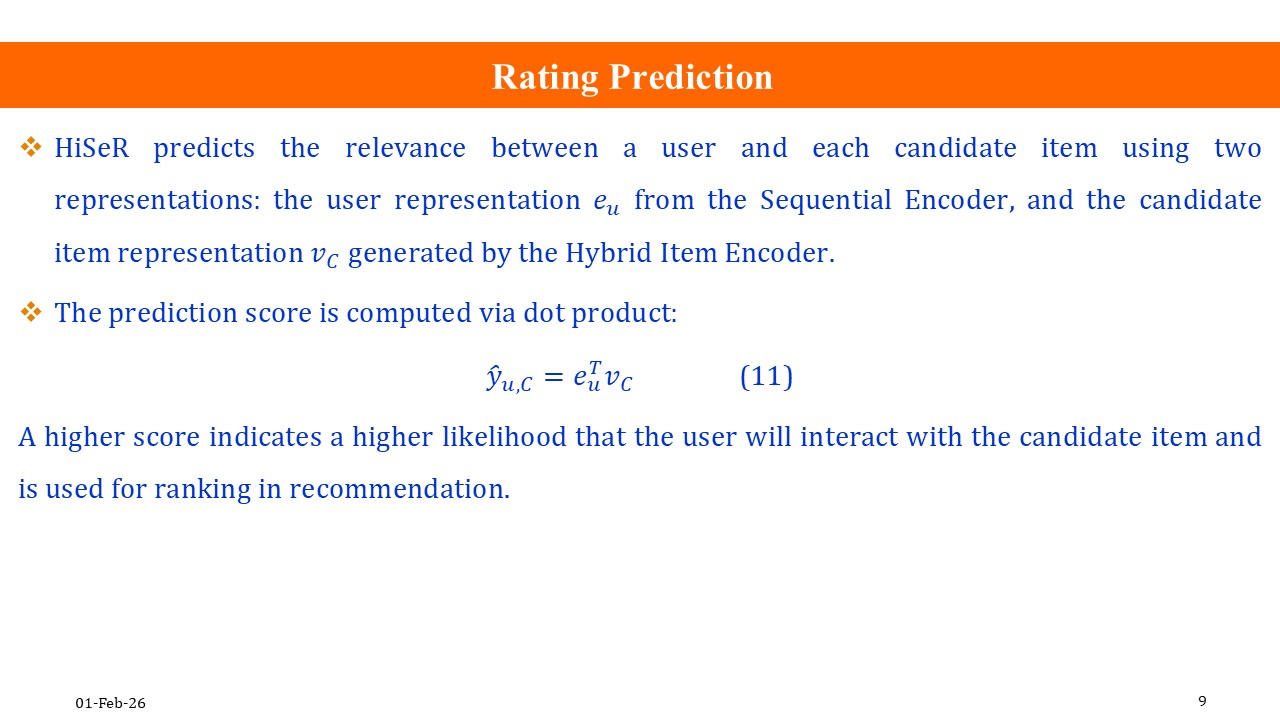 |
After modeling user behavior and item representations, we now move to the Rating Prediction step. At this stage, HiSeR predicts the relevance between a user and each candidate item. To do this, the model combines two representations.
First, we use the user representation, denoted as eue_ueu, which is obtained from the Sequential Encoder and reflects the user’s current preference state. Second, we use the candidate item representation, denoted as vcv_cvc, which is generated by the Hybrid Item Encoder using both the item ID and its associated reviews.
As shown in Equation (11), the prediction score is calculated using the dot product between the user vector and the candidate item vector. This score measures how well the user’s current interests align with the characteristics of the candidate item.
Finally, we use this score for recommendation. A higher prediction score indicates a higher likelihood that the user will interact with the candidate item, and these scores are used to rank items in the recommendation list. |
| ICACT20260275 Slide.10
[Big Slide]
|
Chrome Click!! |
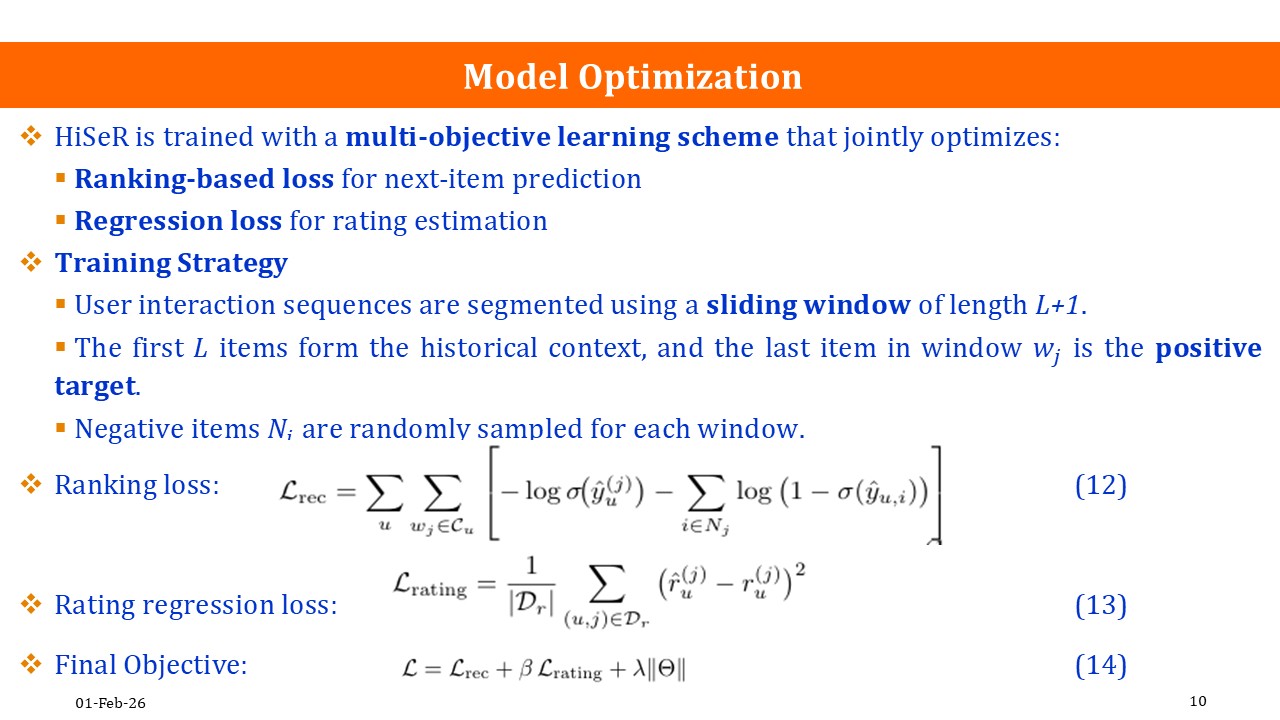 |
HiSeR is trained using a multi-objective learning scheme that jointly optimizes two goals: a ranking-based loss for next-item prediction and a regression loss for rating estimation. This joint optimization allows the model to leverage both implicit sequential behavior and explicit rating signals.
For each user, the interaction sequence is segmented into multiple sliding windows of length L plus one. In each window, the first L items serve as the historical context, while the last item is treated as the positive target. For every window, a set of negative items is randomly sampled to construct training instances.
As shown in Equation (12), the ranking loss encourages the model to assign a higher predicted score to the positive target than to negative items. This loss is defined using the sigmoid function, and it penalizes cases where negative items receive high relevance scores.
In addition to ranking, HiSeR also uses explicit ratings as auxiliary supervision. For each window with an observed rating, the model predicts a rating value, which is compared with the ground-truth rating. As shown in Equation (13), the rating regression loss is computed using the mean squared error over all valid user–item pairs with ratings.
Finally, we combine all objectives into a single loss function. As shown in Equation (14), the final training objective is a weighted sum of the ranking loss and the rating regression loss, together with ℓ2 regularization on the model parameters. The weighting coefficient controls the contribution of the rating prediction task. |
| ICACT20260275 Slide.11
[Big Slide]
|
Chrome Click!! |
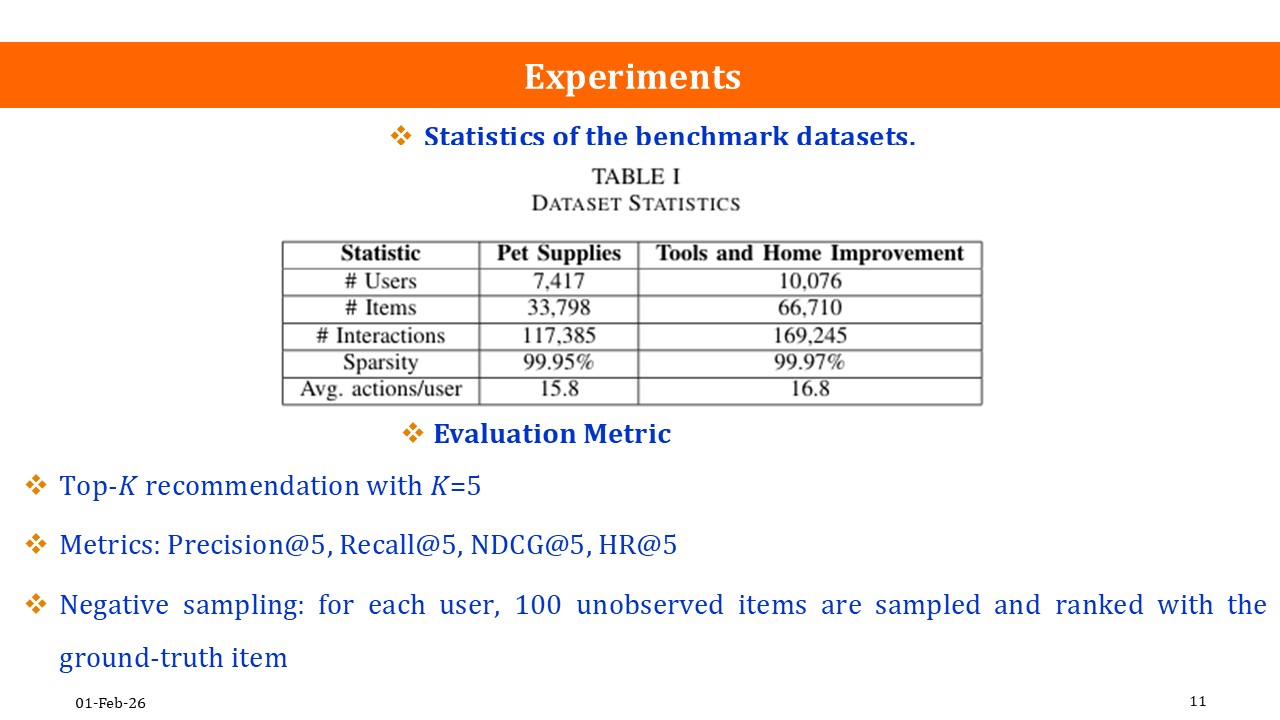 |
We conduct experiments on two Amazon Product Reviews datasets: Pet Supplies and Tools and Home Improvement, which represent two distinct types of consumer behavior. Each dataset contains user IDs, item IDs, timestamps, ratings, and review texts. Users with fewer than ten interactions are filtered out, and interactions are chronologically sorted to form user sequences. The data is split by time, with 70% for training and 30% for testing, preserving temporal order. Table 1 reports the dataset statistics, showing very high sparsity and an average of about 16 interactions per user.
We evaluate performance using Top-K recommendation with K equals 5. Four standard metrics are used: Precision@5, Recall@5, NDCG@5, and Hit Ratio@5, which measure both accuracy and ranking quality of the recommended items.
To reduce computational cost, we follow a standard negative sampling strategy. For each user, 100 unobserved items are randomly sampled as negatives and ranked together with the ground-truth item to compute the evaluation metrics. |
| ICACT20260275 Slide.12
[Big Slide]
|
Chrome Click!! |
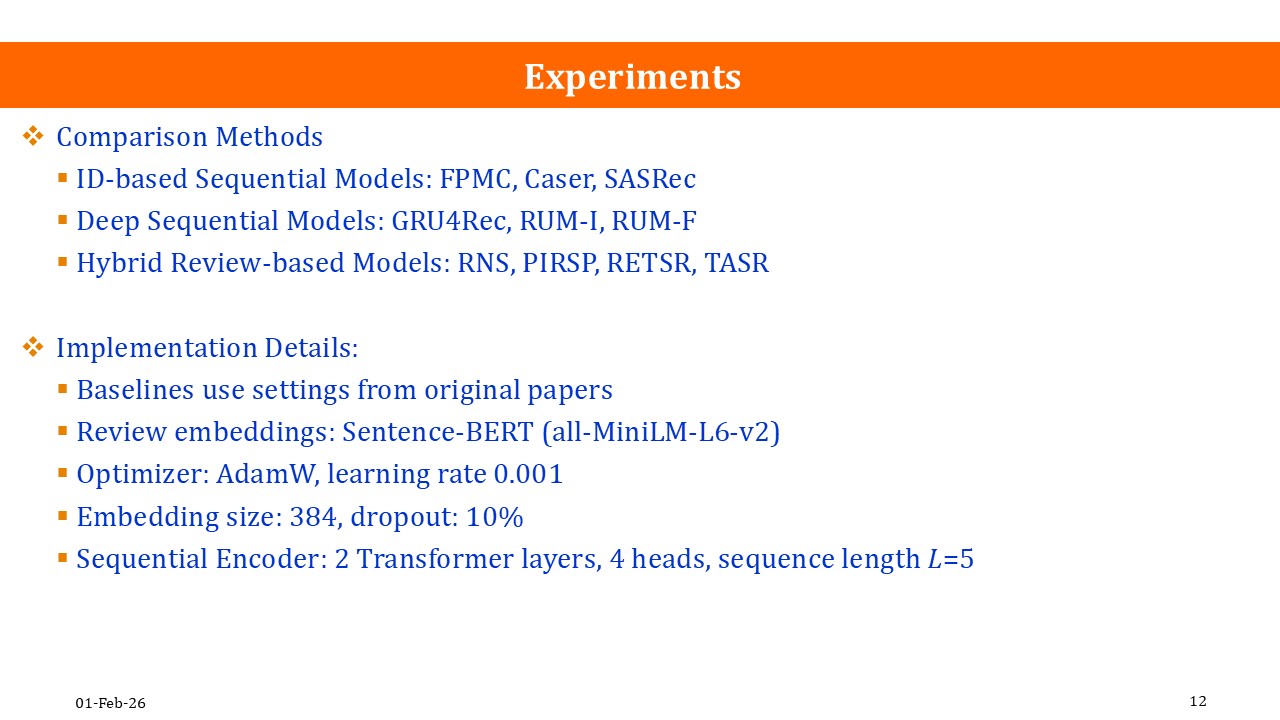 |
To evaluate the effectiveness of HiSeR, we compare it with representative baseline models from three major categories. First, ID-based sequential models, which rely solely on item interaction sequences, including FPMC, Caser, and SASRec. Second, deep sequential models, which employ deep neural architectures to encode user behavior, including GRU4Rec and RUM, with its two variants, RUM-I and RUM-F. Third, hybrid models incorporating review information, which combine interaction sequences with semantic signals from reviews, including RNS, PIRSP, RETSR, and TASR.
All baseline models use the parameter settings reported in their original papers. For HiSeR, review embeddings are generated using Sentence-BERT (all-MiniLM-L6-v2).�The model is optimized with AdamW, using a learning rate of 0.001, an embedding size of 384, and a dropout rate of 10%. To ensure fair comparison, the Sequential Encoder uses two Transformer layers, four attention heads, and a sequence length of L equals 5. |
| ICACT20260275 Slide.13
[Big Slide]
|
Chrome Click!! |
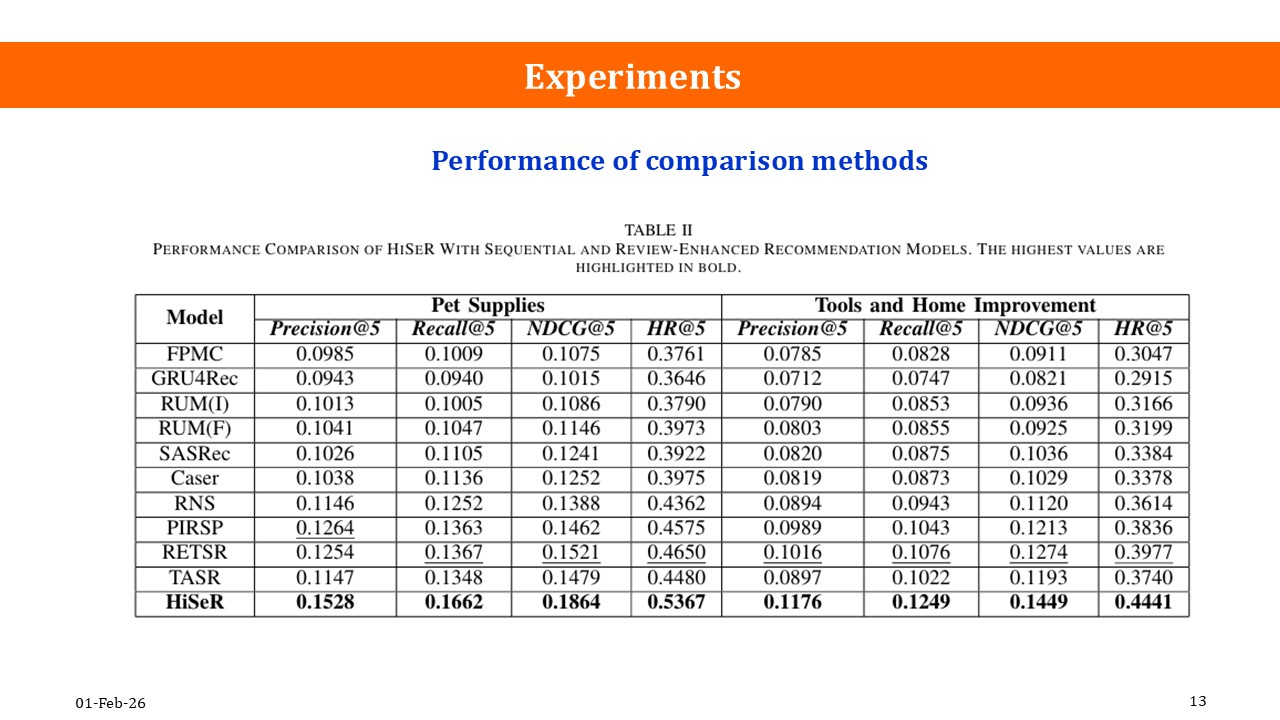 |
Table II reports the performance comparison on two datasets.”
HiSeR consistently outperforms all baseline models on both Pet Supplies and Tools and Home Improvement, achieving the best results across all evaluation metrics.
Compared with ID-only sequential models, HiSeR benefits from incorporating semantic information from reviews.�While review-based models also show competitive performance, they lack a unified mechanism to jointly model sequential behavior and textual semantics.
HiSeR addresses this limitation through a Hybrid Item Encoder and a Transformer-based Sequential Encoder, enabling effective modeling of both semantic signals and short- and long-term dependencies. |
| ICACT20260275 Slide.14
[Big Slide]
|
Chrome Click!! |
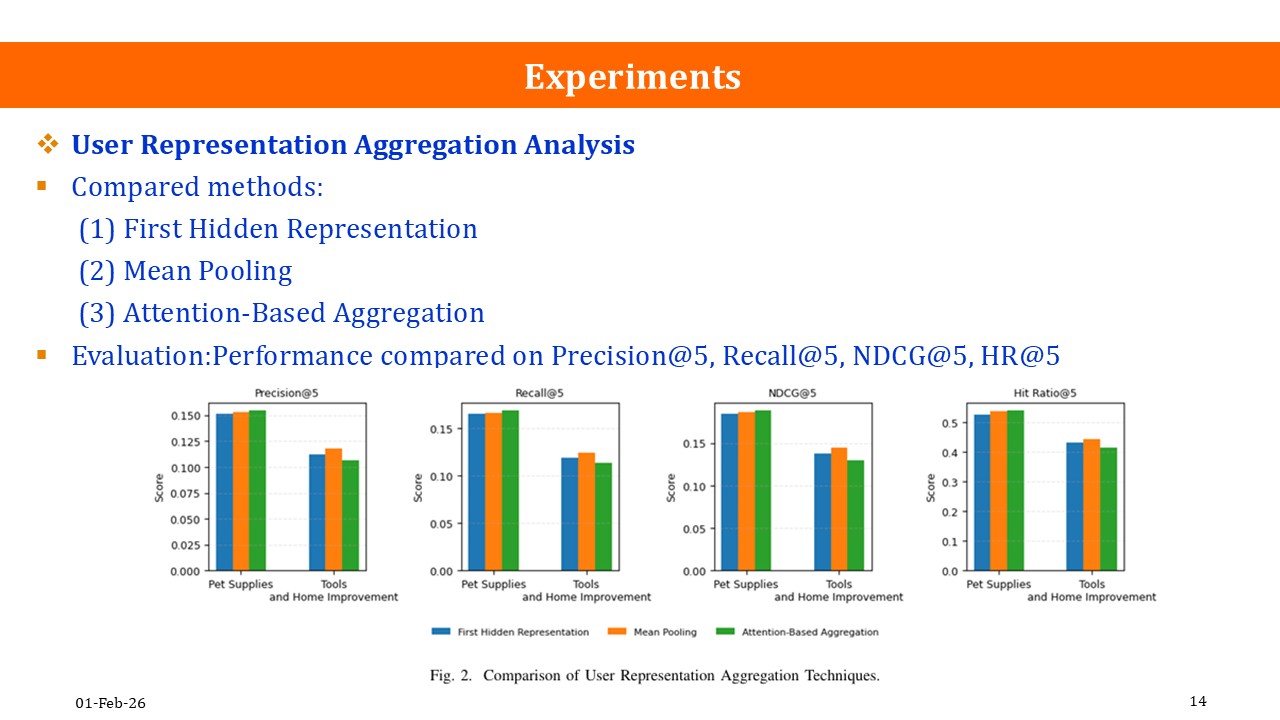 |
Finally, we compares three user aggregation methods: First Hidden Representation, Mean Pooling, and Attention-Based Aggregation. Across all metrics, Mean Pooling shows the most stable performance on both datasets. While attention-based aggregation occasionally performs well on Pet Supplies, it lacks consistency. On Tools and Home Improvement, Mean Pooling consistently achieves the best results. |
| ICACT20260275 Slide.15
[Big Slide]
|
Chrome Click!! |
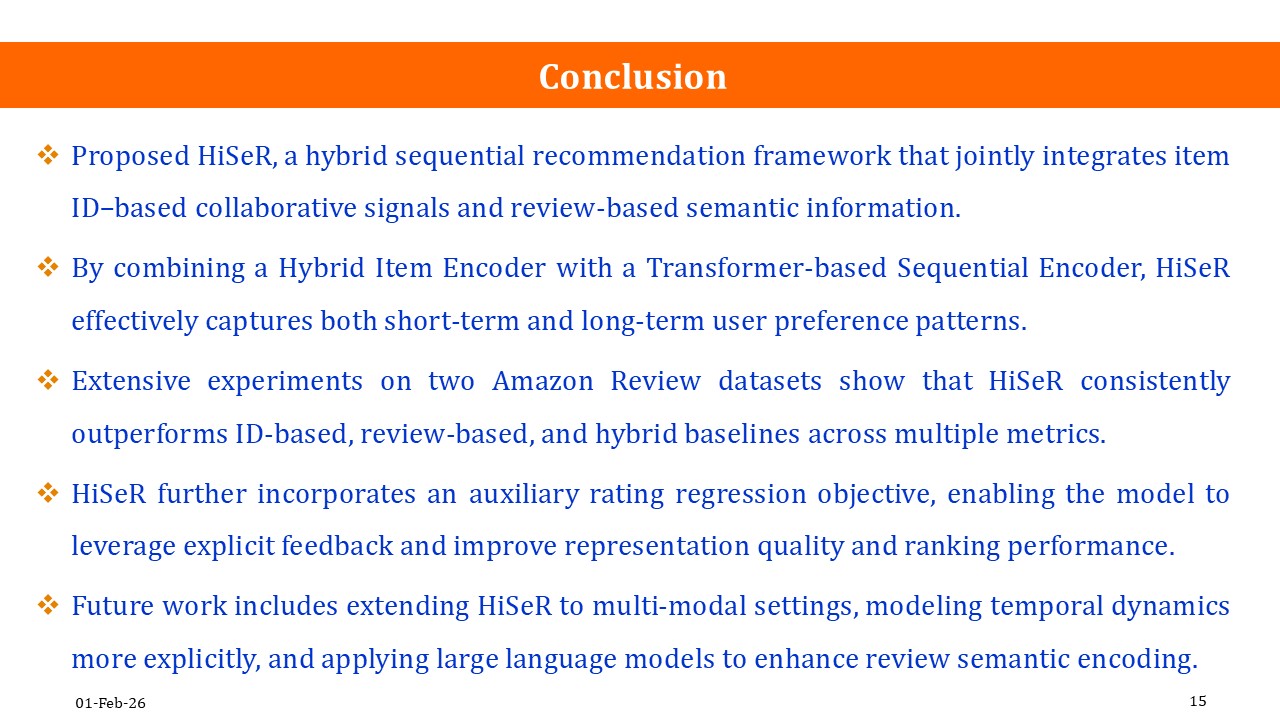 |
To conclude, we propose HiSeR, a hybrid sequential recommendation framework that jointly integrates item ID–based collaborative signals and review-based semantic information.”
By combining a Hybrid Item Encoder with a Transformer-based Sequential Encoder, HiSeR effectively captures both short-term and long-term user preference patterns.
Through extensive experiments on two Amazon review datasets, we show that HiSeR consistently outperforms ID-based, review-based, and hybrid baseline methods across multiple evaluation metrics.
In addition, HiSeR incorporates an auxiliary rating regression objective, allowing the model to leverage explicit feedback and further improve representation quality and ranking performance.
Finally, future work includes extending HiSeR to multimodal settings, modeling temporal dynamics more explicitly, and applying large language models to enhance review semantic encoding.
|
| ICACT20260275 Slide.16
[Big Slide]
|
Chrome Click!! |
 |
Thats all for my presentation. Thank you for your attention. I hope this presentation was insightful. I’m happy to take any questions or discuss further after the session. Thank you again
|
| |





