 ICACT20260299 Slide.01
[Big Slide]
[YouTube] |
Chrome  Click!! |
 |
Hello everyone. Im Chang Liu from Beijing Institute of Technology. Today I will present our work on radar target recognition based on electromagnetic scattering characteristics and simulated echo data.
|
| ICACT20260299 Slide.02
[Big Slide]
|
Chrome Click!! |
 |
My presentation is divided into 5parts.
|
| ICACT20260299 Slide.03
[Big Slide]
|
Chrome Click!! |
 |
First, I will briefly introduce the motivation and main challenges.
|
| ICACT20260299 Slide.04
[Big Slide]
|
Chrome Click!! |
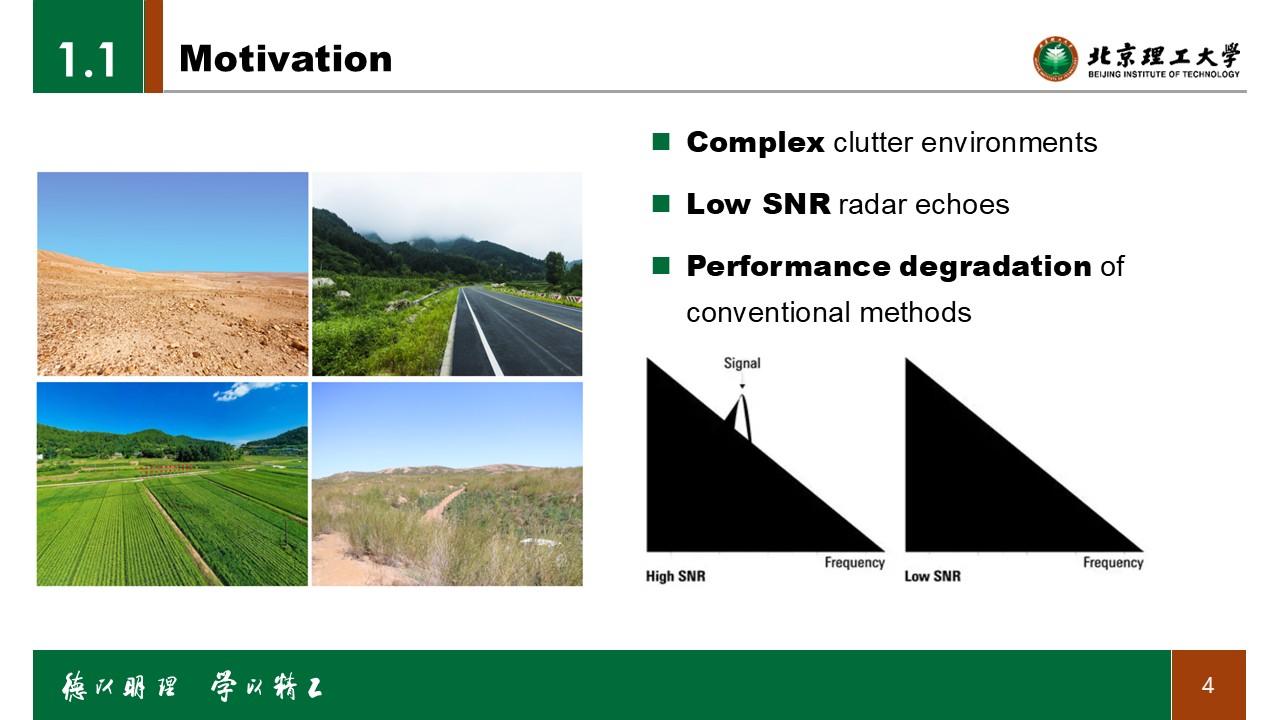 |
Radar target recognition becomes extremely challenging in complex surface environments, such as ground or sea clutter.
In these scenarios, target echoes are usually submerged in strong noise, which significantly degrades recognition performance.
|
| ICACT20260299 Slide.05
[Big Slide]
|
Chrome Click!! |
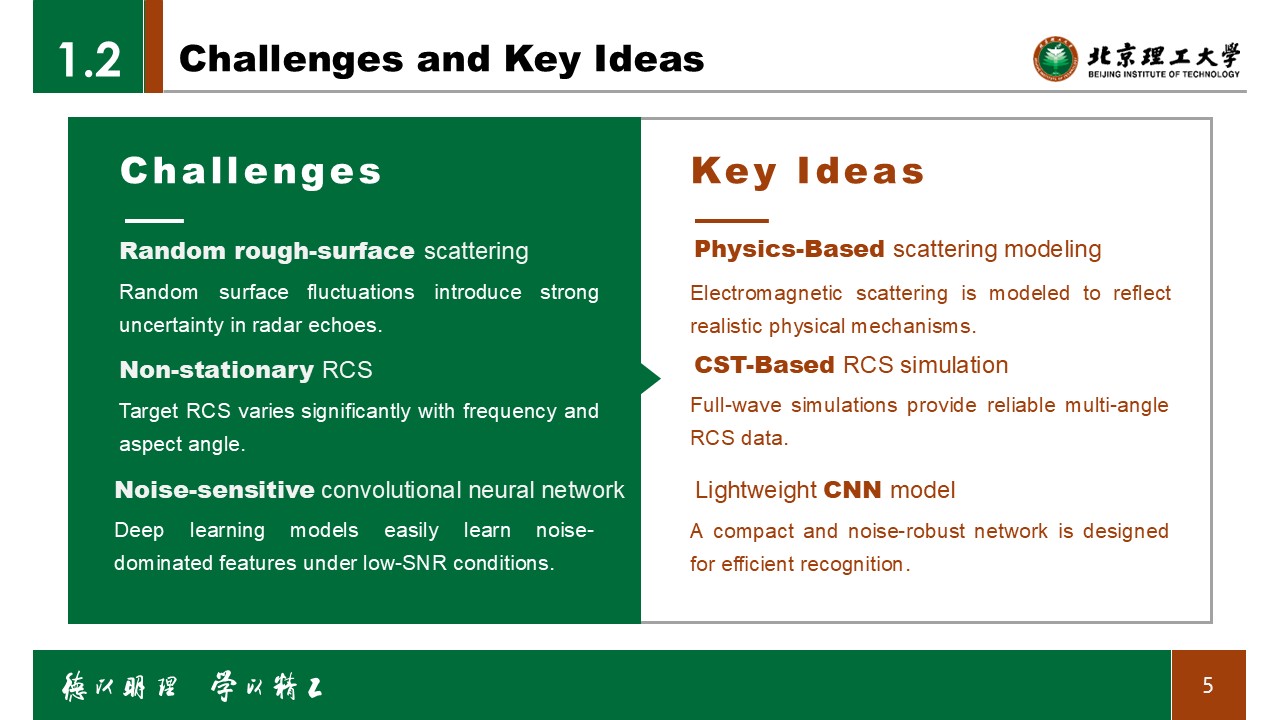 |
There are three main challenges.
First, rough surfaces cause random scattering, which makes radar echoes unstable.
Second, the radar cross section changes with frequency and viewing angle.
Third, deep learning models are very sensitive to noise under low-SNR conditions.
To address these problems, we use physics-based scattering modeling, CST-based RCS simulation, and a lightweight neural network.
|
| ICACT20260299 Slide.06
[Big Slide]
|
Chrome Click!! |
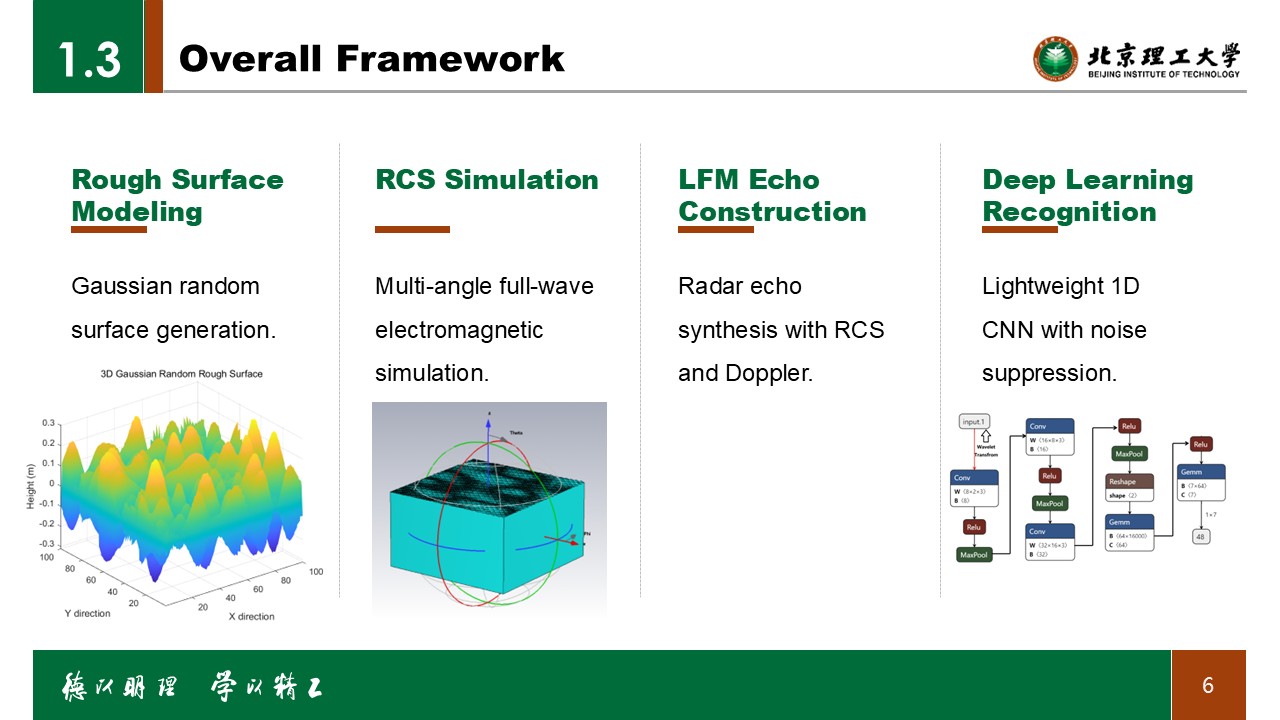 |
Our framework consists of four main stages: rough surface modeling, RCS simulation, LFM echo construction, and deep learning–based recognition.
First, we generate random rough surfaces using a Gaussian statistical model to represent complex ground or sea environments.
Next, full-wave electromagnetic simulations are performed in CST to obtain multi-angle radar cross section data for different targets.
Then, based on the simulated RCS and radar signal models, high-fidelity LFM radar echoes are constructed by incorporating Doppler effects.
Finally, these radar echoes are fed into a lightweight one-dimensional convolutional neural network for target recognition.
|
| ICACT20260299 Slide.07
[Big Slide]
|
Chrome Click!! |
 |
In the next part, we set up the scattering model and generate dataset.
|
| ICACT20260299 Slide.08
[Big Slide]
|
Chrome Click!! |
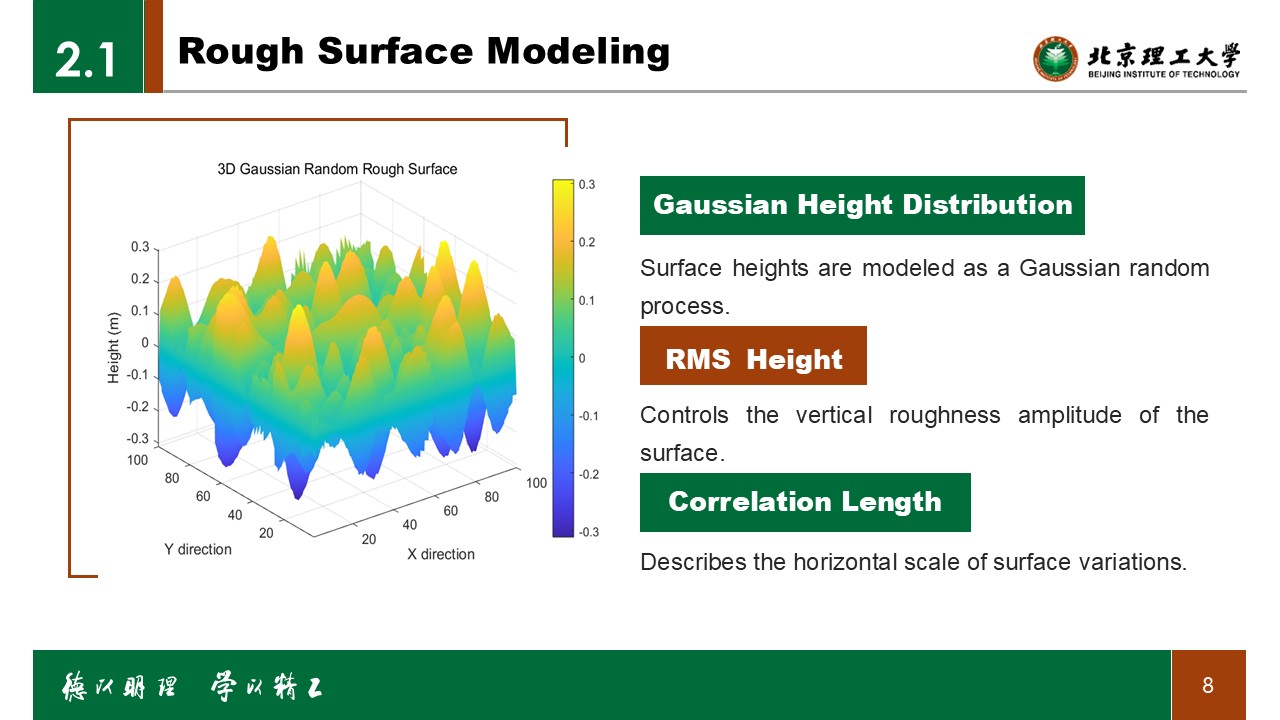 |
We model the surface height using a Gaussian random process.
Two key parameters are used to characterize the surface.
The RMS height controls how strong the surface fluctuations are.
The correlation length controls how fast the surface changes along the horizontal direction.
|
| ICACT20260299 Slide.09
[Big Slide]
|
Chrome Click!! |
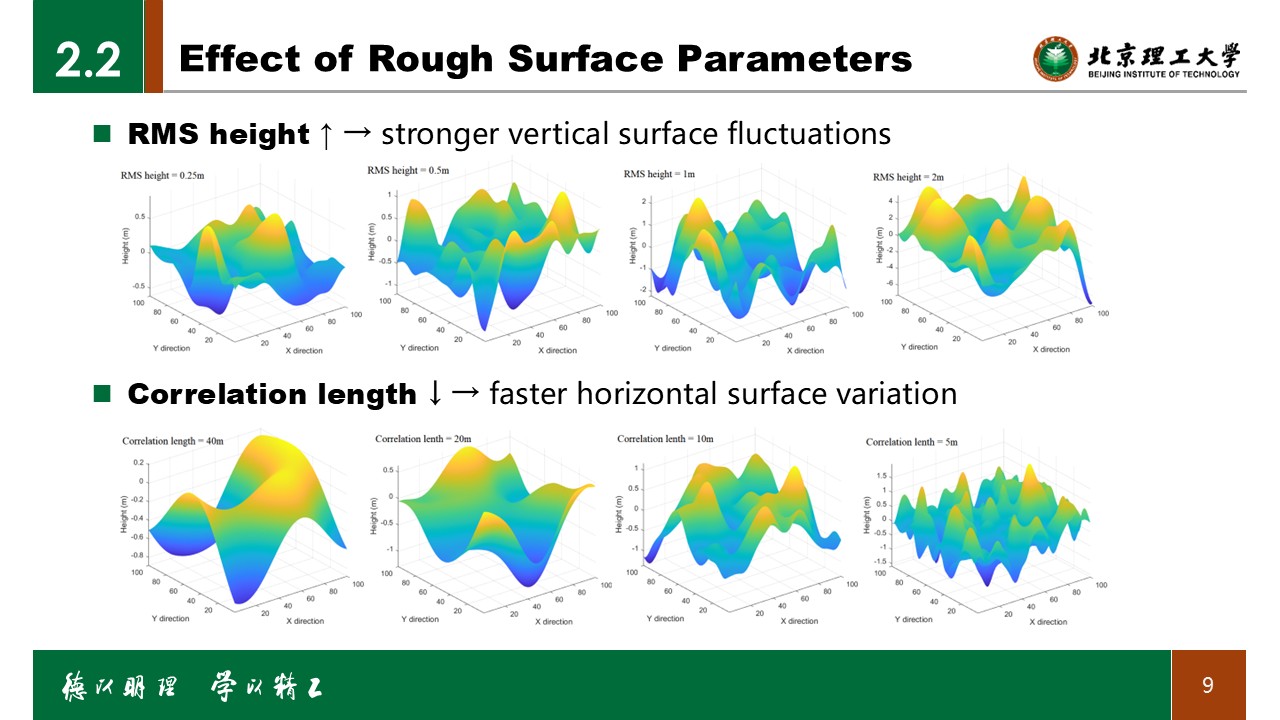 |
Increasing the RMS height leads to stronger vertical surface fluctuations, while decreasing the correlation length results in faster surface variation.
We study these effects using CST-based RCS simulation in the S-band from 2 to 4 gigahertz with multi-angle scanning.
|
| ICACT20260299 Slide.10
[Big Slide]
|
Chrome Click!! |
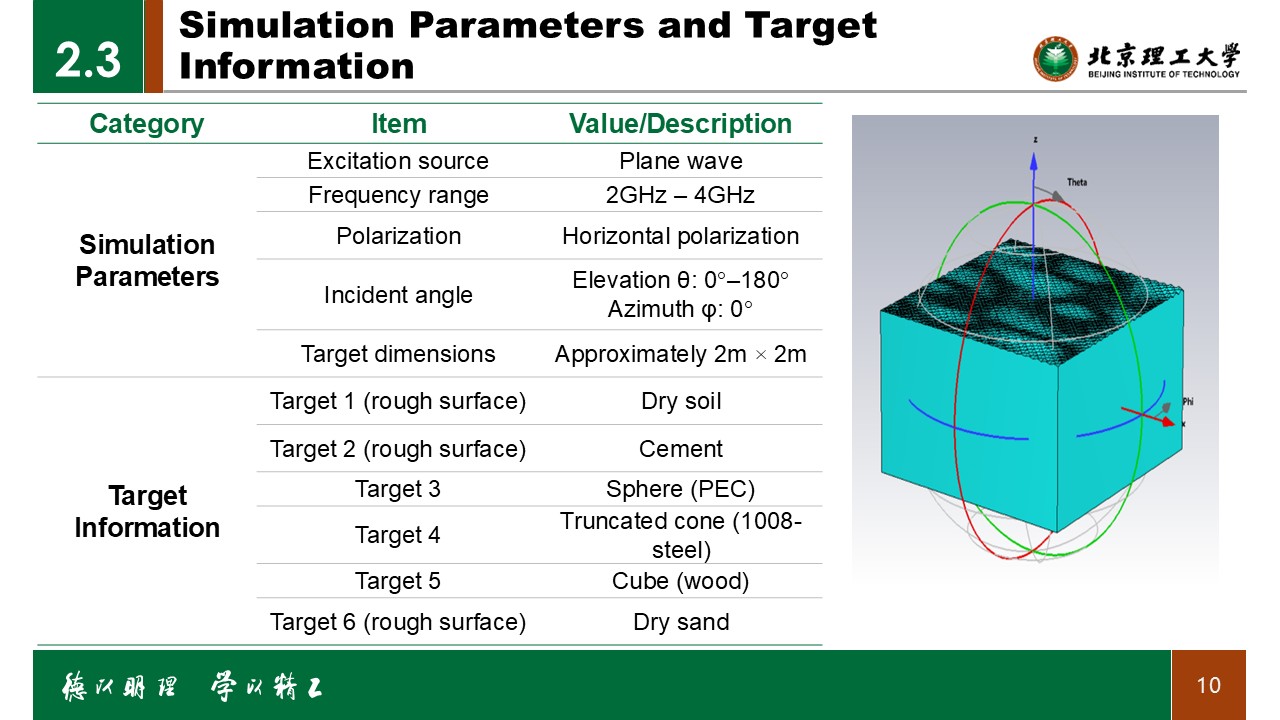 |
On this slide, we present a detailed list of the parameter configurations and target information adopted in our simulation experiments.
In the table on the left, you can find our simulation parameters. We selected six different types of targets, including three rough surfaces—namely dry soil, cement, and dry sand—as well as three standard geometric shapes: a (PEC) sphere, a truncated cone made of 1008 steel, and a wooden cube. These diverse target selections are designed to comprehensively verify the performance of our proposed algorithm.
On the right side is a schematic diagram of the simulation scenario built in CST software.
|
| ICACT20260299 Slide.11
[Big Slide]
|
Chrome Click!! |
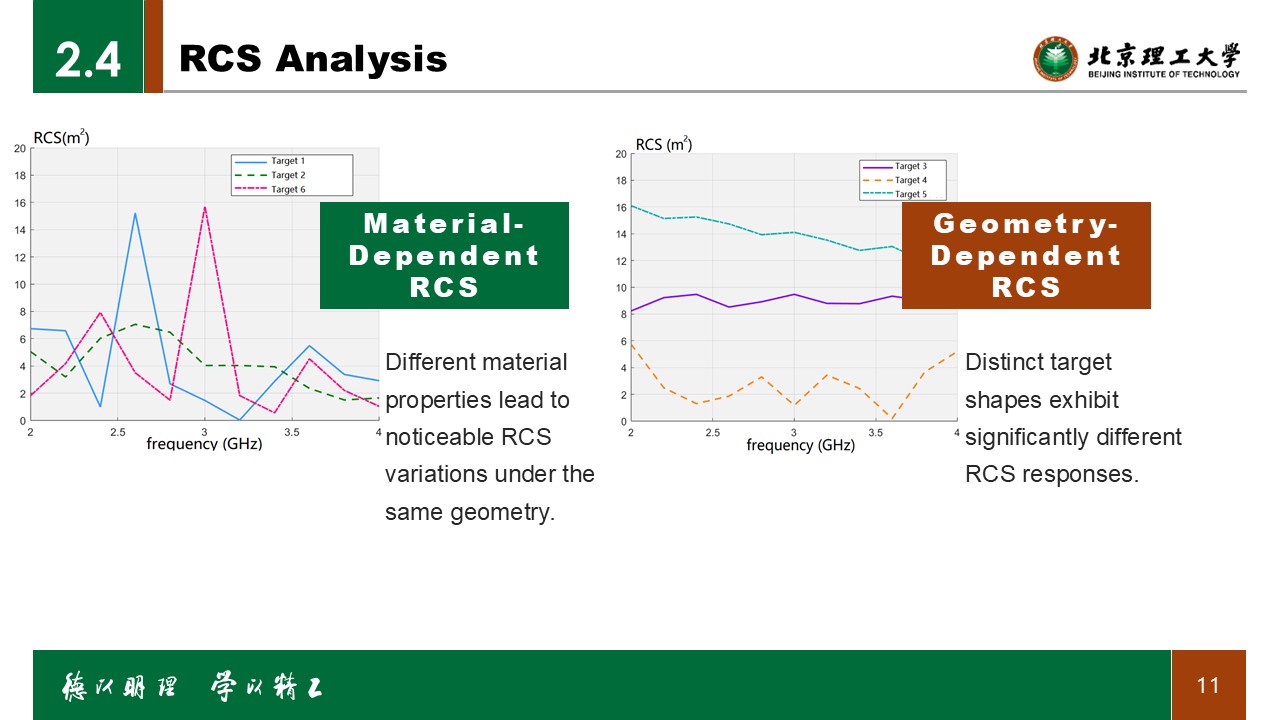 |
These figures show the RCS analysis results.
The right figure shows the RCS responses of different target geometries.
Significant variations can be observed across different target types, indicating that target shape also plays an important role in radar scattering characteristics.
These results demonstrate that RCS contains discriminative information related to both material properties and geometric structures, which provides a solid physical basis for radar target recognition.
|
| ICACT20260299 Slide.12
[Big Slide]
|
Chrome Click!! |
 |
Then we move to the network design part
|
| ICACT20260299 Slide.13
[Big Slide]
|
Chrome Click!! |
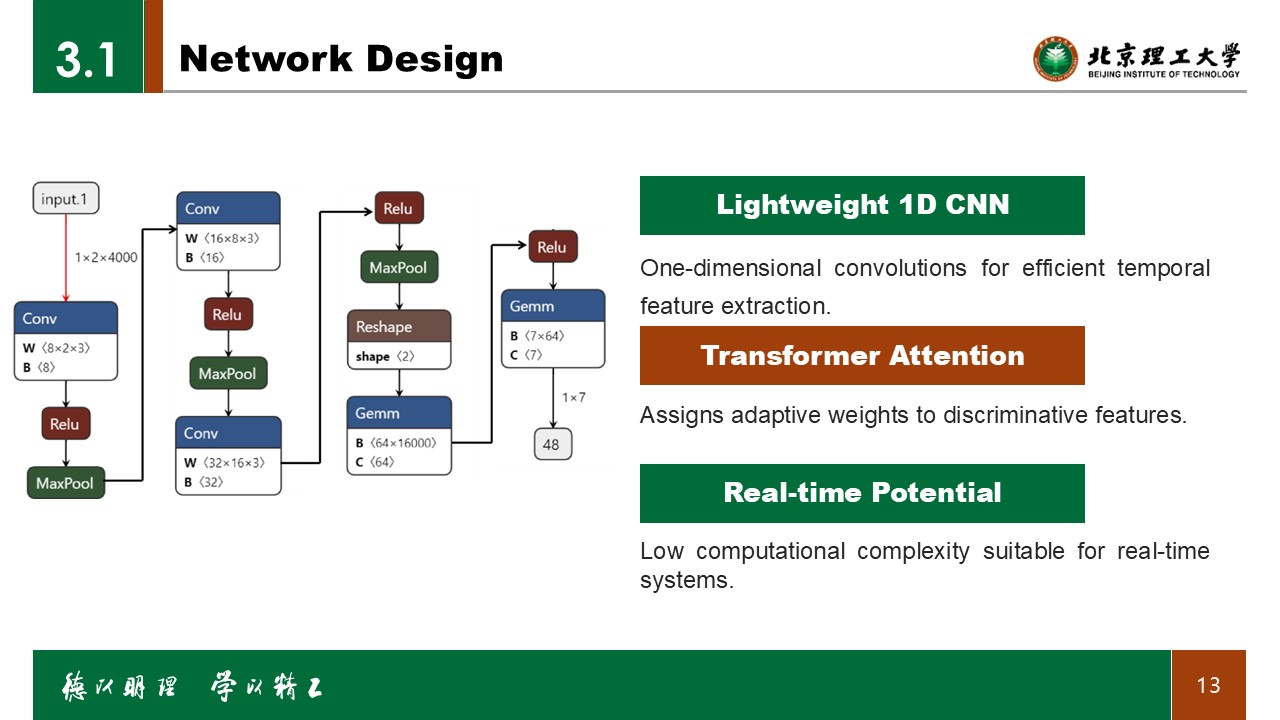 |
We design a lightweight one-dimensional CNN for radar echo signals.
One-dimensional convolution is efficient for time-domain data.
We also introduce an attention mechanism to help the network focus on important features.
Because of its low complexity, the network has good potential for real-time use.
|
| ICACT20260299 Slide.14
[Big Slide]
|
Chrome Click!! |
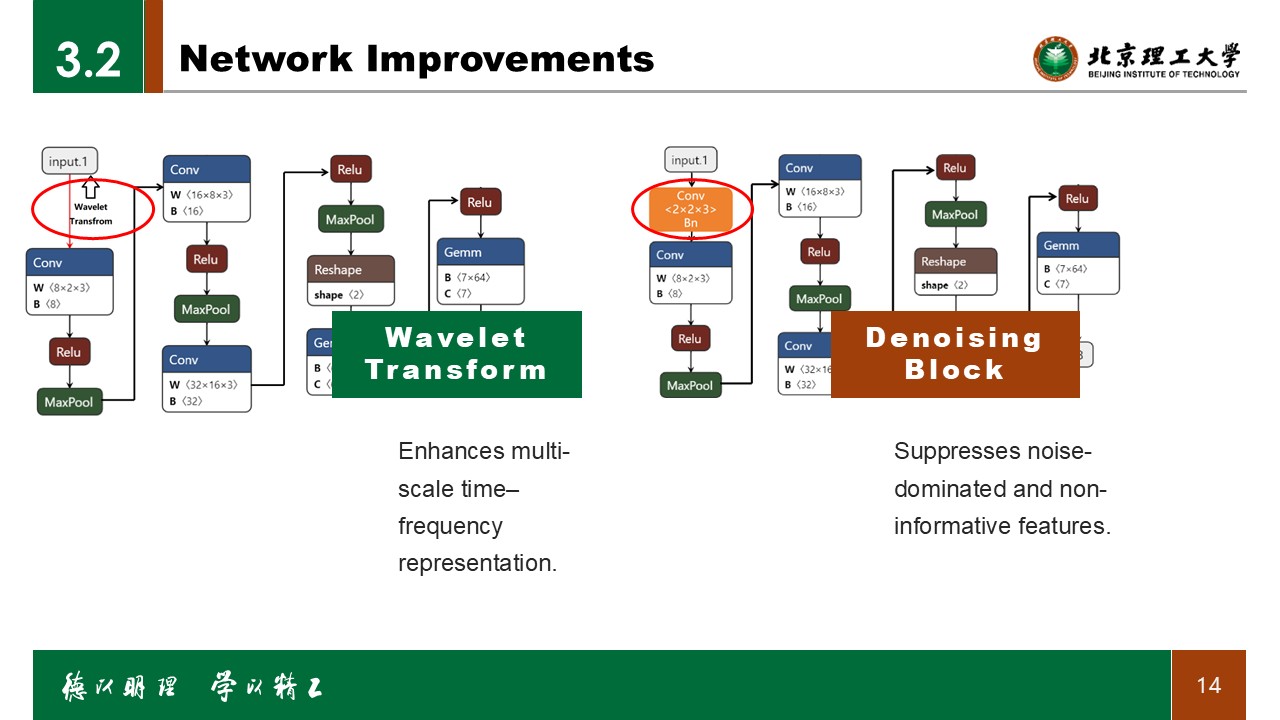 |
We use 2 ways to improved the network.
First, a wavelet transform is applied to the input radar signal to enhance its multi-scale time–frequency representation, which helps capture non-stationary characteristics.
Second, a denoising block is introduced to suppress noise-dominated and non-informative features, improving robustness under low SNR conditions.
However, these two techniques are not applied simultaneously, as cascading wavelet decomposition with additional denoising may excessively remove critical scattering information and degrade recognition performance.
|
| ICACT20260299 Slide.15
[Big Slide]
|
Chrome Click!! |
 |
The forth part is the experiment.
|
| ICACT20260299 Slide.16
[Big Slide]
|
Chrome Click!! |
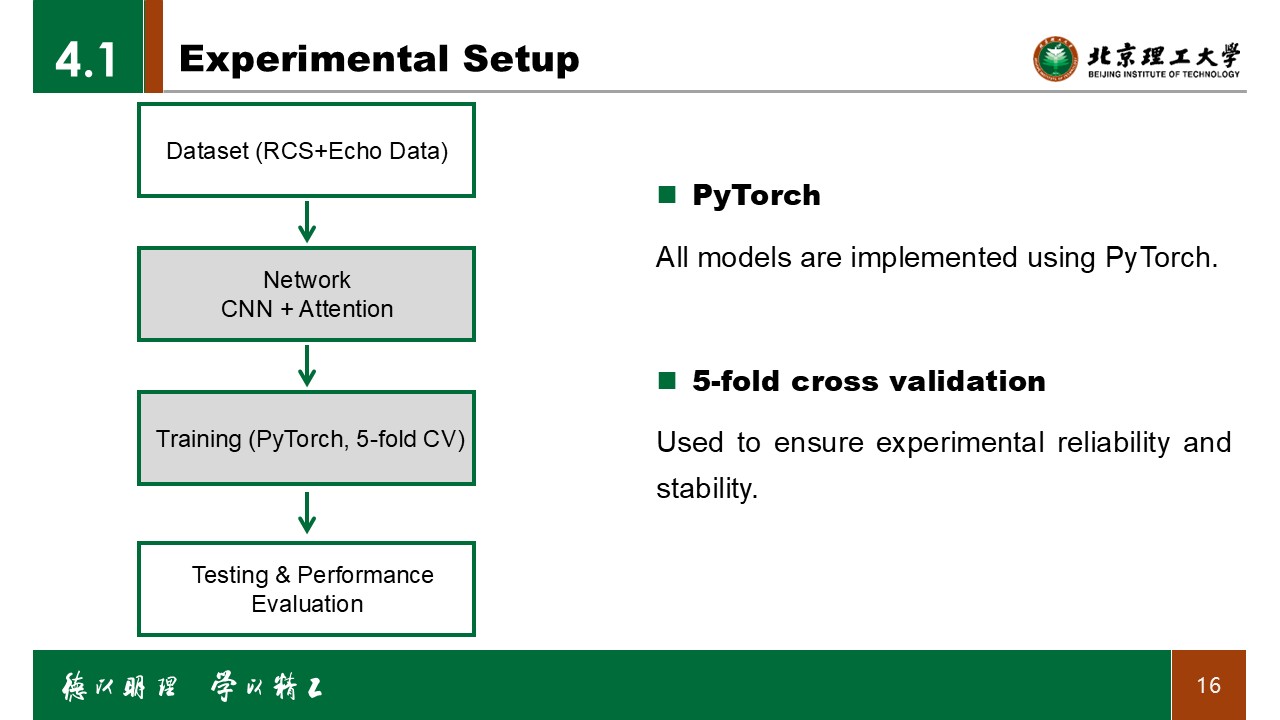 |
This slide briefly introduces the experimental setup.
All experiments are implemented using the PyTorch framework.
To ensure the reliability and stability of the results, We use five-fold cross validation through the experiments.
|
| ICACT20260299 Slide.17
[Big Slide]
|
Chrome Click!! |
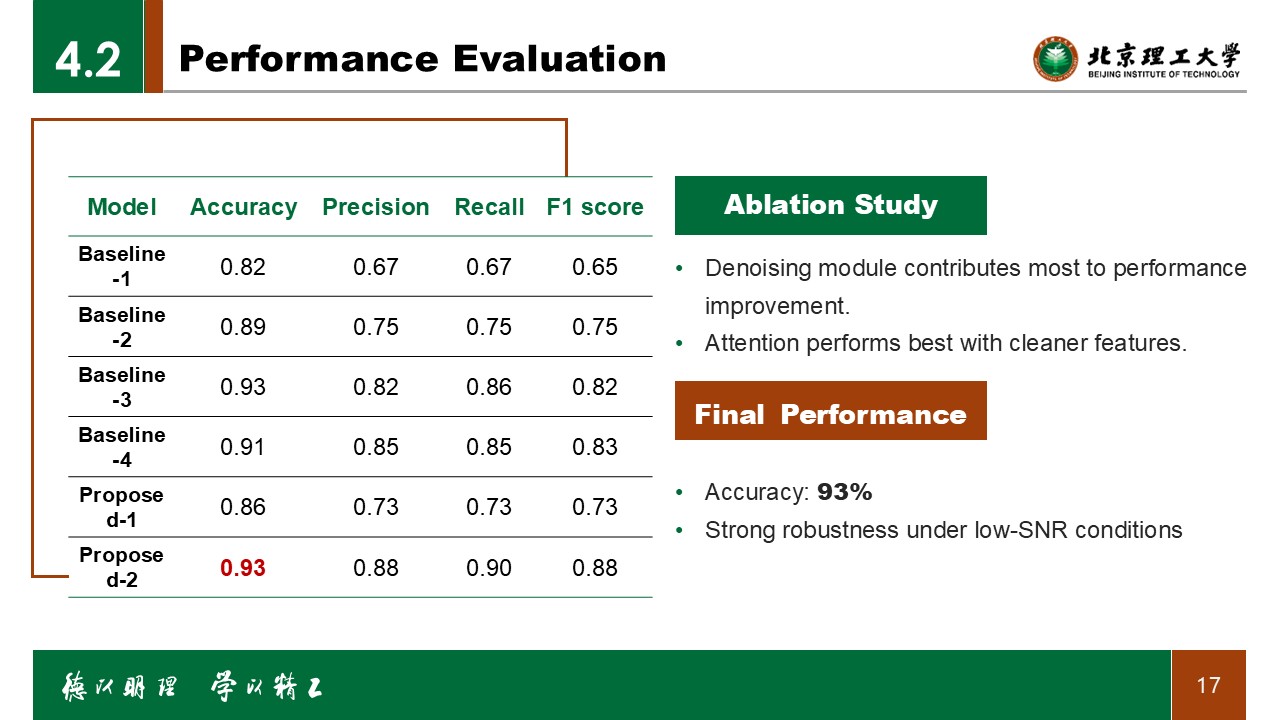 |
The ablation study shows that the denoising module brings the largest performance improvement.
Attention works best when the features are cleaner.
The final model achieves about 93 percent accuracy under low-SNR conditions, which shows strong robustness.
|
| ICACT20260299 Slide.18
[Big Slide]
|
Chrome Click!! |
 |
Finally, its the conclusion part
|
| ICACT20260299 Slide.19
[Big Slide]
|
Chrome Click!! |
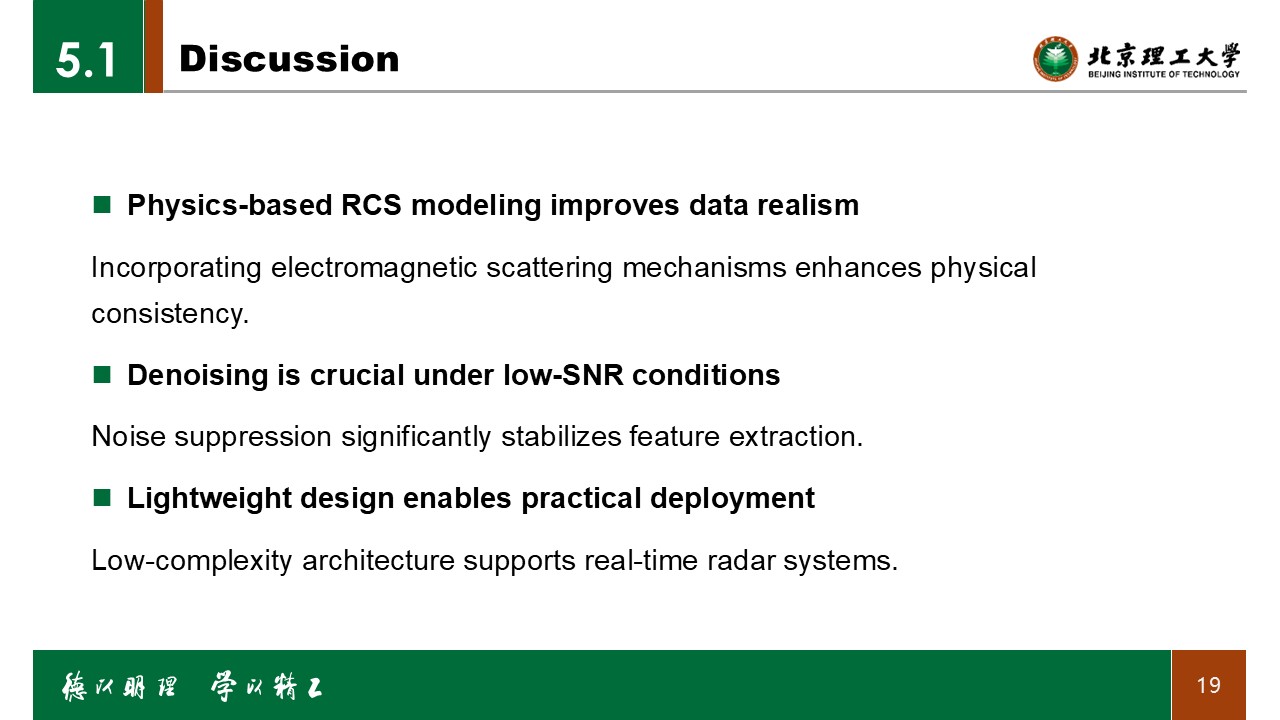 |
From these results, we can get several key insights.
Physics-based RCS modeling helps make the data more realistic.
Denoising is very important under low-SNR conditions.
The lightweight design makes the method suitable for practical radar systems.
|
| ICACT20260299 Slide.20
[Big Slide]
|
Chrome Click!! |
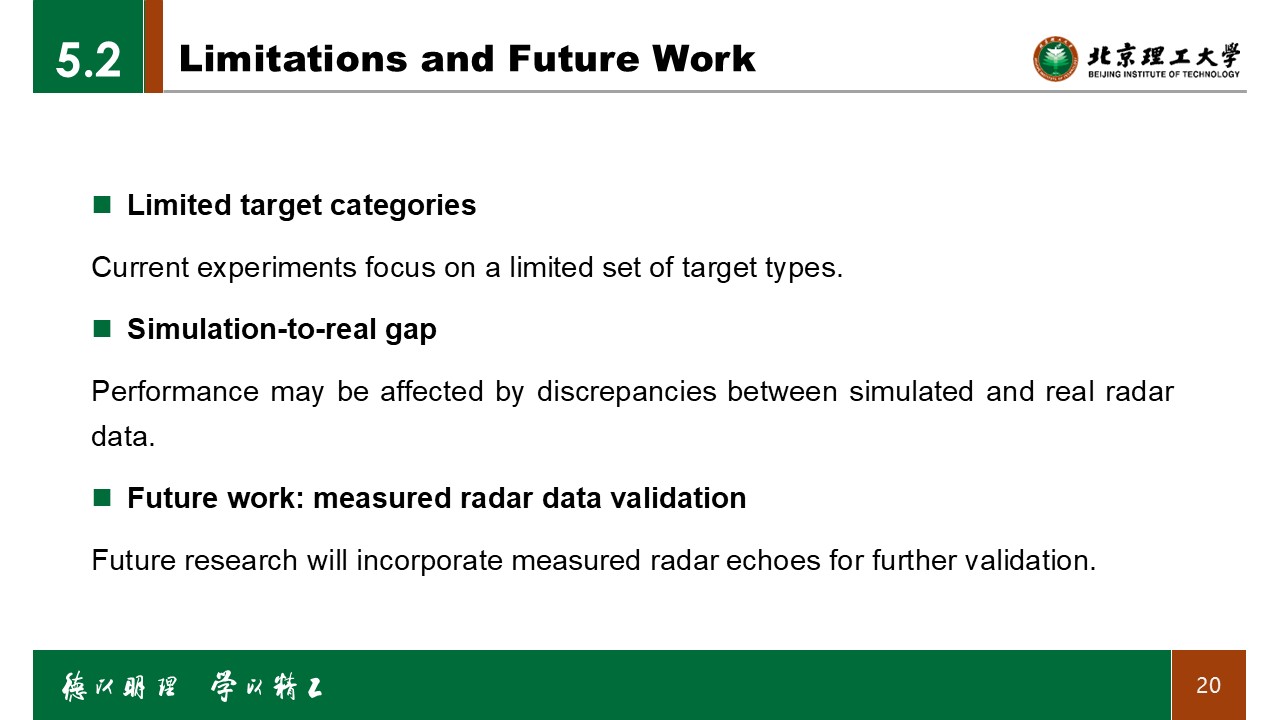 |
Despite the promising results, there are still several limitations in the current work.
First, the experimental evaluation is conducted on a limited number of target categories, which may restrict the generalization of the proposed method.
Second, a simulation-to-real gap may exist, as the training and evaluation data are mainly generated from electromagnetic simulations.
In future work, we plan to incorporate measured radar echo data to further validate and improve the robustness and applicability of the proposed approach.
|
| ICACT20260299 Slide.21
[Big Slide]
|
Chrome Click!! |
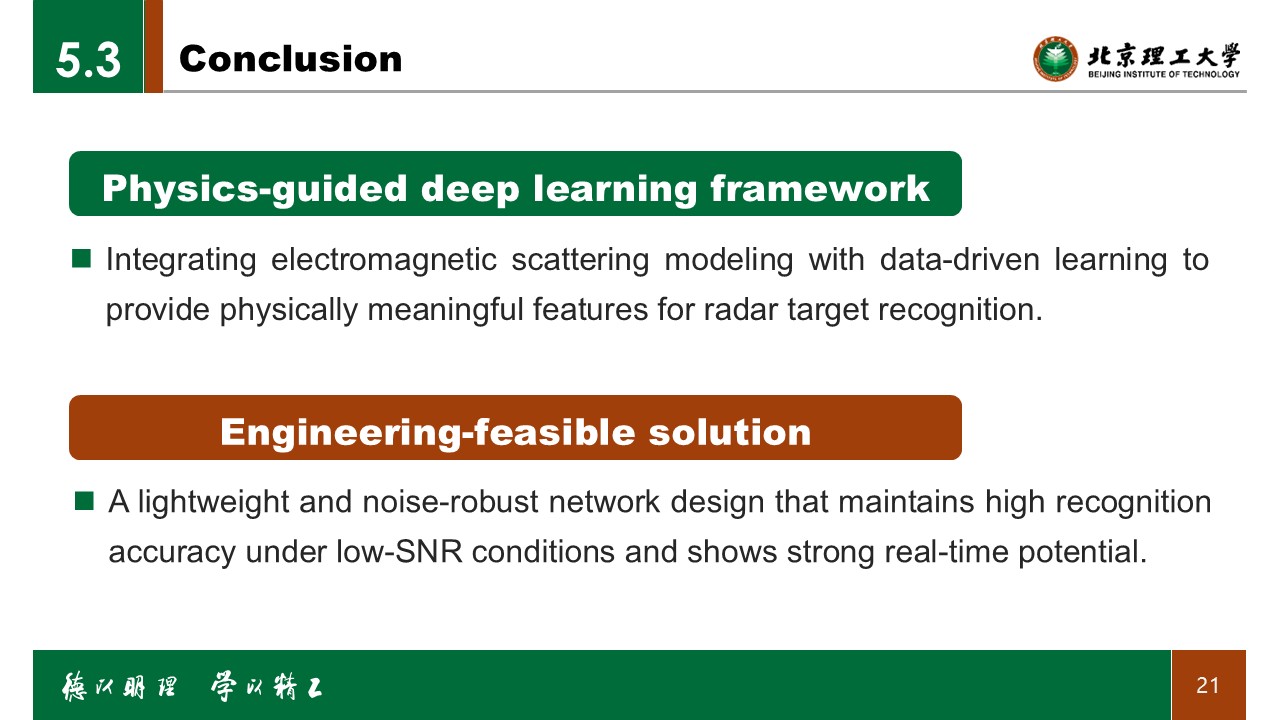 |
In conclusion, we propose a physics-guided deep learning framework for radar target recognition.
The method works well under low-SNR conditions and has good potential for real-time applications.
|
| ICACT20260299 Slide.22
[Big Slide]
|
Chrome Click!! |
 |
Thank you very much for your attention.
|















