 ICACT20260302 Slide.01
[Big Slide]
[YouTube] |
Chrome  Click!! |
 |
Hello everyone. My name is Yibing Zhao from the Institute of Acoustics, Chinese Academy of Sciences. Today, I will be presenting our paper titled ISMCC: Enhancing Goodput in WANs through In-Network Caching and Multipath Coordination. In this work, we propose a network-layer congestion control method to solve the out-of-order delivery problem in wide-area networks and improve end-to-end performance. |
| ICACT20260302 Slide.02
[Big Slide]
[YouTube] |
Chrome Click!! |
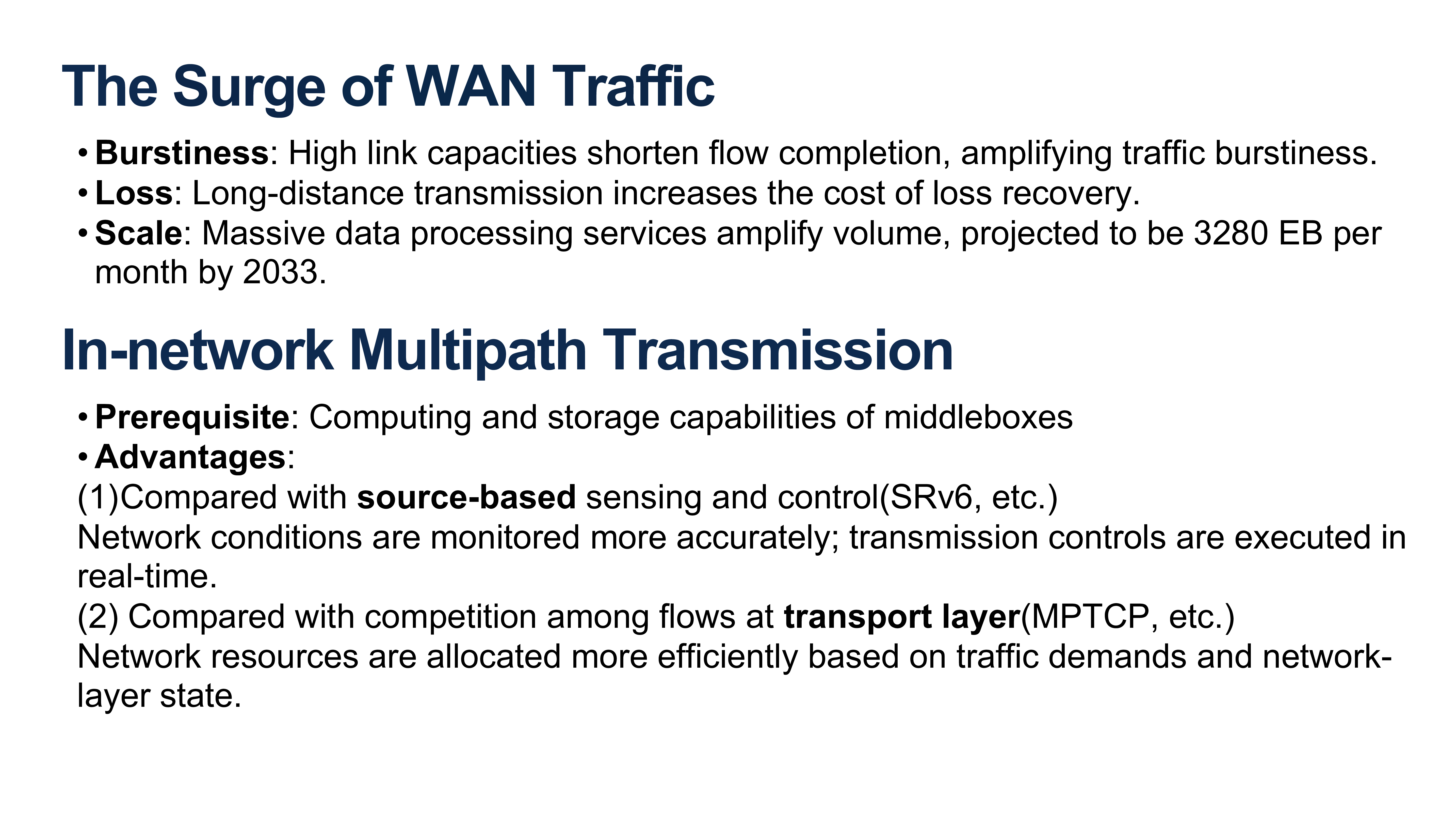 |
Modern Wide-Area Networks are facing a massive surge in traffic, driven by AI and large-scale data processing. This brings three major challenges for data transmission: First, Burstiness: As link capacities increase, flow completion times shorten, which amplifies traffic burstiness. Second, High Loss Cost: Long-distance transmission in WANs makes packet loss recovery extremely expensive. Third, the congestion led by the massive volume of traffic.
To address these issues, leveraging the computing and storage capabilities of network middleboxes in multipath transmission has become a feasible solution. Compared to traditional methods, in-network control offers two key advantages:
First is the More Accurate Sensing: Unlike source-based control, network nodes can monitor real-time conditions, such as burstiness and congestions, more accurately.
Second is the Efficient Resource Allocation: Instead of relying solely on competition between flows at the transport layer, network nodes can allocate the capacity of multiple paths more efficiently and reduce packet loss. |
| ICACT20260302 Slide.03
[Big Slide]
[YouTube] |
Chrome Click!! |
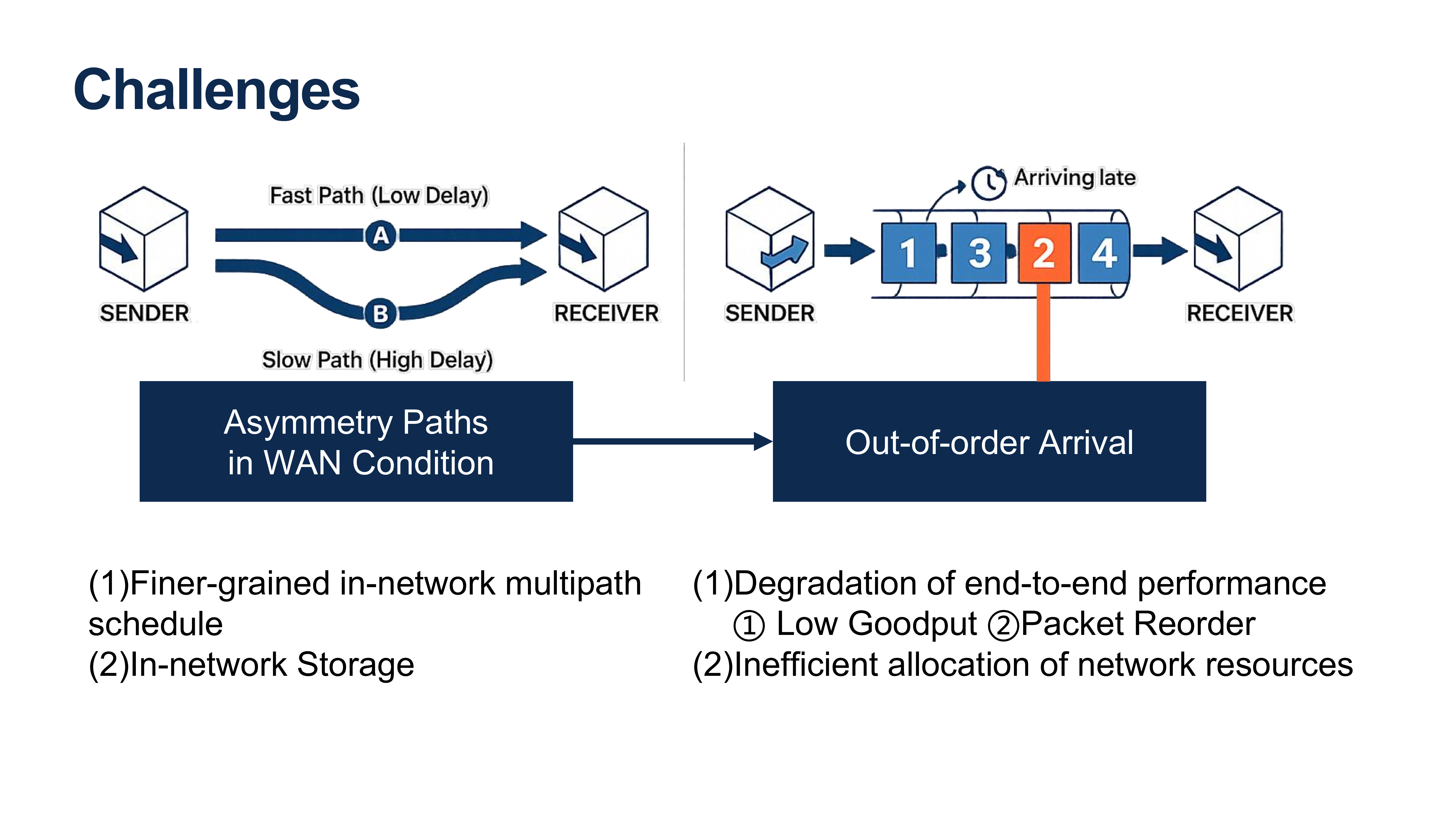 |
However, implementing multipath transmission in WANs faces a critical challenge: Path Asymmetry. As shown in this diagram, when packets from the same flow traverse a Fast Path and a Slow Path due to finer-grained in-network multipath schedule and in-network Storage, they arrive at the receiver out of order. For protocols like TCP, out-of-order arrival is detrimental. It causes Low Goodput and Packet Reorder, leading to Inefficient allocation of network resources. |
| ICACT20260302 Slide.04
[Big Slide]
[YouTube] |
Chrome Click!! |
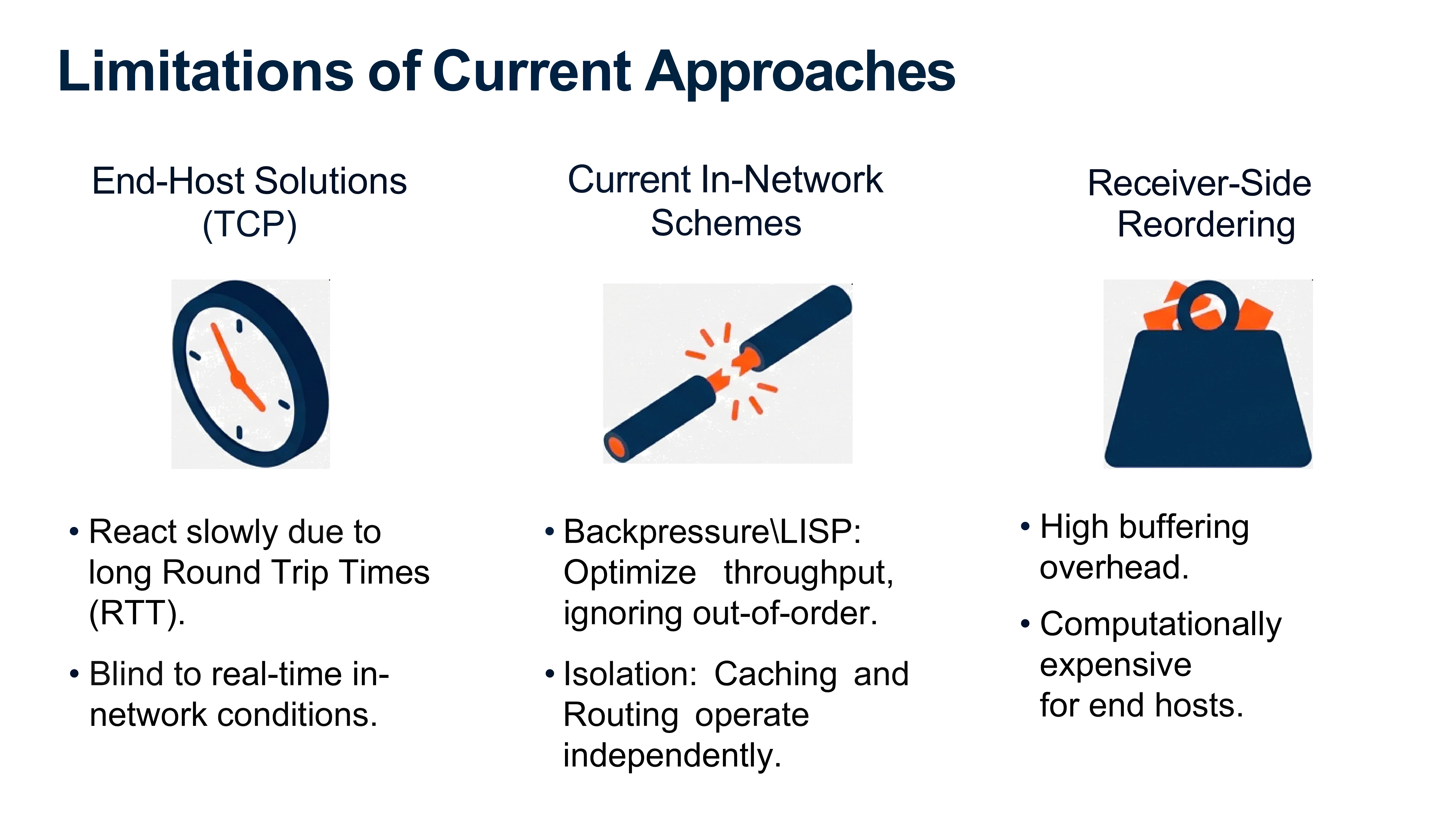 |
Existing solutions have limitations:
Firstly, End-Host Solutions react slowly due to long Round Trip Times (RTT) and Blind to real-time in- network conditions.
Secondly, Current In-Network Schemes (like Backpressure routing and LISP routing) primarily optimize for throughput but often ignore the impact of out-of-order delivery. Critically, existing approaches often treat Caching and Multipath Routing as separate, isolated mechanisms.
Thirdly, Receiver-Side Reordering imposes high buffering and computing overheads on the hosts. |
| ICACT20260302 Slide.05
[Big Slide]
[YouTube] |
Chrome Click!! |
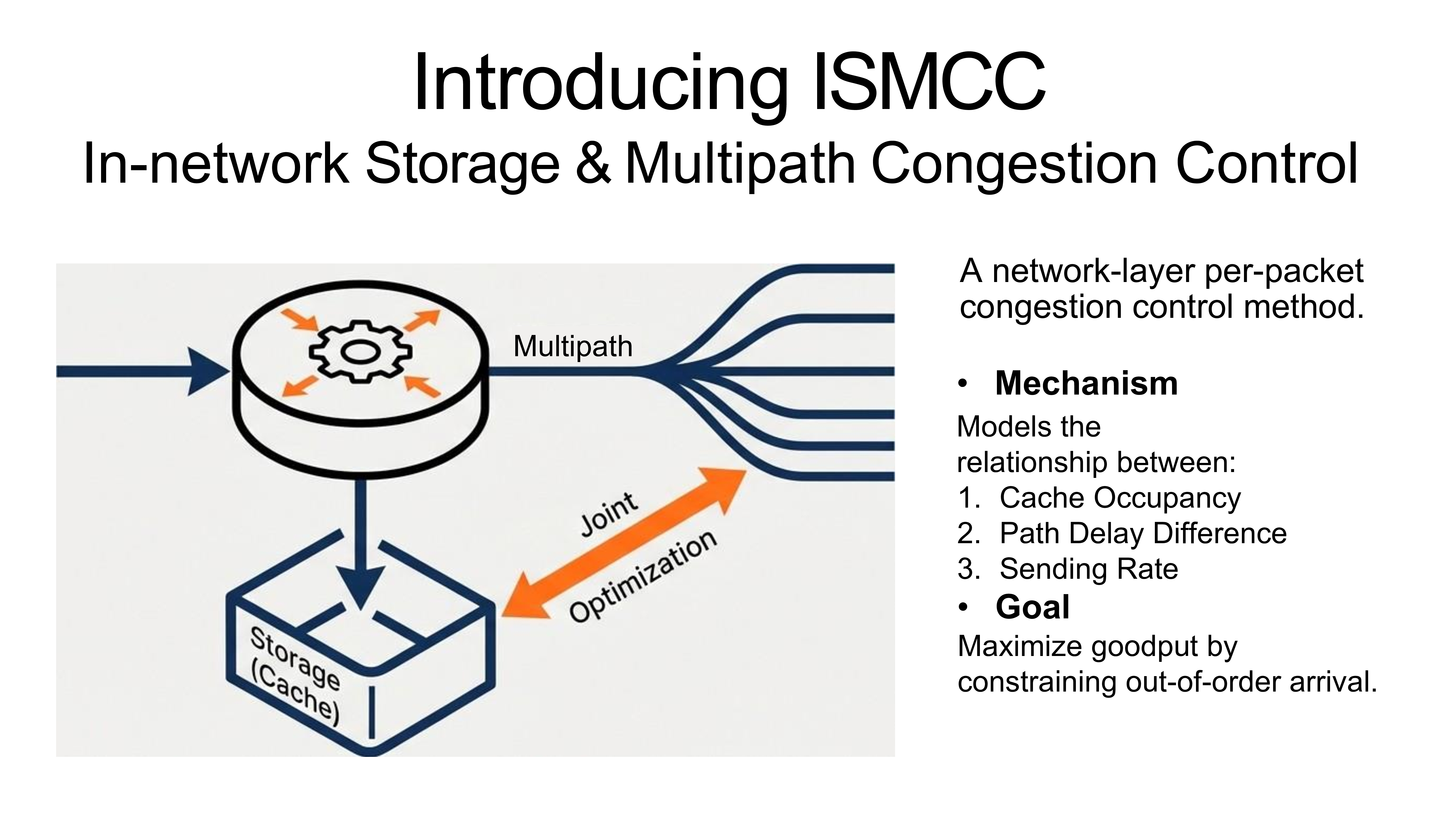 |
To bridge this gap, we propose ISMCC (In-network Cache & Multipath Congestion Control). This is a network-layer per-packet method that jointly optimizes in-network caching and multipath transmission. Our mechanism explicitly models the relationship between cache occupancy, path delay differences, and sending rates. The ultimate goal is to maximize goodput by constraining out-of-order packet arrival. |
| ICACT20260302 Slide.06
[Big Slide]
[YouTube] |
Chrome Click!! |
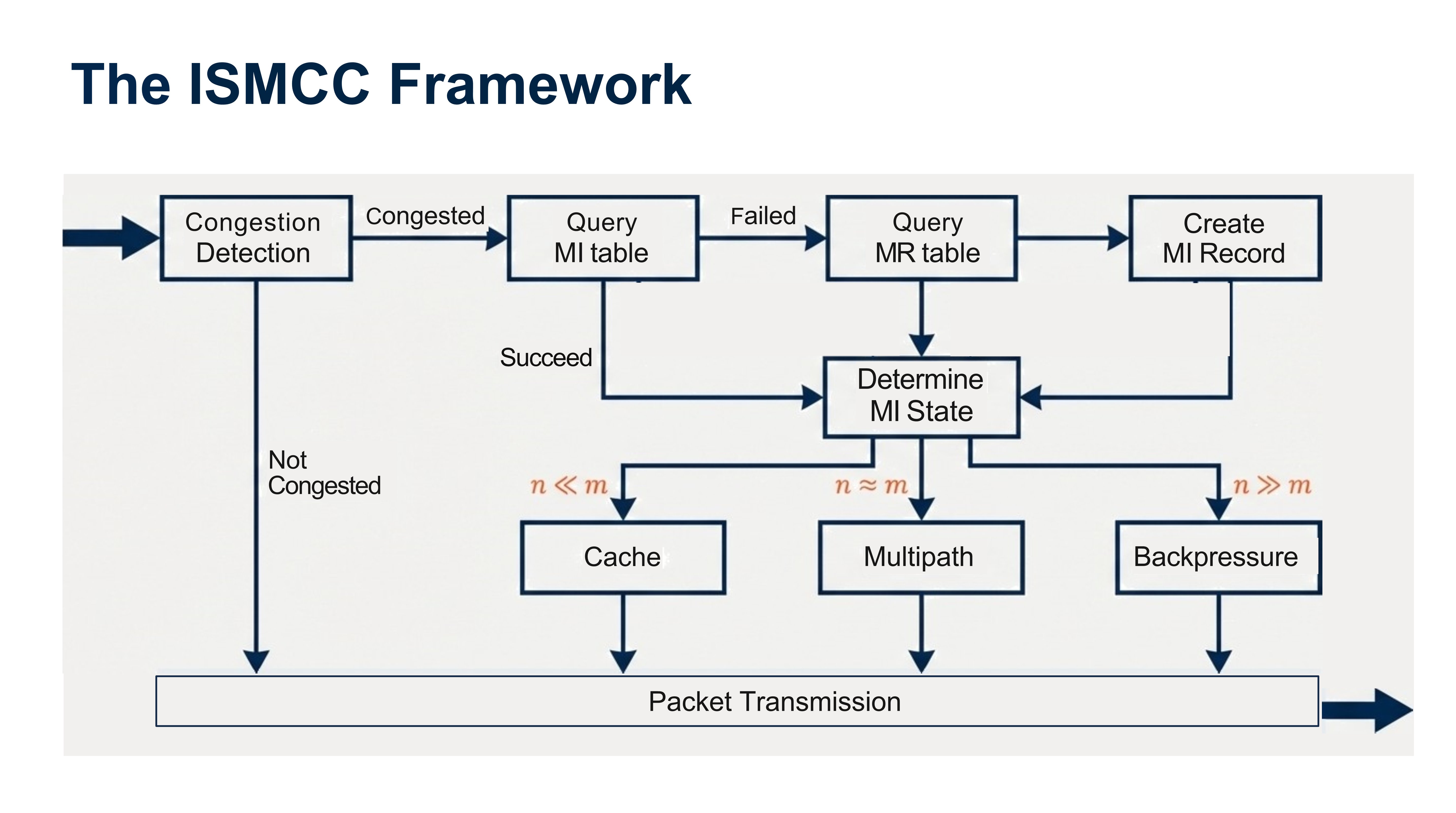 |
This is the overall framework of ISMCC.
When a packet arrives, we first detect if there is congestion.
The system then queries the MI (Multipath Information) Table to determine the state of the aggregated traffic.
Based on the relationship between the current cache occupancy and the target buffer size, the system dynamically switches between three modes: When occupancy is low, Cache is utilized to absorb bursts. When occupancy matches the target, multipath transmission is enabled. And when the node is overwhelmed, Backpressure is signaled upstream. |
| ICACT20260302 Slide.07
[Big Slide]
[YouTube] |
Chrome Click!! |
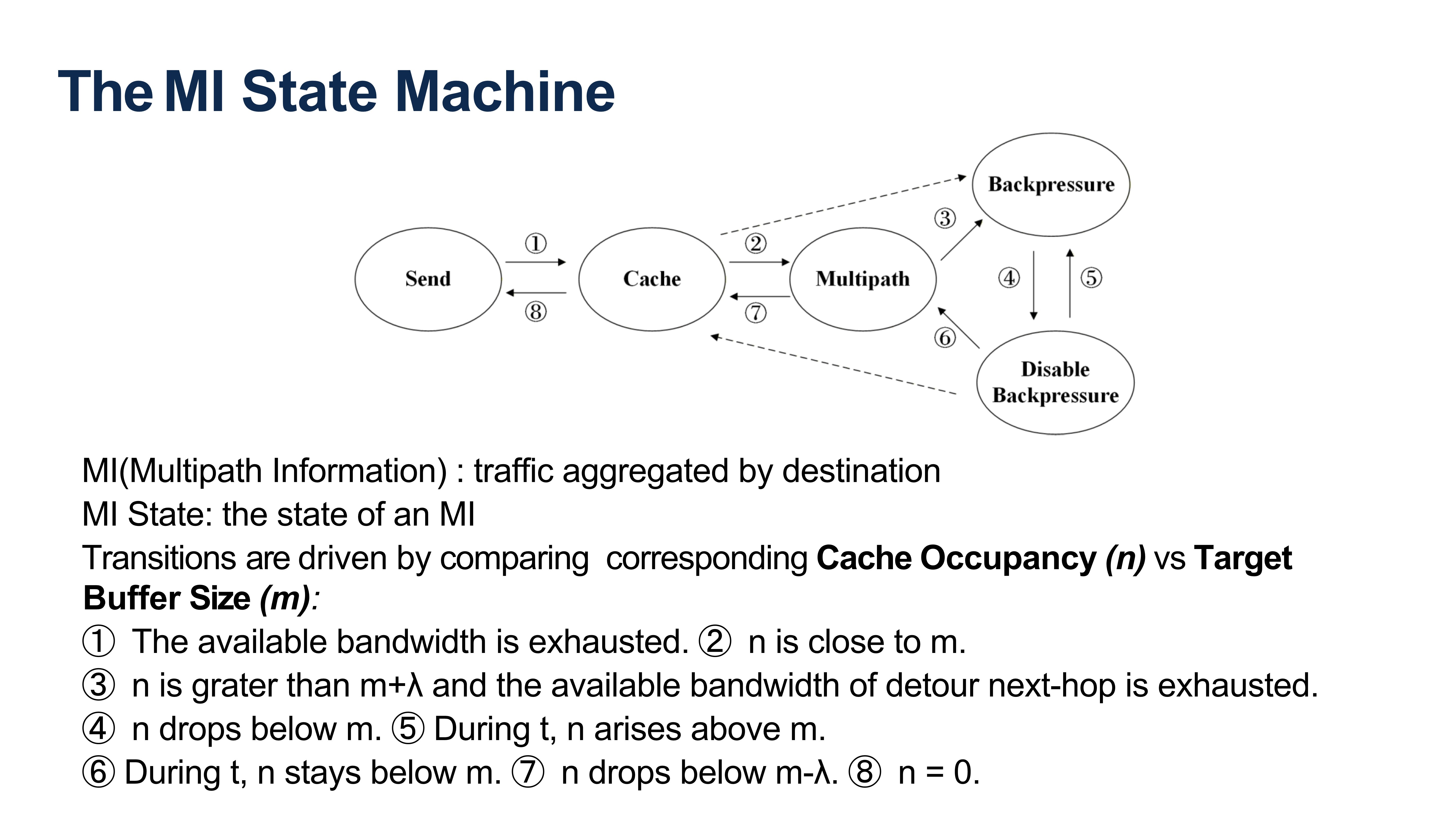 |
Here is the MI state machine that drives our logic.
The transitions are driven by comparing the Cache Occupancy ($n$) against the Target Buffer Size ($m$).
The system smoothly transitions between Send, Store, Multipath, and Backpressure states.
This ensures that we only utilize the secondary path when the cache delay perfectly compensates for the path delay difference, or we signal for help when resources are exhausted. |
| ICACT20260302 Slide.08
[Big Slide]
[YouTube] |
Chrome Click!! |
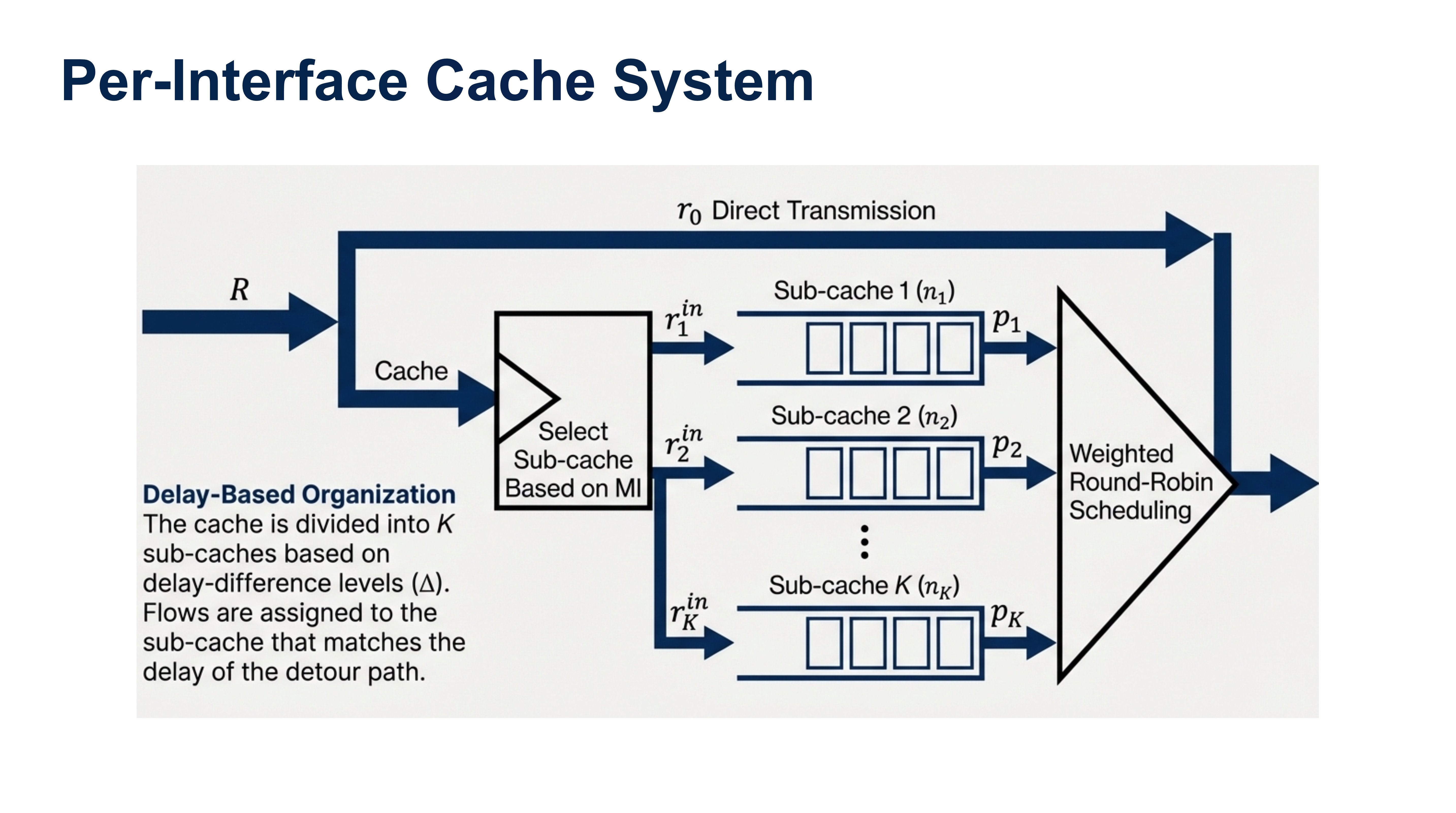 |
A key component of our design is the Per-Interface Cache System.
At each interface, the cache is divided into K Sub-caches, organized by delay-difference levels.
MIs are assigned to the sub-cache that best matches the delay of their potential detour path.
At the output, we use a Weighted Round-Robin scheduler to ensure fair bandwidth allocation among these sub-caches. |
| ICACT20260302 Slide.09
[Big Slide]
[YouTube] |
Chrome Click!! |
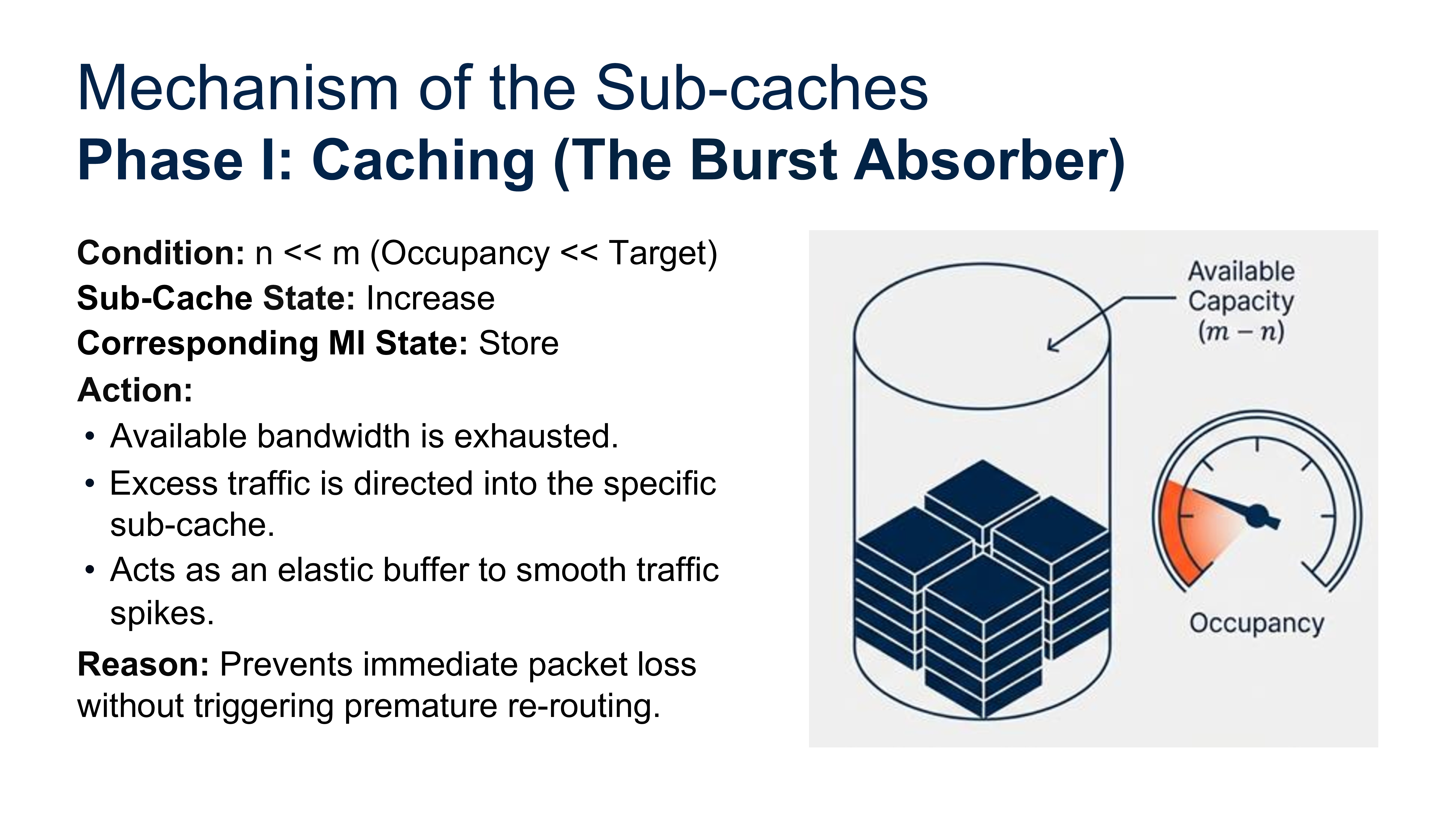 |
Now, lets look at the three operating phases.Phase 1 is Caching.
When congestion begins and cache occupancy ($n$) is significantly lower than the target ($m$) , the sub-cache acts as a Burst Absorber.
We store excess traffic in the buffer to smooth out spikes. At this stage, we do not yet divert traffic to the detour path, avoiding premature reordering. |
| ICACT20260302 Slide.10
[Big Slide]
[YouTube] |
Chrome Click!! |
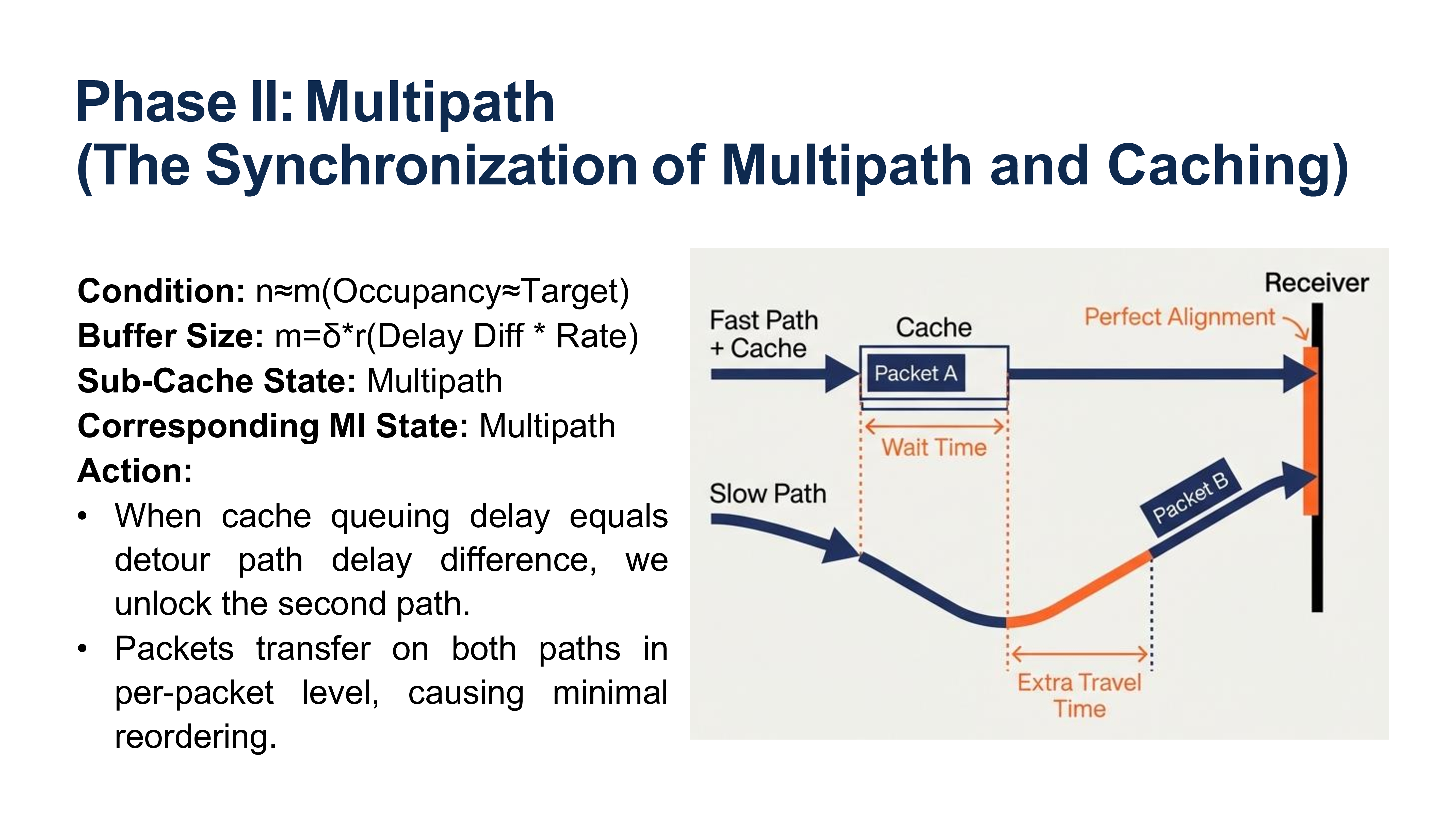 |
Phase 2 is Multipath..
This is where the coordination happens. When the cache occupancy ($n$) reaches the target size ($m$), the queuing delay in the cache equals the delay difference between the fast and slow paths.
This creates a Perfect Alignment.
We can now send packets via both the cached path and the detour path simultaneously. The packets from the cache (which waited) and the packets from the slow path will arrive at the receiver at roughly the same time, minimizing out-of-order arrival. |
| ICACT20260302 Slide.11
[Big Slide]
[YouTube] |
Chrome Click!! |
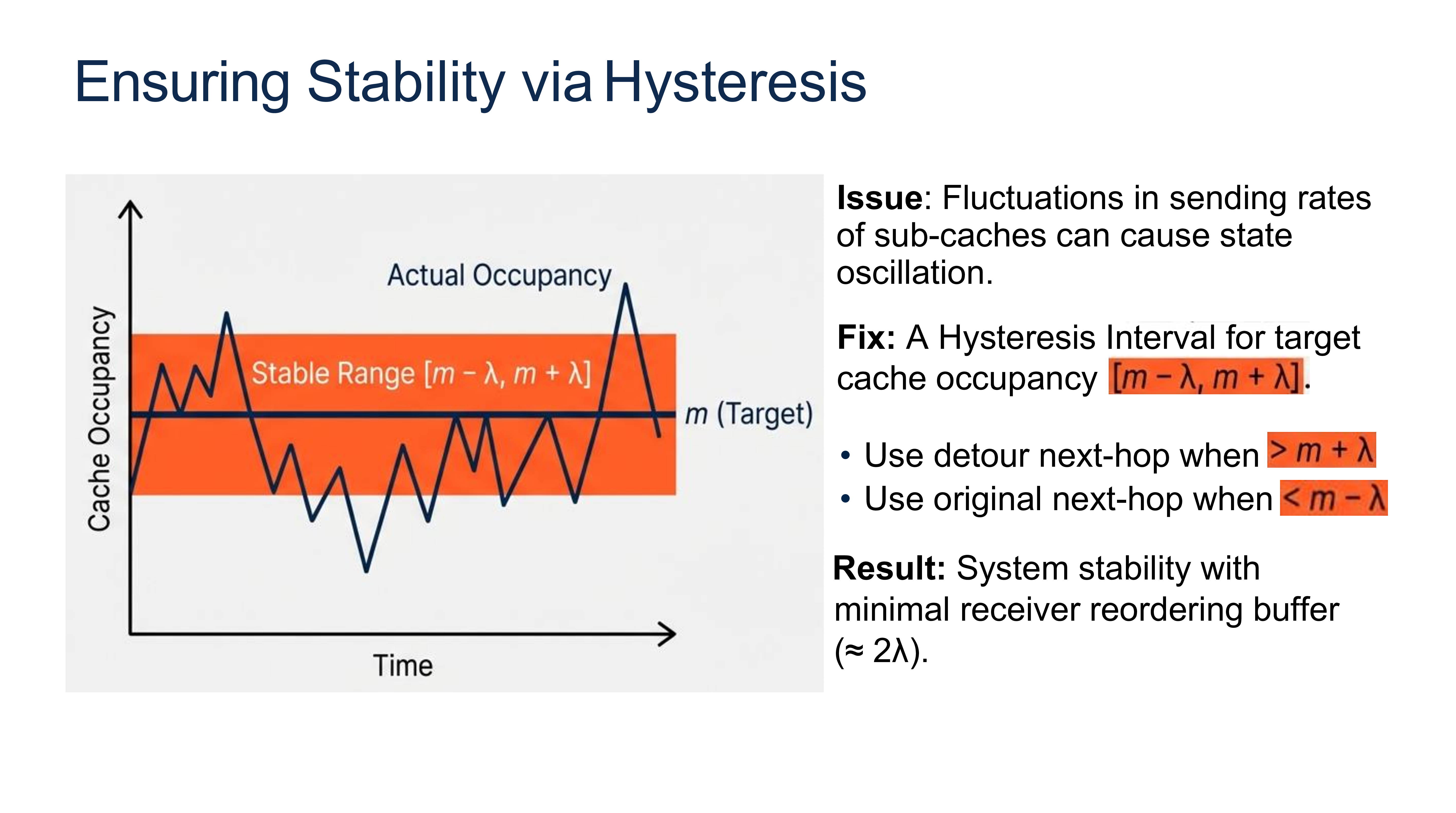 |
To prevent the system from oscillating between states due to minor rate fluctuations, we introduce a Hysteresis Interval.
We define a stable range $[m-\lambda, m+\lambda]$.
We only switch to the detour path when occupancy exceeds the upper bound, and switch back to caching when it drops below the lower bound.
This ensures stability while keeping the required reordering buffer at the receiver very small—approximately $2\lambda$. |
| ICACT20260302 Slide.12
[Big Slide]
[YouTube] |
Chrome Click!! |
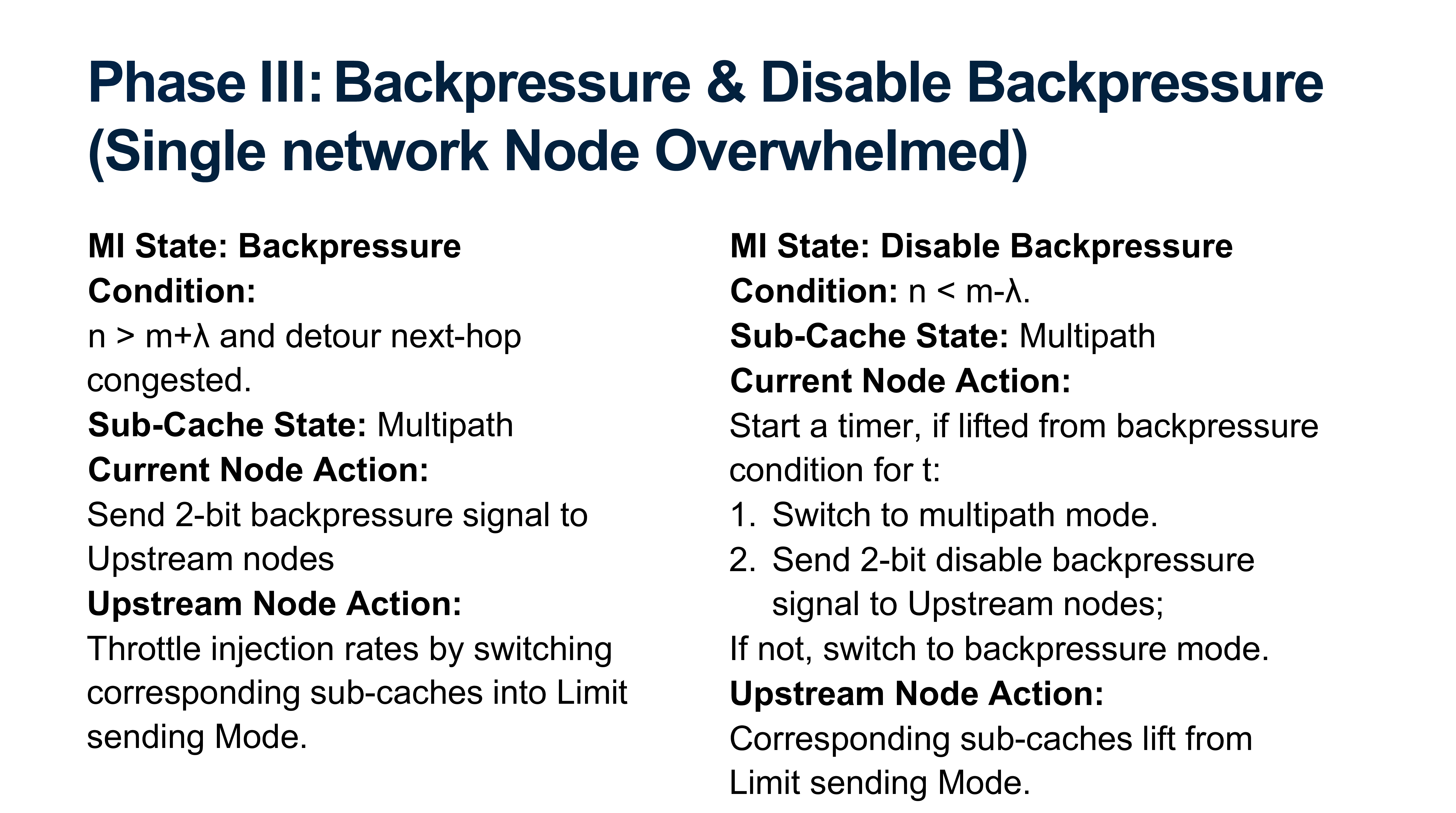 |
Phase 3 is Backpressure. If a single node becomes overwhelmed—meaning occupancy exceeds the limit and the detour path is also full—we trigger Backpressure. A 2-bit signal is sent upstream to throttle the injection rate. When the congestion alleviates for a period of time, the backpressure is lifted and a Disable Backpressure signal allows the upstream node to resume normal transmission. |
| ICACT20260302 Slide.13
[Big Slide]
[YouTube] |
Chrome Click!! |
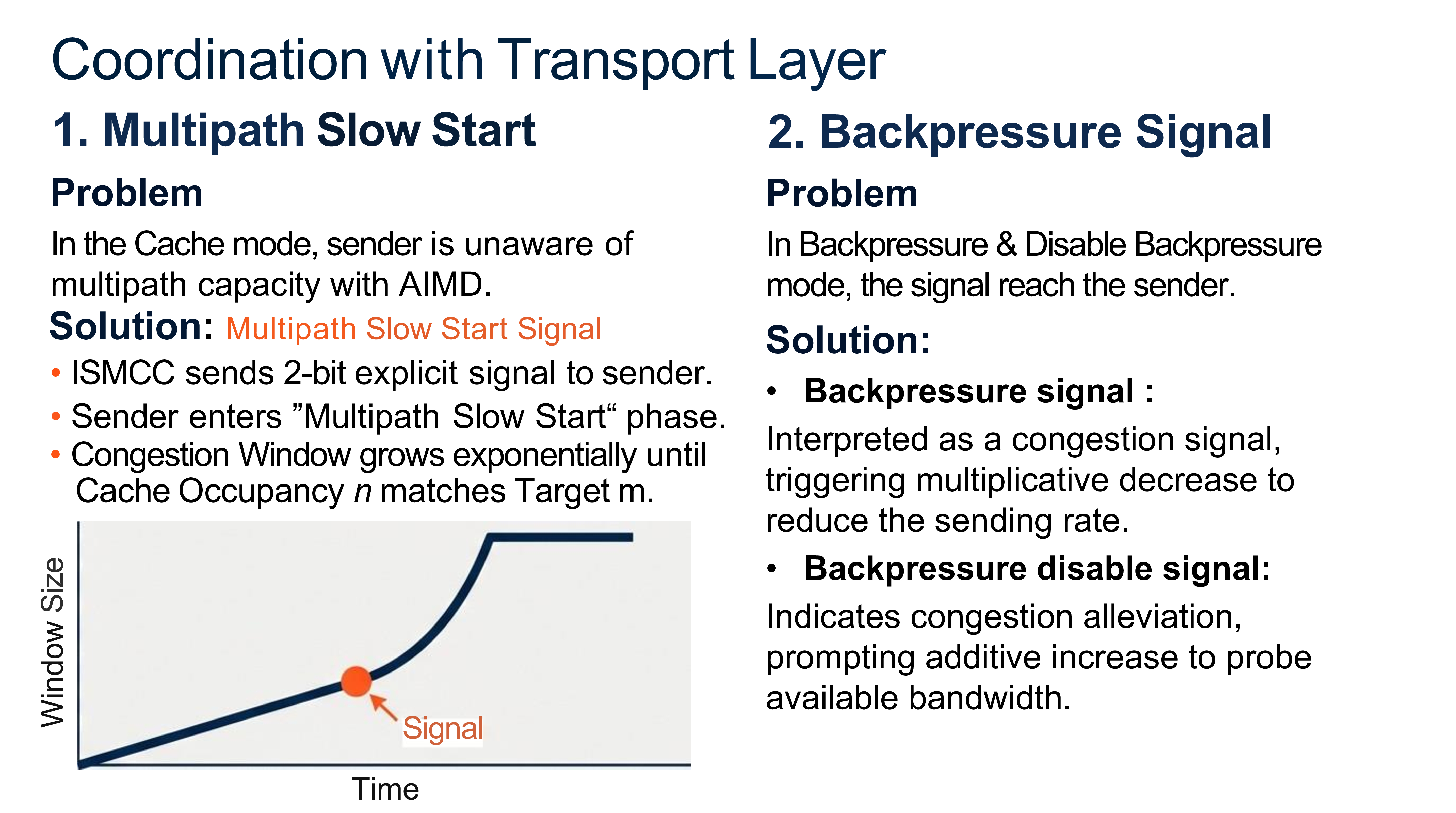 |
To ensure robust functionality, ISMCC also coordinates with the Transport Layer. First, we implement a Multipath Slow Start mechanism in the Cache mode. When an available detour path is detected, the sender is notified to exponentially increase its window to fill the new capacity. Second, for Backpressure, we translate the signals into standard congestion responses—multiplicative decrease for congestion, and additive increase when backpressure is disabled. |
| ICACT20260302 Slide.14
[Big Slide]
[YouTube] |
Chrome Click!! |
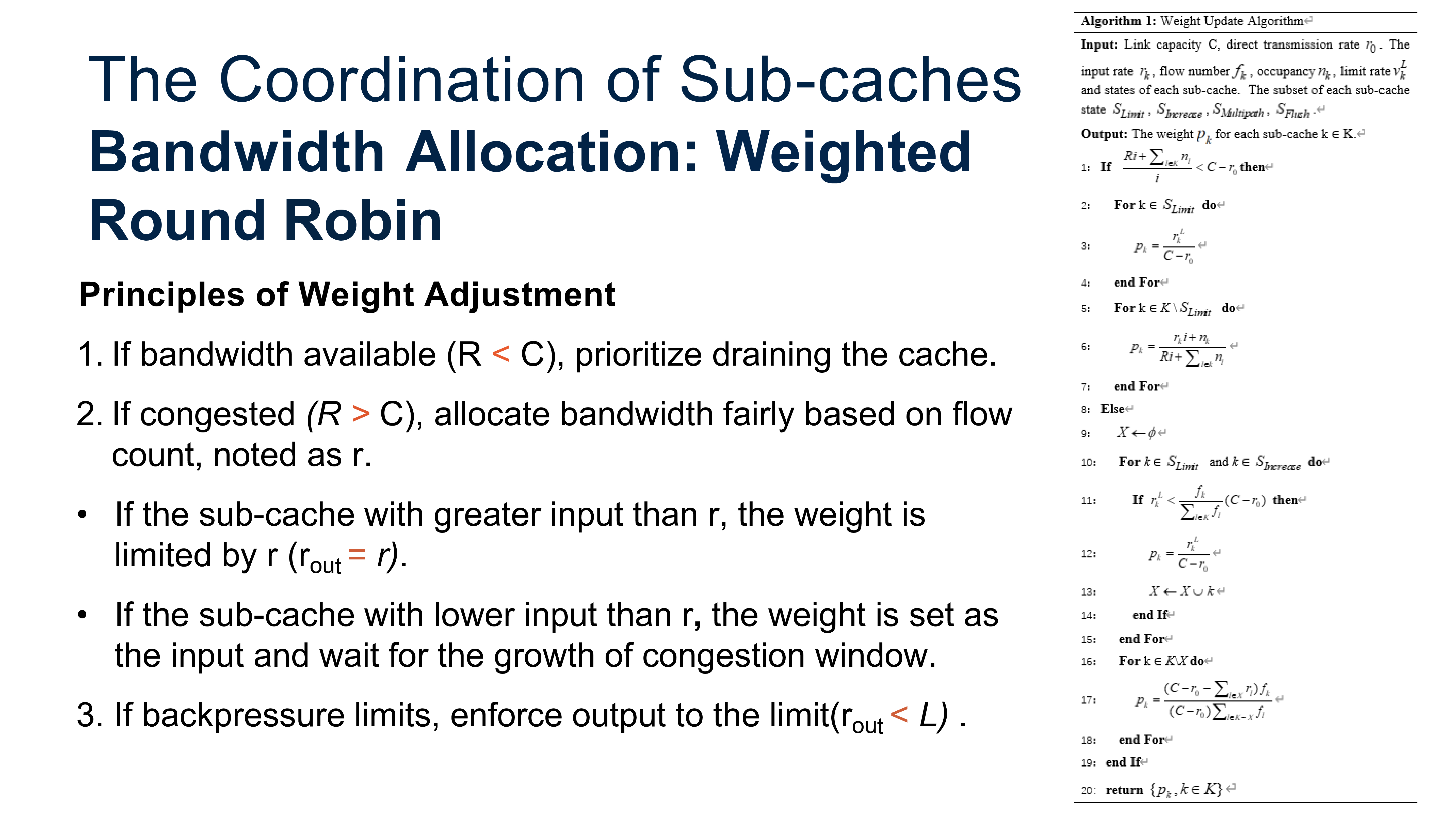 |
For bandwidth allocation, we use a dynamic Weight Update Algorithm. The principle is simple: If there is available bandwidth, we prioritize draining the cache. If the link is congested, we allocate weights fairly based on the number of flows in each sub-cache. This ensures fairness between different streams sharing the same interface. If backpressure limits, we strictly enforce the output limit. |
| ICACT20260302 Slide.15
[Big Slide]
[YouTube] |
Chrome Click!! |
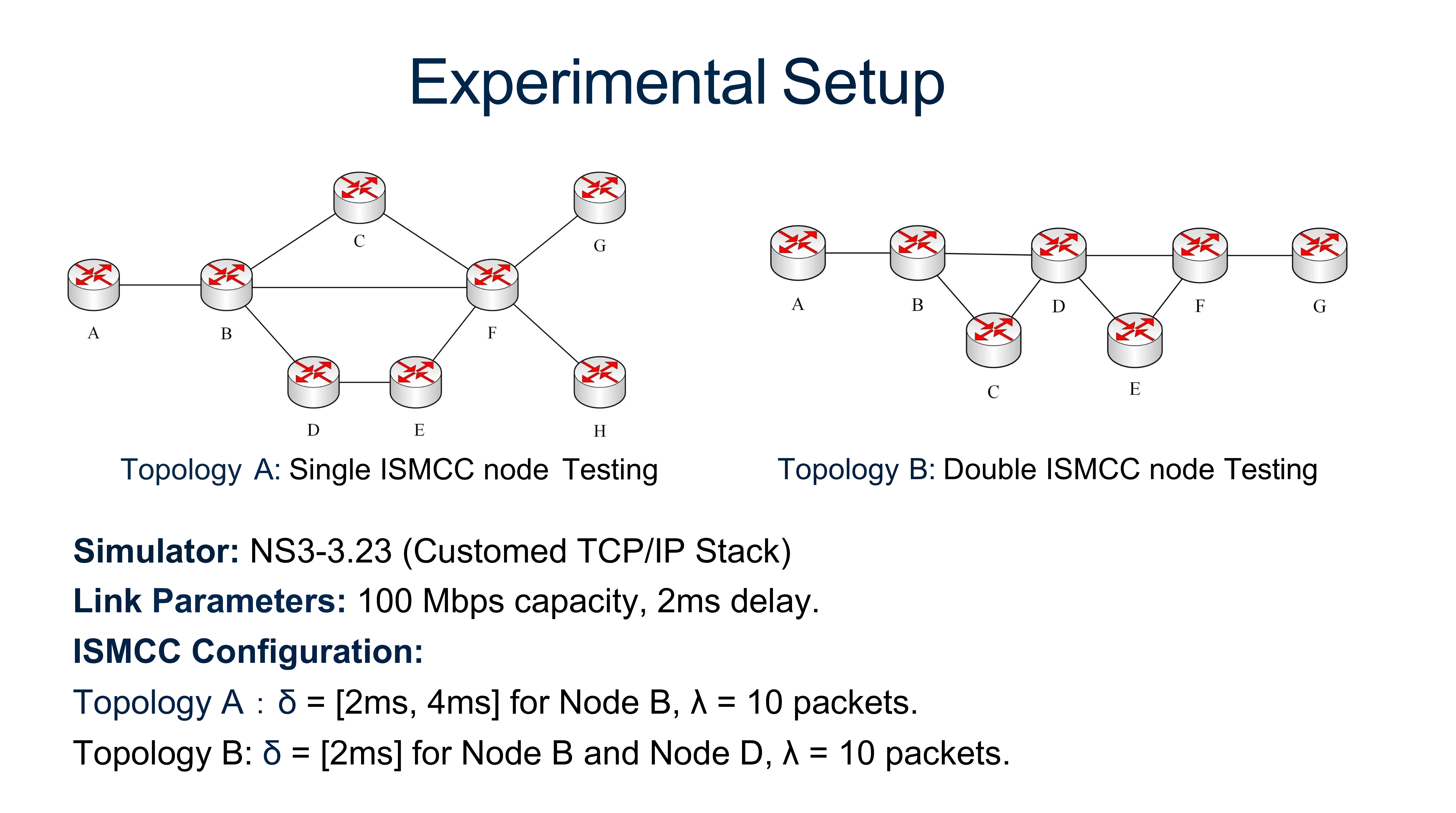 |
We evaluated ISMCC using the NS-3 simulator. We used two topologies: Topology A tests the single-node performance of caching and multipath. Topology B tests the multi-node coordination and backpressure mechanism. The link capacity was set to 100 Mbps with a 2ms delay. |
| ICACT20260302 Slide.16
[Big Slide]
[YouTube] |
Chrome Click!! |
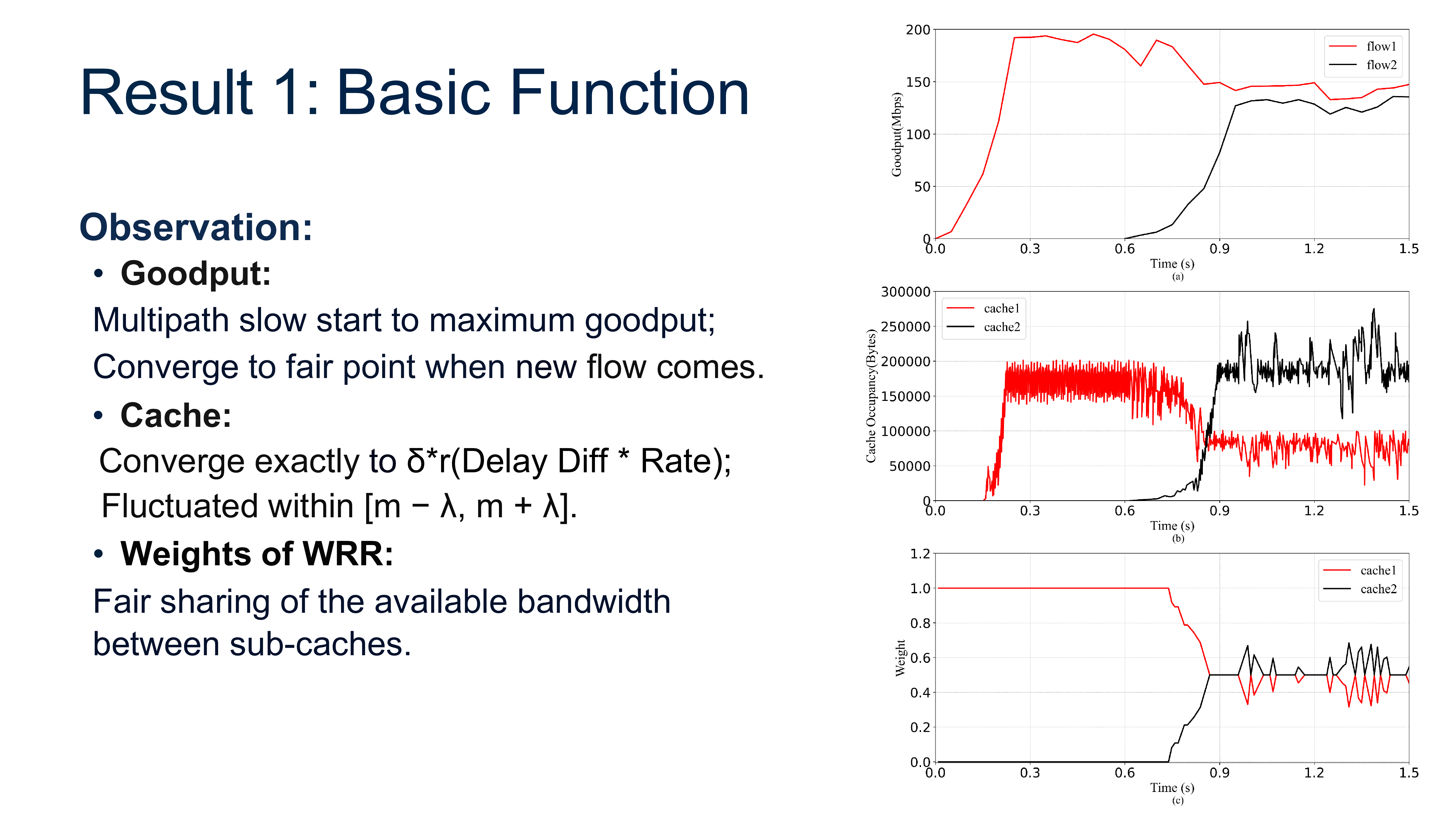 |
Lets examine the evaluation of ISMCCs fundamental performance.
Figure (a) demonstrates that Flow 1 rapidly ramps up to fully utilize the multipath capacity. Upon the arrival of Flow 2, the bandwidth allocation converges to a fair state.
Figure (b) depicts the cache occupancy. The red line for Cache 1 stabilizes precisely within the target interval [$m$ plus-or-minus $\lambda$] , confirming that our mechanism effectively synchronizes queue size with path delay difference.
Figure (c) presents the weight adjustments of the WRR algorithm. It shows that as Flow 2 joins, the sub-cache weights adjust and converge to their fair shares. |
| ICACT20260302 Slide.17
[Big Slide]
[YouTube] |
Chrome Click!! |
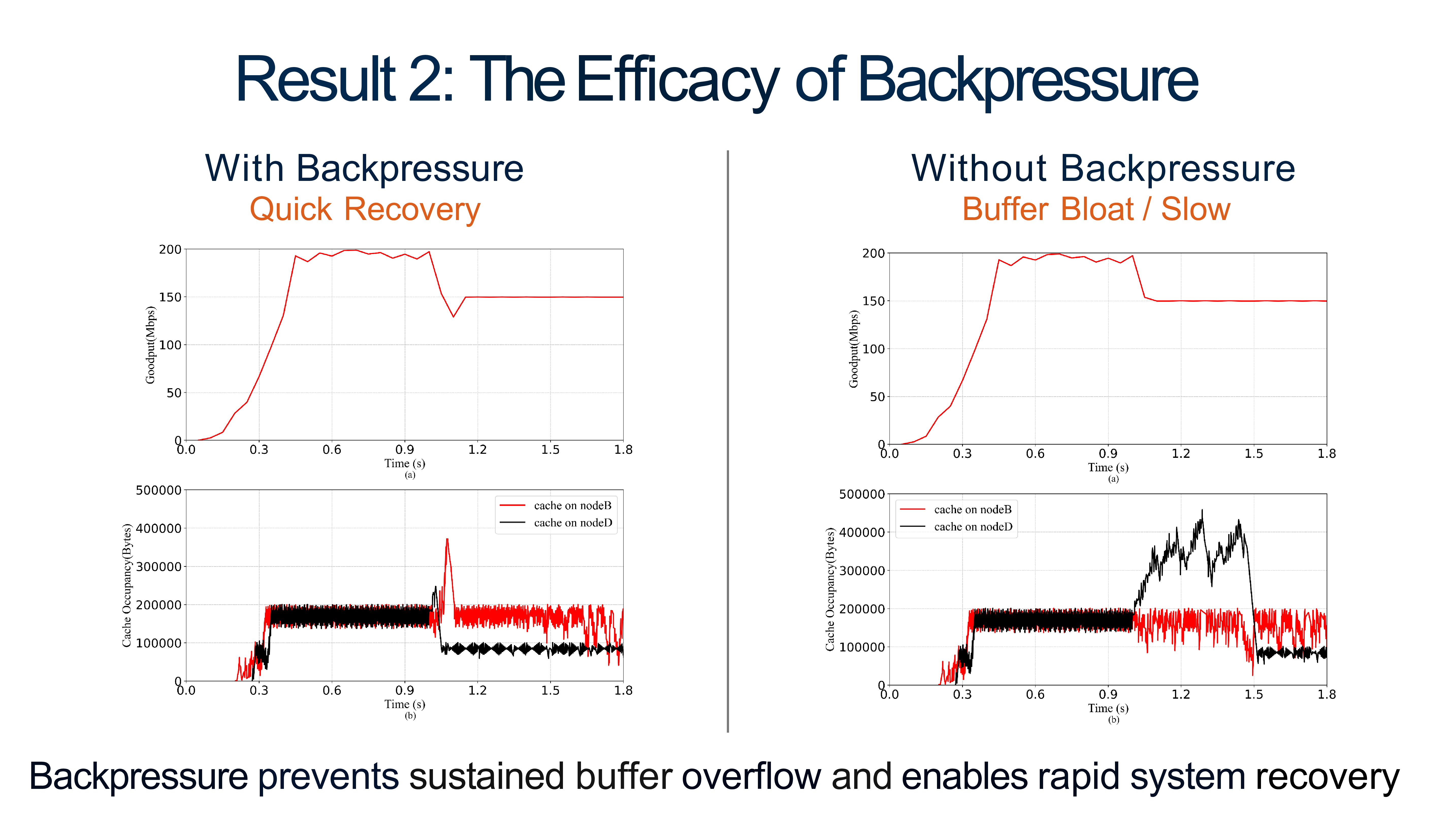 |
Next, we look at the efficacy of Backpressure. In this experiment, we dropped the bandwidth at 1.0 second. As shown in Figure (a) and (b), the system with Backpressure (top graphs) recovers quickly. The cache spikes briefly but then stabilizes. Without Backpressure (bottom graphs), the cache suffers from sustained buffer bloat, and the goodput recovers much slower. |
| ICACT20260302 Slide.18
[Big Slide]
[YouTube] |
Chrome Click!! |
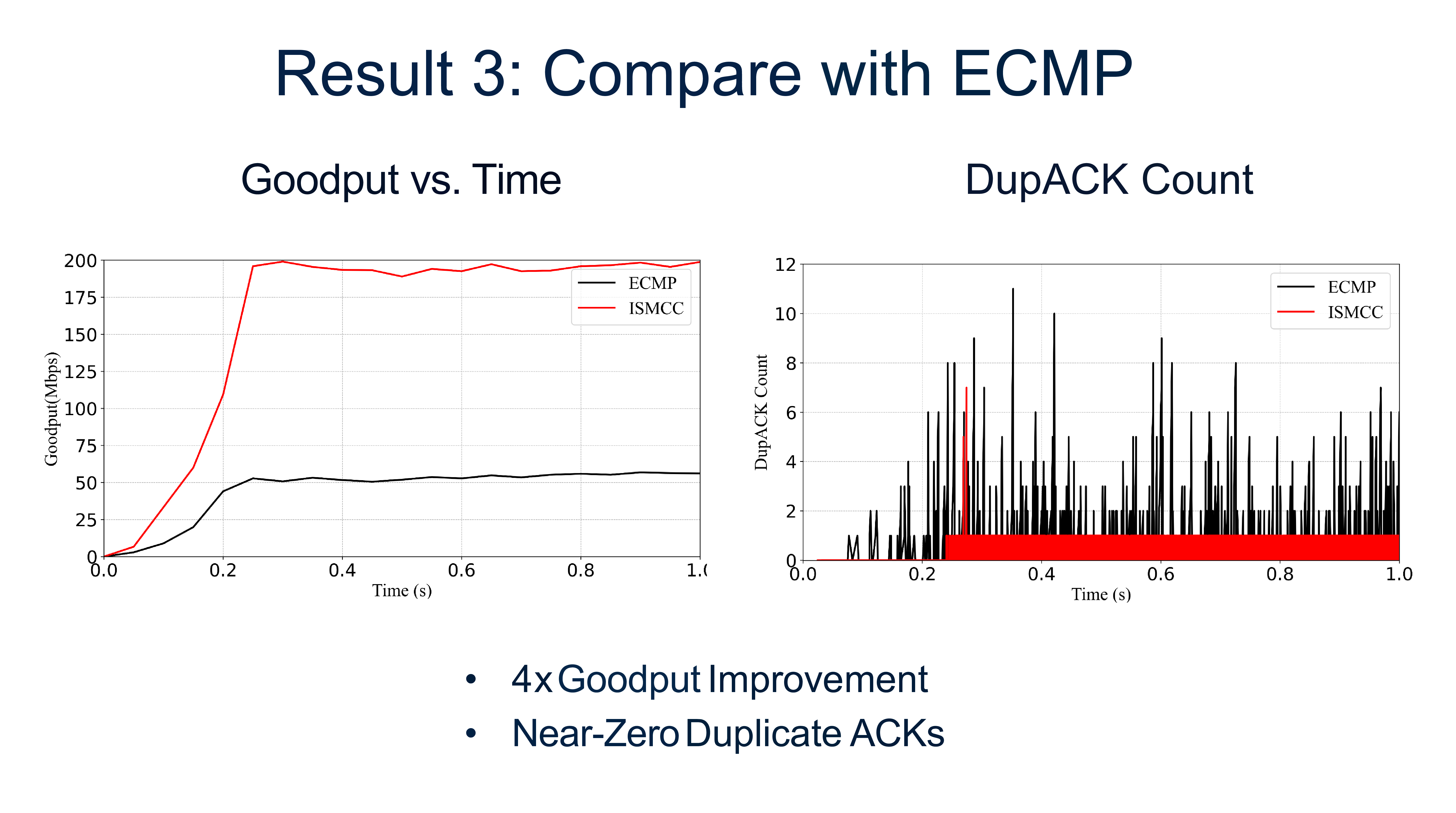 |
Finally, we compared ISMCC against standard ECMP routing. The difference is clear. As seen in the left graph, ISMCC achieves a 3 to 4 times improvement in Goodput. The reason is shown on the right: ECMP causes massive packet reordering, indicated by the high number of Duplicate ACKs (black bars). ISMCC (red bars) keeps Duplicate ACKs near zero, effectively eliminating the reordering problem. |
| ICACT20260302 Slide.19
[Big Slide]
[YouTube] |
Chrome Click!! |
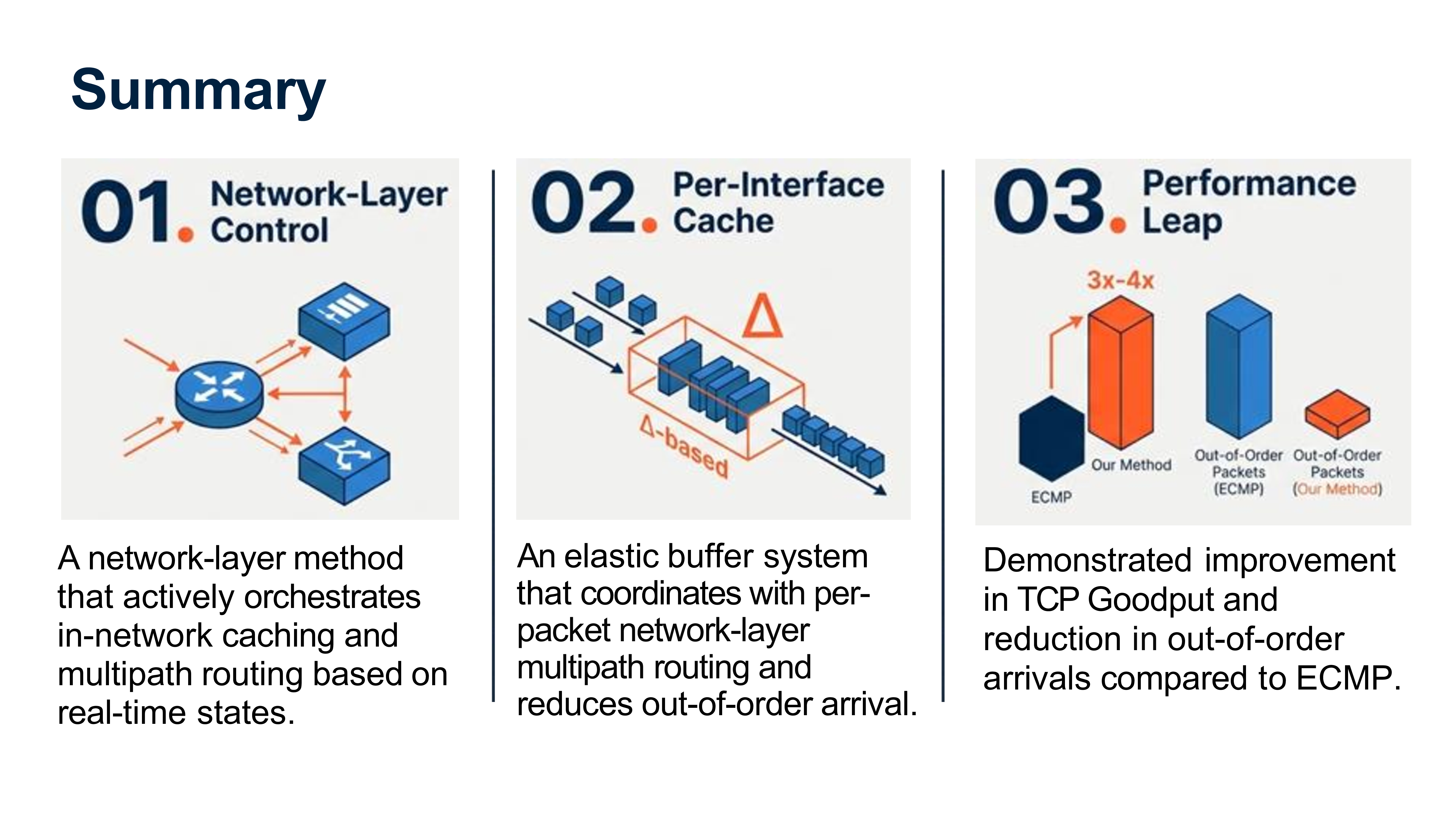 |
To summarize:
1. ISMCC is a network-layer method that actively orchestrates caching and multipath based on real-time states.
2. Our Per-Interface Cache acts as an elastic buffer to enable precise, per-packet network-layer multipath routing and reduces out-of-order arrival.
3. We demonstrated a 3x to 4x improvement in TCP Goodput and reduction in out-of-order arrivals compared to ECMP. |
| ICACT20260302 Slide.20
[Big Slide]
[YouTube] |
Chrome Click!! |
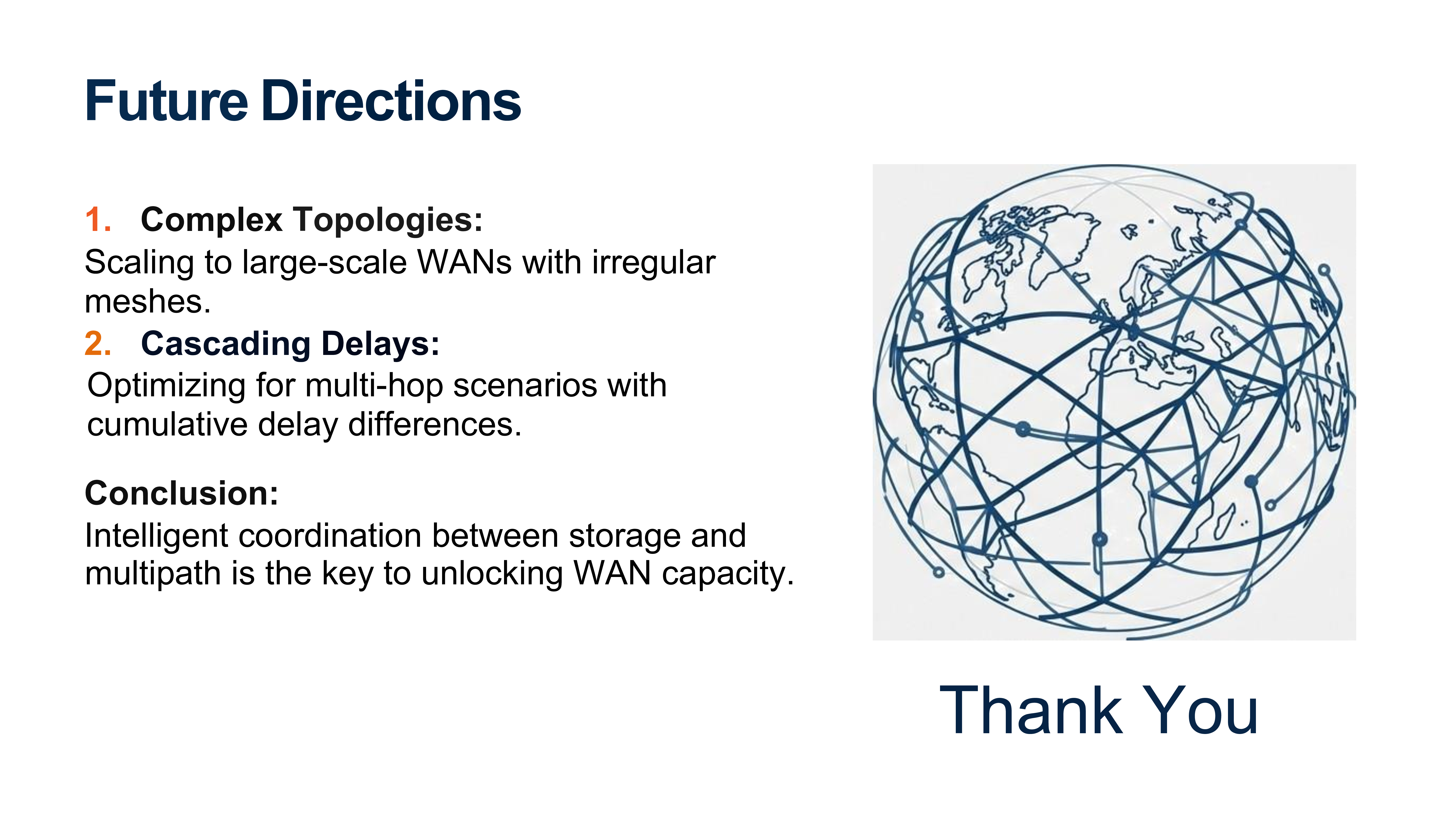 |
Looking ahead, we plan to extend ISMCC to support more complex topologies with large-scale irregular meshes and optimize for cascading delays in multi-hop scenarios. And our conclusion is that intelligent coordination between storage and multipath is the key to unlocking the full capacity of Wide-Area Networks. Thank you for your attention. |















