 ICACT20260349 Slide.01
[Big Slide] |
Chrome  Click!! |
 |
Title
Good morning/afternoon.�My name is Woo-Sung Jung from the Electronics and Telecommunications Research Institute, ETRI, Republic of Korea.
Today, I will present our work titled “Protocol-Aware Dynamic Synchronization for Multi-Rate Maritime Co-Simulation.”
This research addresses a fundamental synchronization problem that arises when we jointly simulate maritime communication systems and ship dynamics operating at very different time scales.
|
| ICACT20260349 Slide.02
[Big Slide]
|
Chrome Click!! |
 |
Contents
This presentation is organized into three parts.
First, I will introduce the background and the multi-rate challenges in maritime co-simulation.
Second, I will explain our proposed protocol-aware dynamic synchronization method and its algorithmic design.
Finally, I will present experimental results, followed by conclusions and future research directions.
|
| ICACT20260349 Slide.03
[Big Slide]
|
Chrome Click!! |
 |
Part I – Introduction
In the first part, I will briefly explain why synchronization has become a critical issue in modern maritime cyber–physical systems.
|
| ICACT20260349 Slide.04
[Big Slide]
|
Chrome Click!! |
 |
Research Background
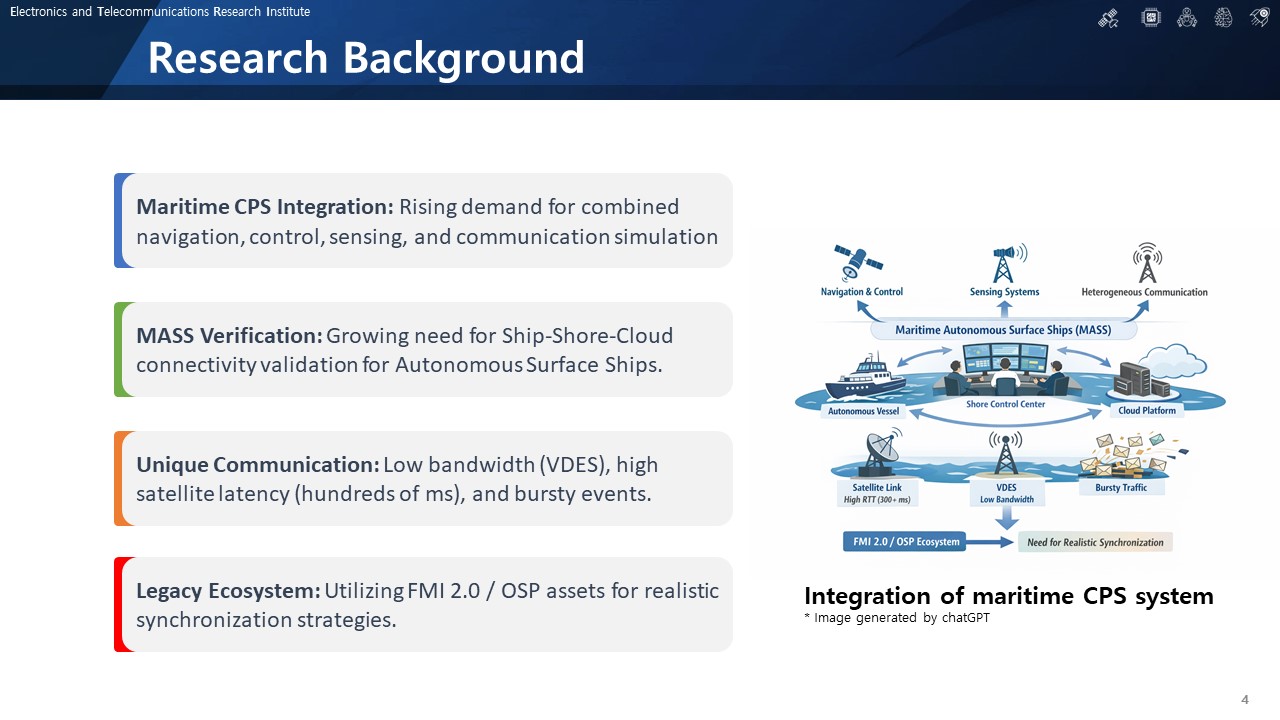
Maritime cyber–physical systems increasingly integrate navigation, control, sensing, and communication into a unified simulation environment.
In particular, with the growing interest in Maritime Autonomous Surface Ships, or MASS, there is a strong need to validate ship–shore–cloud connectivity before real deployment.
However, maritime communication environments are very unique.�They often rely on low-bandwidth systems such as VDES, experience satellite round-trip times of several hundred milliseconds, and show bursty, event-driven traffic patterns.
At the same time, most existing maritime simulation ecosystems are still based on FMI 2.0 and OSP, which motivates us to develop realistic synchronization strategies without discarding legacy assets.
|
| ICACT20260349 Slide.05
[Big Slide]
|
Chrome Click!! |
 |
The Multi-rate Challenges
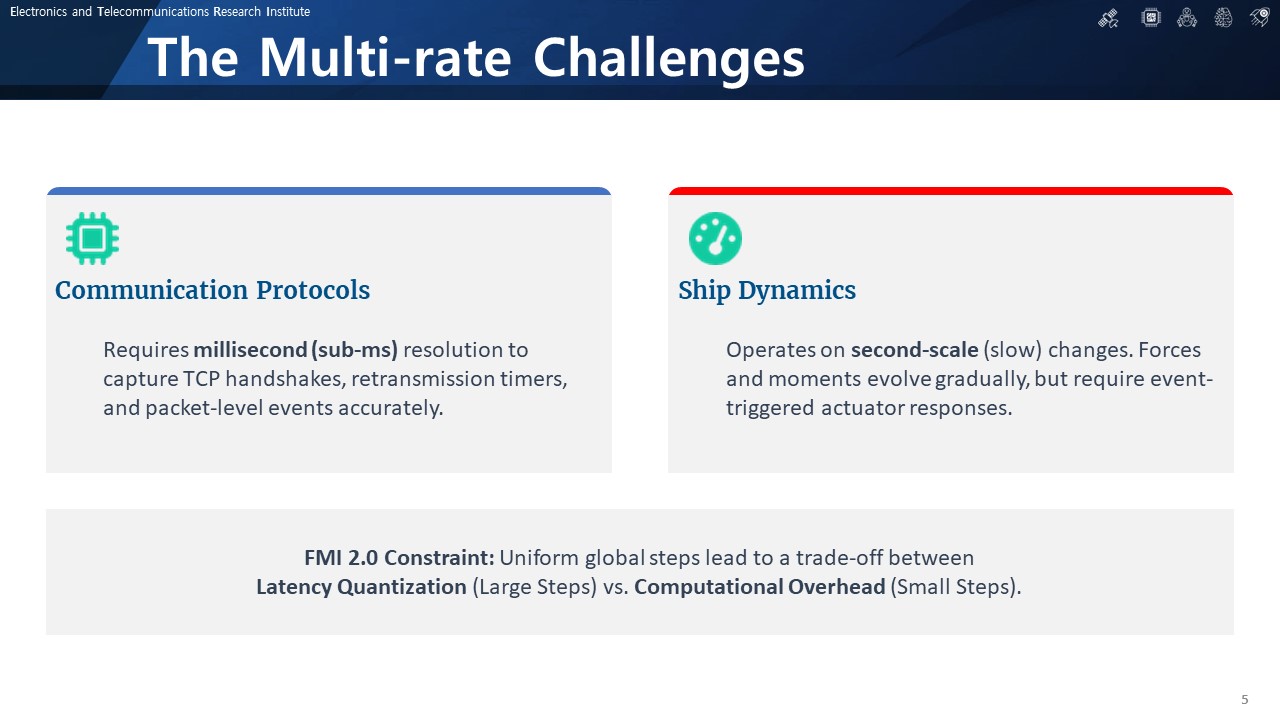
Here we see the core multi-rate challenge.
Communication protocols, such as TCP, require millisecond or even sub-millisecond resolution to correctly capture handshakes, retransmission timers, and packet-level events.
In contrast, ship dynamics evolve much more slowly, on the order of seconds, due to the large inertia of vessels.
The problem is that FMI 2.0 enforces a uniform global step size.
If the step is large, communication latency becomes heavily quantized.�If the step is small, the ship dynamics model is evaluated far more often than necessary, leading to excessive computational overhead.
|
| ICACT20260349 Slide.06
[Big Slide]
|
Chrome Click!! |
 |
Limitations of Existing Methods
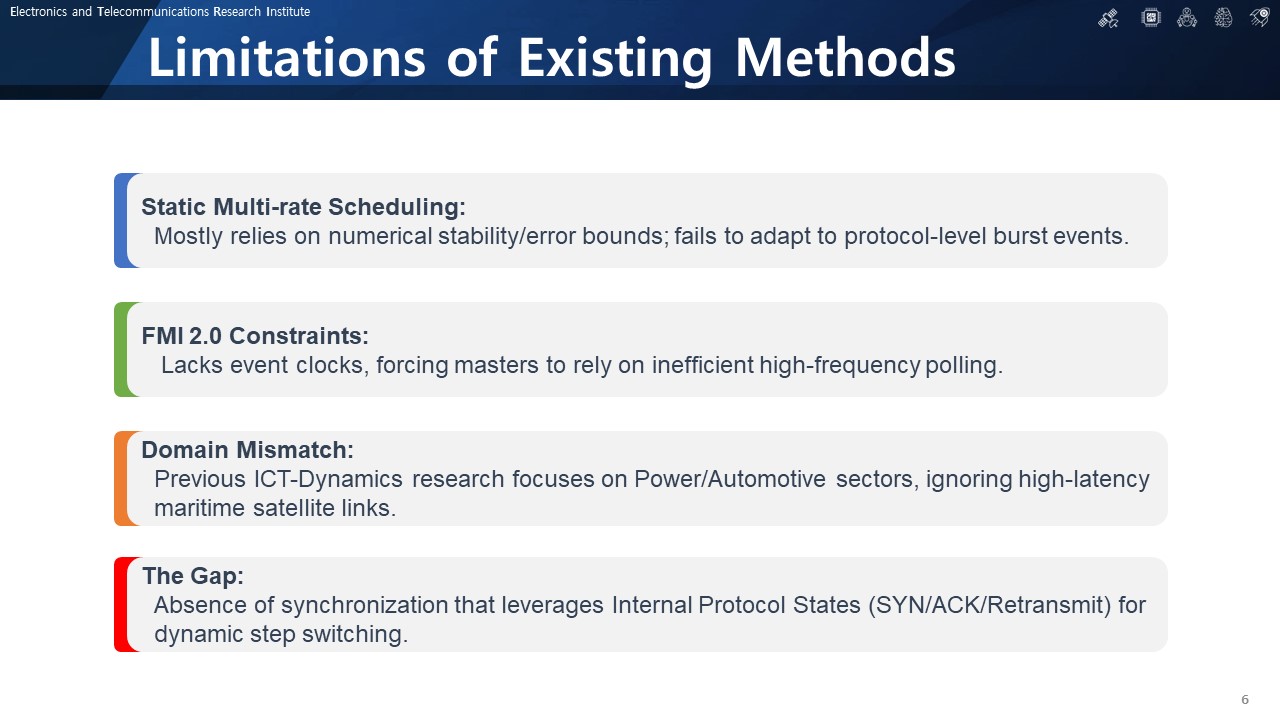
Existing approaches suffer from several limitations.
First, static multi-rate scheduling mostly relies on numerical stability or error bounds and cannot adapt to bursty protocol-level events.
Second, FMI 2.0 lacks explicit event clocks, forcing master algorithms to rely on inefficient high-frequency polling.
Third, although communication–dynamics co-simulation has been studied, it mainly focuses on power systems or automotive domains and does not reflect high-latency maritime satellite links.
As a result, there is a clear gap:�no FMI 2.0-compatible synchronization method that leverages internal protocol states, such as SYN, ACK, or retransmission, for dynamic step switching.
|
| ICACT20260349 Slide.07
[Big Slide]
|
Chrome Click!! |
 |
Part II – Protocol-Aware Synchronization
To address this gap, we propose a protocol-aware synchronization framework, which I will explain in this part.
|
| ICACT20260349 Slide.08
[Big Slide]
|
Chrome Click!! |
 |
Proposed Method Overview
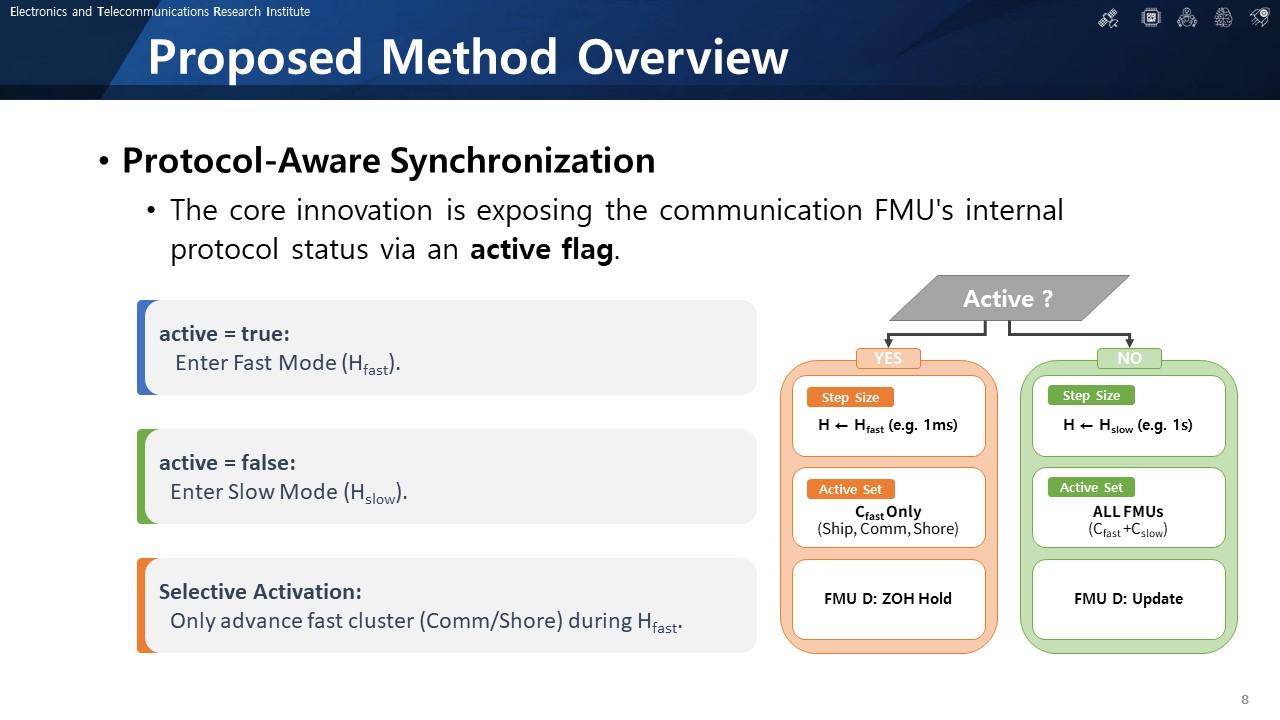
The core innovation of our approach is very simple but powerful.
We expose the internal protocol status of the communication FMU through a Boolean flag called active.
When active is true, meaning that handshake or data transfer is ongoing, the simulator enters a fast mode using a small step size, such as 1 millisecond.
When active is false, the simulator switches to a slow mode with a large step size, such as 1 second.
Importantly, only the fast cluster is executed during fast mode, while slow dynamics are held using a zero-order hold.
|
| ICACT20260349 Slide.09
[Big Slide]
|
Chrome Click!! |
 |
System Architecture
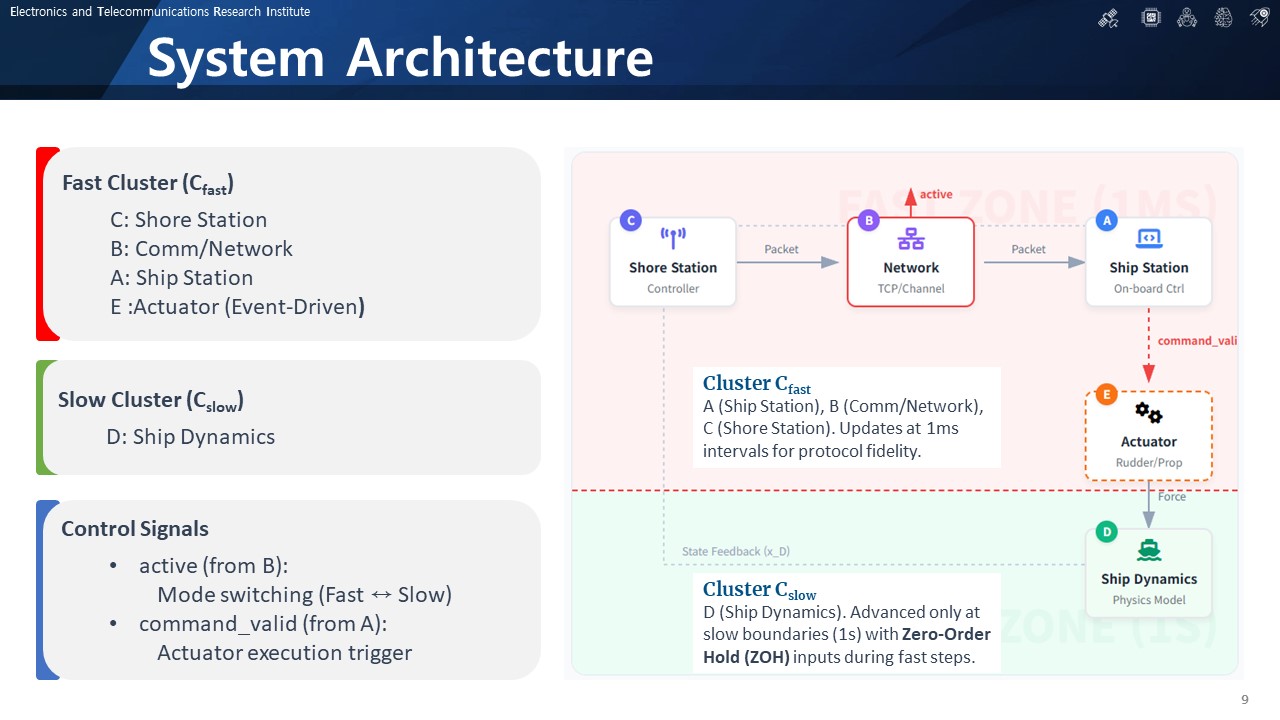
This slide illustrates the system architecture and FMU clustering.
The fast cluster consists of the ship station, communication network, shore station, and an event-driven actuator.�These FMUs are updated at millisecond resolution to preserve protocol fidelity.
The slow cluster contains the ship dynamics FMU, which is updated only at slow boundaries.
Two control signals coordinate the system:�the active signal from the communication FMU controls mode switching, and command_valid triggers actuator execution.
|
| ICACT20260349 Slide.10
[Big Slide]
|
Chrome Click!! |
 |
Algorithm: Communication-Aware Sync Master
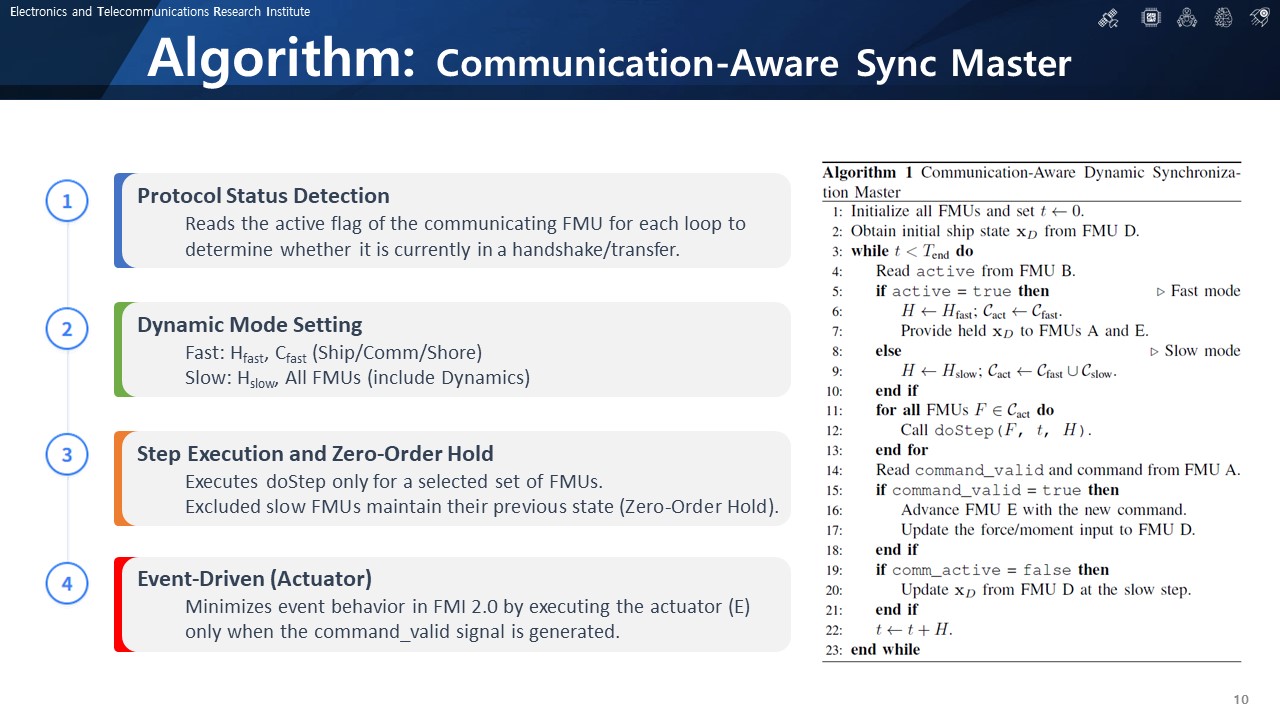
This slide summarizes the master algorithm.
At each loop, the master first reads the active flag from the communication FMU to detect protocol activity.
Based on this flag, it dynamically selects the step size and the set of FMUs to be executed.
During fast mode, slow FMUs are excluded and their states are held using zero-order hold.
Finally, actuator execution is handled in an event-driven manner using the command_valid signal, effectively emulating FMI 3.0 clock behavior within FMI 2.0.
|
| ICACT20260349 Slide.11
[Big Slide]
|
Chrome Click!! |
 |
Experiment Setup
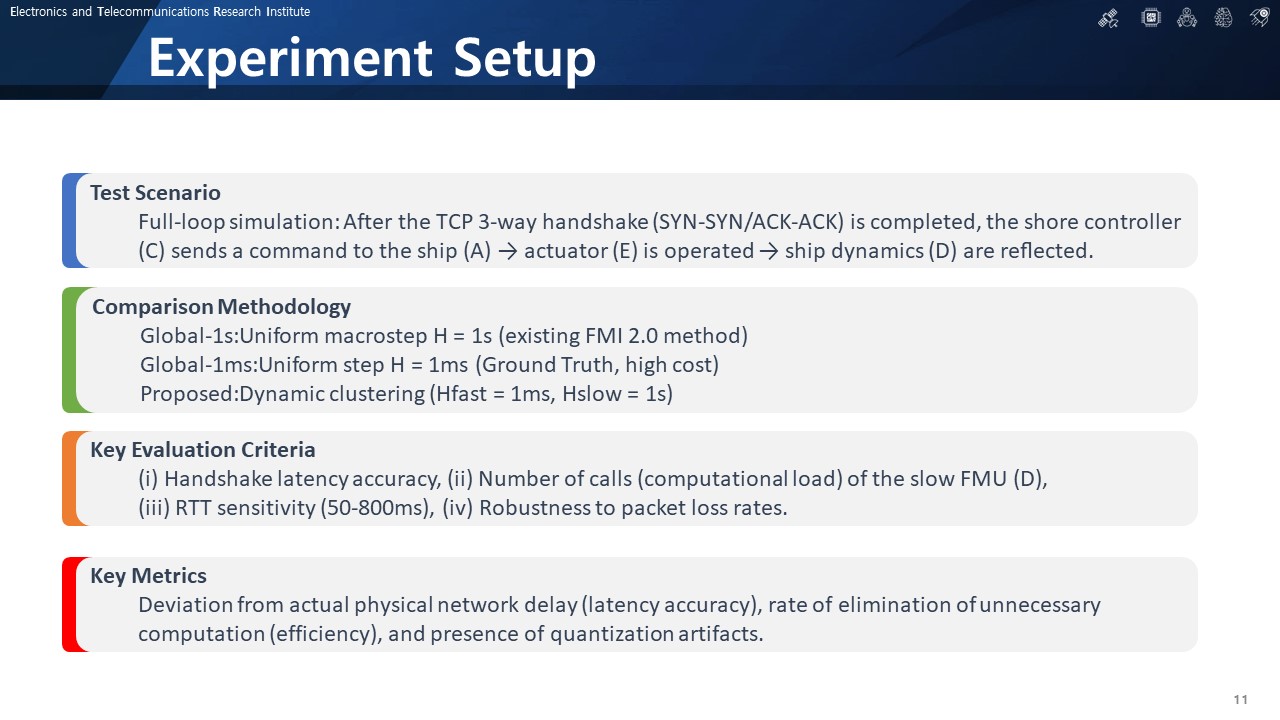
To evaluate the proposed method, we designed a full-loop simulation scenario.
After a TCP three-way handshake, a command is sent from the shore controller to the ship, which triggers the actuator and affects ship dynamics.
We compare three methods:�Global-1s, a uniform 1-second step;�Global-1ms, a uniform 1-millisecond step used as ground truth;�and our proposed dynamic clustering approach.
Evaluation metrics include handshake latency accuracy, computational load of the ship dynamics FMU, RTT sensitivity, and robustness to packet loss.
|
| ICACT20260349 Slide.12
[Big Slide]
|
Chrome Click!! |
 |
Results 1 – Handshake Latency
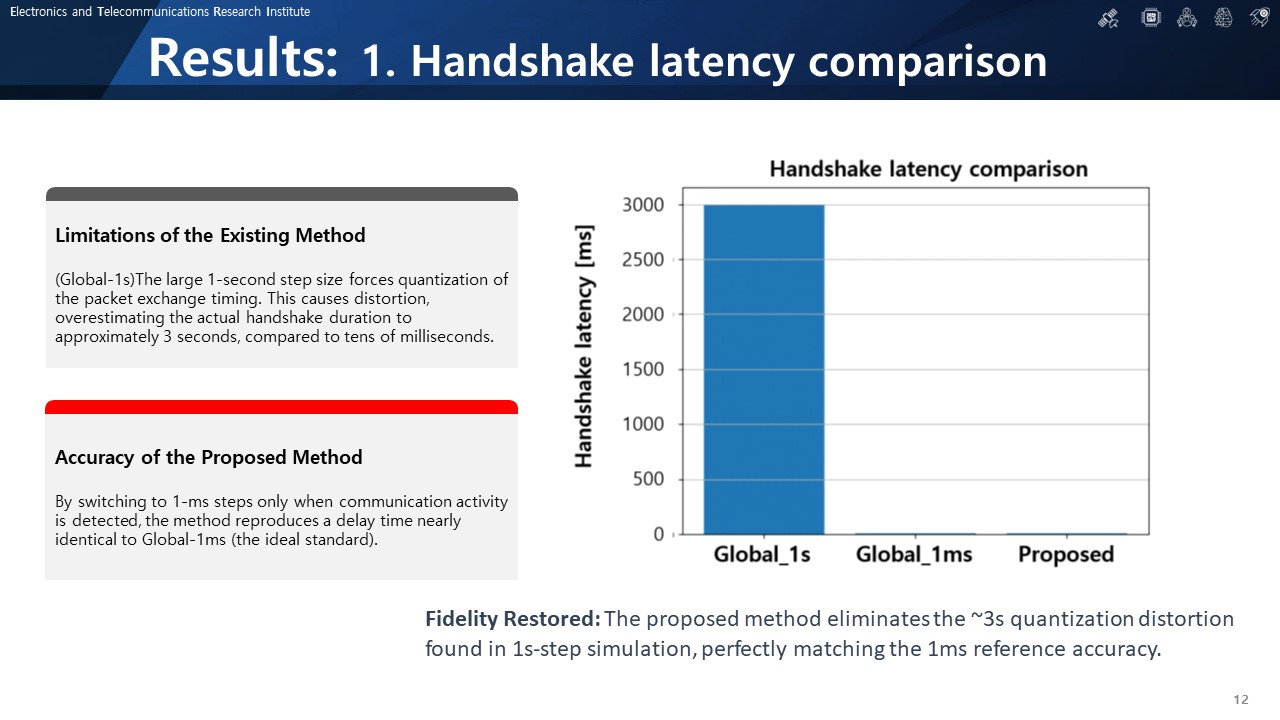
This slide shows the handshake latency comparison.
With Global-1s, packet timing is heavily quantized, resulting in an inflated handshake delay of about 3 seconds.
Global-1ms reproduces realistic millisecond-level timing but at a very high computational cost.
Our proposed method achieves nearly identical accuracy to Global-1ms by switching to fast mode only during communication activity, completely eliminating quantization distortion.
|
| ICACT20260349 Slide.13
[Big Slide]
|
Chrome Click!! |
 |
Results 2 – Slow FMU Call Count
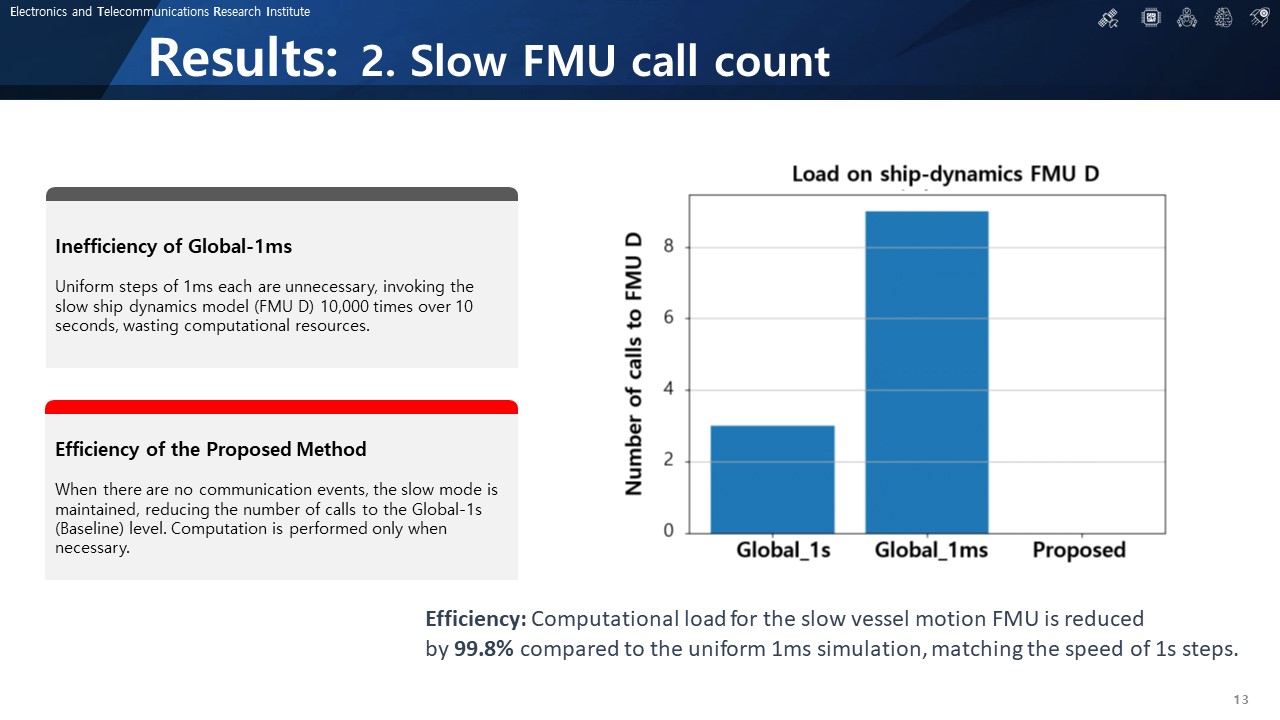
Here we compare the computational load.
Global-1ms unnecessarily invokes the ship dynamics FMU around 10,000 times over 10 seconds.
In contrast, the proposed method keeps the number of calls close to the Global-1s baseline.
This corresponds to a 99.8% reduction in slow FMU computations, while preserving communication accuracy.
|
| ICACT20260349 Slide.14
[Big Slide]
|
Chrome Click!! |
 |
Results 3 – Sensitivity to RTT
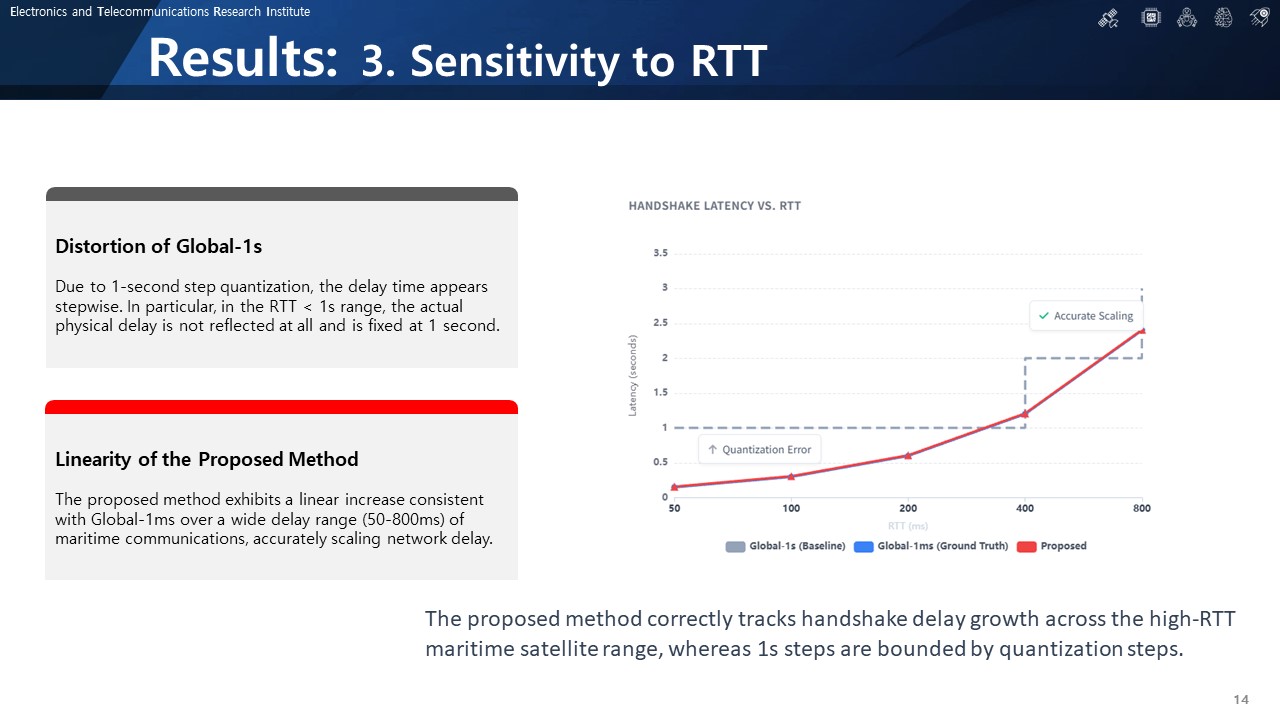
This slide shows handshake latency as a function of network RTT.
With Global-1s, delays are dominated by step quantization and appear as stair-step patterns, especially for RTT values below one second.
The proposed method accurately tracks latency growth from 50 to 800 milliseconds, closely matching the Global-1ms reference.
This confirms correct scaling under maritime satellite communication conditions.
|
| ICACT20260349 Slide.15
[Big Slide]
|
Chrome Click!! |
 |
Results 4 – Packet Loss
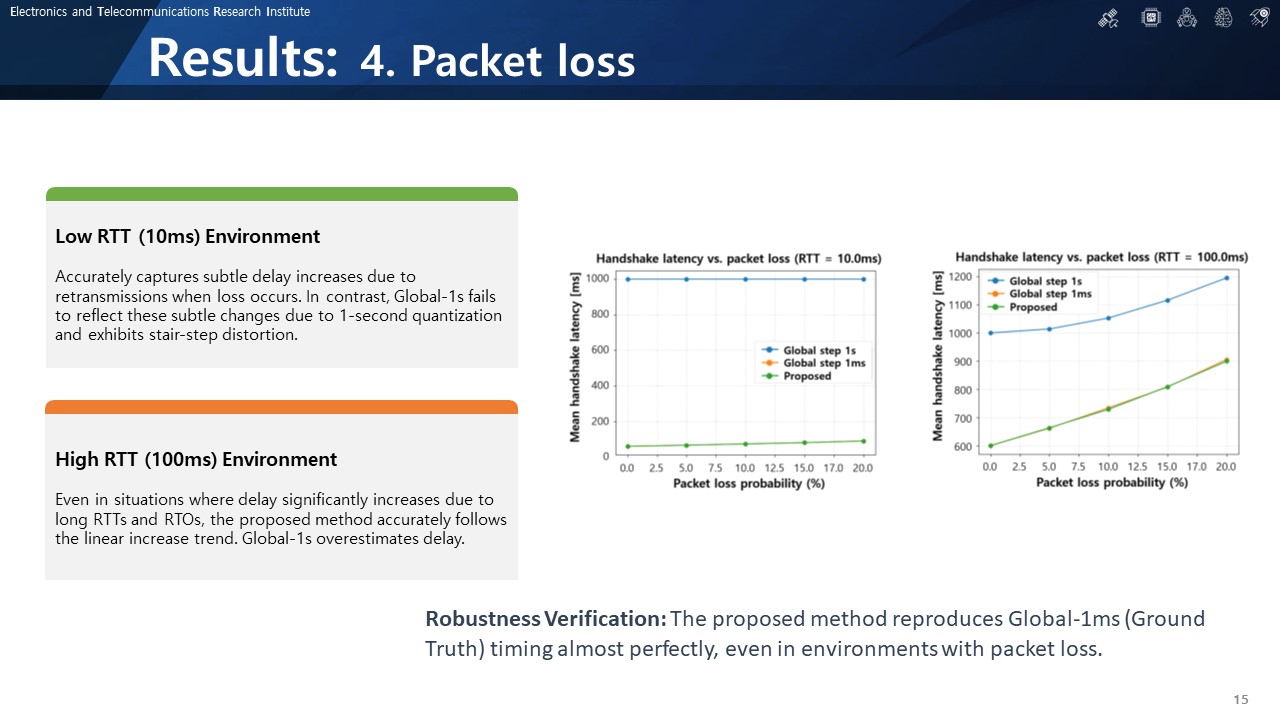
Finally, we evaluate robustness to packet loss.
Under low RTT conditions, the proposed method captures subtle delay increases caused by retransmissions, while Global-1s fails to do so.
Under high RTT conditions, retransmission delays grow significantly, and again the proposed method closely follows the ground truth.
Overall, the method reproduces Global-1ms timing almost perfectly, even in lossy maritime networks.
|
| ICACT20260349 Slide.16
[Big Slide]
|
Chrome Click!! |
 |
Part III – Conclusion
In the final part, I will summarize our findings and discuss their implications.
|
| ICACT20260349 Slide.17
[Big Slide]
|
Chrome Click!! |
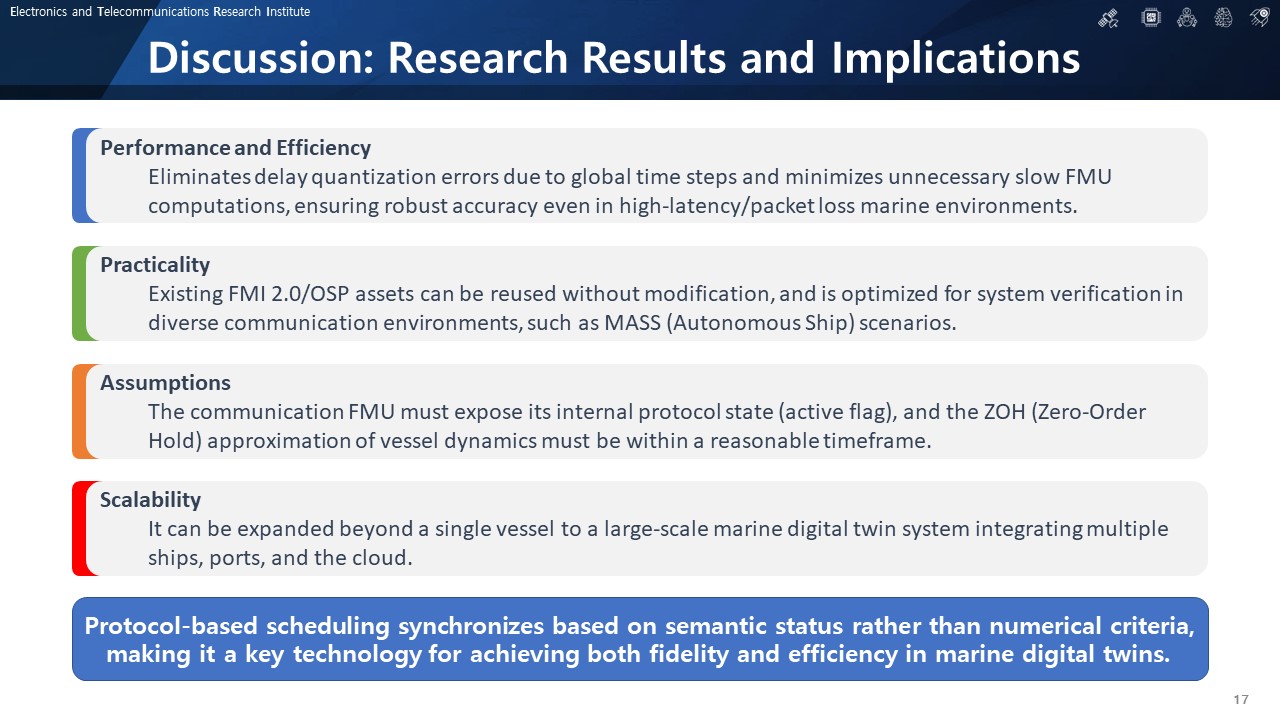 |
Discussion: Implications
The proposed method eliminates latency quantization while minimizing unnecessary computation, ensuring robust accuracy in high-latency maritime environments.
A key advantage is practicality: existing FMI 2.0 and OSP assets can be reused without modification.
The approach assumes that the communication FMU can expose protocol state and that zero-order hold remains valid over short fast intervals.
Finally, the method is scalable and can be extended to large-scale maritime digital twin systems.
|
| ICACT20260349 Slide.18
[Big Slide]
|
Chrome Click!! |
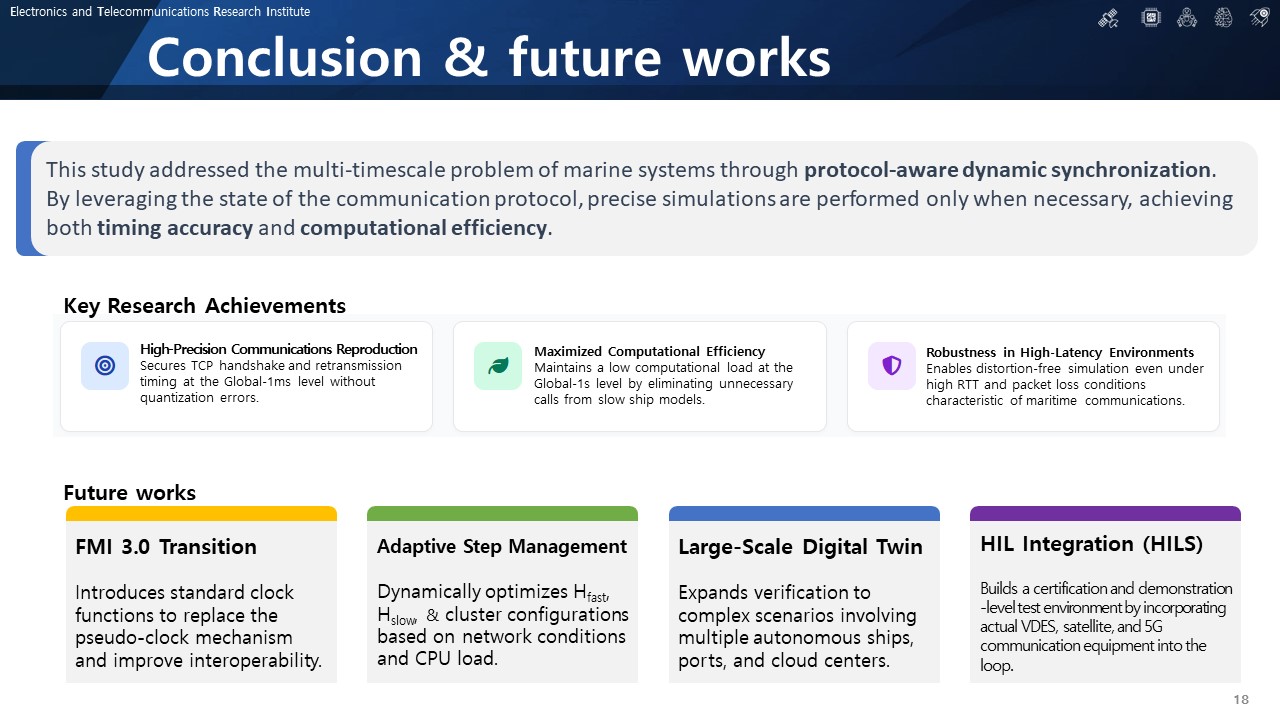 |
Conclusion & Future Works
In conclusion, this study addresses the multi-timescale problem of maritime systems through protocol-aware dynamic synchronization.
We achieve Global-1ms-level communication fidelity with Global-1s-level computational cost.
Future work includes transitioning to FMI 3.0 clocks, adaptive step management, large-scale digital twin expansion, and hardware-in-the-loop integration with real maritime communication equipment.
|
| ICACT20260349 Slide.19
[Big Slide]
|
Chrome Click!! |
 |
Thank You
Thank you very much for your attention.�I will be happy to answer any questions.
|
| ICACT20260349 Slide.20
[Big Slide]
|
Chrome Click!! |
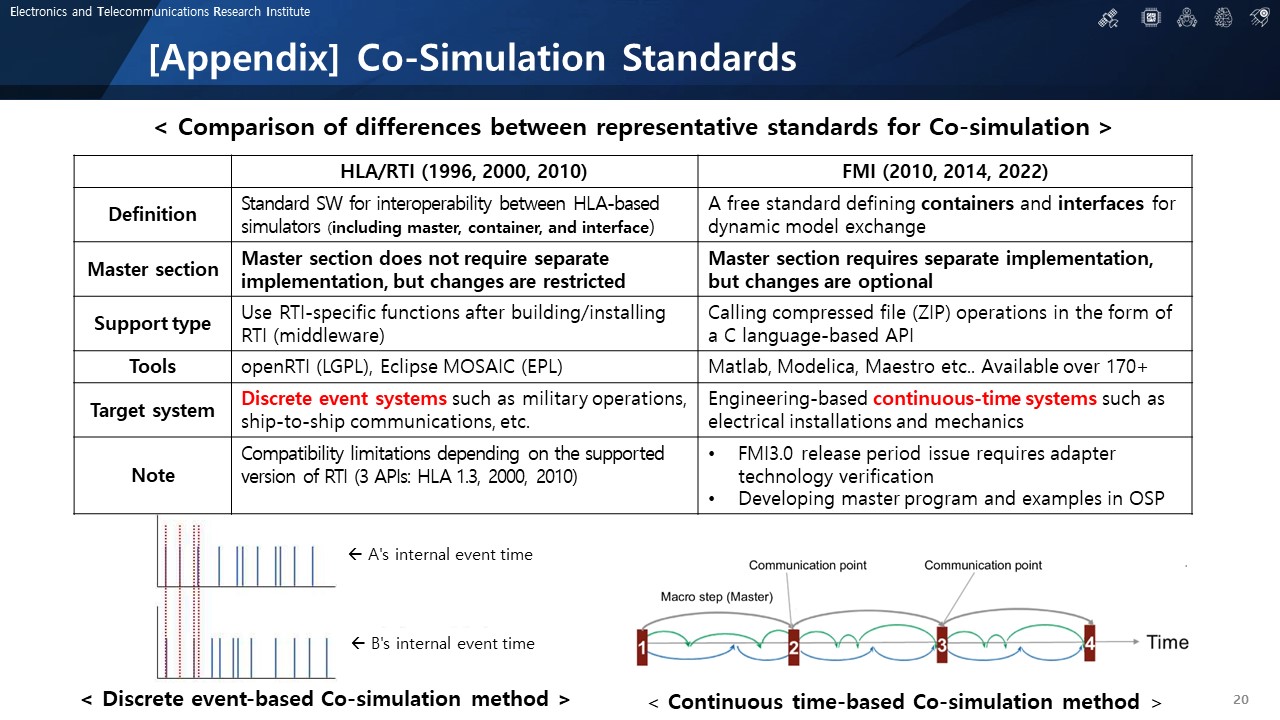 |
Appendix for Co-simulation standard comparison. |















