 ICACT20260355 Slide.01
[Big Slide]
[YouTube] |
Chrome  Click!! |
 |
Good morning everyone.
My name is Yanyan Xue.
Today, I am very pleased to present our work titled “An Efficient Random Routing Transmission Mechanism with Raptor Coding and Adaptive Redundancy Control.”
This work was conducted at the Institute of Acoustics, Chinese Academy of Sciences, in collaboration with the University of Chinese Academy of Sciences.
|
| ICACT20260355 Slide.02
[Big Slide]
[YouTube] |
Chrome Click!! |
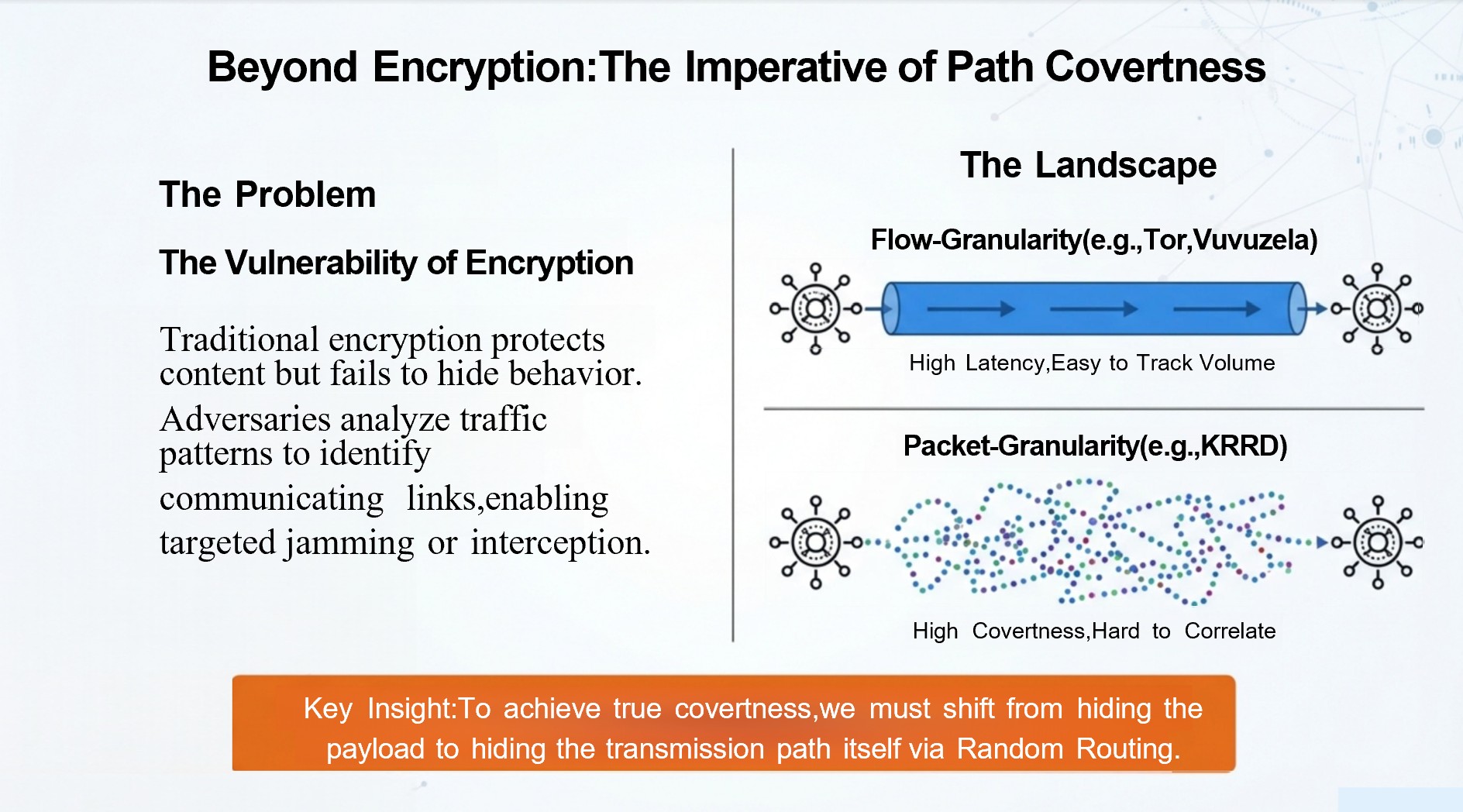 |
We begin with a fundamental problem in secure communication.
Traditional encryption protects the content of communication, but it does not hide communication behavior.
As a result, adversaries can analyze traffic patterns, identify active links, and launch jamming or interception attacks.
Therefore, encryption alone is not sufficient for covert communication.
To achieve true covertness, we must move beyond hiding payloads and instead hide the transmission path itself.
This motivates the use of random routing.
Existing systems can be divided into two categories.
Flow-granularity systems, such as Tor and Vuvuzela, provide strong anonymity, but suffer from high latency.
Packet-granularity systems, such as KRRD, forward each packet along an independent random path.
|
| ICACT20260355 Slide.03
[Big Slide]
[YouTube] |
Chrome Click!! |
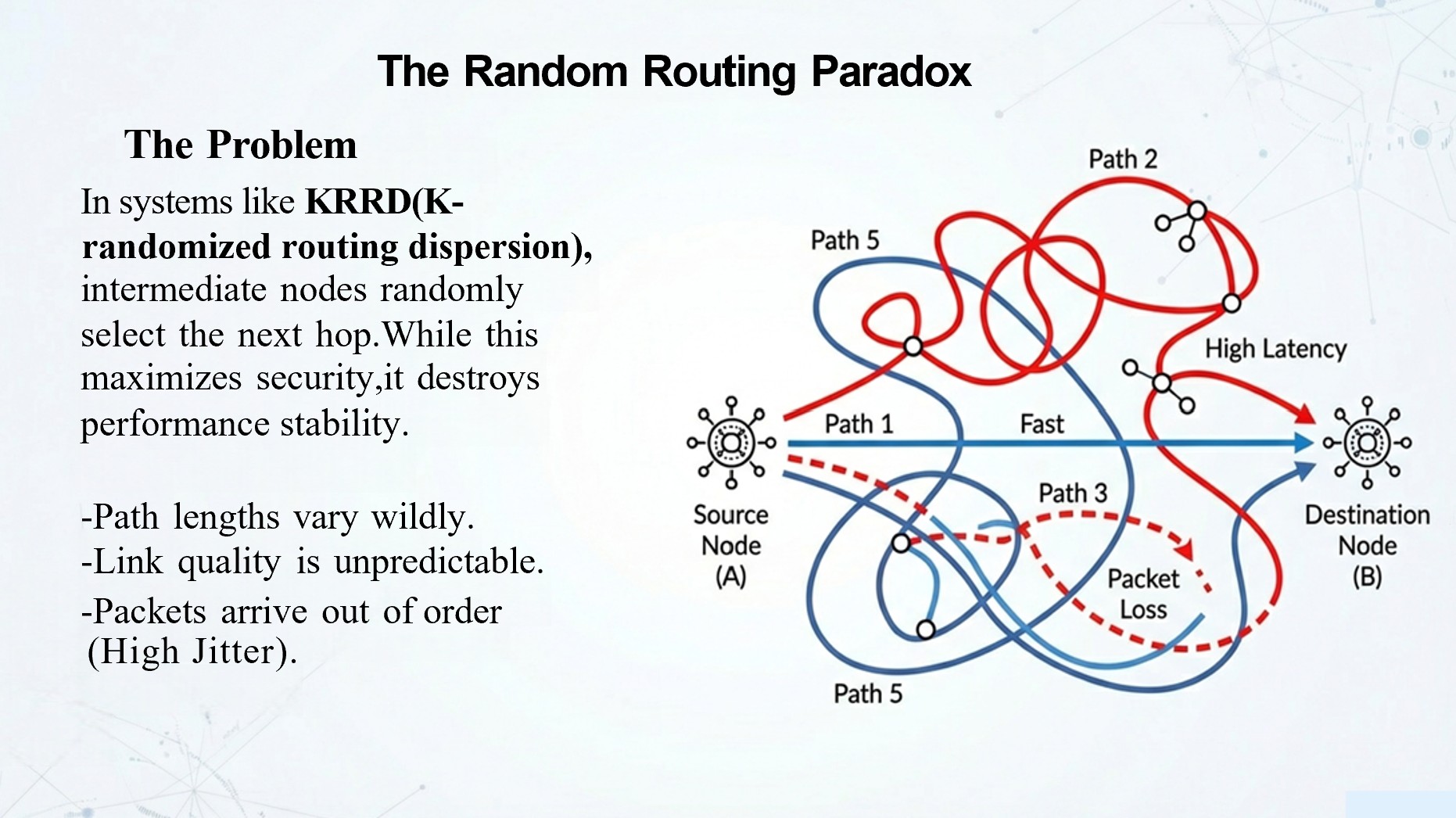 |
However, random routing introduces a serious challenge.
Because routing paths are unpredictable, path lengths vary widely, link quality is unstable, and packets may arrive out of order.
As a result, performance stability is severely degraded.
|
| ICACT20260355 Slide.04
[Big Slide]
[YouTube] |
Chrome Click!! |
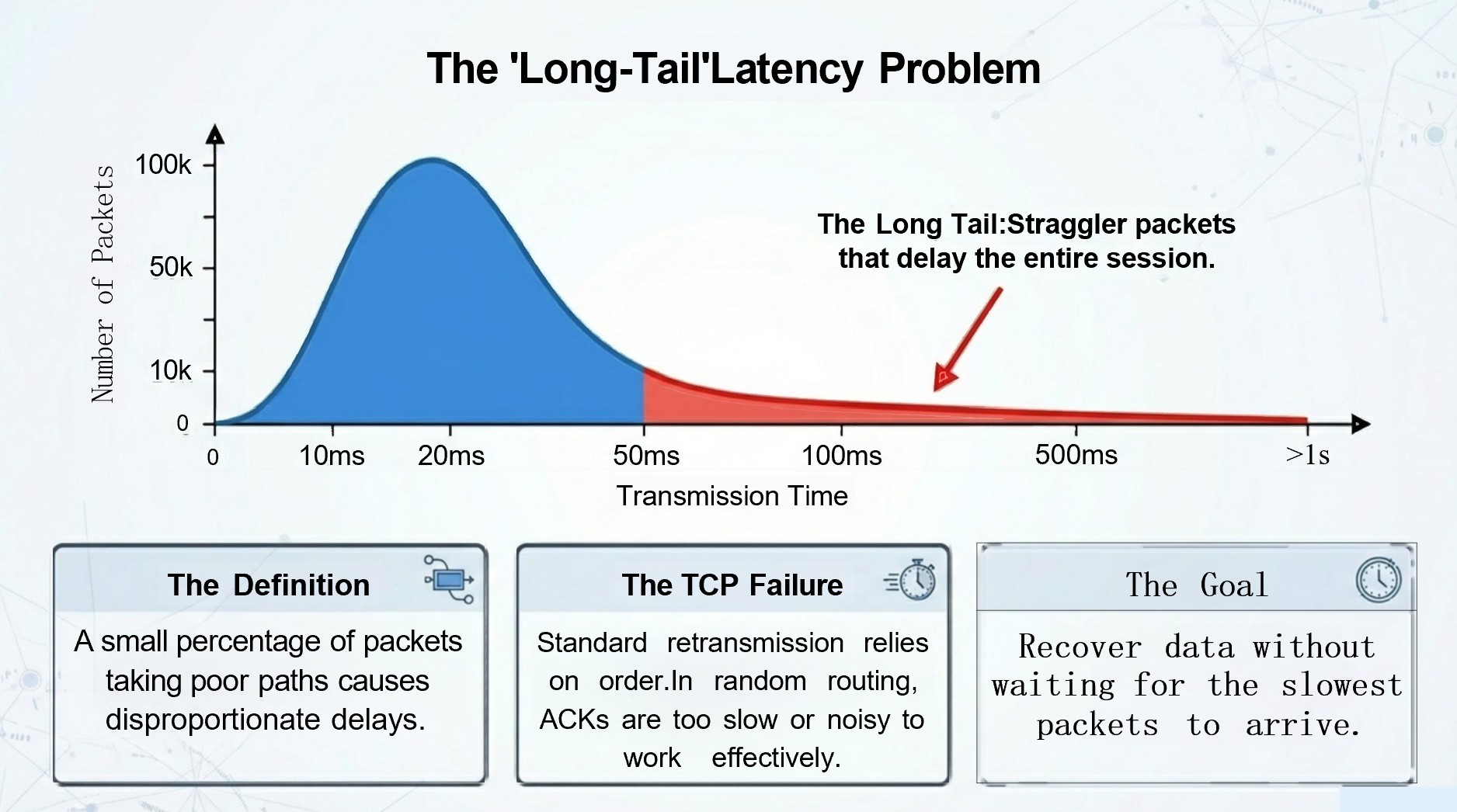 |
This leads to the so-called long-tail latency problem.
Most packets arrive quickly, but a small number of packets experience extremely long delays or are lost.
Unfortunately, the entire session must wait for these straggler packets.
|
| ICACT20260355 Slide.05
[Big Slide]
[YouTube] |
Chrome Click!! |
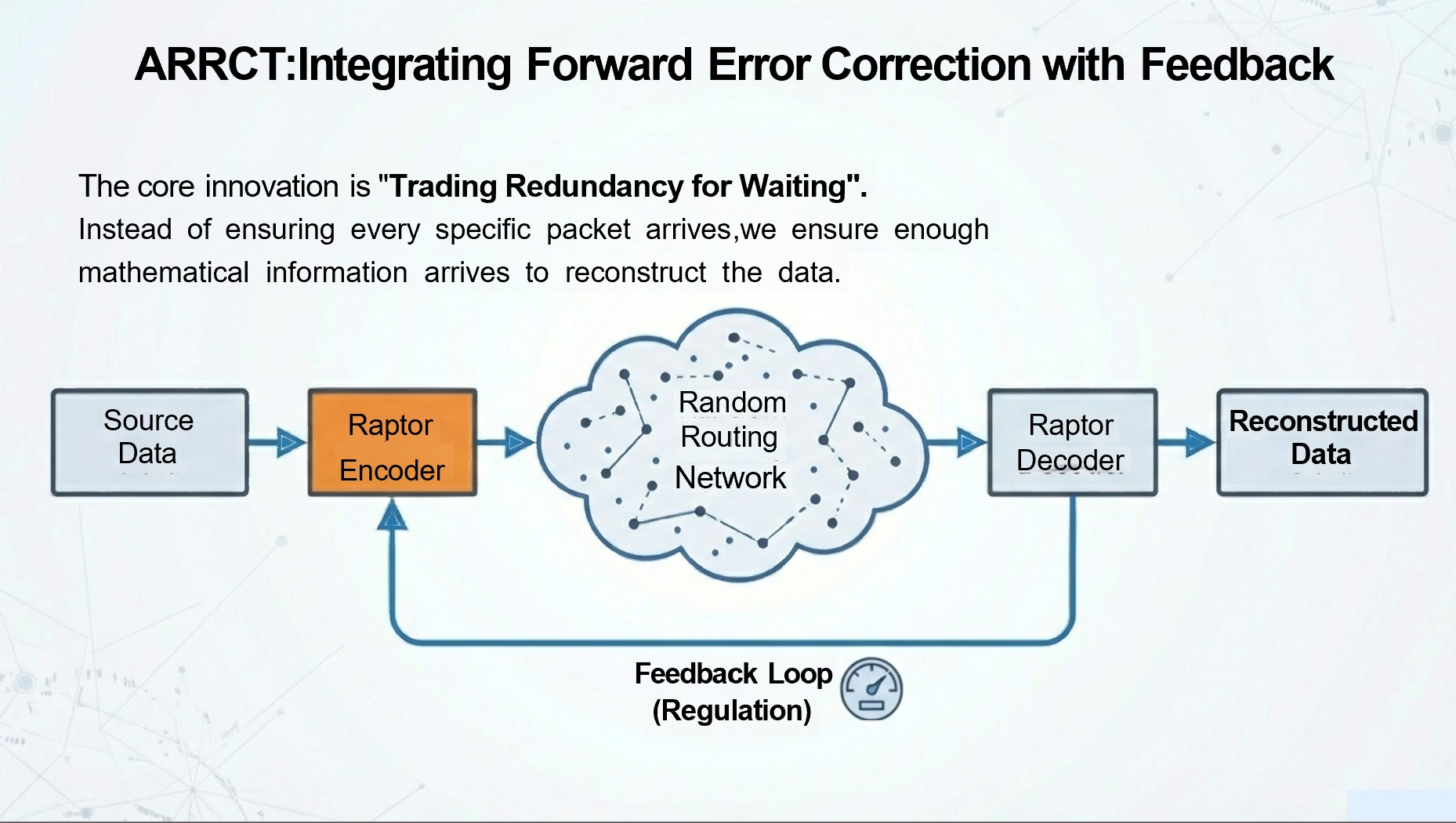 |
Our core idea is simple.
Instead of waiting for every specific packet to arrive, we ensure that enough information arrives to reconstruct the original data.
In other words, we trade redundancy for waiting time.
|
| ICACT20260355 Slide.06
[Big Slide]
[YouTube] |
Chrome Click!! |
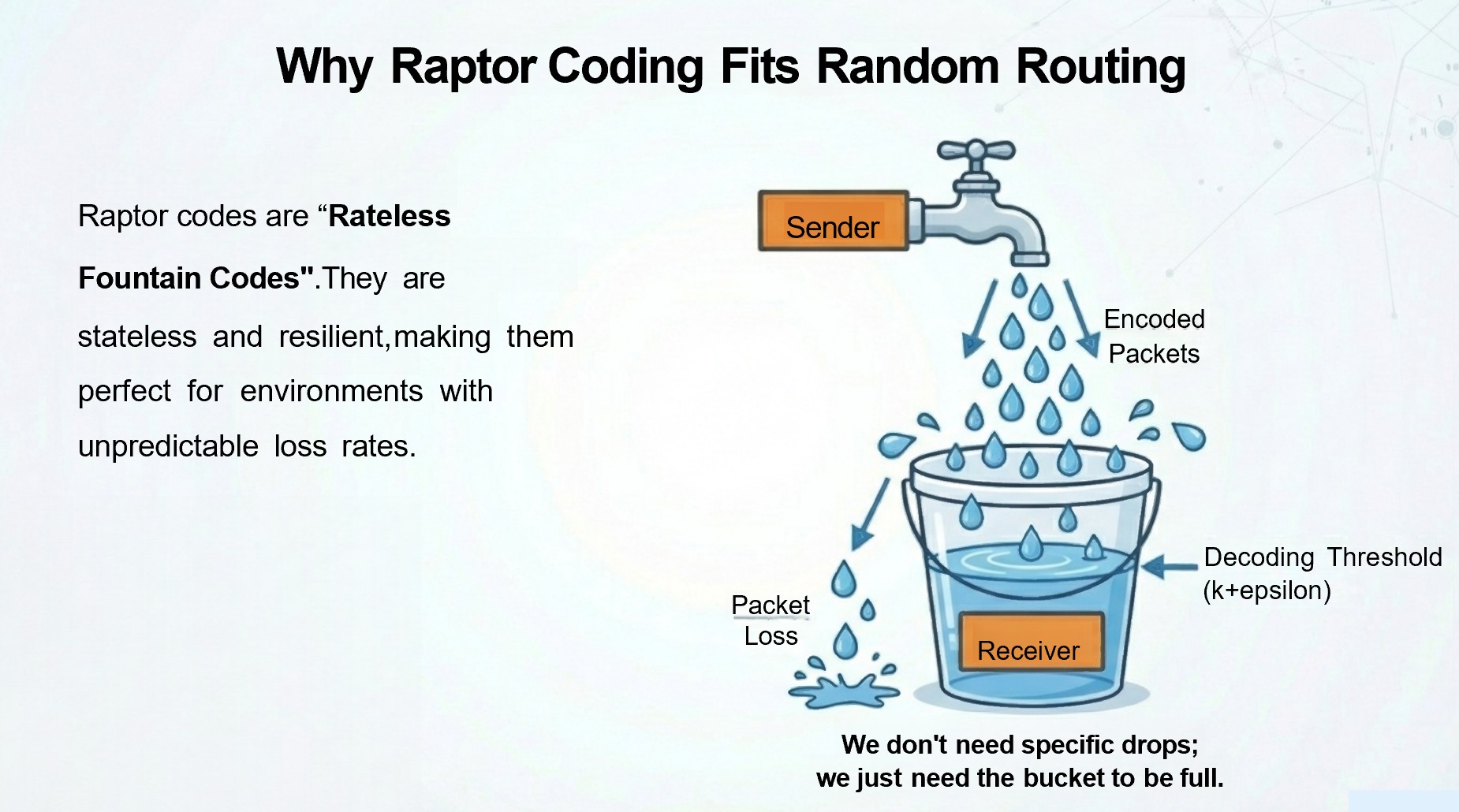 |
To achieve this, we adopt Raptor codes.
Raptor codes are rateless fountain codes.
The sender can generate an unlimited number of encoded packets, and the receiver can decode once slightly more than k packets are received.
|
| ICACT20260355 Slide.07
[Big Slide]
[YouTube] |
Chrome Click!! |
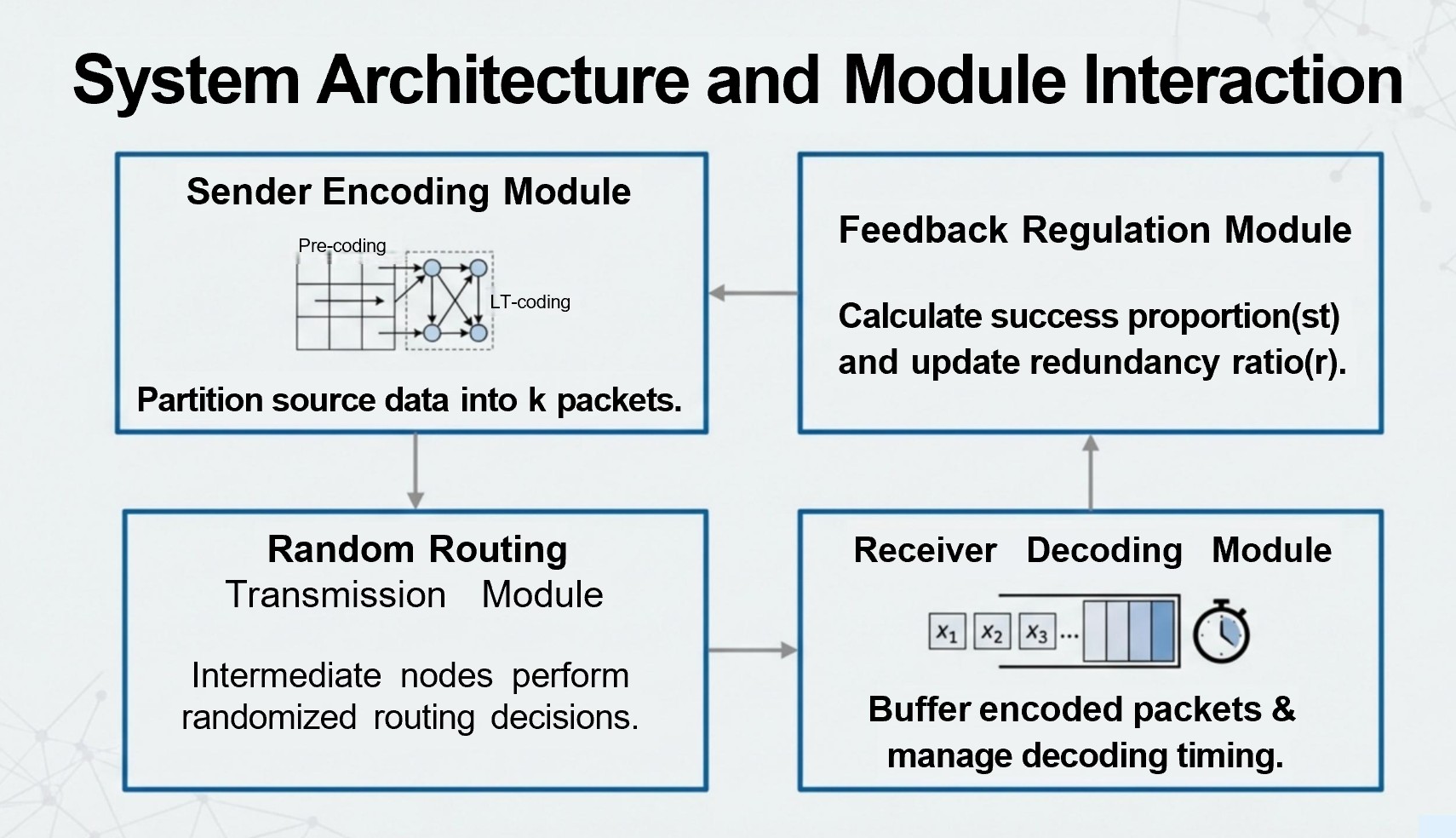 |
This slide shows the overall ARRCT architecture.
At the sender, source data is encoded using Raptor coding.
Packets are forwarded through a random routing network.
At the receiver, packets are buffered and decoded, and feedback is generated.
|
| ICACT20260355 Slide.08
[Big Slide]
[YouTube] |
Chrome Click!! |
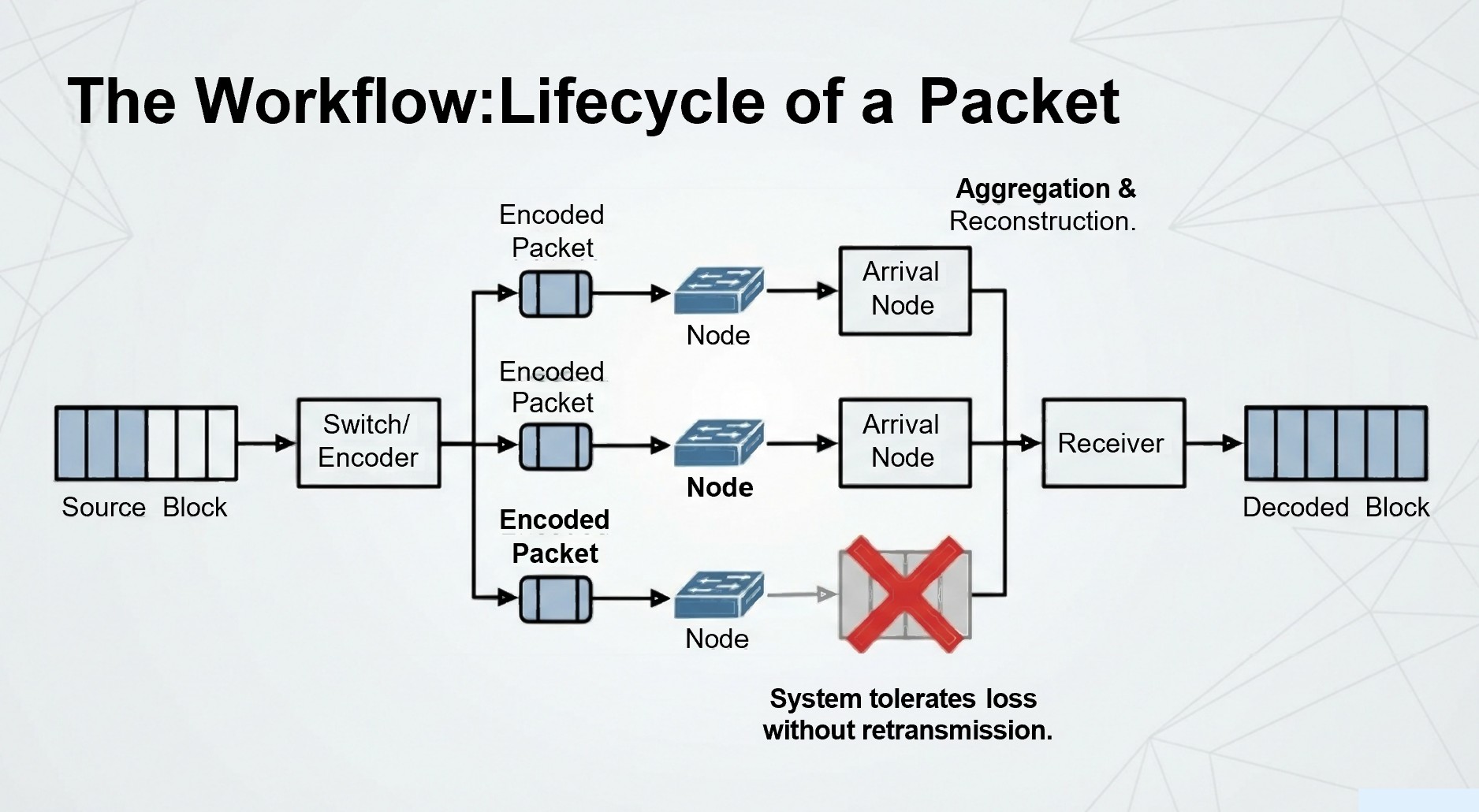 |
Here we illustrate the packet processing workflow.
Packets traverse independent random paths. Some packets are lost.
However, as long as enough packets arrive, decoding succeeds without retransmission.
|
| ICACT20260355 Slide.09
[Big Slide]
[YouTube] |
Chrome Click!! |
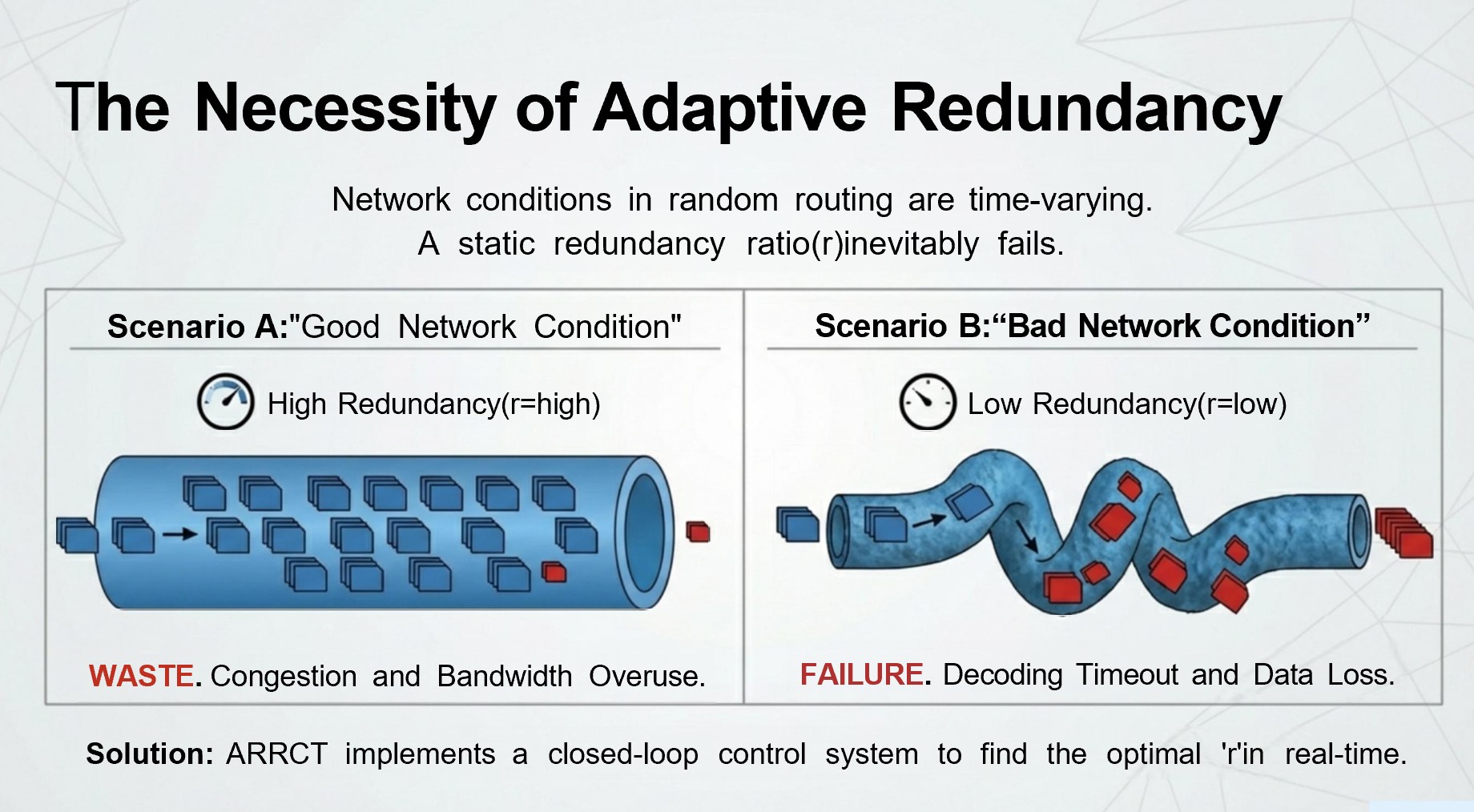 |
A fixed redundancy ratio cannot adapt to dynamic network conditions.
If redundancy is too high, bandwidth is wasted.
If redundancy is too low, decoding fails.
Therefore, static redundancy is inefficient.
|
| ICACT20260355 Slide.10
[Big Slide]
[YouTube] |
Chrome Click!! |
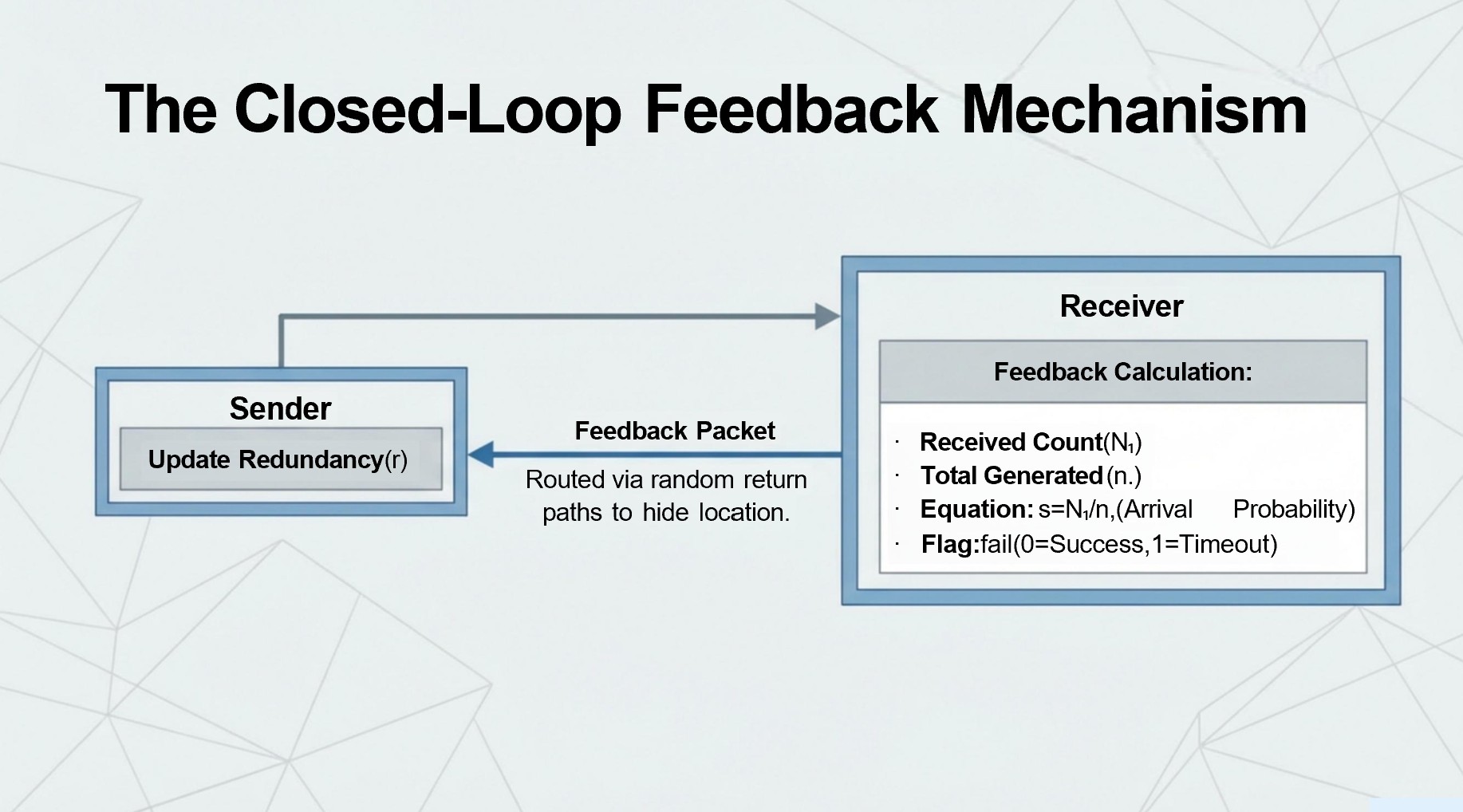 |
ARRCT introduces a closed-loop feedback mechanism.
The receiver estimates the packet arrival probability, and checks whether decoding succeeds.
This information is fed back to the sender through random return paths.
|
| ICACT20260355 Slide.11
[Big Slide]
[YouTube] |
Chrome Click!! |
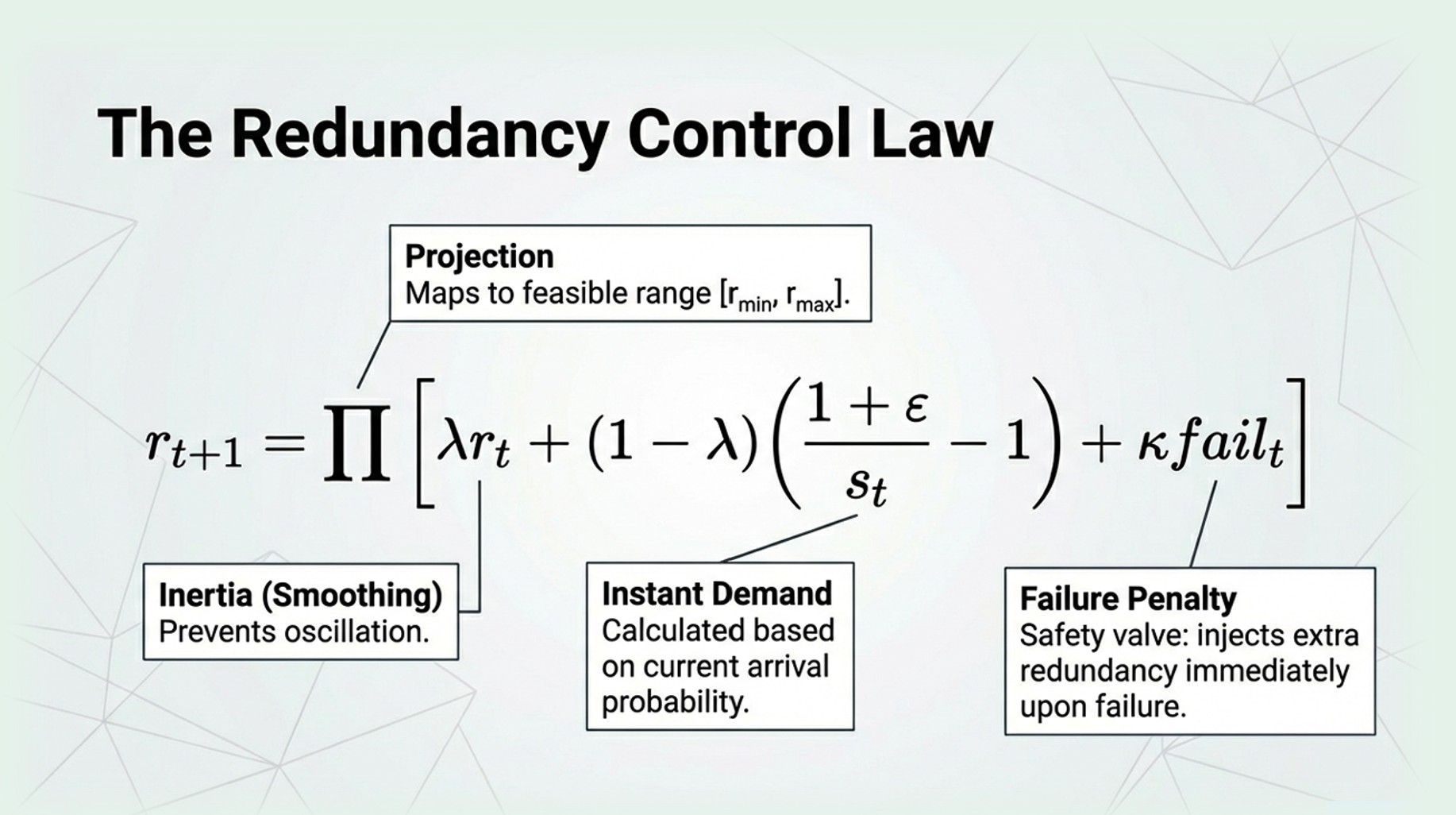 |
Based on this feedback, the sender updates the redundancy ratio.
The control law considers historical information, current network conditions, and decoding failures.
This ensures stability and fast recovery.
|
| ICACT20260355 Slide.12
[Big Slide]
[YouTube] |
Chrome Click!! |
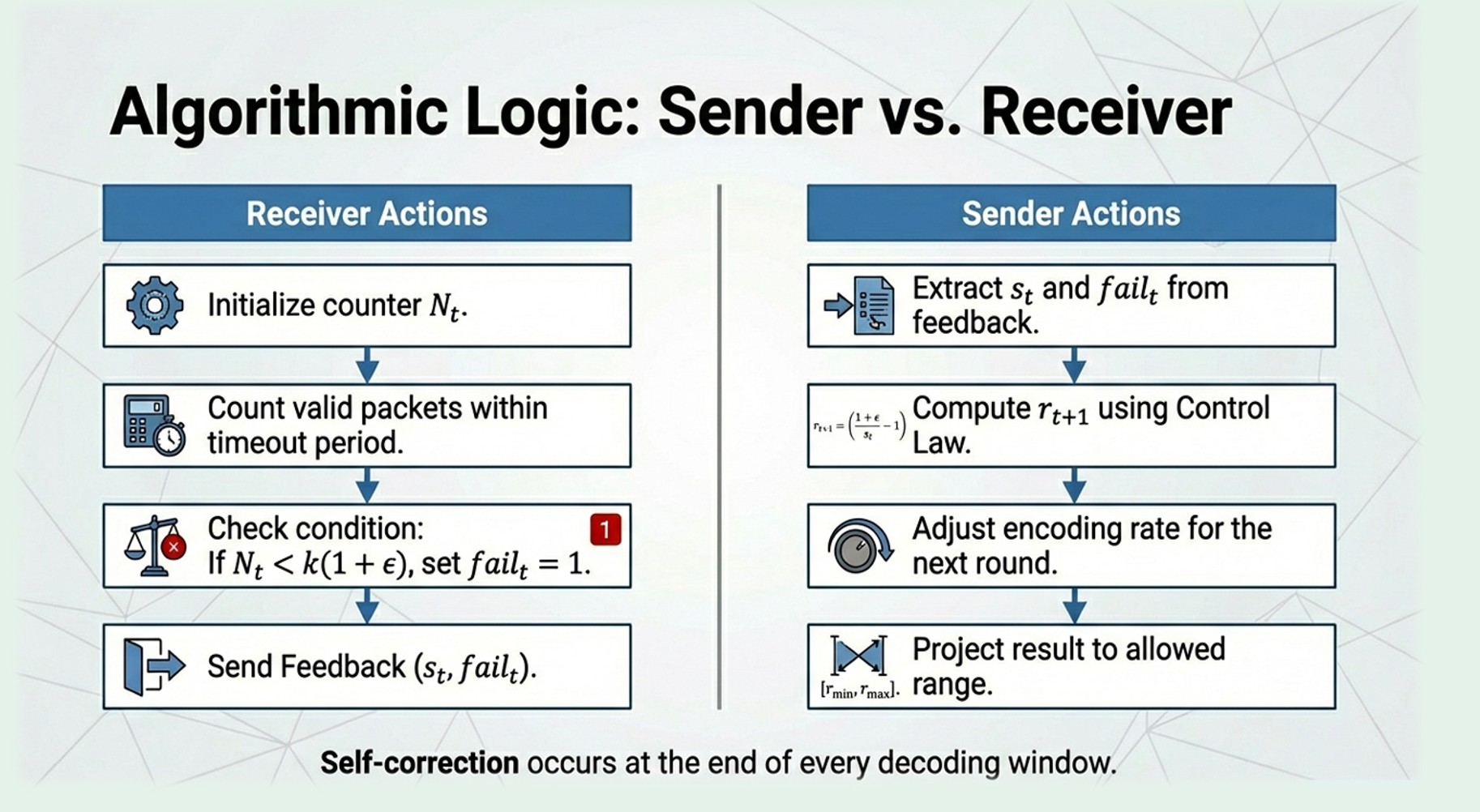 |
This slide summarizes the core algorithmic logic of ARRCT from both the receiver and sender perspectives.
On the receiver side, the receiver counts how many encoded packets arrive within a decoding window and checks whether the decoding threshold is met. If decoding fails, it sets a failure flag and reports both the arrival rate and the decoding result back to the sender.
On the sender side, this feedback is used to update the redundancy ratio through the control law, and the new encoding rate is applied in the next round.
In this way, ARRCT achieves self-correction without relying on retransmissions.
|
| ICACT20260355 Slide.13
[Big Slide]
[YouTube] |
Chrome Click!! |
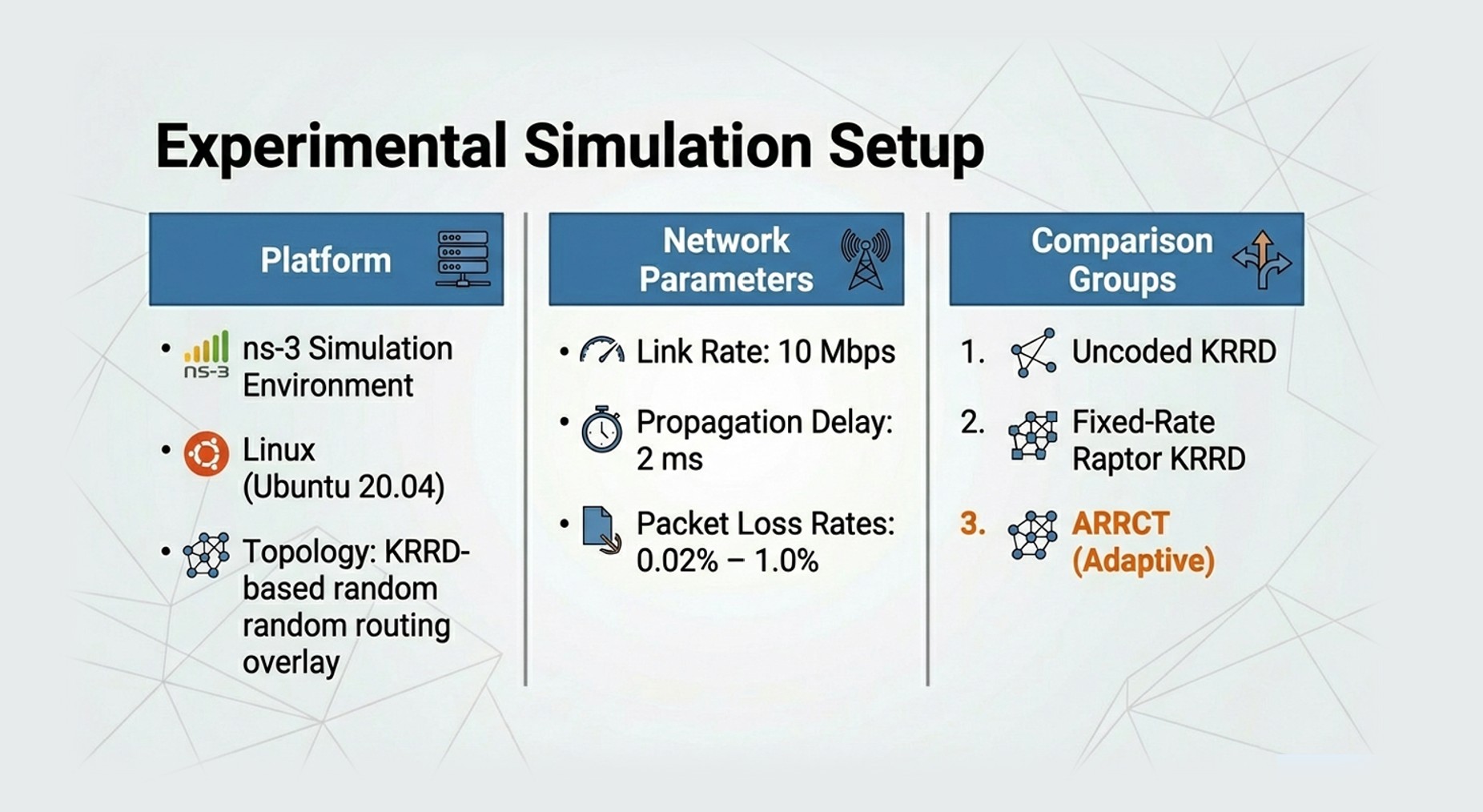 |
We evaluate ARRCT using ns-3 simulations.
We compare three schemes: uncoded random routing, fixed-redundancy Raptor coding, and ARRCT.
|
| ICACT20260355 Slide.14
[Big Slide]
[YouTube] |
Chrome Click!! |
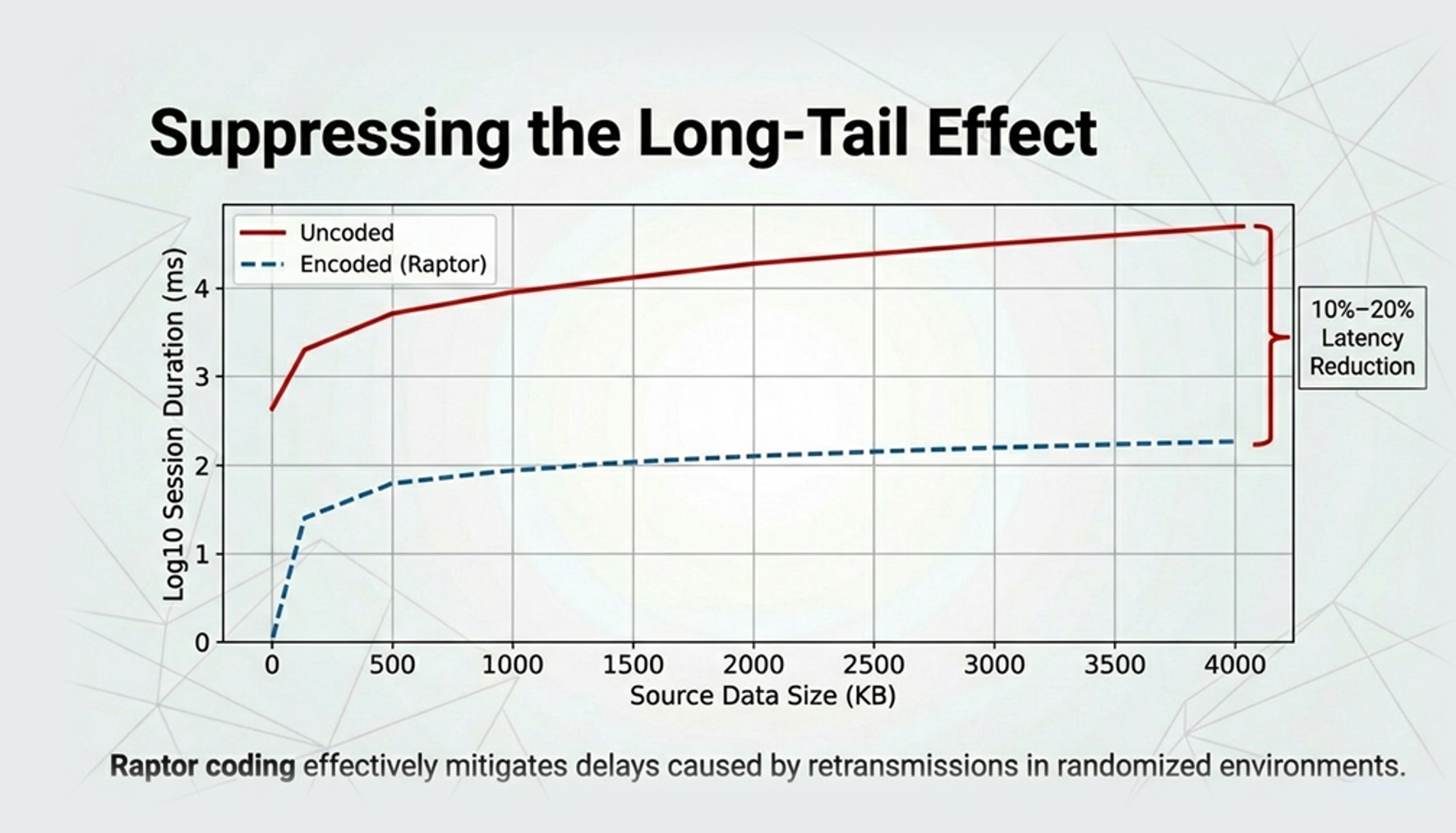 |
First, we evaluate the benefit of Raptor coding.
Compared with uncoded transmission, Raptor coding reduces session completion time by approximately ten to twenty percent.
|
| ICACT20260355 Slide.15
[Big Slide]
[YouTube] |
Chrome Click!! |
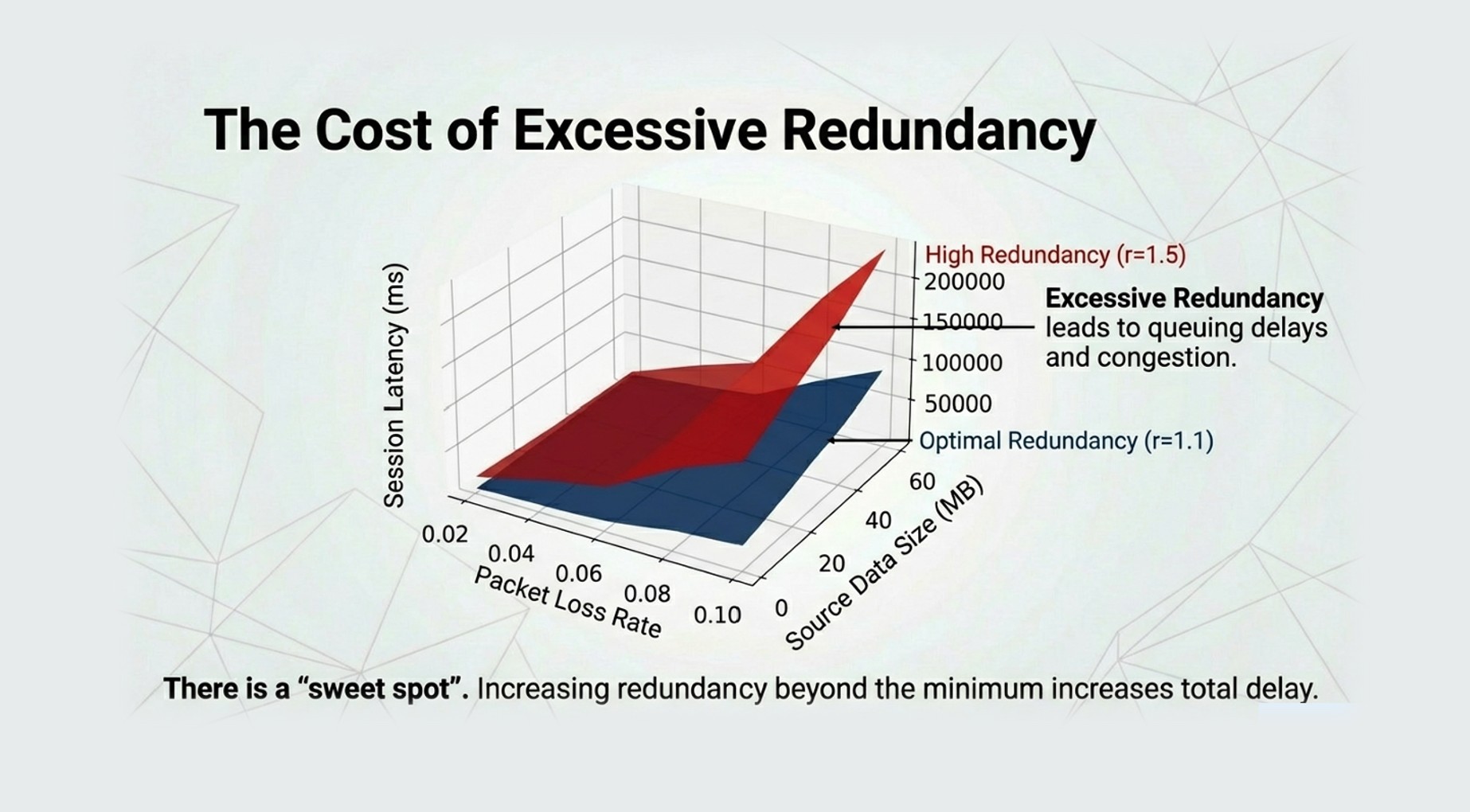 |
Next, we study the impact of redundancy.
Excessive redundancy introduces additional delay due to congestion and queuing.
Therefore, redundancy must be carefully controlled.
|
| ICACT20260355 Slide.16
[Big Slide]
[YouTube] |
Chrome Click!! |
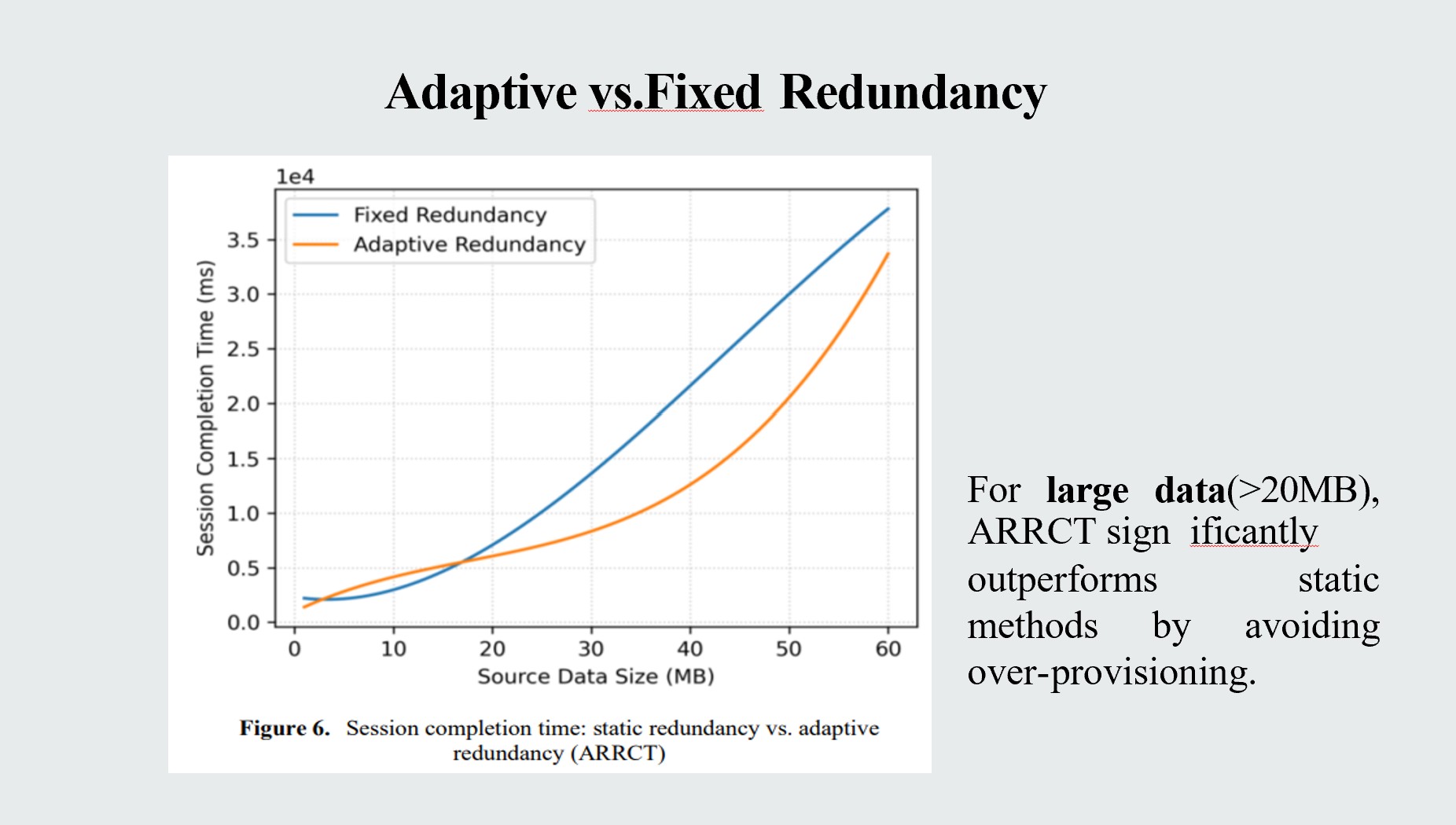 |
We then compare ARRCT with fixed redundancy.
ARRCT consistently achieves lower session completion time by dynamically adapting redundancy.
|
| ICACT20260355 Slide.17
[Big Slide]
[YouTube] |
Chrome Click!! |
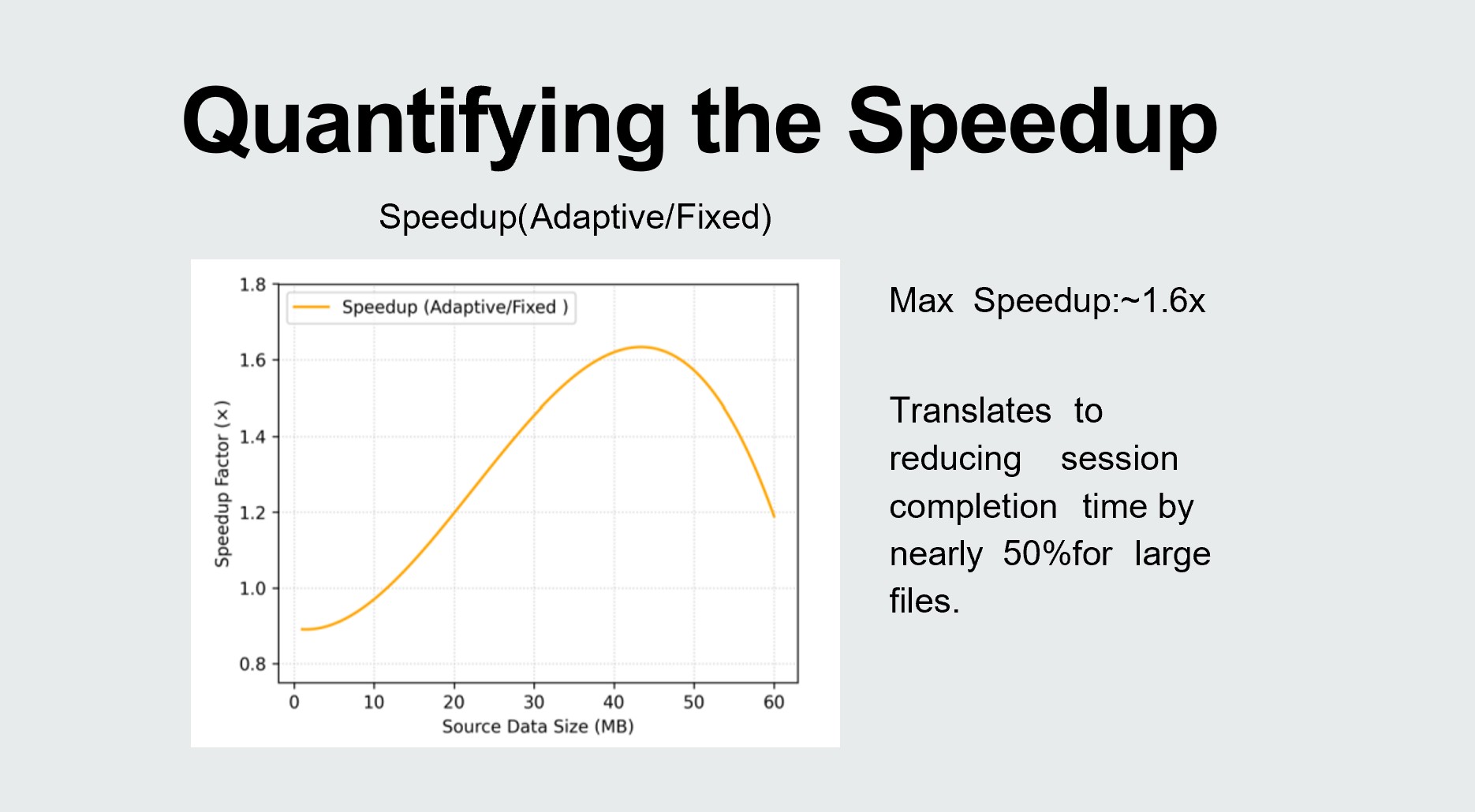 |
For large data transfers, ARRCT achieves up to one point six times speedup.
This corresponds to nearly fifty percent reduction in session completion time.
|
| ICACT20260355 Slide.18
[Big Slide]
[YouTube] |
Chrome Click!! |
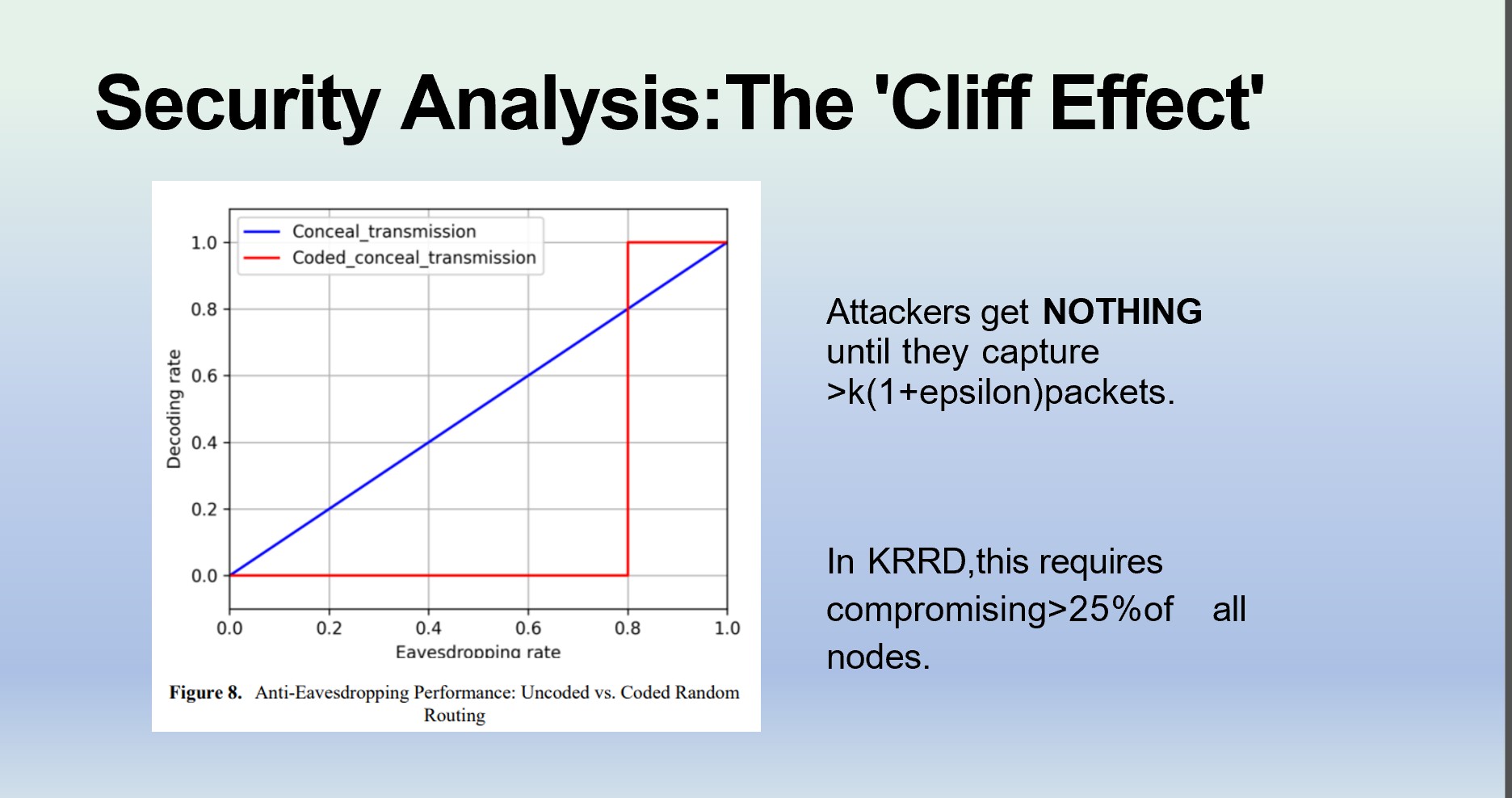 |
ARRCT does not weaken security.
With Raptor coding, an attacker gains no information until enough packets are captured.
In KRRD, this would require compromising more than twenty-five percent of nodes.
|
| ICACT20260355 Slide.19
[Big Slide]
[YouTube] |
Chrome Click!! |
 |
To conclude,
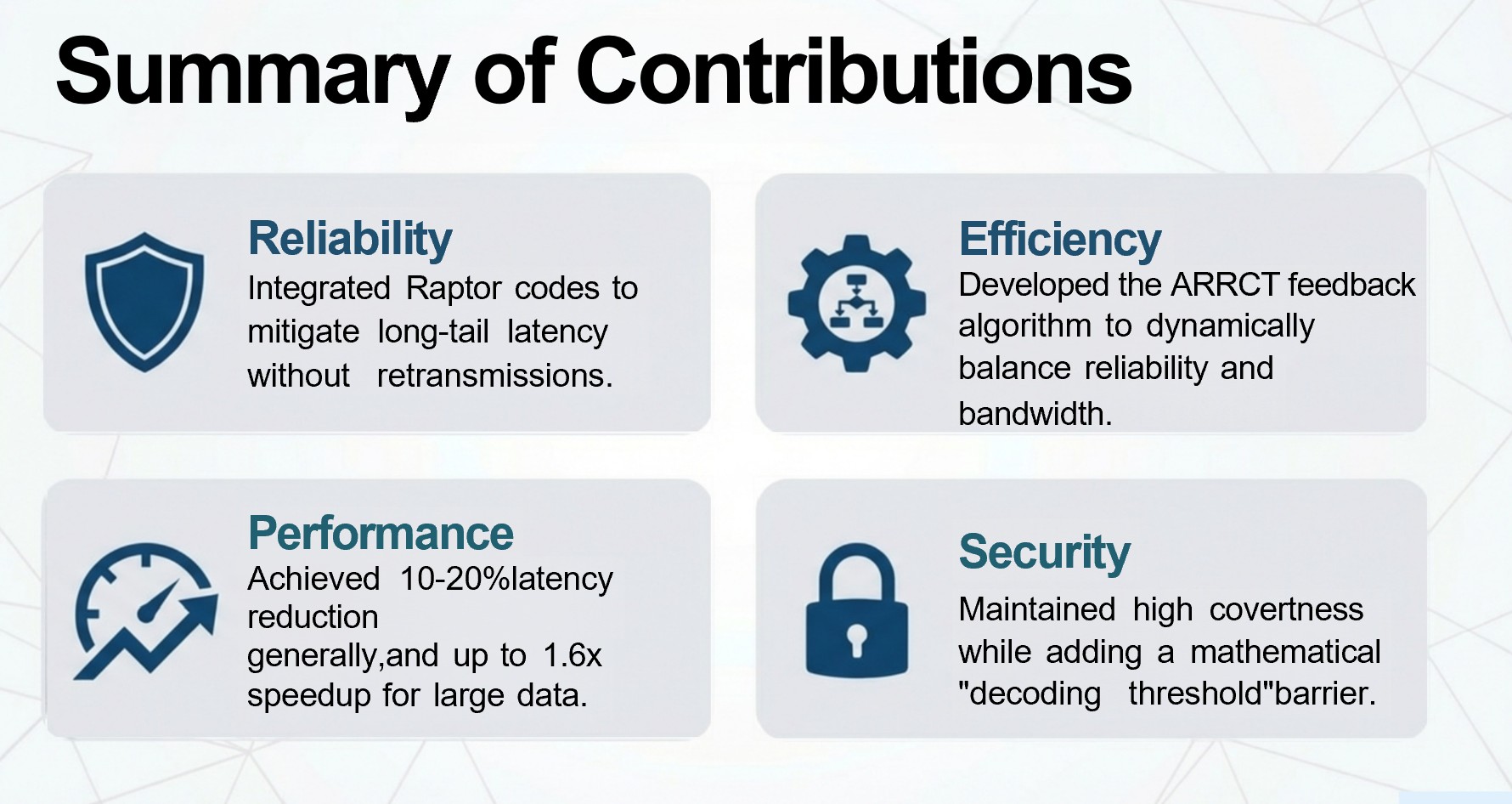
We propose ARRCT, which integrates Raptor coding with adaptive redundancy control for random routing networks.
ARRCT improves performance while preserving strong covertness.
|
| ICACT20260355 Slide.20
[Big Slide]
[YouTube] |
Chrome Click!! |
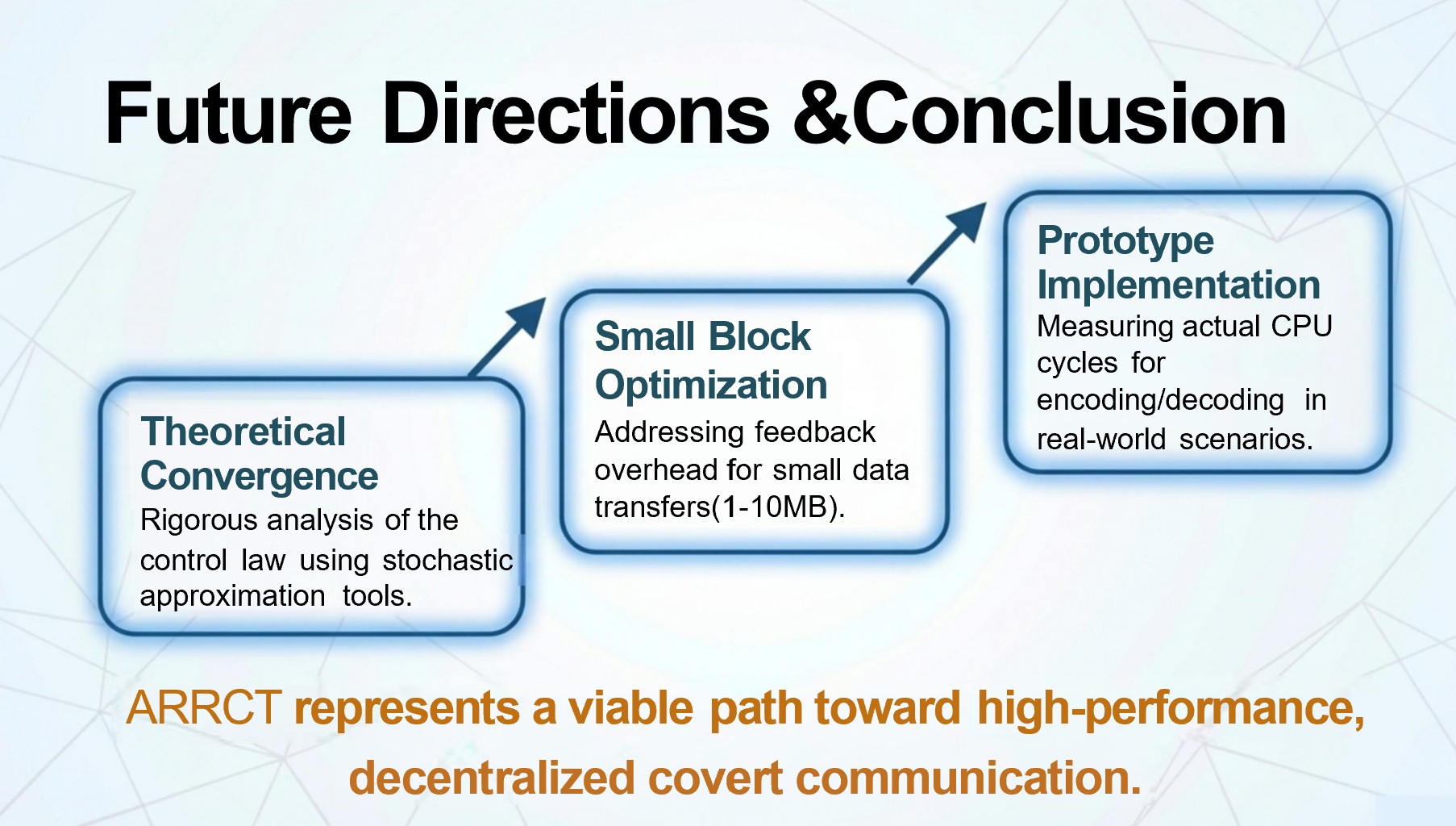 |
Finally, I would like to briefly discuss future directions and conclude this talk.
First, we plan to conduct a rigorous theoretical analysis of the ARRCT control law using stochastic approximation tools.
Second, we will optimize the mechanism for small data blocks, where feedback overhead becomes more noticeable.
Third, we aim to build a prototype system and measure real-world encoding and decoding costs.
In summary, ARRCT represents a viable path toward high-performance, decentralized covert communication, balancing security and efficiency in random routing networks.
|
| ICACT20260355 Slide.21
[Big Slide]
[YouTube] |
Chrome Click!! |
 |
Thank you very much for your attention.
I am happy to take questions.
|















