 ICACT20260376 Slide.01
[Big Slide]
[YouTube] |
Chrome  Click!! |
 |
Good morning, honorable chair, distinguished experts, and fellow researchers. My name is Zien Zhang, and I am a master’s student from the School of Mechatronical Engineering at Beijing Institute of Technology.Today, I am honored to present our work titled: “Research on Transmission Characteristics of Photonic-Crystal Fiber with a Subwavelength Air Core.”
|
| ICACT20260376 Slide.02
[Big Slide]
[YouTube] |
Chrome Click!! |
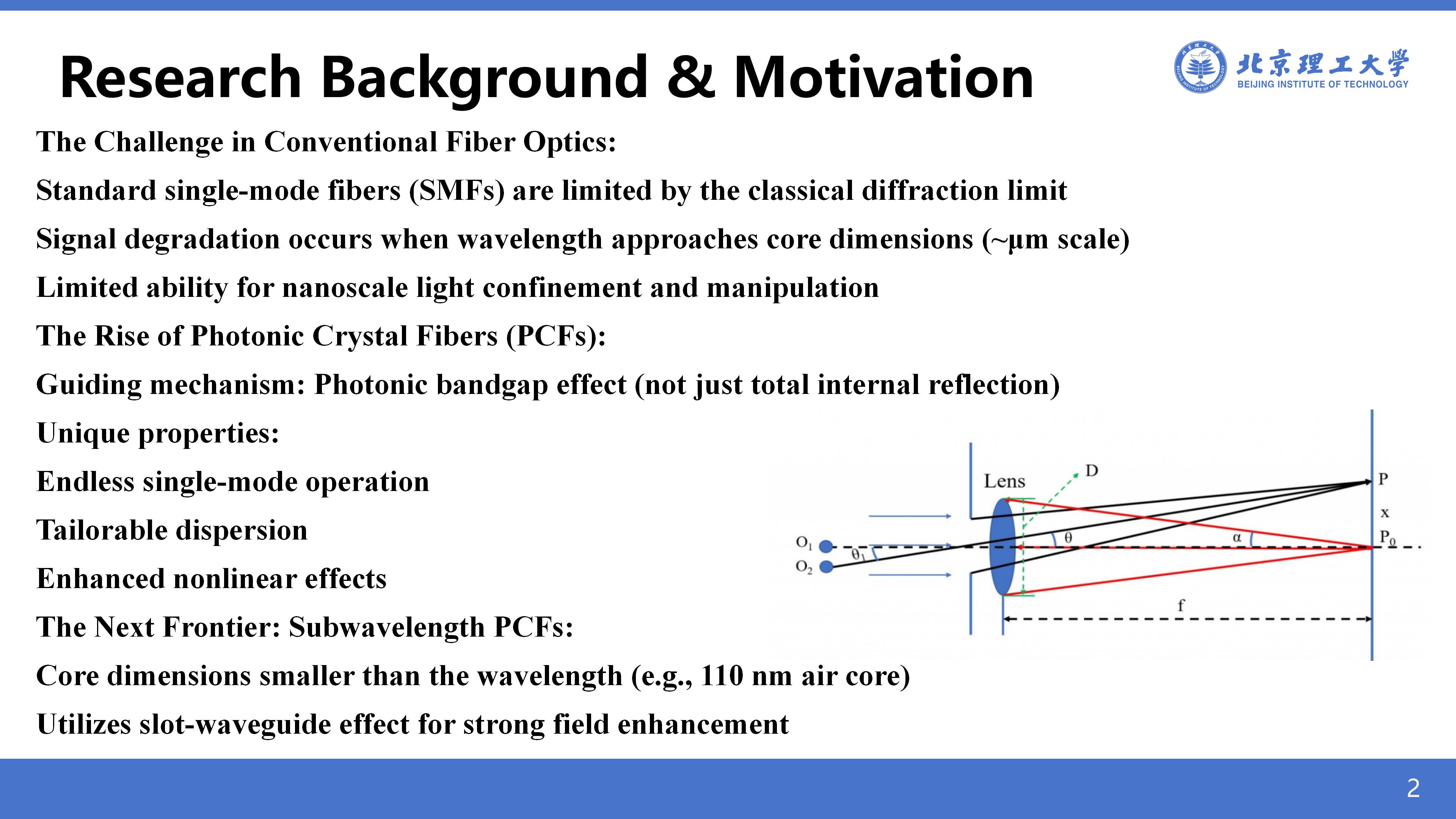 |
Conventional single-mode fibers face a fundamental limitation: the classical diffraction limit.
When the operating wavelength approaches the core dimensions, significant signal degradation occurs, restricting their use in nanoscale photonics.
Photonic crystal fibers, or PCFs, have emerged as a promising alternative, guiding light through the photonic bandgap effect.
They offer unique properties such as endless single-mode operation and tailorable dispersion.
Our research focuses on pushing this frontier further by designing a subwavelength air-core PCF, which utilizes the slot-waveguide effect to achieve optical confinement beyond the diffraction limit.
Our objective is to develop a high-performance fiber polarizer with superior extinction ratio and low insertion loss. |
| ICACT20260376 Slide.03
[Big Slide]
[YouTube] |
Chrome Click!! |
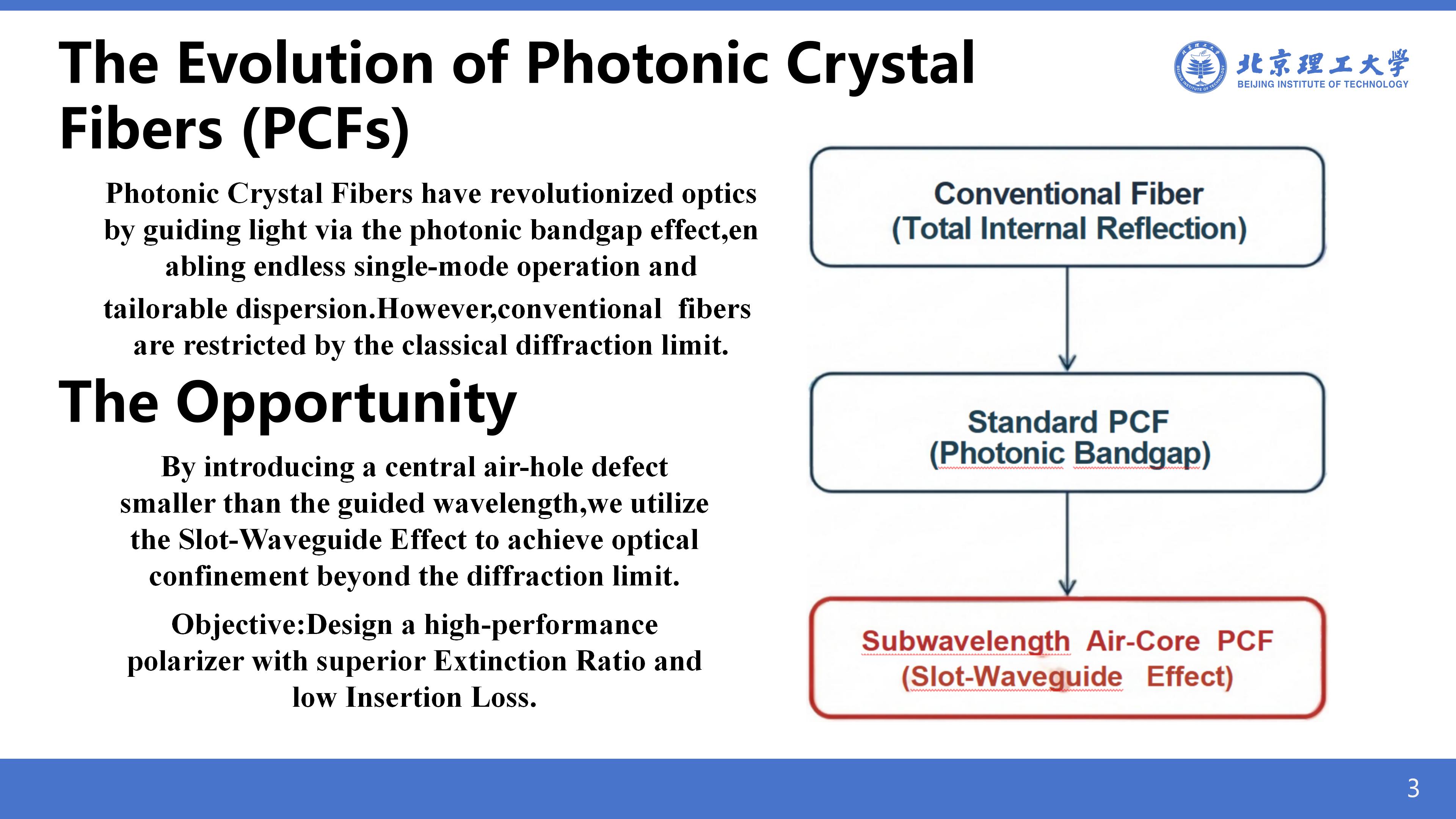 |
PCFs have revolutionized optical guiding by using a periodic microstructured cladding.
Unlike conventional fibers, they are not limited by total internal reflection.
However, even PCFs are constrained by the diffraction limit when the core size is in the micron scale.
Our approach introduces a central air-hole defect with a diameter of only 110 nanometers, which is smaller than the guided wavelength.
This enables us to harness the slot-waveguide effect, confining light in a low-index region and overcoming the classical limit. |
| ICACT20260376 Slide.04
[Big Slide]
[YouTube] |
Chrome Click!! |
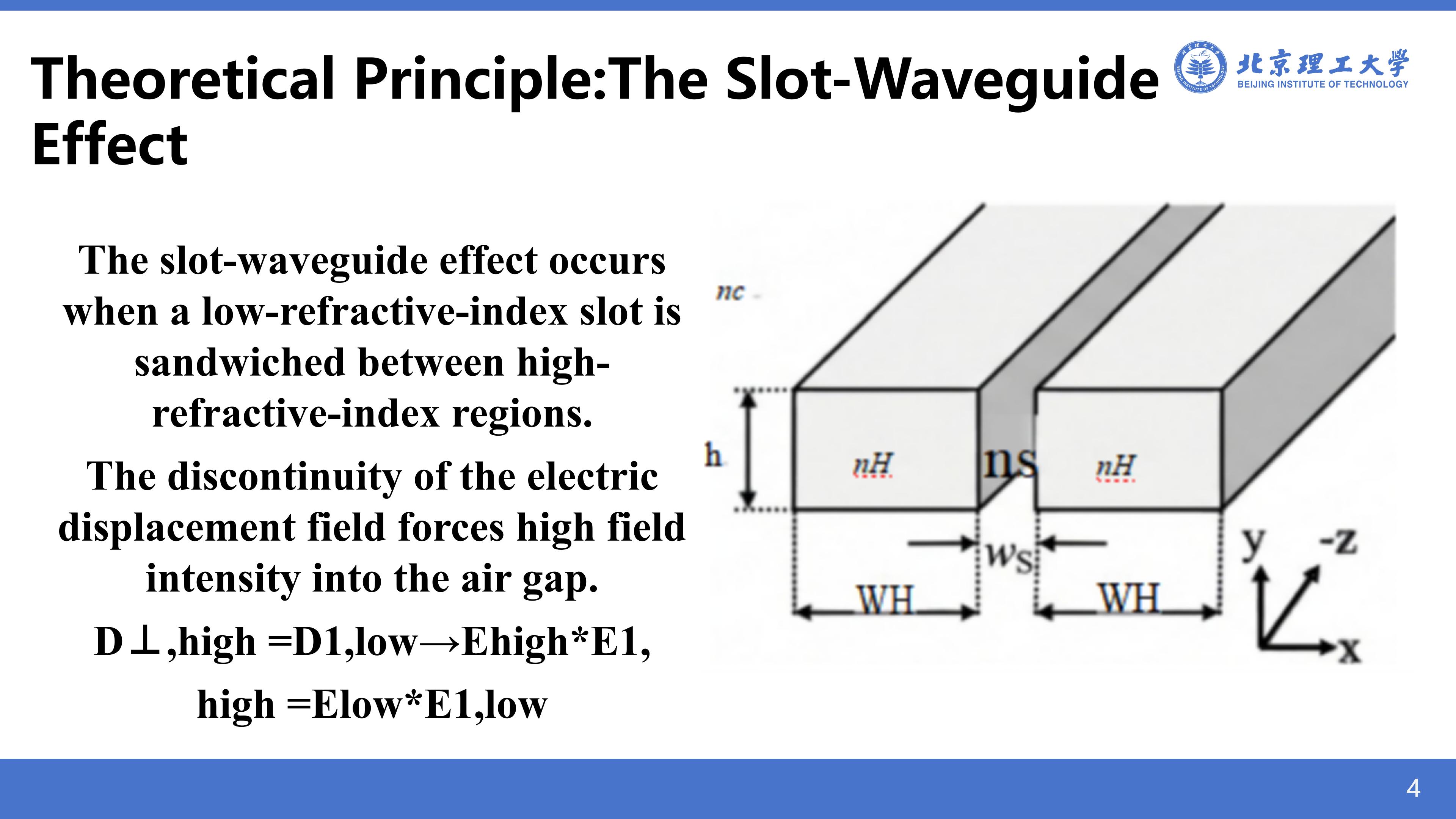 |
The slot-waveguide effect occurs when a low-refractive-index region—such as an air gap—is sandwiched between two high-index materials.
Due to the continuity condition of the electric displacement field, the electric field is strongly enhanced within the low-index slot.
This allows for intense light confinement in an air core much smaller than the wavelength. |
| ICACT20260376 Slide.05
[Big Slide]
[YouTube] |
Chrome Click!! |
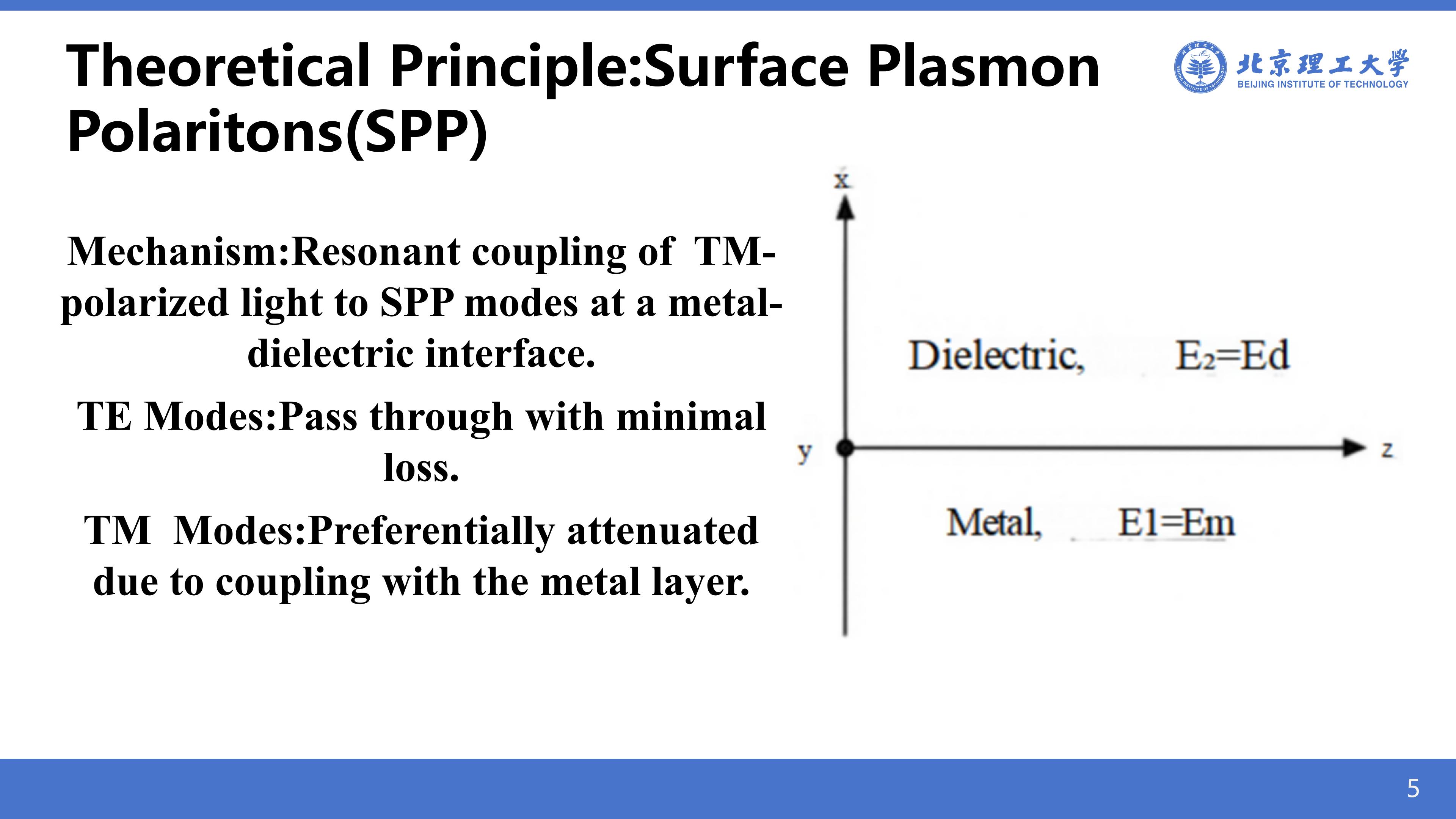 |
For polarization control, we utilize surface plasmon polaritons at a metal-dielectric interface.
When a metal layer is introduced, TM-polarized light couples resonantly to lossy SPP modes, leading to its attenuation.
Meanwhile, TE-polarized light passes through with minimal loss.
This mechanism forms the basis of our polarizer design. |
| ICACT20260376 Slide.06
[Big Slide]
[YouTube] |
Chrome Click!! |
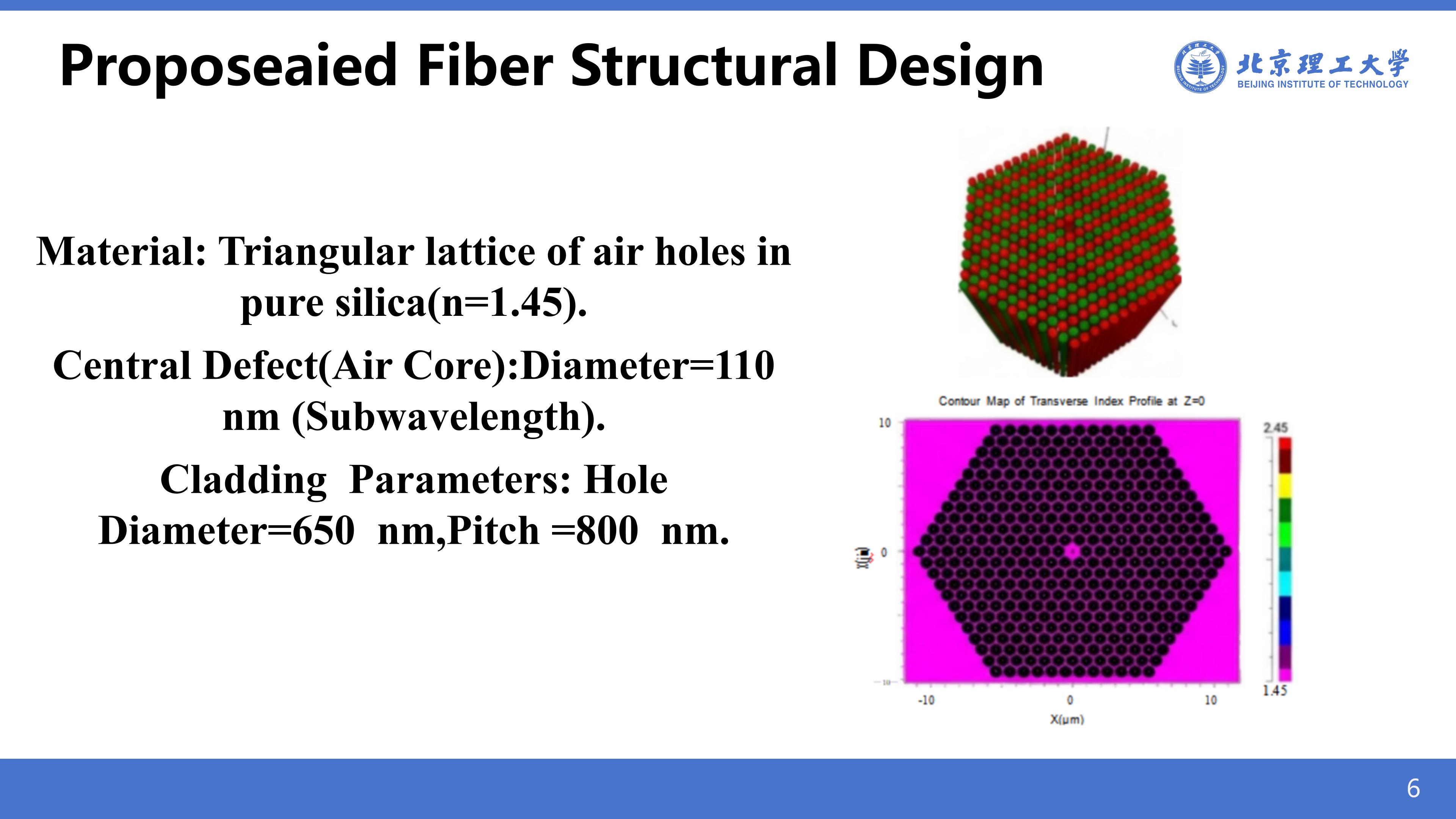 |
Our proposed PCF is based on a triangular lattice of air holes in pure silica.
The central defect is an air core with a diameter of 110 nm.
The cladding holes have a diameter of 650 nm and a pitch of 800 nm.
This structure is optimized to maximize the slot-waveguide effect while ensuring fabricability. |
| ICACT20260376 Slide.07
[Big Slide]
[YouTube] |
Chrome Click!! |
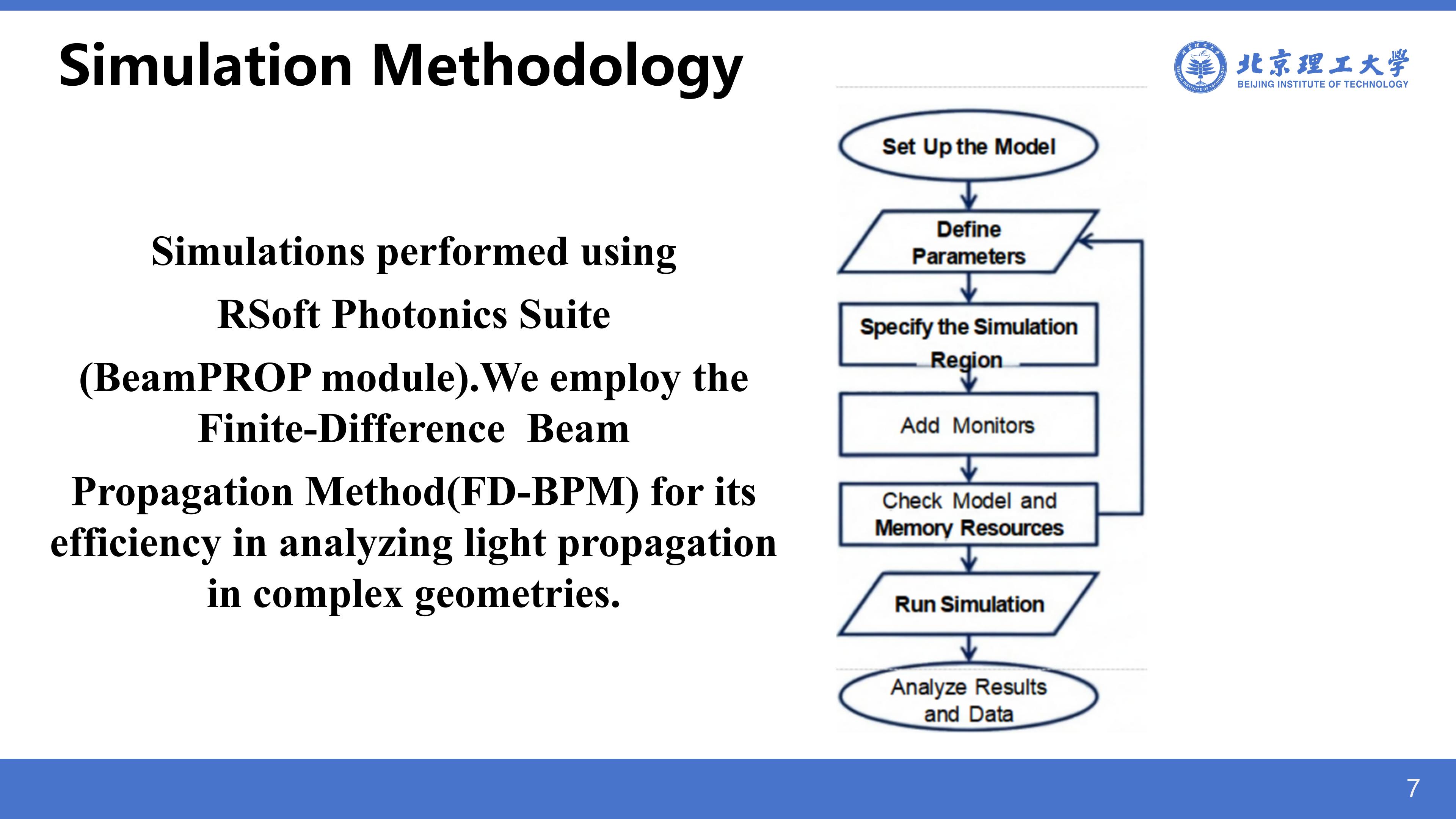 |
All simulations were performed using the RSoft Photonics Suite, specifically the BeamPROP module based on the Finite-Difference Beam Propagation Method.
This approach allows efficient and accurate modeling of light propagation in complex waveguide geometries. |
| ICACT20260376 Slide.08
[Big Slide]
[YouTube] |
Chrome Click!! |
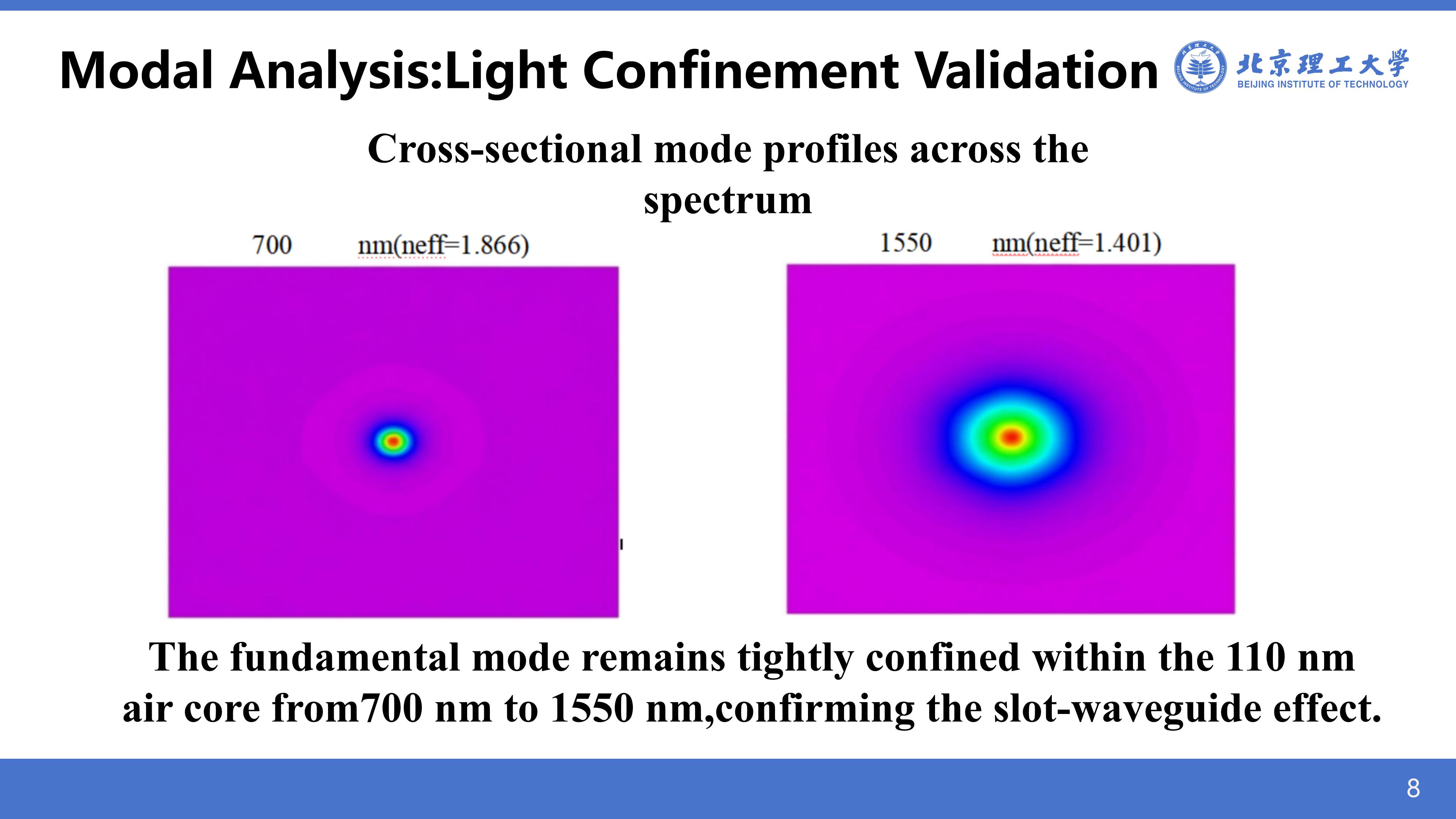 |
Our simulations confirm that the fundamental mode remains tightly confined within the 110 nm air core across a broad wavelength range—from 700 nm to 1550 nm.
This validates the slot-waveguide effect and demonstrates the fiber’s ability to guide light beyond the diffraction limit. |
| ICACT20260376 Slide.09
[Big Slide]
[YouTube] |
Chrome Click!! |
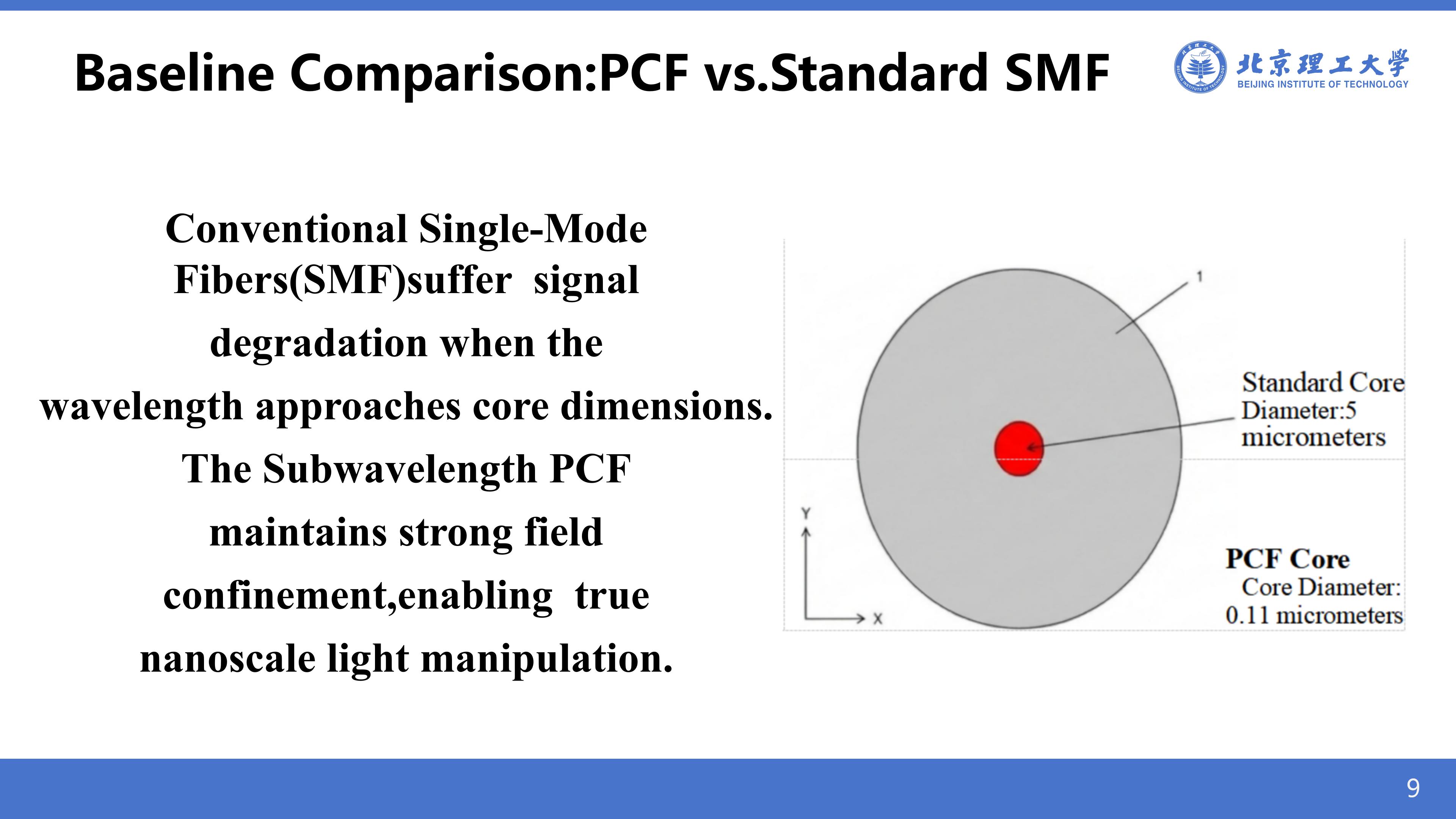 |
Compared to a standard single-mode fiber, which suffers from signal degradation when the wavelength approaches the core size, our subwavelength PCF maintains strong field confinement.
This enables true nanoscale light manipulation, overcoming a key limitation of conventional fiber technology. |
| ICACT20260376 Slide.10
[Big Slide]
[YouTube] |
Chrome Click!! |
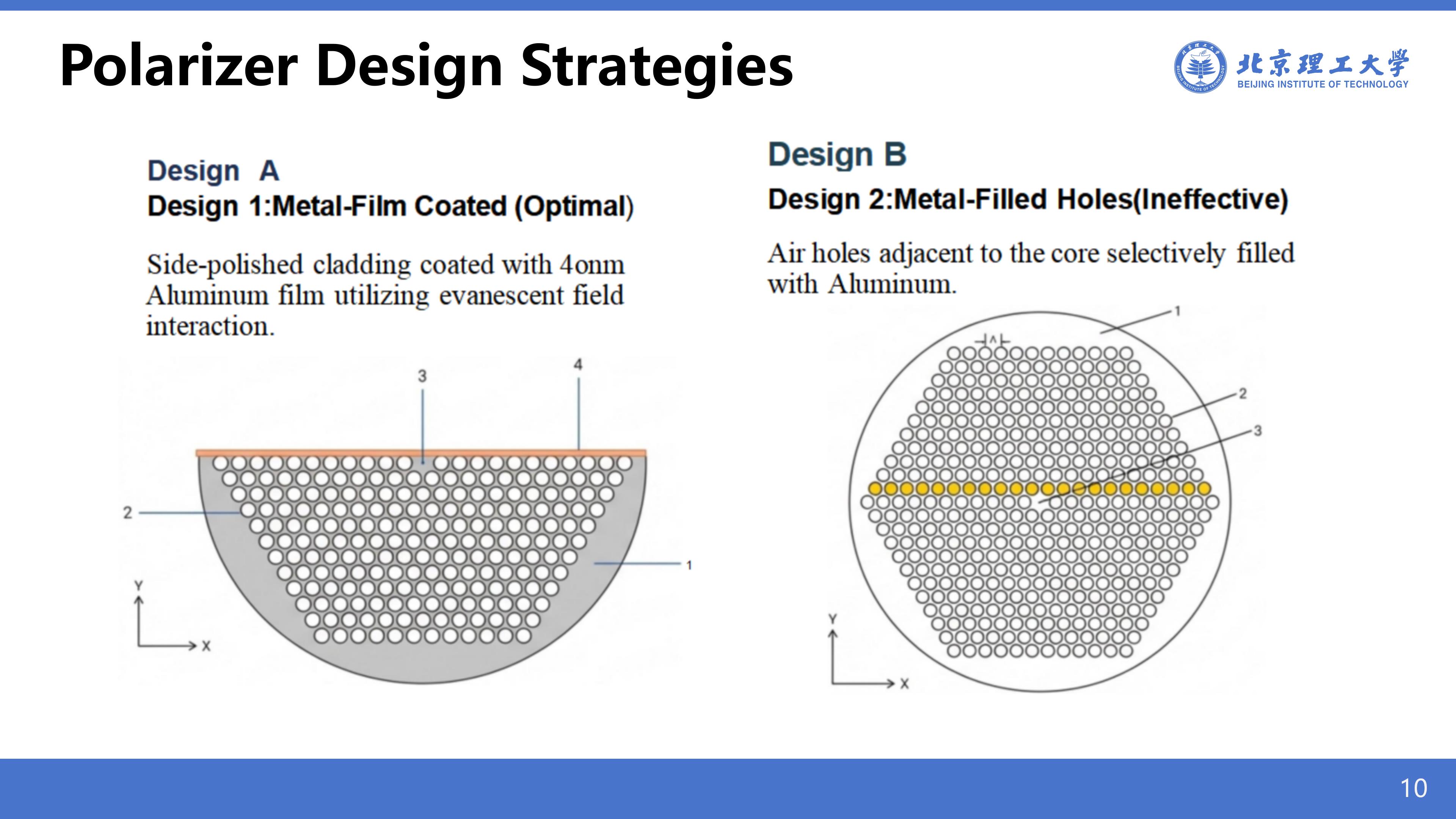 |
We investigated two polarizer designs based on the same PCF platform:
A metal-film coated design, where the fiber is side-polished and coated with aluminum.
A metal-filled hole design, where air holes near the core are filled with aluminum. |
| ICACT20260376 Slide.11
[Big Slide]
[YouTube] |
Chrome Click!! |
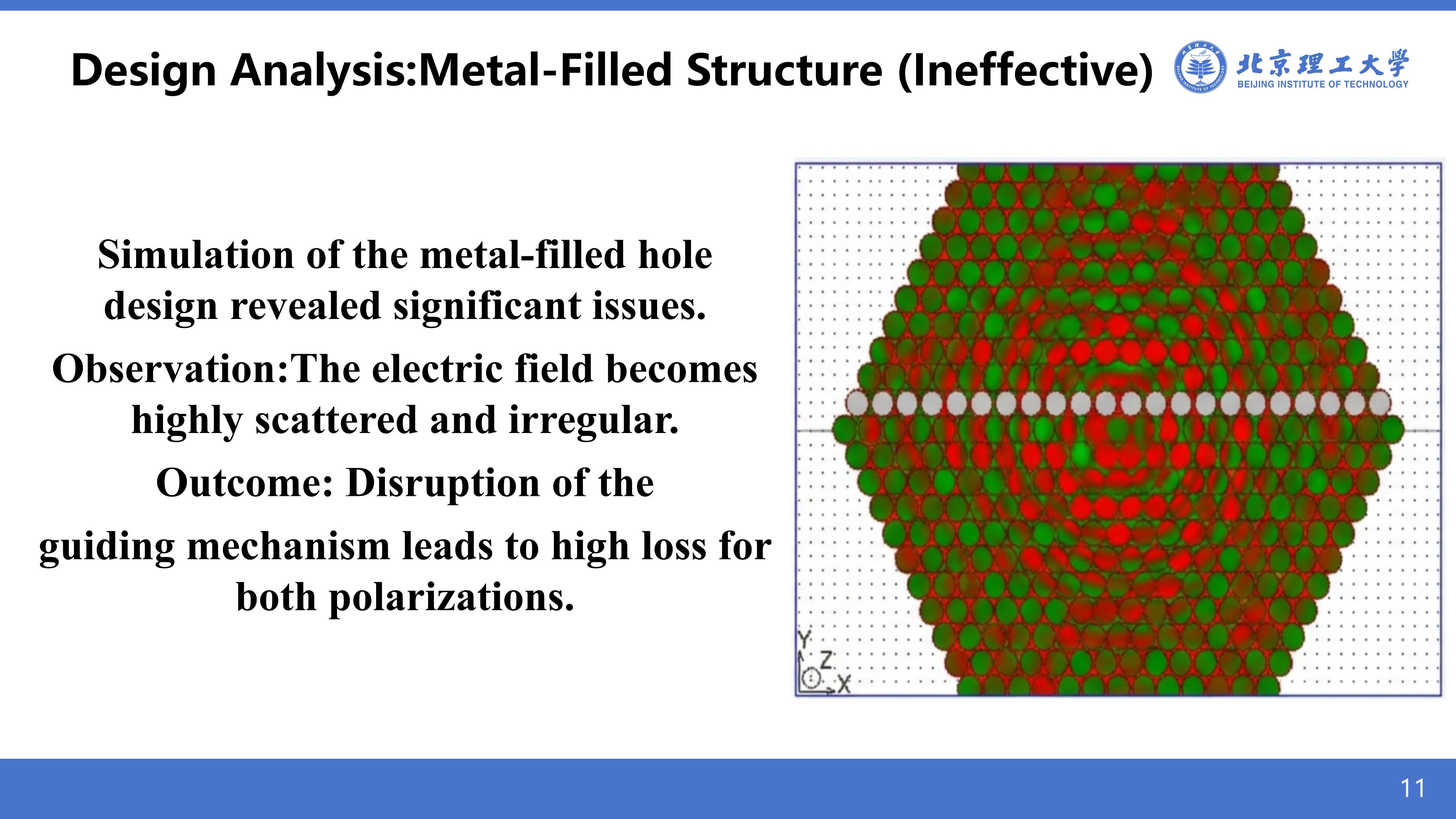 |
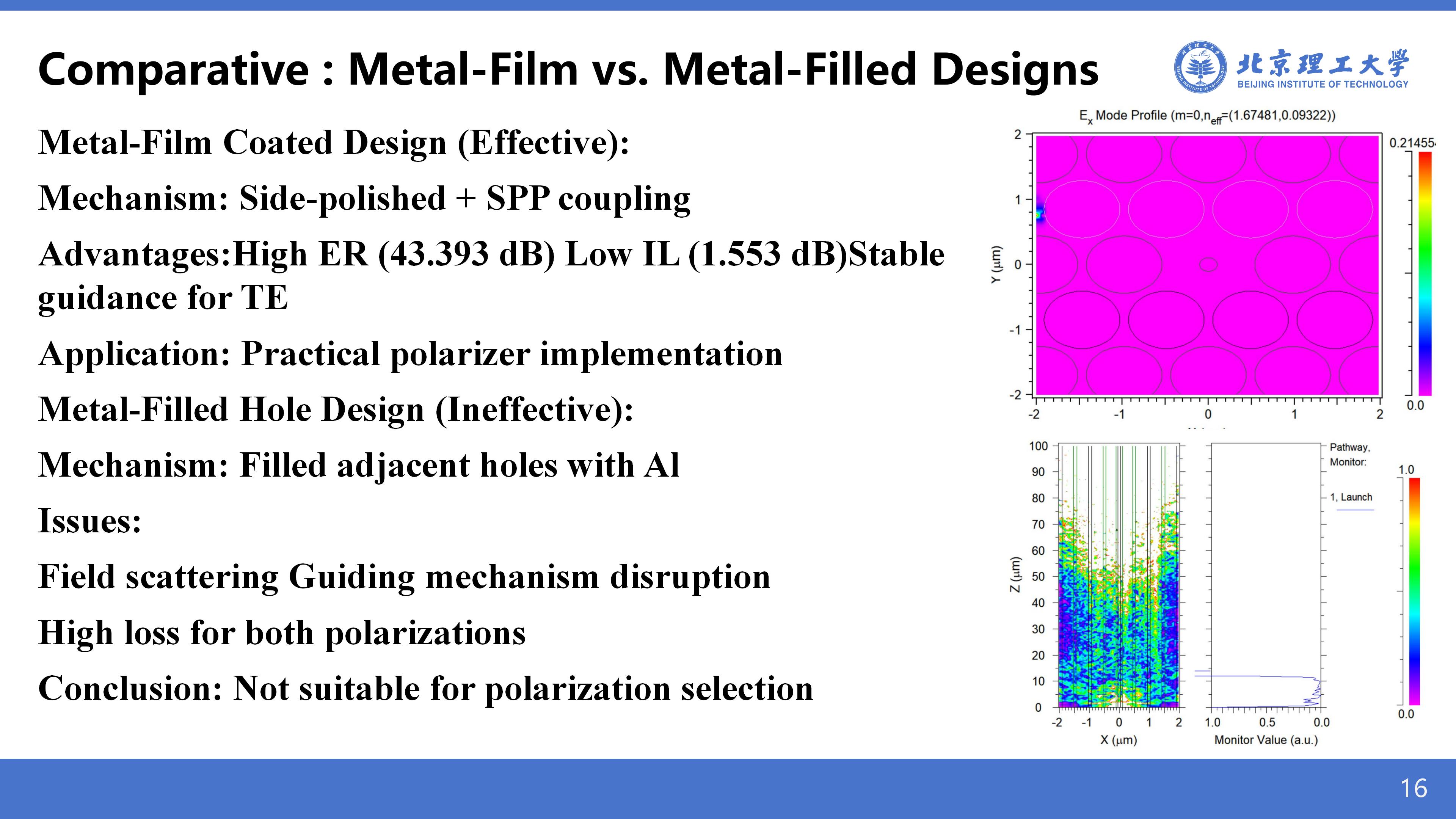
The metal-filled design proved ineffective.
Simulations showed significant field scattering and disruption of the guiding mechanism, leading to high loss for both polarizations.
Thus, this approach is unsuitable for polarization selection. |
| ICACT20260376 Slide.12
[Big Slide]
[YouTube] |
Chrome Click!! |
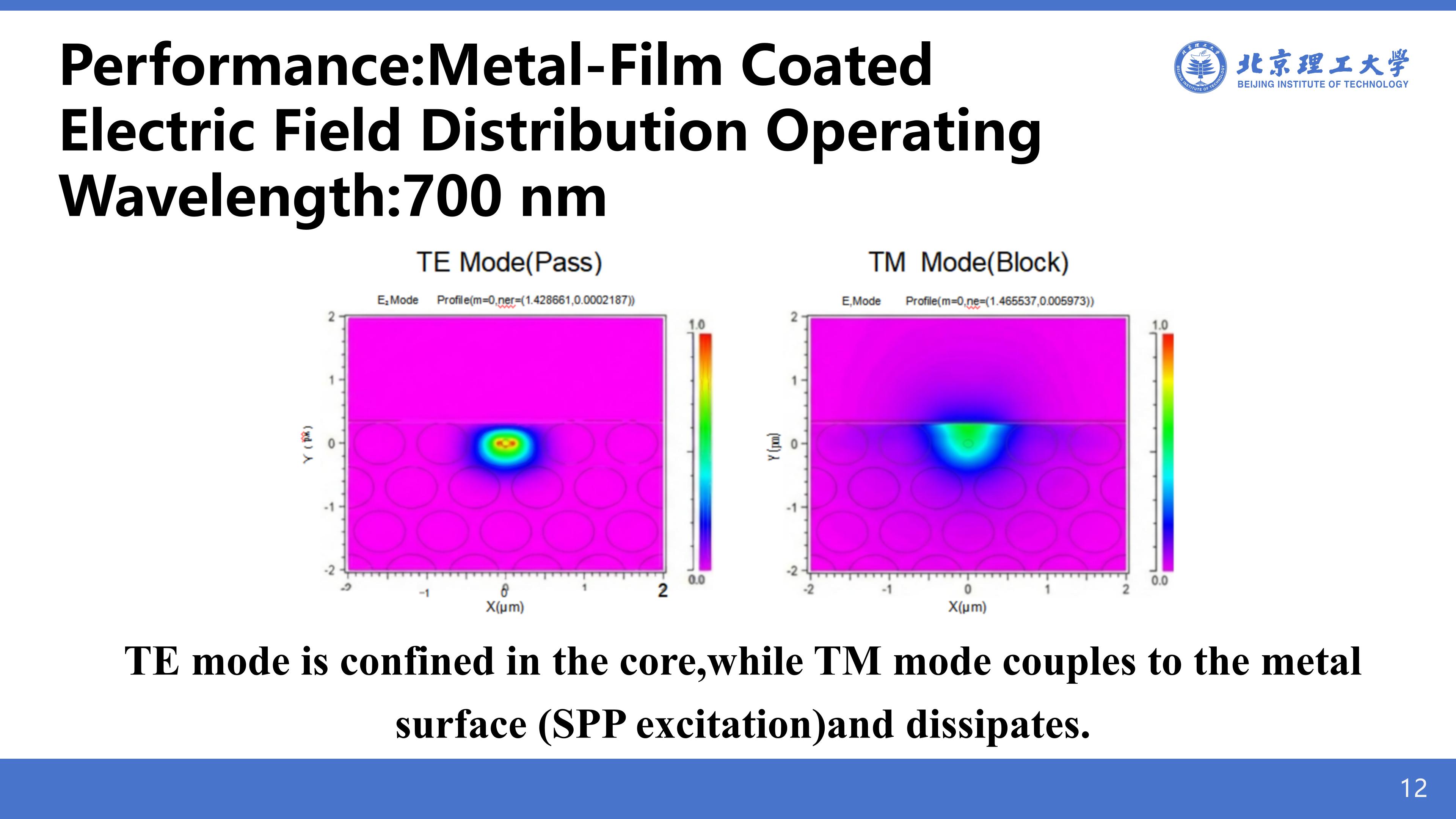 |
For the metal-film coated design at 700 nm, we observe clear polarization selectivity.
The TE mode remains confined in the core, while the TM mode couples to the metal surface via SPP excitation and is strongly attenuated. |
| ICACT20260376 Slide.13
[Big Slide]
[YouTube] |
Chrome Click!! |
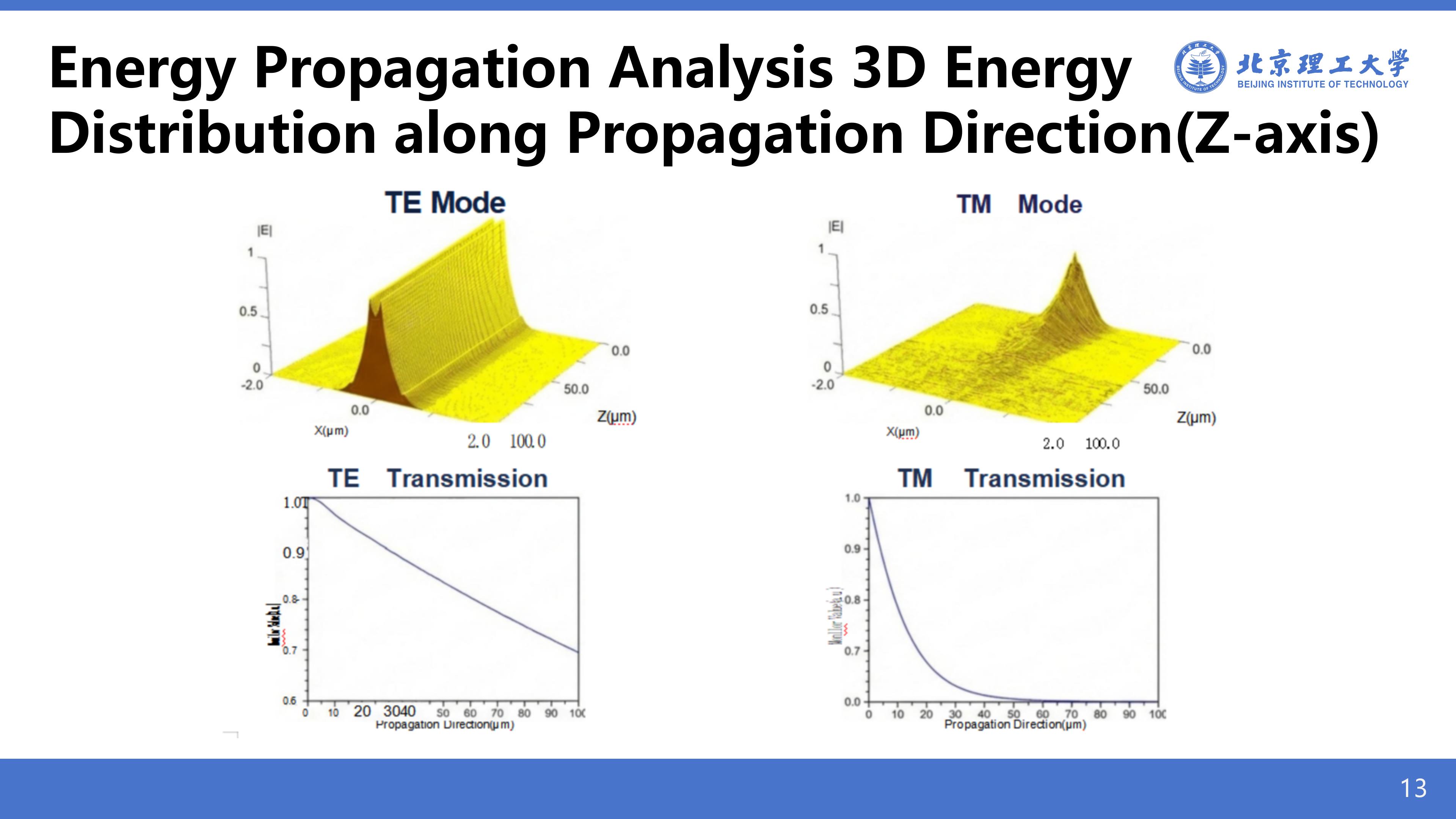 |
3D energy distribution along the propagation direction further illustrates this behavior:
TE light propagates with low loss, while TM light decays rapidly due to SPP coupling. |
| ICACT20260376 Slide.14
[Big Slide]
[YouTube] |
Chrome Click!! |
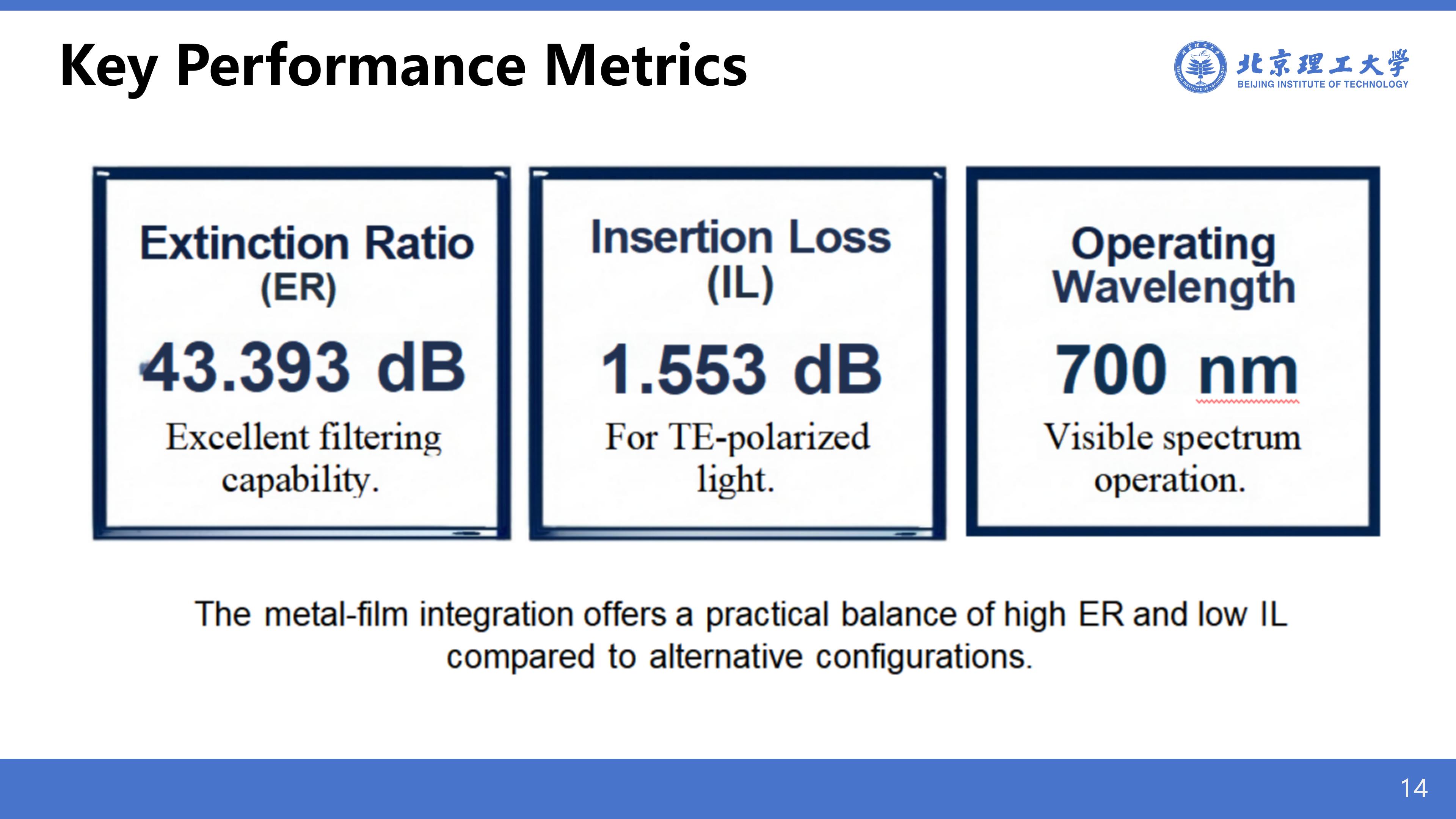 |
The metal-film polarizer achieves an extinction ratio of 43.393 dB and an insertion loss of only 1.553 dB for TE-polarized light.
These values demonstrate excellent performance suitable for sensitive photonic systems. |
| ICACT20260376 Slide.15
[Big Slide]
[YouTube] |
Chrome Click!! |
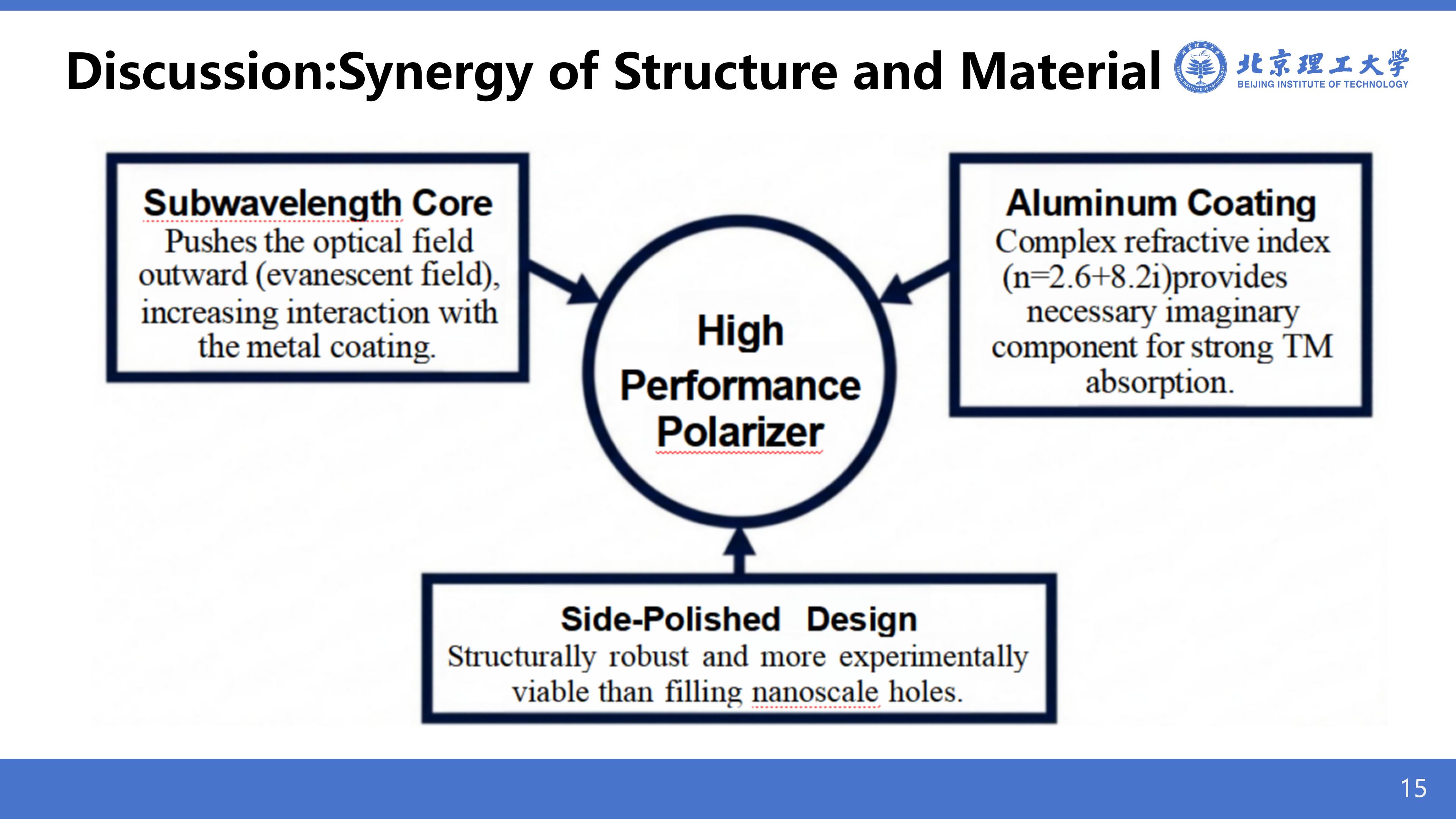 |
The success of the metal-film design lies in the controlled interaction between the guided mode and the SPP layer.
The subwavelength core ensures strong field intensity near the metal interface, enhancing polarization selectivity while maintaining structural robustness. |
| ICACT20260376 Slide.16
[Big Slide]
[YouTube] |
Chrome Click!! |
 |
To summarize:
The metal-film coated design is highly effective, offering high ER, low IL, and stable guidance for TE light.
The metal-filled hole design fails due to field scattering and high loss for both polarizations.
Thus, the side-polished metal-film approach is the preferred method for practical polarizer implementation. |
| ICACT20260376 Slide.17
[Big Slide]
[YouTube] |
Chrome Click!! |
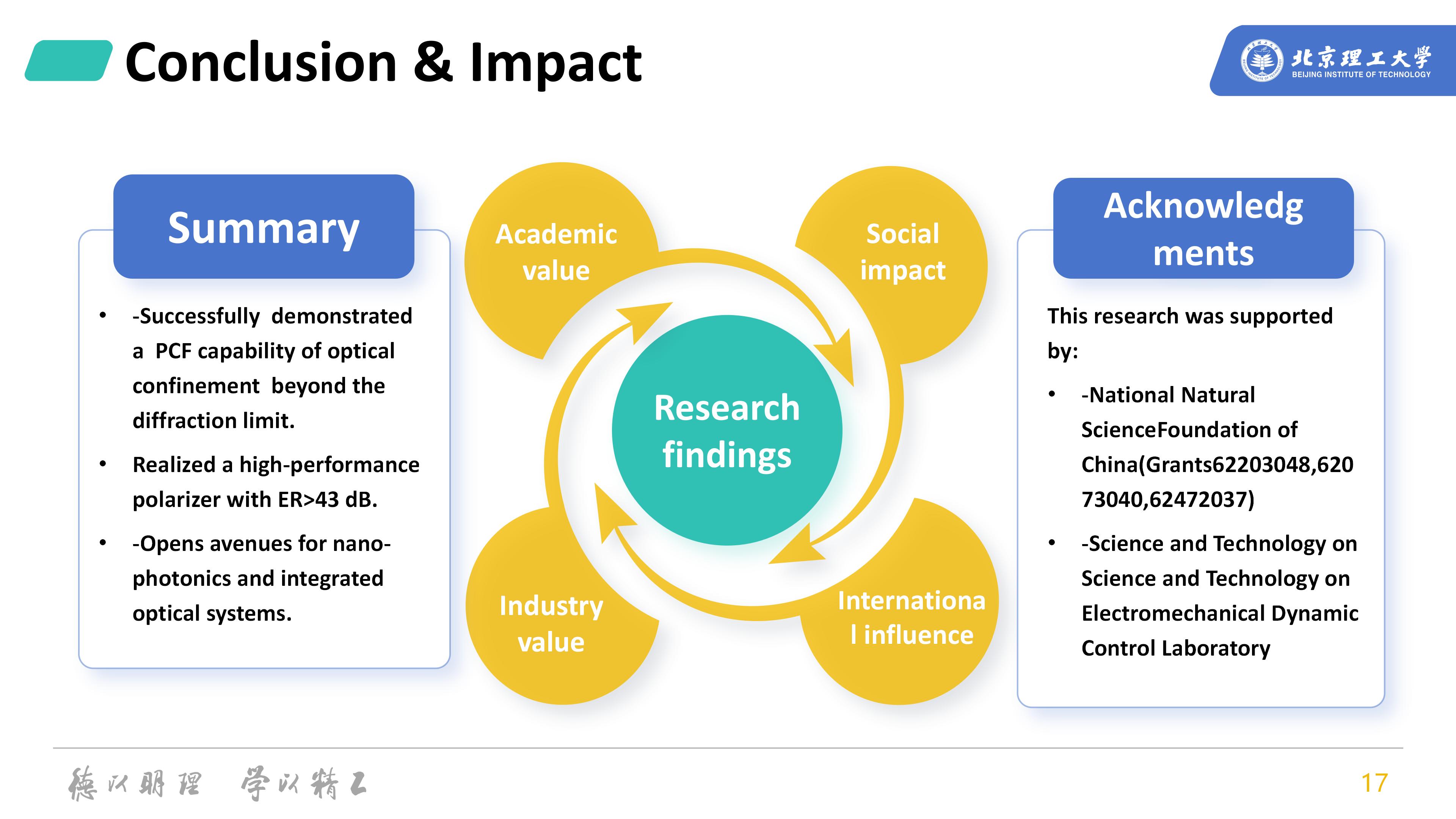 |
In conclusion, we have designed and numerically validated a novel subwavelength air-core PCF that overcomes the classical diffraction limit via the slot-waveguide effect.
We also demonstrated a high-performance polarizer based on this fiber, achieving an exceptional extinction ratio of over 43 dB with low insertion loss.
This work paves the way for advanced nanophotonic devices and integrated polarization control systems. |
| ICACT20260376 Slide.18
[Big Slide]
[YouTube] |
Chrome Click!! |
 |
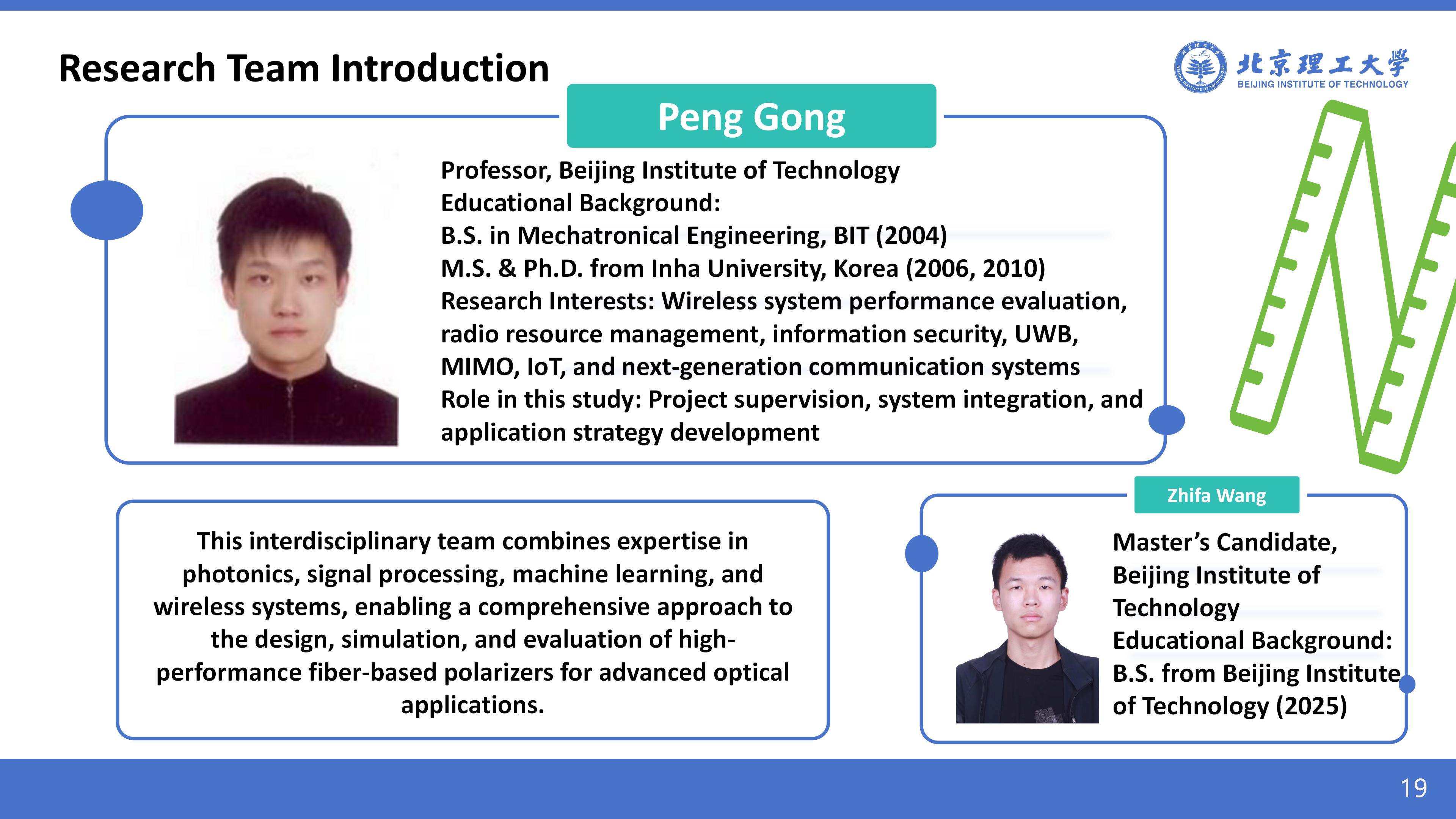
This work was conducted by our research team from Beijing Institute of Technology.
We are grateful for the support from the National Natural Science Foundation of China and the Science and Technology on Electromechanical Dynamic Control Laboratory. |
| ICACT20260376 Slide.19
[Big Slide]
[YouTube] |
Chrome Click!! |
 |
We appreciate your attention and welcome your questions and suggestions. |
| ICACT20260376 Slide.20
[Big Slide]
[YouTube] |
Chrome Click!! |
 |
I am Zien Zhang, and this is our presentation.
We look forward to your feedback and fruitful discussions. |















