 ICACT20210248 Slide.01
[Big Slide]
[YouTube] |
Chrome  Click!! |
 |
Hi everyone. My name is Tae-shin Kang in smart contents major of ICT convergence division at Pyeongtaek University. Our presentation today is about Blockchain-based Lightweight Transaction Process Modeling and Development. We proposed a new blockchain process model we called Lightweight Transaction to minimize the use of system resources and we modeled the LwTx architecture and applied it to several application services. |
| ICACT20210248 Slide.02
[Big Slide]
[YouTube] |
Chrome Click!! |
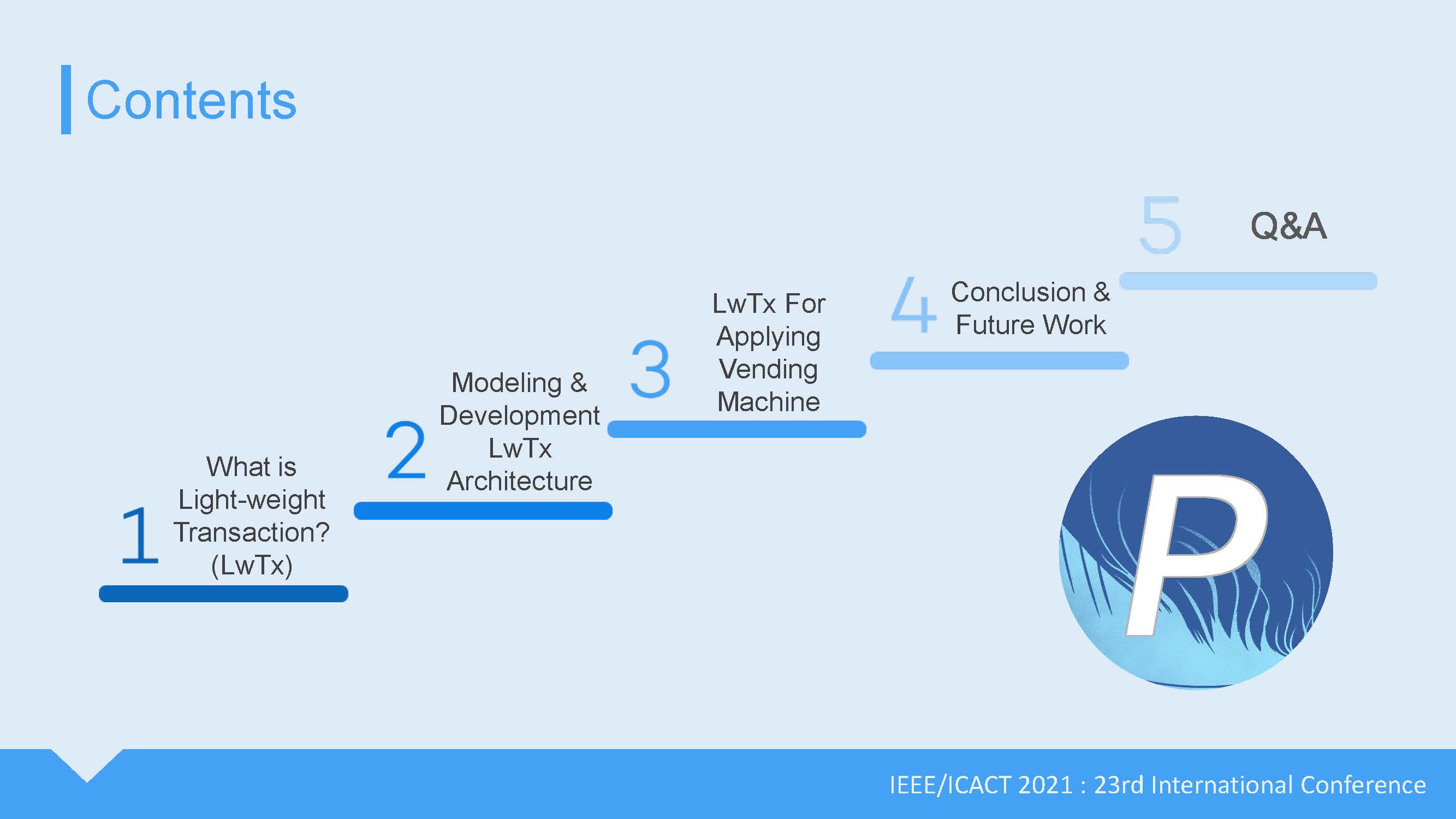 |
Presentation order is as follows. First, let's take a quick look at what the new concept is, Light-weight Transaction (LwTx), and the core elements and technologies used in LwTx. Section 2 introduces LwTx architecture and a new coin based on the LwTx architecture. Section 3 explores the payment transaction process with a LwTx process based on the vending machine blockchain application model. Finally, Section 4 discusses the conclusion and future challenges of this study. |
| ICACT20210248 Slide.03
[Big Slide]
[YouTube] |
Chrome Click!! |
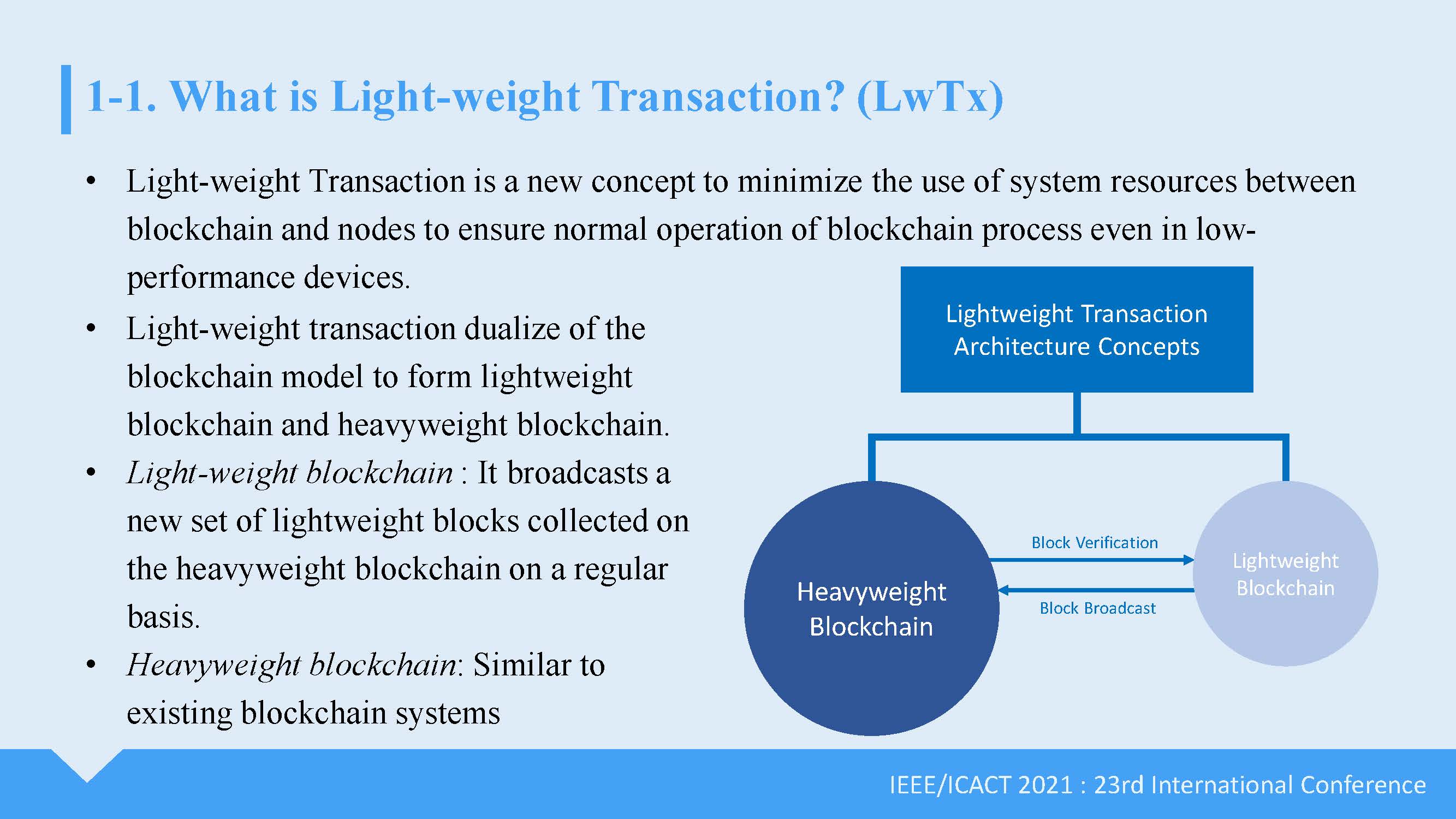 |
The first thing to look at is what Light-weight Transaction is. Light-weight Transaction is a new concept to minimize the use of system resources between blockchain and nodes to ensure normal operation of blockchain process even in low-performance devices. The following figure is a brief representation of the Lightweight Transaction Architecture Concept. It dualize of the blockchain model to form heavyweight blockchain and lightweight blockchain. The role of lightweight blockchain is to regularly broadcast new lightweight block sets collected in heavyweight blockchain. Overall, the role of heavyweight blockchain is similar to existing blockchain systems for examples bitcoin blockchain systems. Differences from existing systems include logic to validate blocks broadcast by lightweight blockchain.
|
| ICACT20210248 Slide.04
[Big Slide]
[YouTube] |
Chrome Click!! |
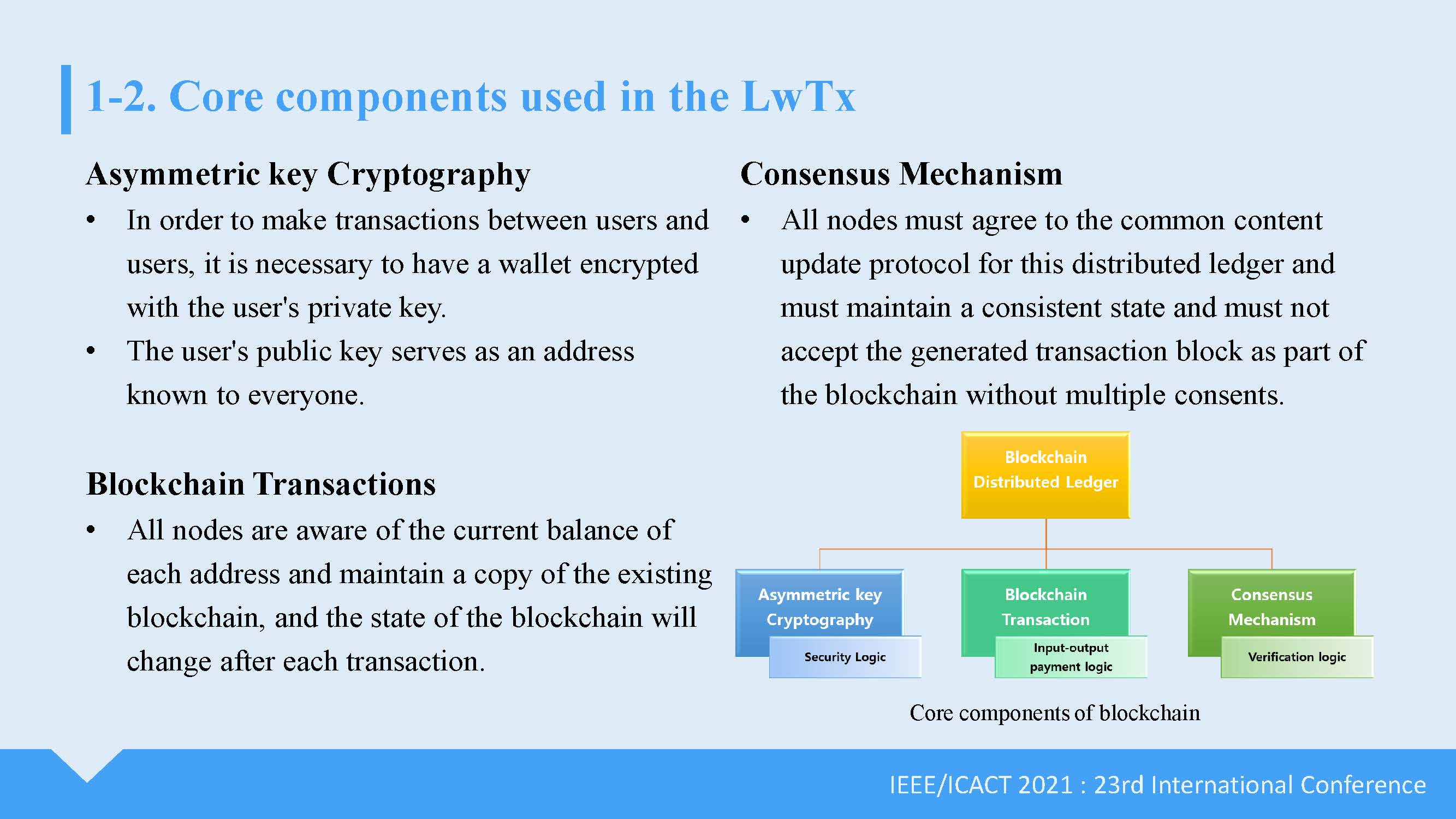 |
Before we look at the detail of LwTx architecture, let's look at the core elements and technologies used in LwTx. First, blockchain networks use public key cryptography for the safe operation of the blockchain. In order to make transactions between users and users, it is necessary to have a wallet encrypted with the user's private key. The user's public key serves as an address known to everyone. Second, Blockchain has a P2P-based information exchange system between nodes. This exchange takes place via a file created by the source node and broadcast to the entire network for verification. All nodes are aware of the current balance of each address and maintain a copy of the existing blockchain, and the state of the blockchain will change after each transaction. Since the unit time transaction volume is enormous, it is very important to verify the authenticity of the transaction and discard the fake. And last, all nodes must agree to the common content update protocol for this distributed ledger and must maintain a consistent state and must not accept the generated transaction block as part of the blockchain without multiple consents. This process is called the consensus mechanism. |
| ICACT20210248 Slide.05
[Big Slide]
[YouTube] |
Chrome Click!! |
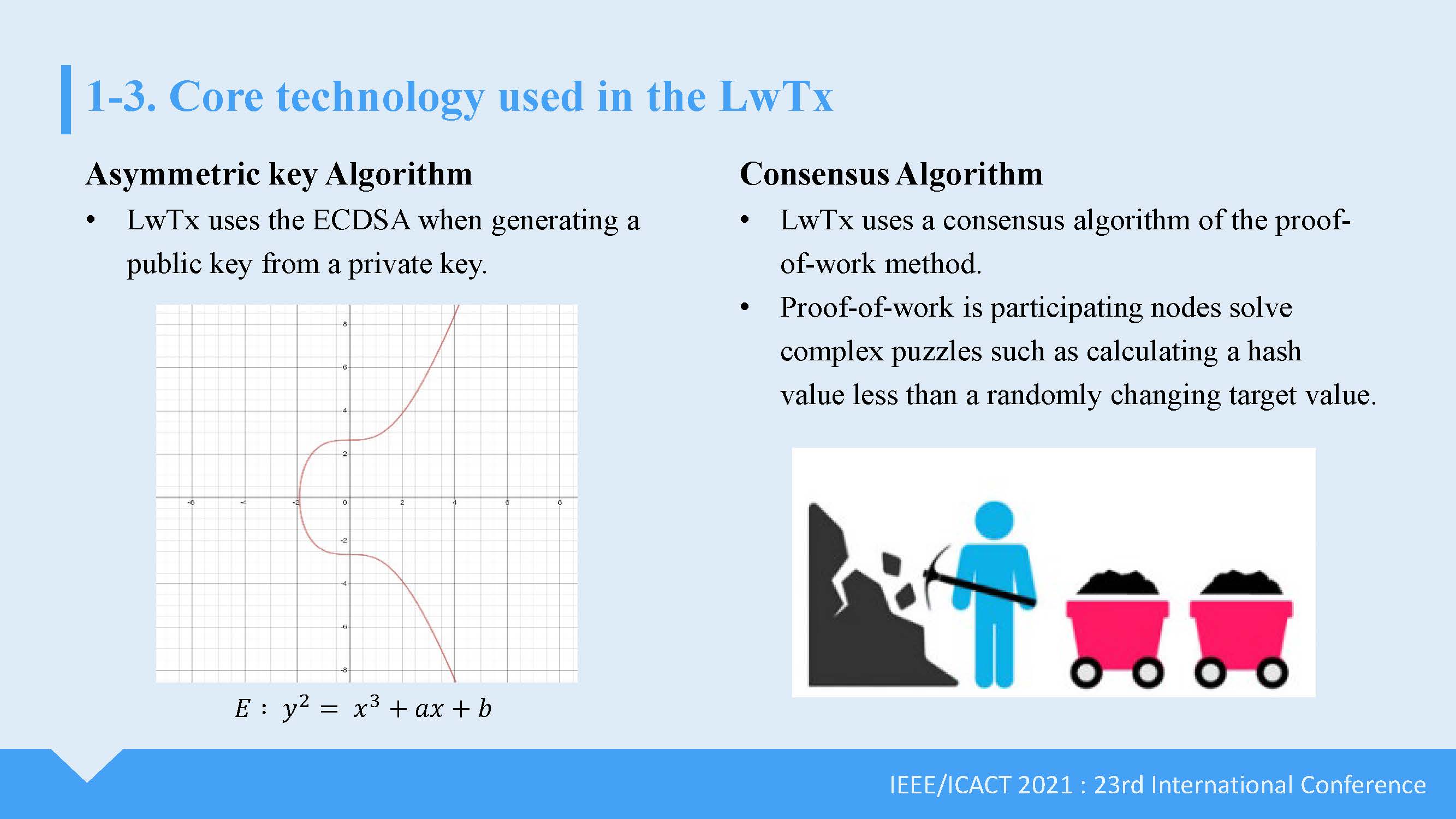 |
Next, I'll explain the background technology used in LwTx. First, all transactions occurring on the blockchain network are signed using public key cryptography, and transactions that are not verified with a valid signature are not approved. LwTx uses the ECDSA when generating a public key from a private key. ECDSA is a cryptographic algorithm that combines an elliptic curve cryptography (ECC) with an electronic signature and is widely used in cryptocurrencies. The following Equation and graph shows the elliptic curve equation used in ECDSA. Second, in a distributed network of users full of distrust, consensus is the only and essential determinant for security update of blocks shared by everyone. LwTx uses a consensus algorithm of the proof-of-work method. Proof-of-work is participating nodes solve complex puzzles such as calculating a hash value less than a randomly changing target value. So it is similar to mining gold. |
| ICACT20210248 Slide.06
[Big Slide]
[YouTube] |
Chrome Click!! |
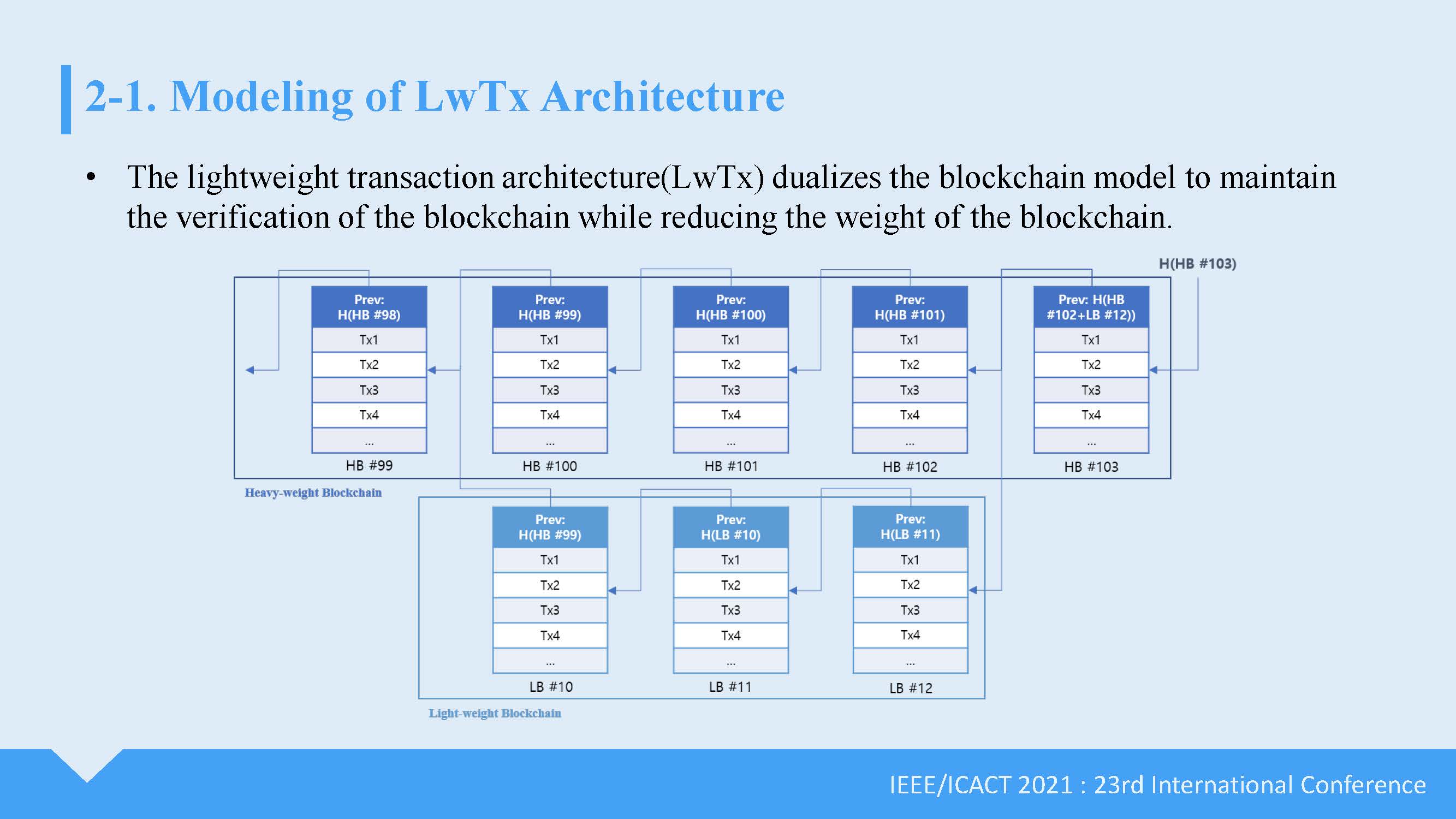 |
Now let's look at the LwTx architecture. The lightweight transaction architecture (LwTx) dualizes the blockchain model to maintain the verification of the blockchain while reducing the weight of the blockchain. The following figure shows the LwTx based blockchain structure. First, the initial block of the lightweight blockchain branches off and receives the last verified block of the heavyweight blockchain network. Second, transactions occurring in the lightweight blockchain network are sequentially collected and stored in a lightweight block and repeat this process until certain conditions are met.
Third, when the number of blocks of the lightweight blockchain is more than a certain number or the execution time of the lightweight transaction reaches the synchronization time limit, the blocks of the lightweight node are broadcast to the heavyweight blockchain to join the blockchain network. Therefore, these blocks became part of the heavyweight blockchain block. Fourth, in the heavyweight blockchain, if the blocks of the lightweight blockchain are properly verified and reflected, all blocks in the lightweight blockchain are deleted after a certain period of time, and the subsequent lightweight blockchain creation process is continuously performed.
|
| ICACT20210248 Slide.07
[Big Slide]
[YouTube] |
Chrome Click!! |
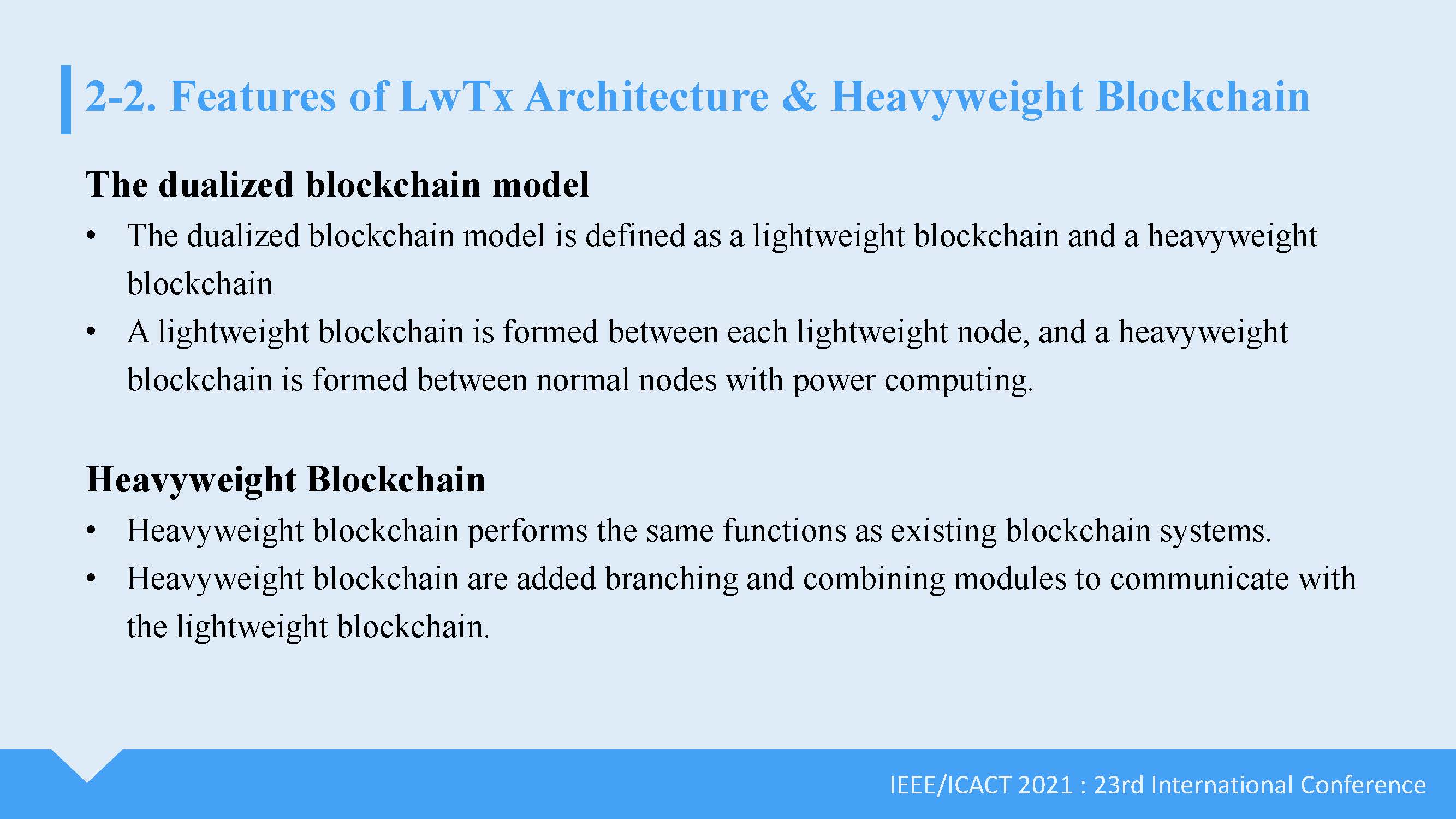 |
LwTx has a dualized blockchain model defined as a lightweight blockchain and a heavyweight blockchain. A lightweight blockchain is formed between each lightweight node, and a heavyweight blockchain is formed between normal nodes with power computing.
Heavyweight Blockchain is not special compared to lightweight blockchain.It performs the same functions as existing blockchain systems.In addition, heavyweight blockchain are added branching and combining modules to communicate with the lightweight blockchain. |
| ICACT20210248 Slide.08
[Big Slide]
[YouTube] |
Chrome Click!! |
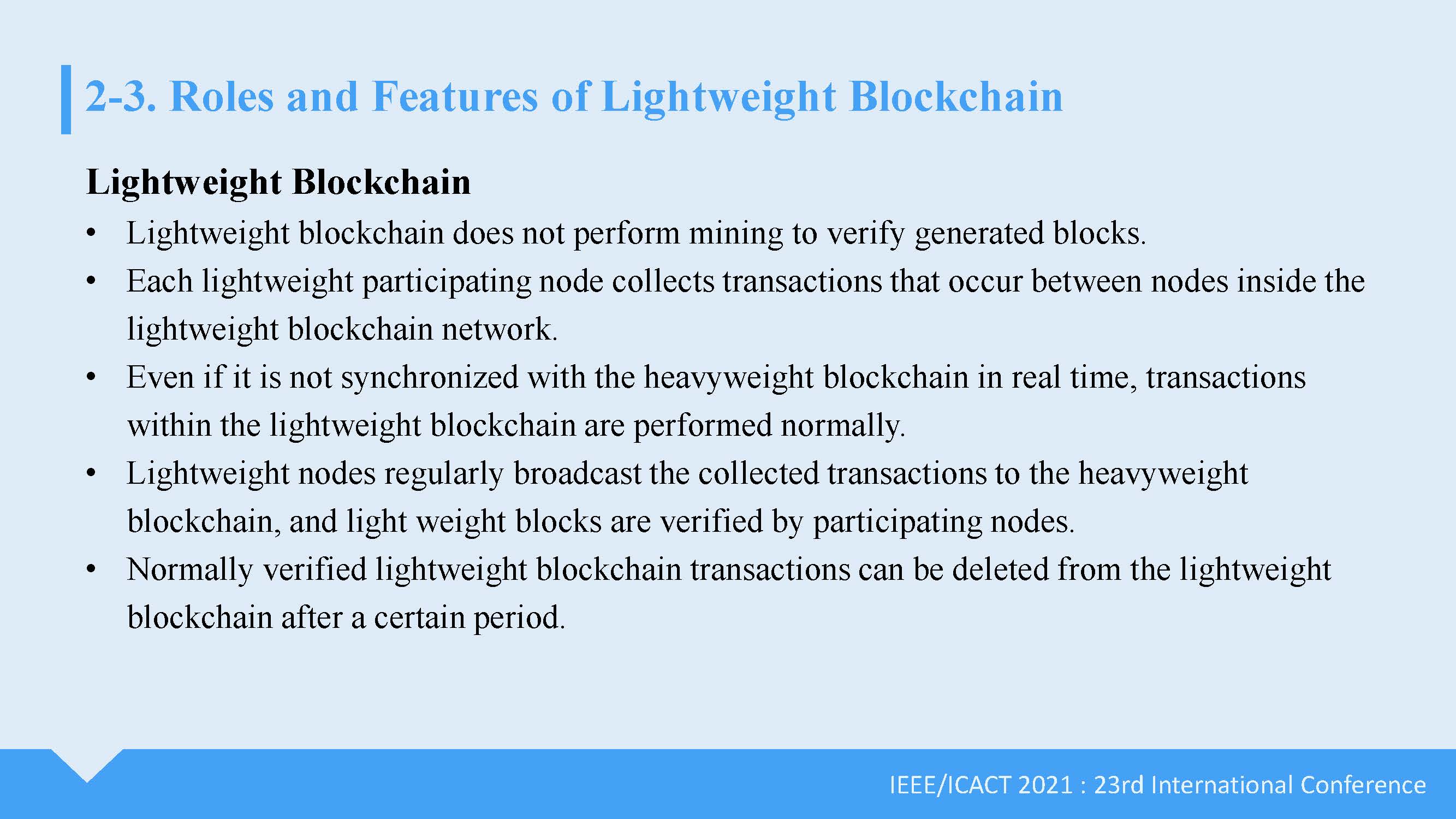 |
On the other hand, Lightweight Blockchain does not perform mining to verify generated blocks.
Each lightweight participating node collects transactions that occur between nodes inside the lightweight blockchain network.
Even if it is not synchronized with the heavyweight blockchain in real time, transactions within the lightweight blockchain are performed normally.
Lightweight nodes regularly broadcast the collected transactions to the heavyweight blockchain, and light weight blocks are verified by participating nodes.
Normally verified lightweight blockchain transactions can be deleted from the lightweight blockchain after a certain period.
|
| ICACT20210248 Slide.09
[Big Slide]
[YouTube] |
Chrome Click!! |
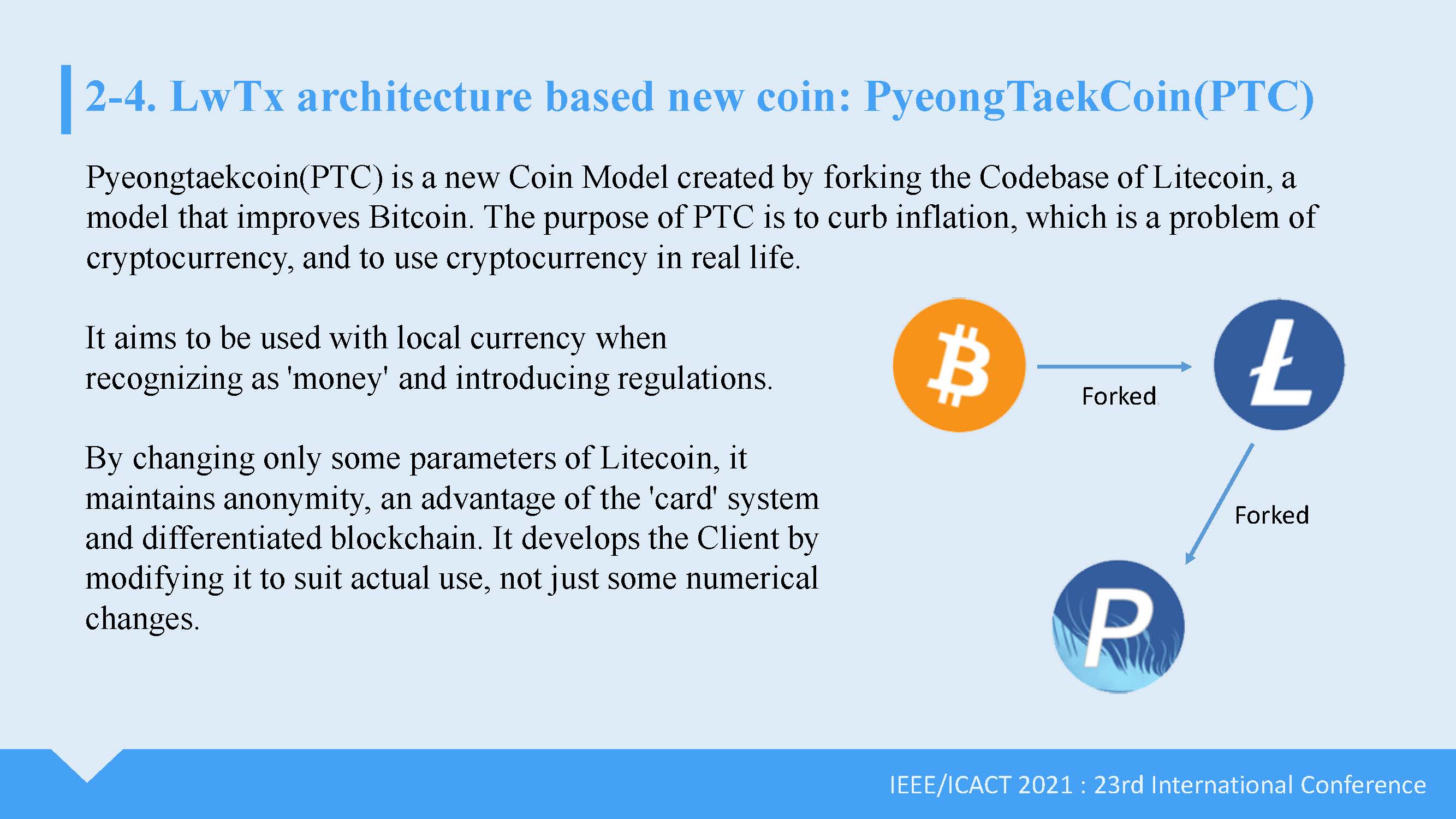 |
Next, I will introduce Pyeongtaekcoin (PTC), a new coin based on LwTx Architecture. PTC is a new Coin Model created by forking the Codebase of Litecoin, a model that improves Bitcoin. The purpose of Pyeongtaekcoin (PTC) is to curb inflation, which is a problem of cryptocurrency, and to use cryptocurrency in real life. It aims to be used with local currency when recognizing as 'money' and introducing regulations. By changing only some parameters of Litecoin, it maintains anonymity, an advantage of the 'card' system and differentiated blockchain. It develops the Client by modifying it to suit actual use, not just some numerical changes.
|
| ICACT20210248 Slide.10
[Big Slide]
[YouTube] |
Chrome Click!! |
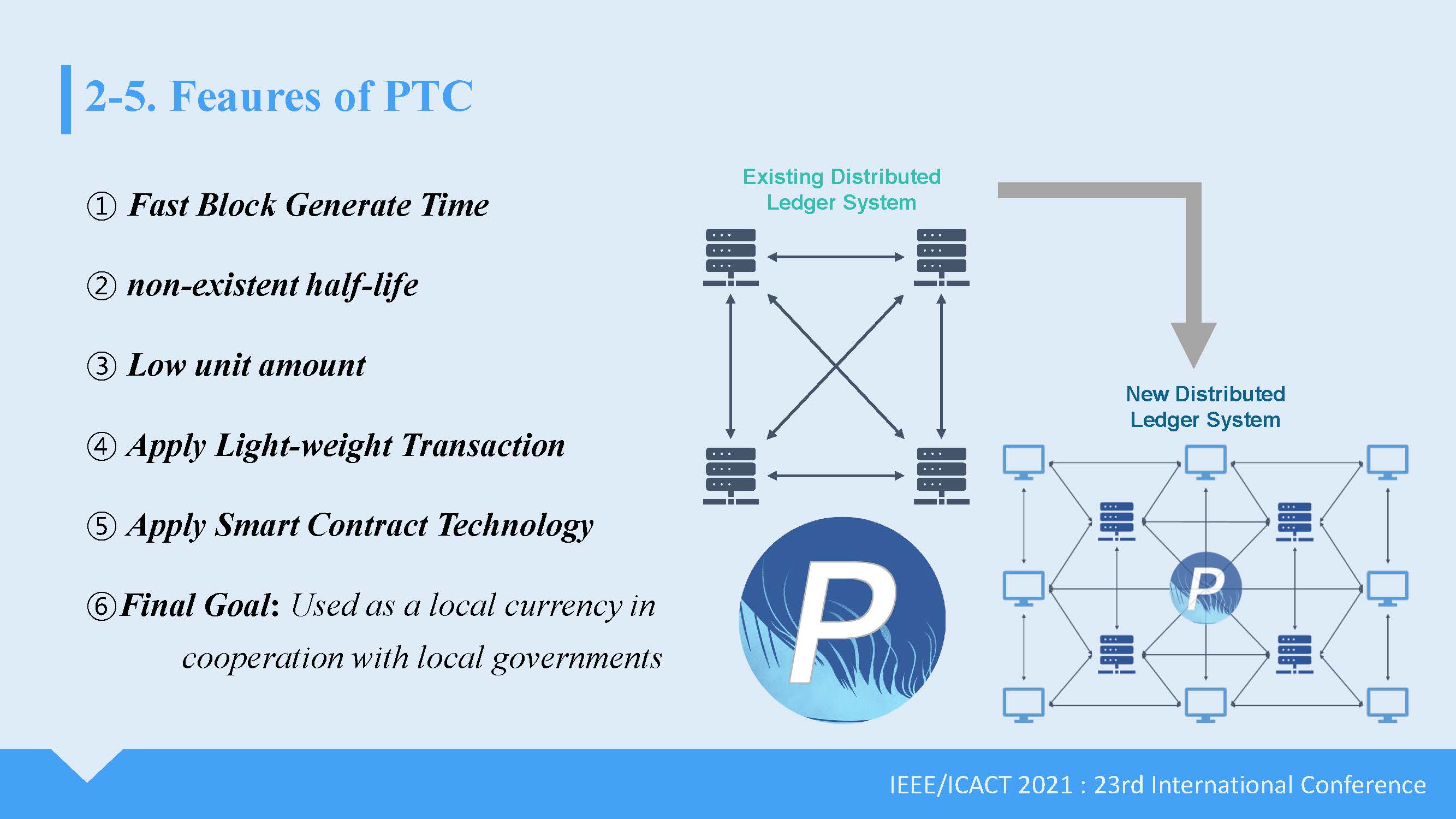 |
The following are the characteristics of the PTC:
First, the fast block creation time. Create blocks quickly to induce quick agreement.
second is non-existent half-life. It inhibits inflation in coins by not having a half-life.
Third is low unit amount. The value of the unit amount of the 1PTC should be close to 1 dollar. To realize a low unit amount, the block reward must be set high, and the total issuance of coins must be increased.
The Fourth is Apply Light-weight Transaction. LwTx enables clients to operate even in poor hardware environments.
Fifth is Apply Smart Contract. It is designed to be suitable for real-life use with Smart Contract technology.
And the last is Final goal of PTC. it is used as a local currency in cooperation with local governments.
|
| ICACT20210248 Slide.11
[Big Slide]
[YouTube] |
Chrome Click!! |
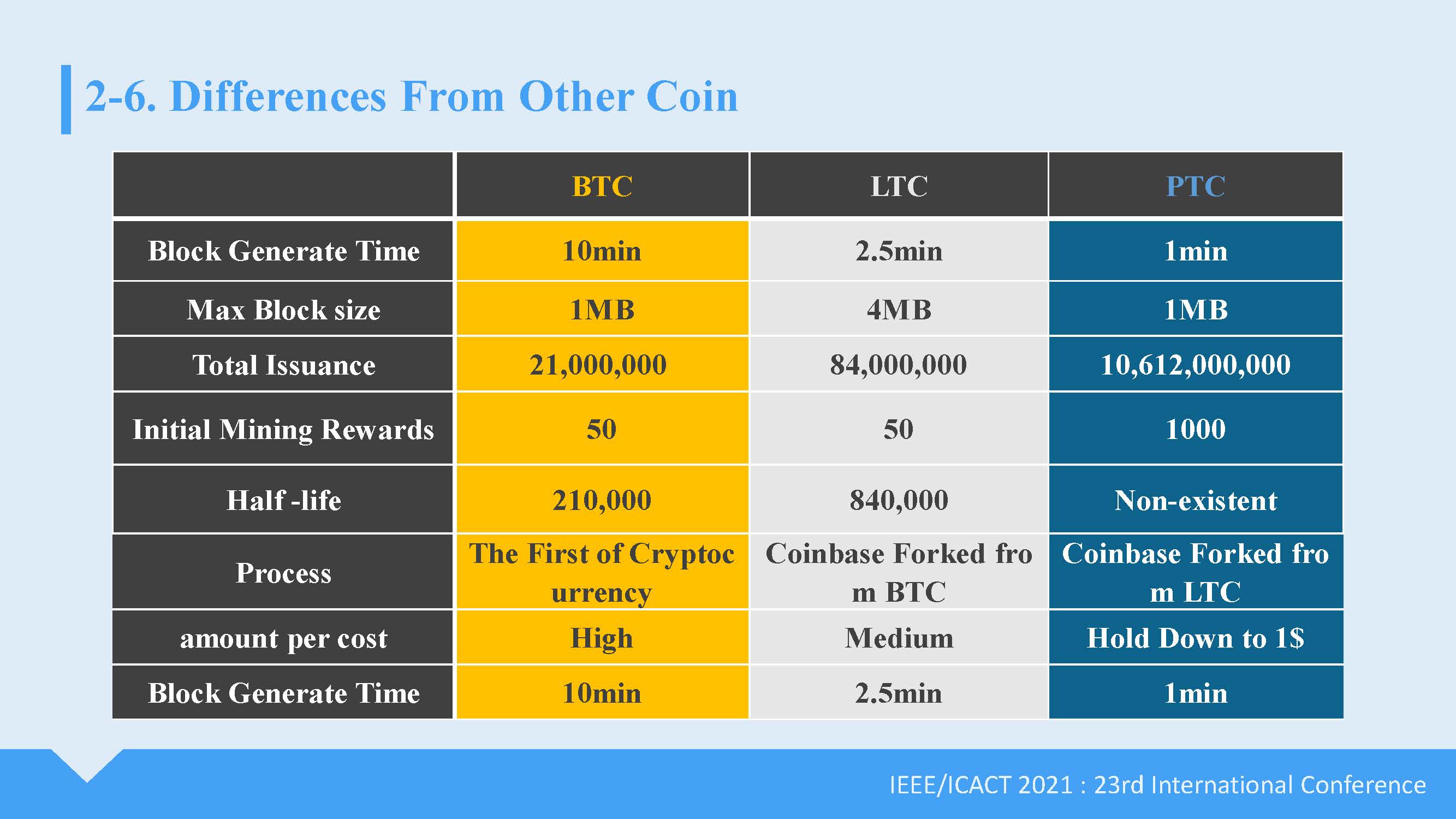 |
The last part of Section 2 is the comparison between PTC and other coins. PTC has reduced the block generation cycle to 1 minute to shorten the minimum verification time of the blockchain and has the intention to reduce the value of the unit amount as much as possible by increasing the mining reward and total issuance. Also, since there is no half-life, it prevents the price of coins from rising rapidly every half-life. |
| ICACT20210248 Slide.12
[Big Slide]
[YouTube] |
Chrome Click!! |
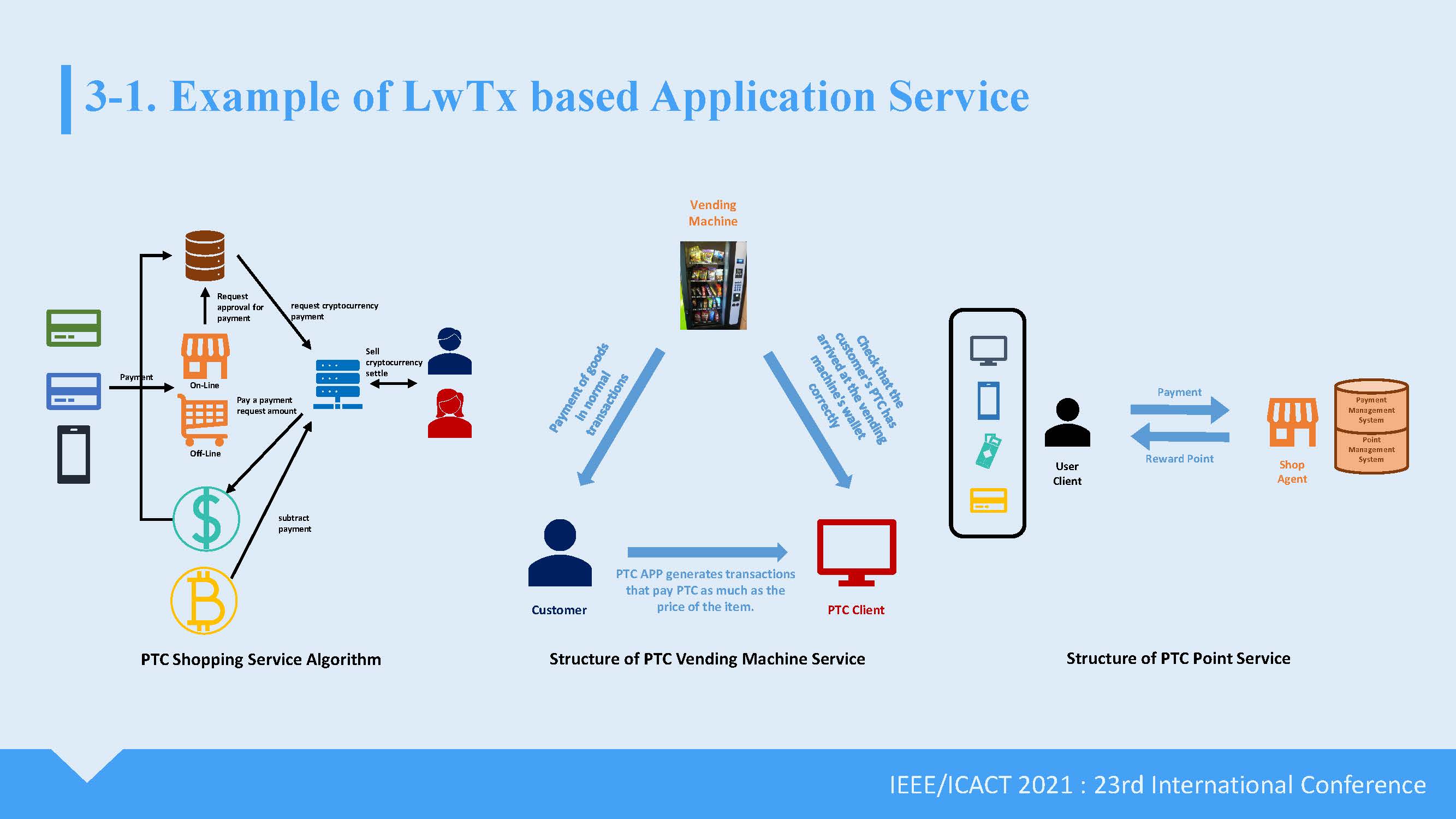 |
The topic we will discuss in this section is examples of LwTx based application services. The following figure shows an example of an examples of LwTx based application services. We would like to describe the application process that applied LwTx to Vending Machine among these various application services. |
| ICACT20210248 Slide.13
[Big Slide]
[YouTube] |
Chrome Click!! |
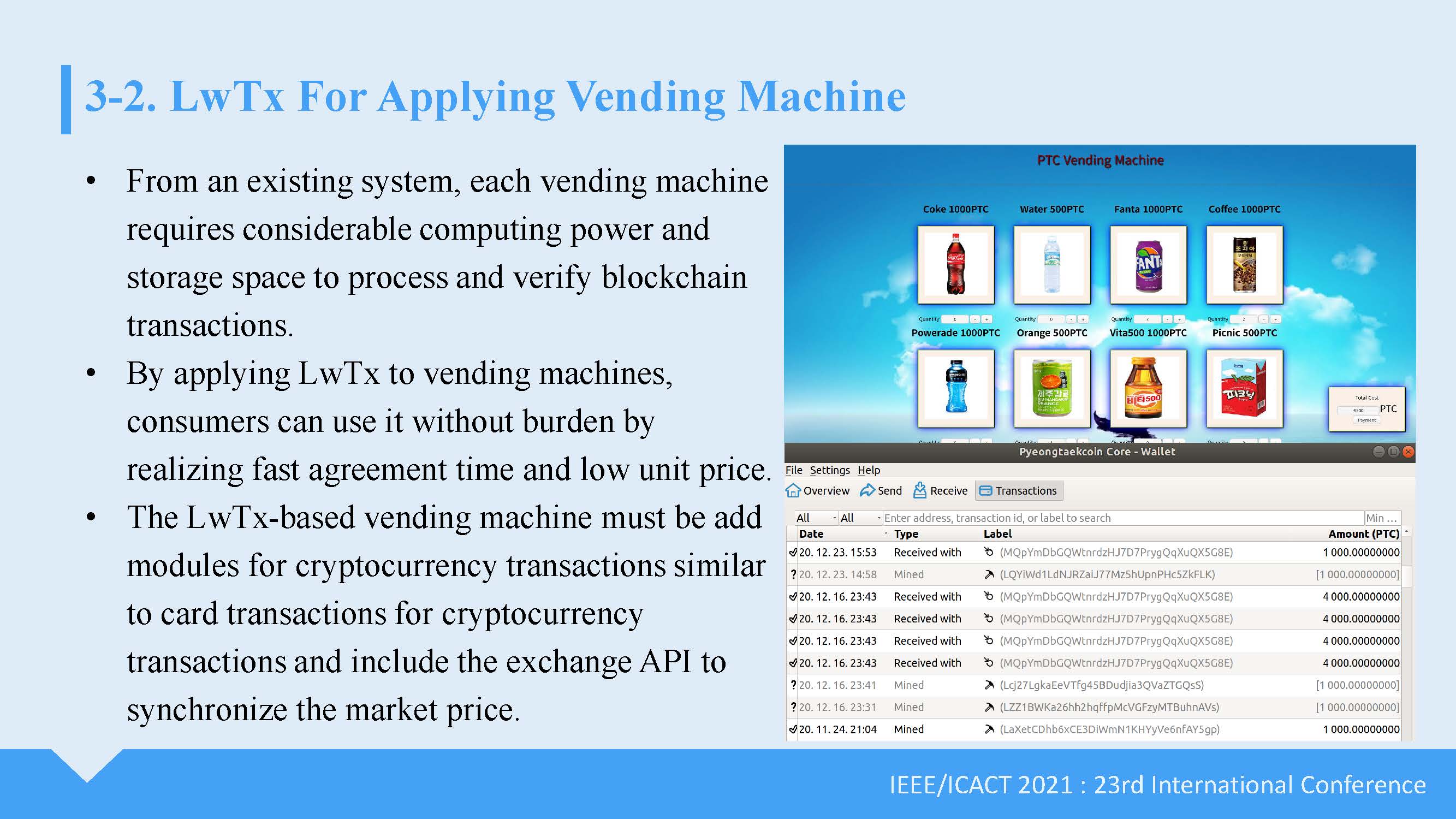 |
From an existing system, each vending machine requires considerable computing power and storage space to process and verify blockchain transactions.
By applying LwTx to vending machines, consumers can use it without burden by realizing fast agreement time and low unit price.
The LwTx-based vending machine must be add modules for cryptocurrency transactions similar to card transactions for cryptocurrency transactions and include the exchange API to synchronize the market price. The following figure shows the application of lwtx to vending machines.
|
| ICACT20210248 Slide.14
[Big Slide]
[YouTube] |
Chrome Click!! |
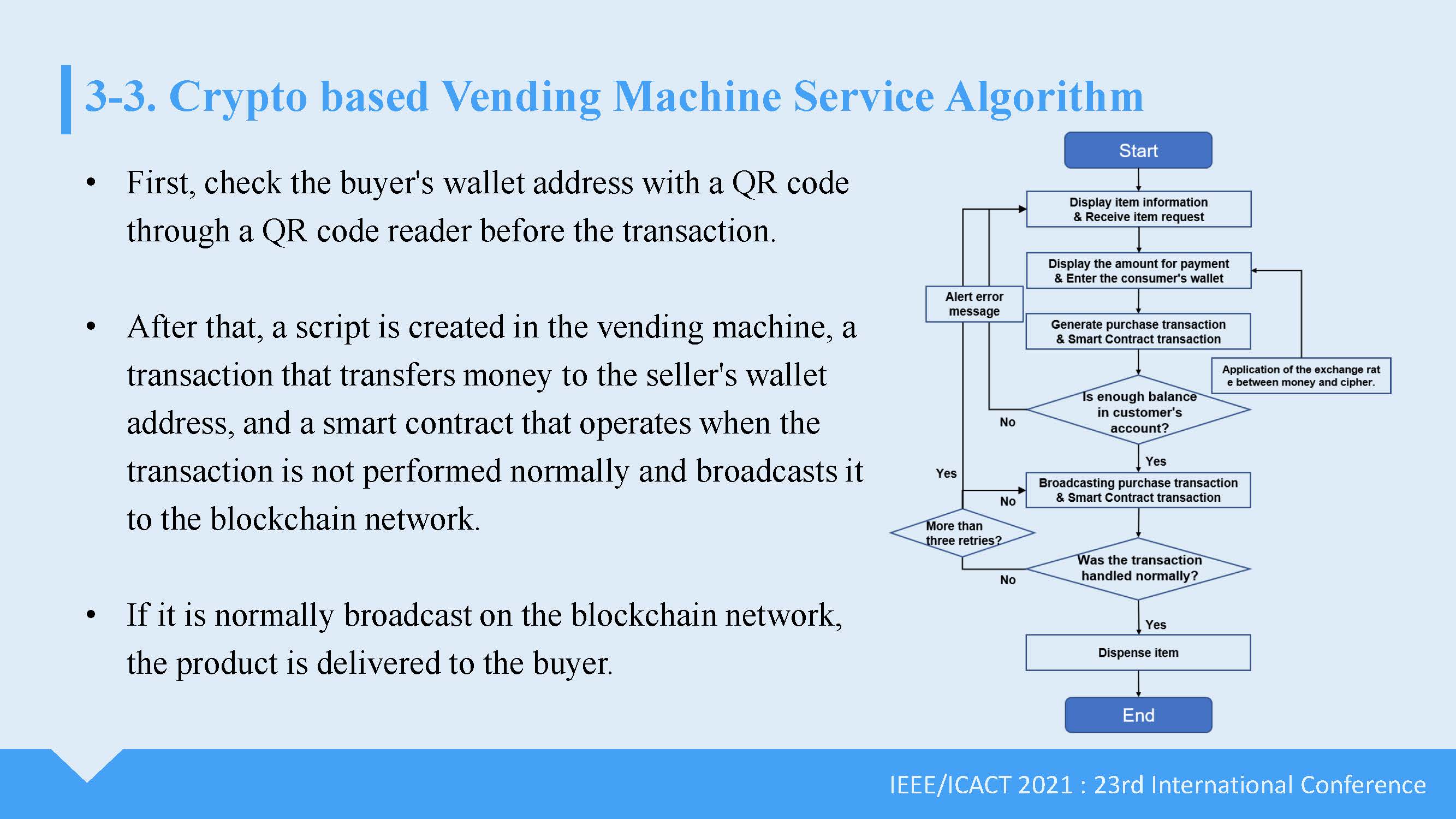 |
The following flow chart shows the cryptocurrency-based vending machine service algorithm. The biggest difference from the existing vending machine service algorithm is that a module for cryptocurrency transactions similar to card transactions is added for cryptocurrency transactions, and the exchange API to synchronize the market price must be included inside the vending machine due to the nature of cryptocurrency that the market price changes from time to time. to be. First, check the buyer's wallet address with a QR code through a QR code reader before the transaction.
After that, a script is created in the vending machine, a transaction that transfers money to the seller's wallet address, and a smart contract that operates when the transaction is not performed normally and broadcasts it to the blockchain network.
If it is normally broadcast on the blockchain network, the product is delivered to the buyer.
|
| ICACT20210248 Slide.15
[Big Slide]
[YouTube] |
Chrome Click!! |
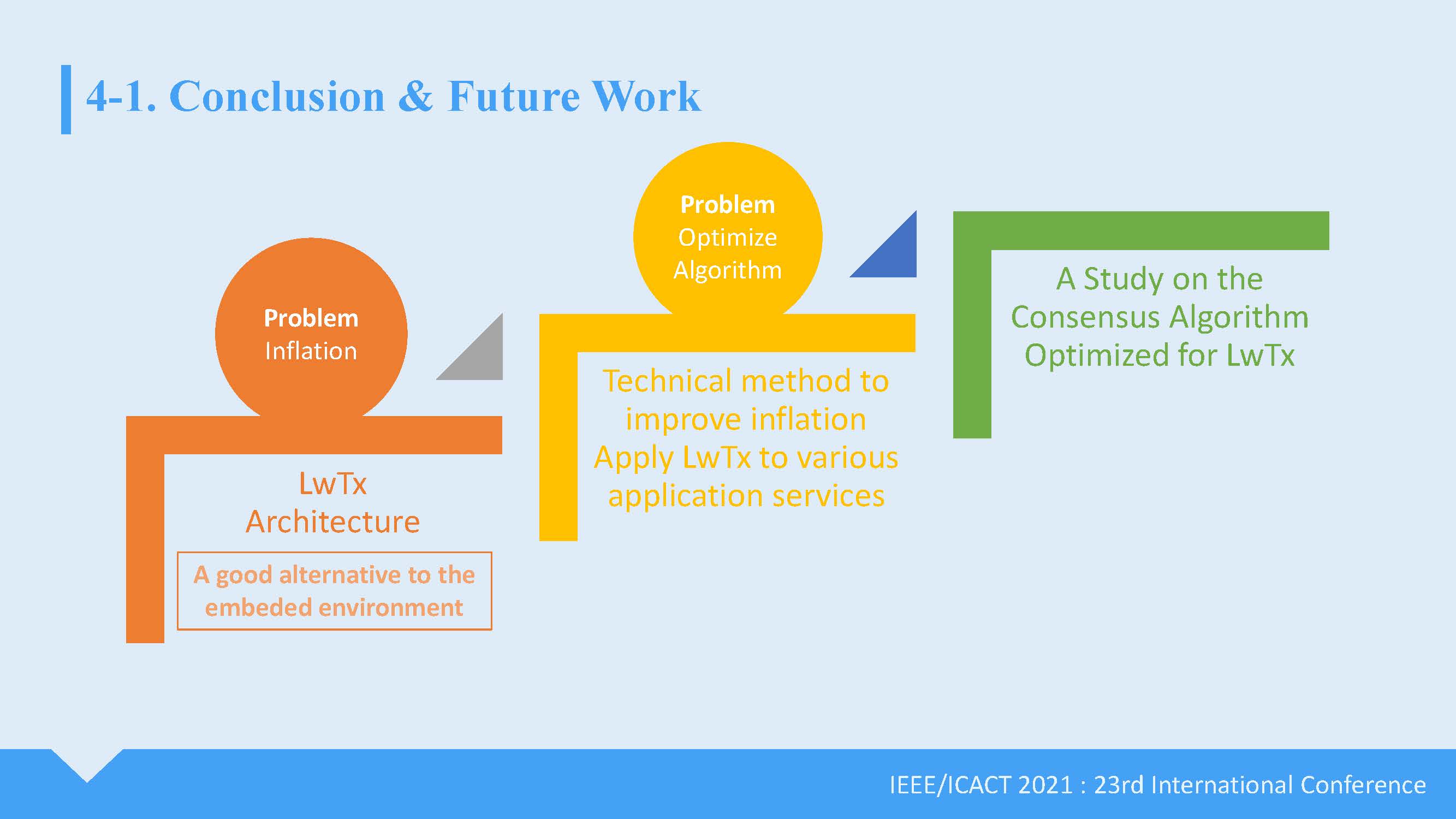 |
This study presented a good alternative to the application environment where normal block hash calculation ability and electric power wasted on a large-scale blockchain network were burdensome. Nevertheless, despite the proposed lightweight transaction-based blockchain system suggesting an improvement direction for the resource constraint problem, there remains a problem of how to suppress the biased inflation of issued cryptocurrencies. Future research intends to propose a technical method to improve inflation biased in cryptocurrency based on the proposed lightweight blockchain process, and to discover and apply application cases of vending machines. |
| ICACT20210248 Slide.16
[Big Slide]
[YouTube] |
Chrome Click!! |
 |
Thank you for your attention. Do you have any questions? Welcome any comment or question. I'm Tae-shin Kang from Pyeongtaek University. Thank you. |
| ICACT20210248 Slide.17
[Big Slide]
[YouTube] |
Chrome Click!! |
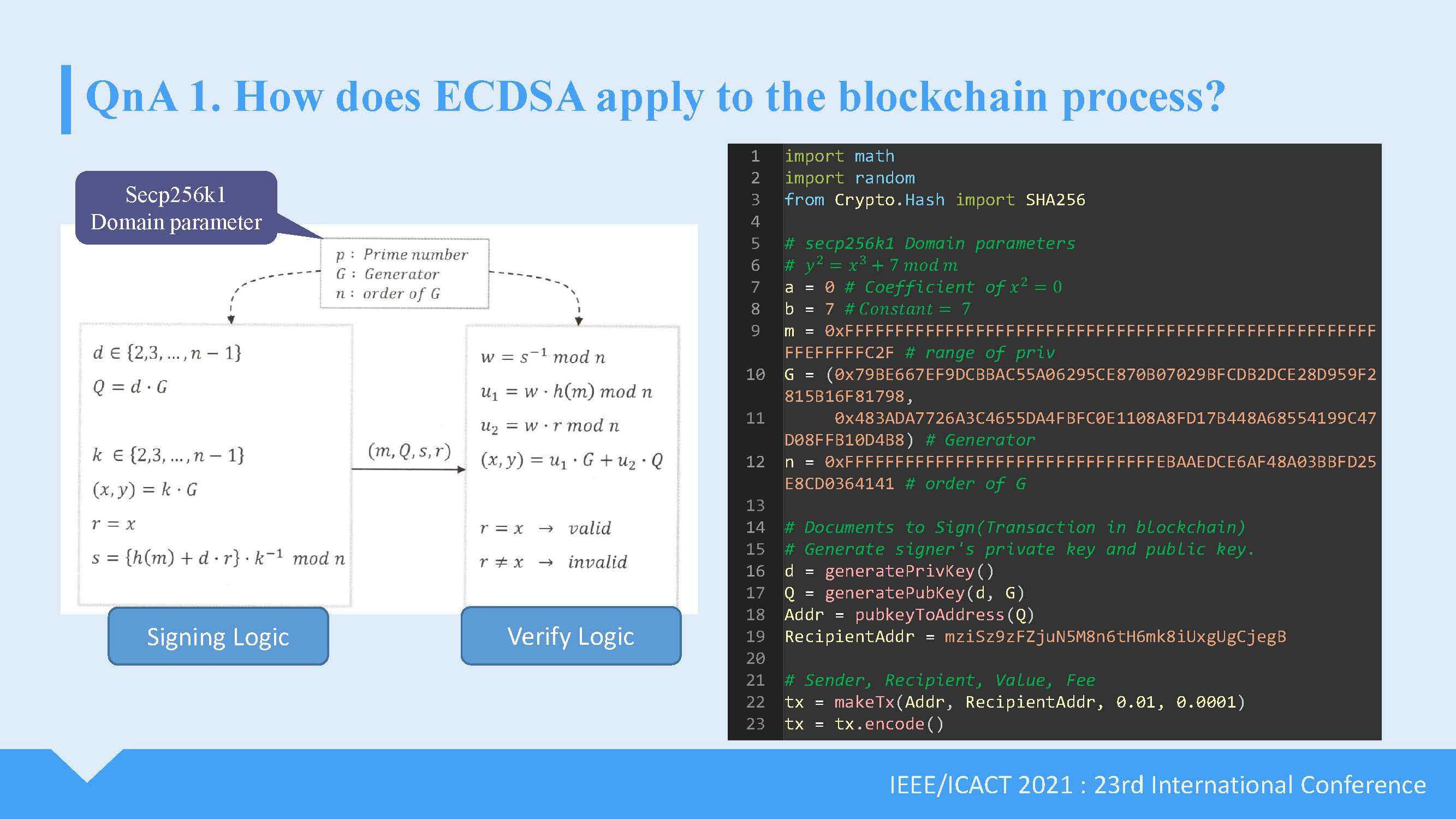 |
This section is a pre-QnA section and It offers a new YouTube video via links. The first pre-QnA is about "How does ECDSA apply to the blockchain process?".The following is a representation of the operating logic of ECDSA and the simple Python code that applied it to the blockchain process. In the figure to the left, d in signing Logic means the private key of the signing user, and Q is the public key calculated by ECC's. k and x correspond to a temporarily created key for signing, and generate a signature through the last line of operations. The verification process is computed through the following process and is considered valid if the key value derived from the next verification process matches the key value in Signing Logic. The code on the right is a step-by-step representation of the ECDSA signature and verification process. Functions such as generatePrivKey are assumed to be pre-implemented. Lines 7 through 12 represent the Domain parameters of secp256k1. The signing logic starts at line 16 . First, private key is generated on line 16, and then the public key is obtained by computing the private key and generator generated on line 17. Line 18 is a code that hashes the public key to obtain the address of the sender's wallet. Line 19 stored the recipient's wallet address. In blockchain, the transaction corresponds to the message to be signed. Line 22 is a code that generates transactions in which the sender sends 0.01 coin to the receiver. The fee here is 0.0001 coin, and it is assumed that a large amount of coin exists in the sender's wallet. |
| ICACT20210248 Slide.18
[Big Slide]
[YouTube] |
Chrome Click!! |
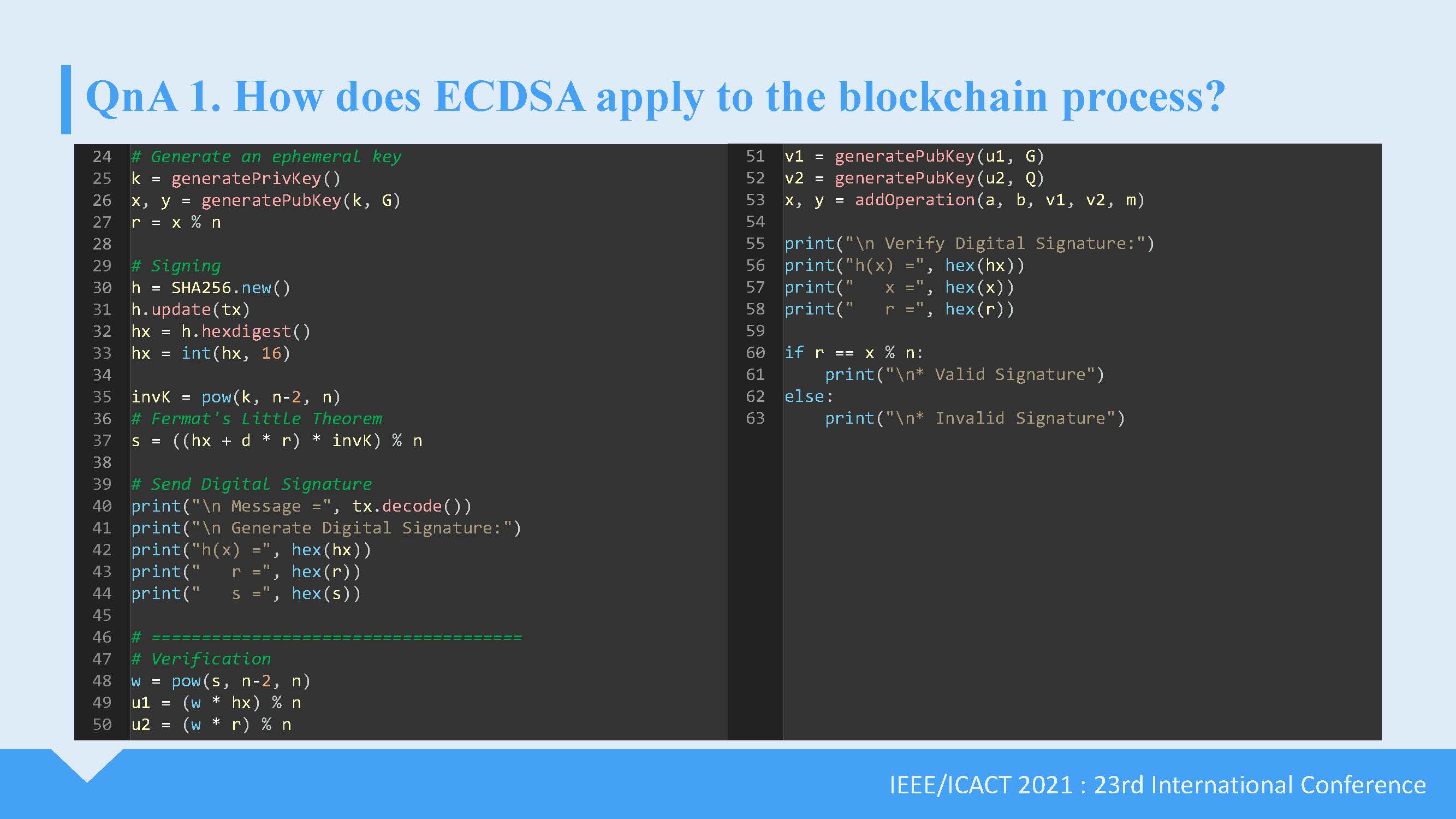 |
Lines 25 and 26 generate ephemeral keys for signatures. The 26 line means k·G, which means that addOperation is performed k times.Line 27 stores the x value of the ephemeral generated public key in r. Lines 30 through 33 are the process of hashing messages to sign them. The message here is a transaction. Lines 35 through 37 represent the last line of the signing logic of the previous slide.Starting with Line 48, the verification process is a code representation. Line 48 obtains an inverse source of s and stores it in w. Lines 49 and 50 are codes that obtain the values u1 and u2 required for the verification procedure. Lines 51 and 52 perform the u1·G, u2·Q operations necessary for verification. The following operations correspond to those used by generatePubKey.In line 53, the x and y values are obtained through operations. If this x value matches the previously obtained r value, this signature is a valid signature. |
| ICACT20210248 Slide.19
[Big Slide]
[YouTube] |
Chrome Click!! |
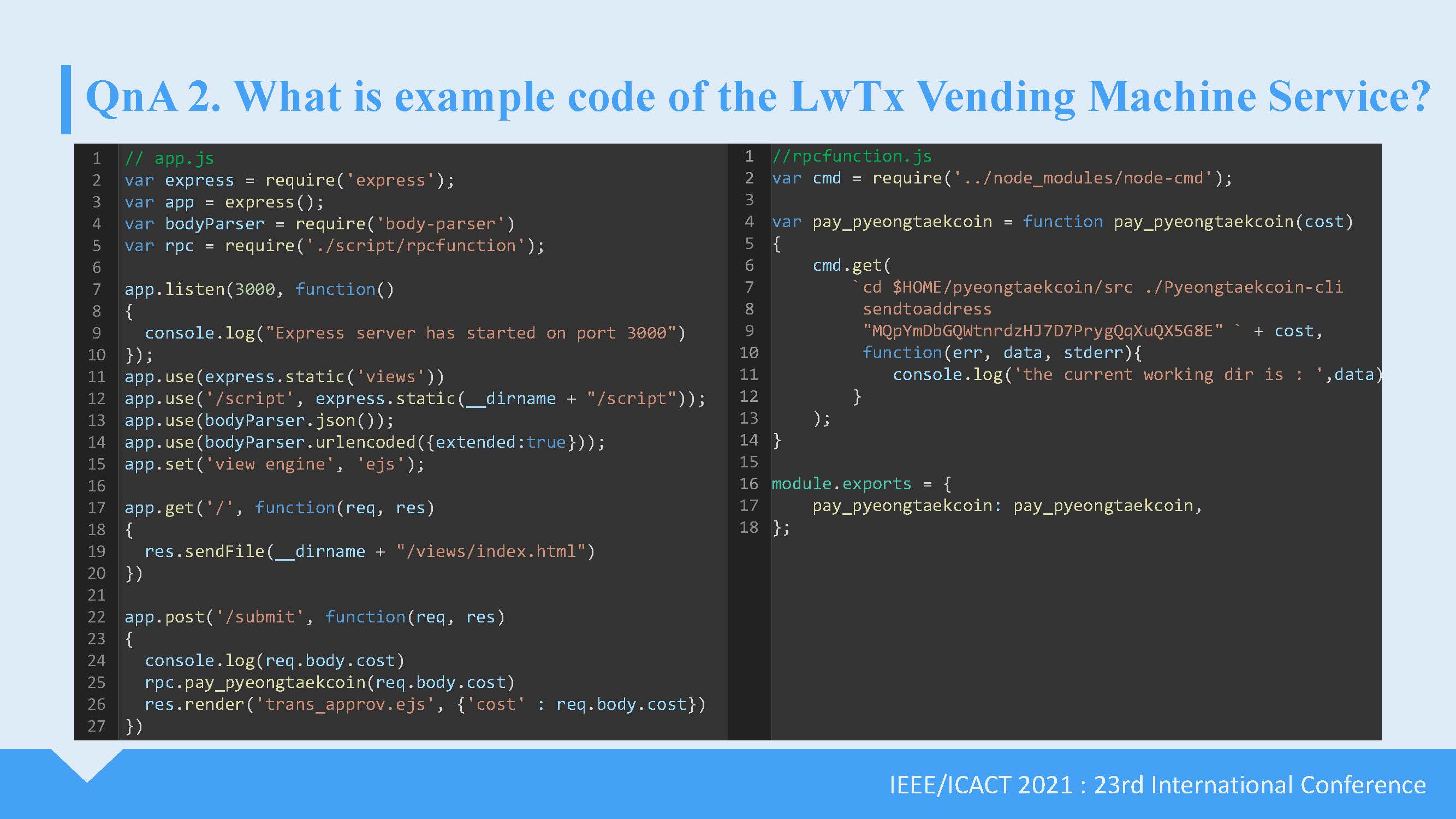 |
The next pre-QnA is about "What is example code of the LwTx Vending Machine Service?". The following code indicates simple vending machine operation using node js. rpcfunction.js has include function via api on the LwTx client. rpcfunction.js lines 4 through 14 represent a function for transferring PTCs. The amount paid to the address of the recipient is transferred. This code has no exception handling, but only simple remittance processing is implemented. app.js is a brief description of the vending machine server code. From line 22, when an event occurs, the pay_pyongtaekcoin() function is executed and a notification message is output if it is settled normally. |
| ICACT20210248 Slide.20
[Big Slide]
[YouTube] |
Chrome Click!! |
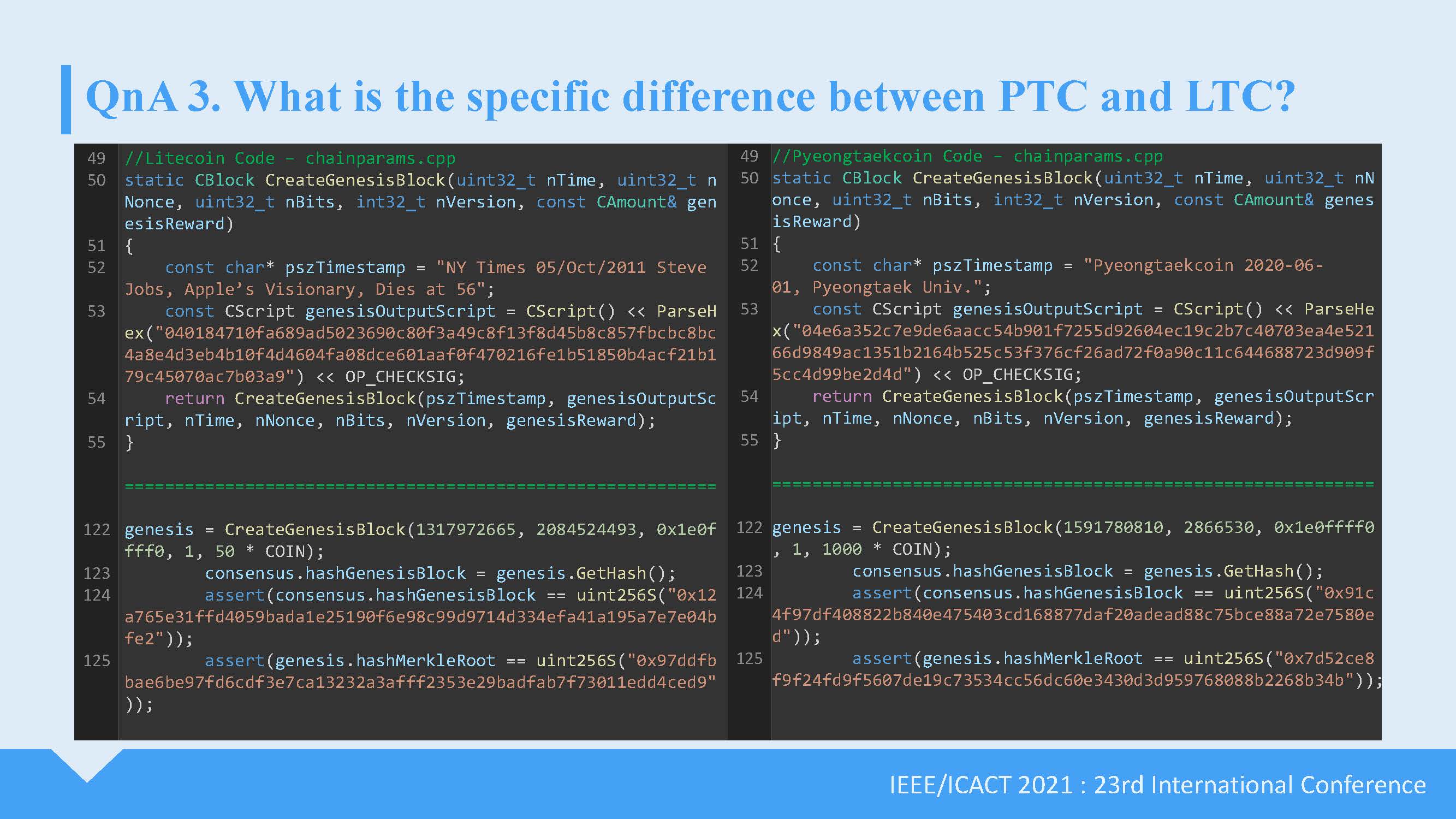 |
The last pre-QnA is about "What is the specific difference between PTC and LTC?" The following code shows the difference between LTC and PTC.Left side code is LTC, and right side code is PTC. We introduce only some important parts because we cannot show both the differences in code between LTC and PTC. It is a function that creates a genesis block from lines 50 to 55. Change the timestamp value on line 52 and the public key value on line 53 to the newly created public key value. Line 122 is the code for generating genesisblock, and Line 123 obtains the hash value of the Genesis block. Line 124 verifies the integrity of the genesisblock by comparing it with the hash value of the obtained Genesis block and the hard-coded hash value. Line 125 compares the obtained Mercleroot value with the hard-coded Mercleroot value to verify the integrity of the transaction.
|
| ICACT20210248 Slide.21
[Big Slide]
[YouTube] |
Chrome Click!! |
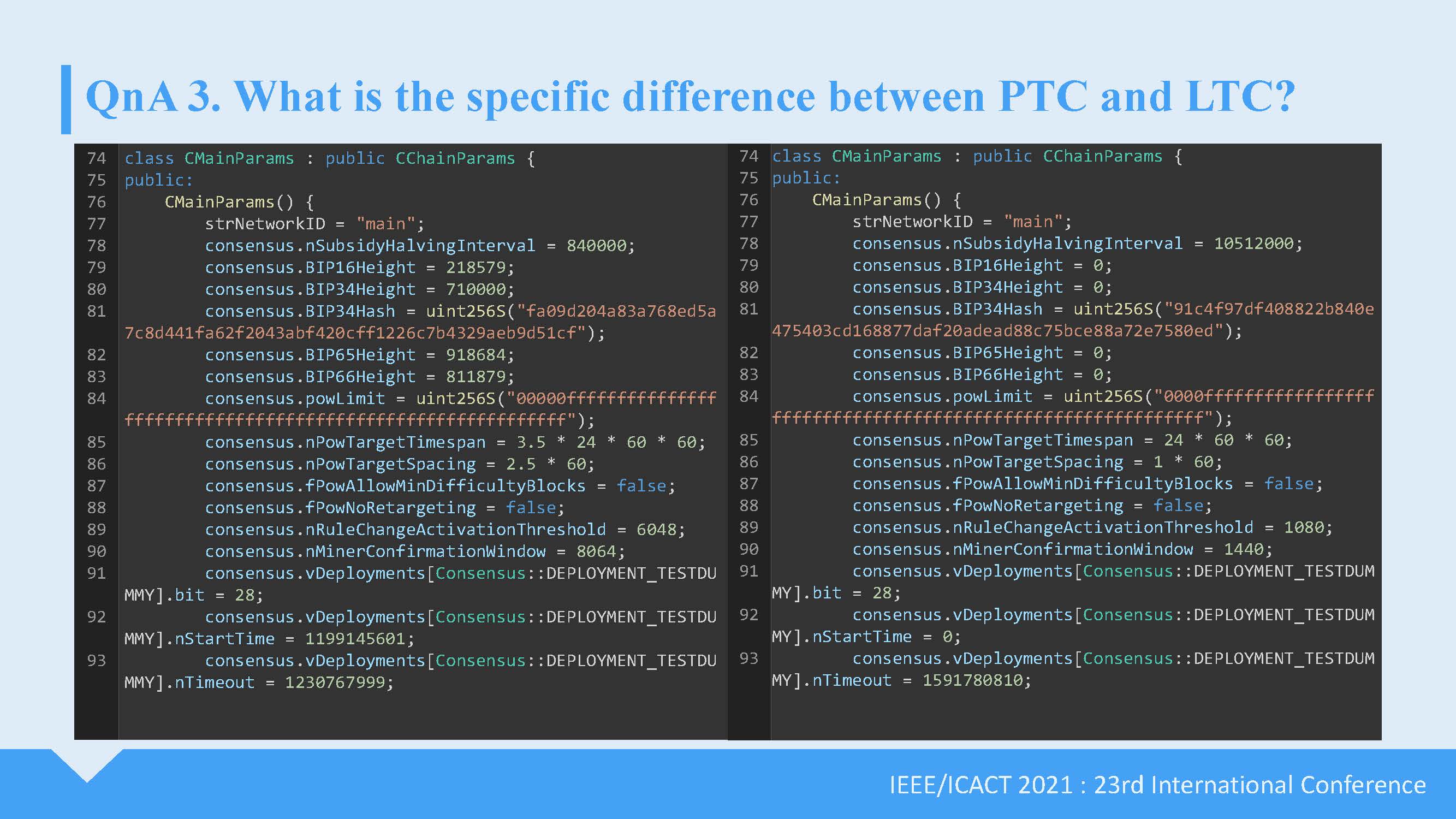 |
Line 78 is the code that sets the half-life. Sets whether you will apply a half-life every few blocks. Because PTC does not have a half-life, it is set to the number of blocks issuing coins. Line 84 is a code that sets the difficulty of mining. Because mining speed needs to be faster than LTC, mining difficulty is lower than LTC. Line 86 is where the target mining speed is set. PTC aims to generate one block per minute. It means 1 minute multifly 60 seconds. |















