 ICACT20260272 Slide.01
[Big Slide] |
Chrome  Click!! |
 |
Good morning everyone. Today, I will briefly present my research on the impact of Mongolia’s national communication satellite on communication services. My name is Zolbayar, and I am the author of this study.
|
| ICACT20260272 Slide.02
[Big Slide]
|
Chrome Click!! |
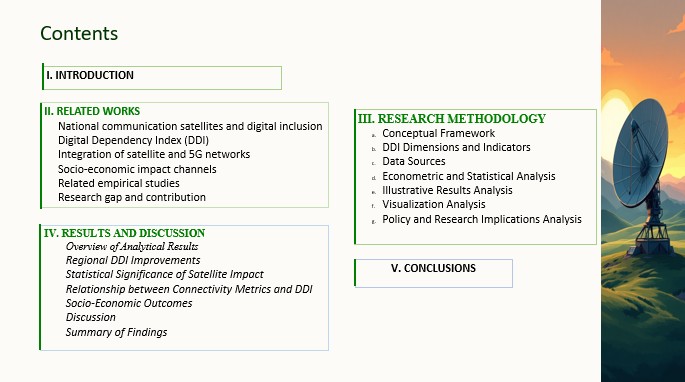 |
In this presentation, I will introduce the background of the study and review related work on national communication satellites and digital inclusion. Then, I will explain the research methodology, discuss the key results, and conclude with the main findings and implications.
|
| ICACT20260272 Slide.03
[Big Slide]
|
Chrome Click!! |
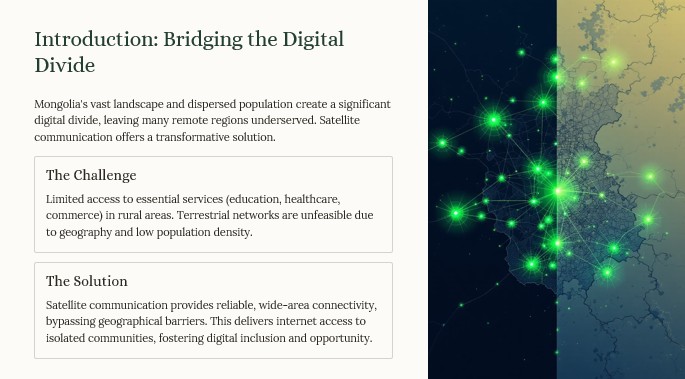 |
As outlined in the contents, I will start with an introduction to the background of this study.
First, I would like to discuss how Mongolia’s geographic conditions contribute to the digital divide and why this issue is important.
|
| ICACT20260272 Slide.04
[Big Slide]
|
Chrome Click!! |
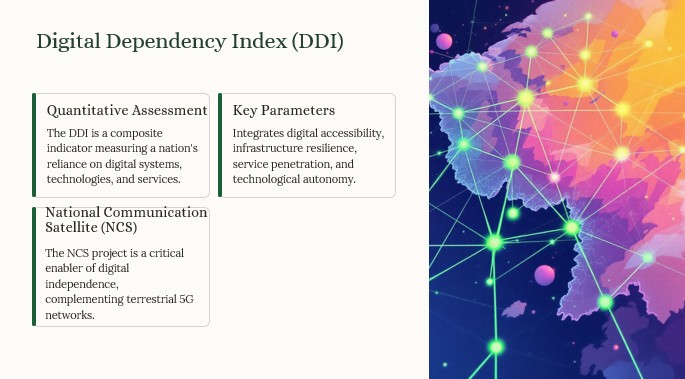 |
To better explain the digital divide, this study uses the Digital Dependency Index, or DDI, as a quantitative measure. It helps us understand how Mongolia’s national communication satellite supports digital independence by complementing terrestrial 5G networks.
|
| ICACT20260272 Slide.05
[Big Slide]
|
Chrome Click!! |
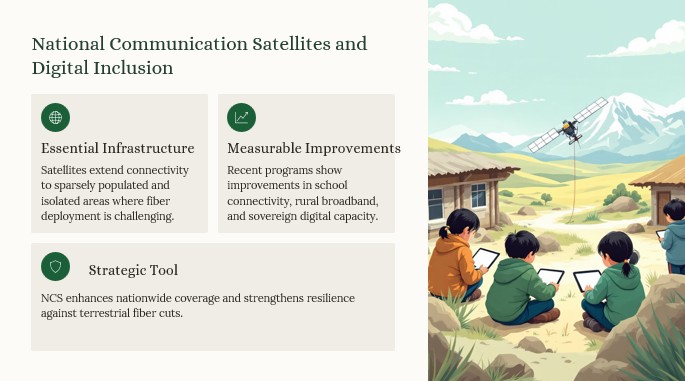 |
Building on the DDI concept, national communication satellites play a key role in improving digital inclusion. They provide essential connectivity to remote areas, support measurable improvements in broadband access, and strengthen network resilience nationwide.
|
| ICACT20260272 Slide.06
[Big Slide]
|
Chrome Click!! |
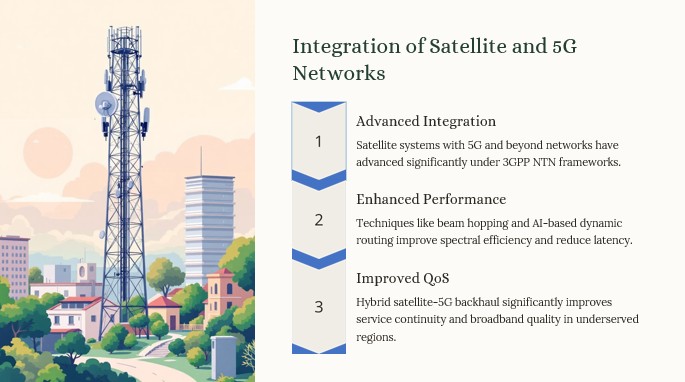 |
In addition to standalone satellite systems, integration with 5G networks has advanced significantly in recent years. This hybrid satellite–5G approach improves performance, reduces latency, and delivers more reliable service in underserved regions.
|
| ICACT20260272 Slide.07
[Big Slide]
|
Chrome Click!! |
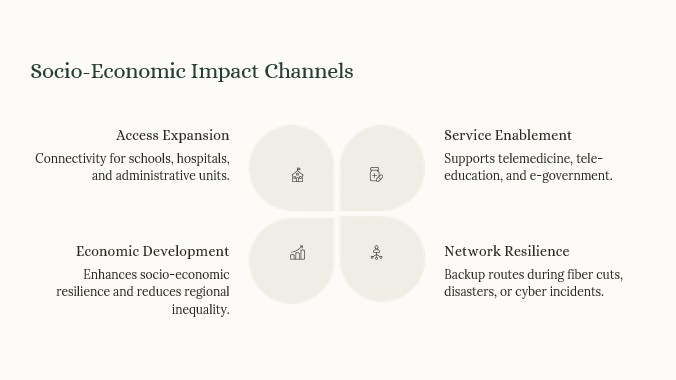 |
These connectivity improvements translate into clear socio-economic impacts. Expanded access enables essential services like education and healthcare, supports digital government, and strengthens economic development and network resilience.
|
| ICACT20260272 Slide.08
[Big Slide]
|
Chrome Click!! |
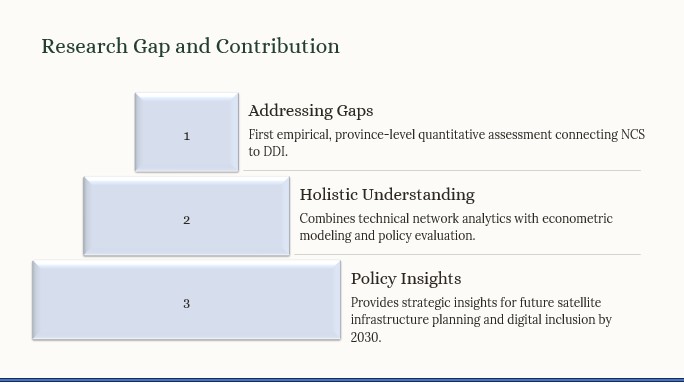 |
Based on these impact channels, this study addresses a clear research gap in existing literature. It provides the first province-level quantitative link between the national communication satellite and the Digital Dependency Index, while also offering holistic analysis and policy-relevant insights.
|
| ICACT20260272 Slide.09
[Big Slide]
|
Chrome Click!! |
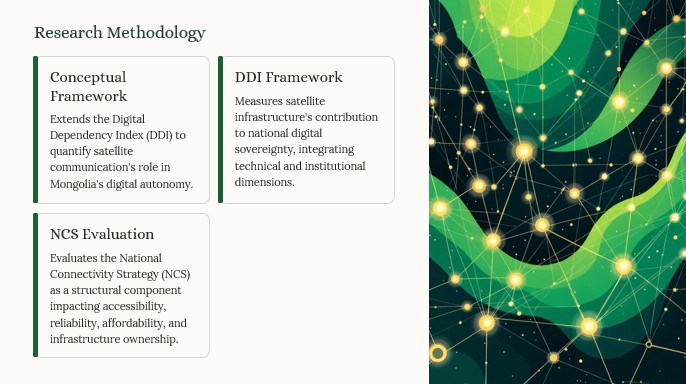 |
To address this research gap, I use an extended DDI-based conceptual framework tailored to Mongolia. The methodology evaluates the national communication satellite within the National Connectivity Strategy, focusing on its contribution to digital autonomy and infrastructure performance.
|
| ICACT20260272 Slide.10
[Big Slide]
|
Chrome Click!! |
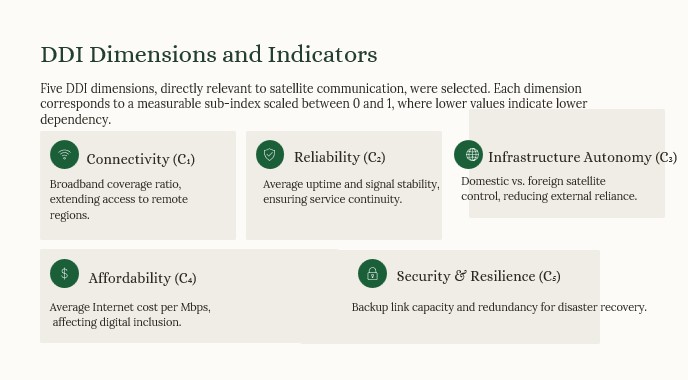 |
Based on this framework, the DDI is broken down into five key dimensions relevant to satellite communication. These indicators capture connectivity, reliability, infrastructure autonomy, affordability, and security to quantitatively assess digital dependency.
|
| ICACT20260272 Slide.11
[Big Slide]
|
Chrome Click!! |
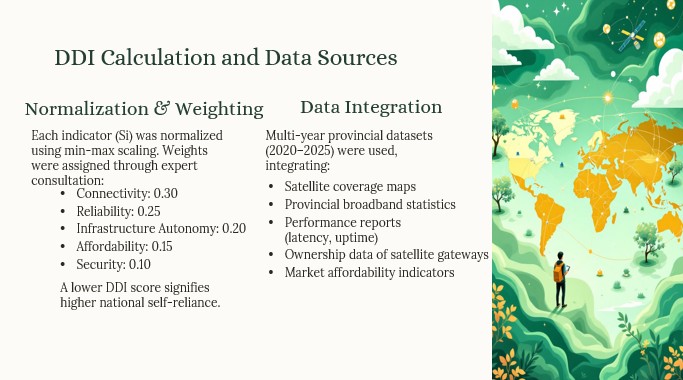 |
Using these dimensions, the DDI is calculated through normalization and expert-based weighting. The analysis integrates multi-year provincial data, including satellite coverage, broadband performance, and affordability indicators, to ensure robust and comparable results.
|
| ICACT20260272 Slide.12
[Big Slide]
|
Chrome Click!! |
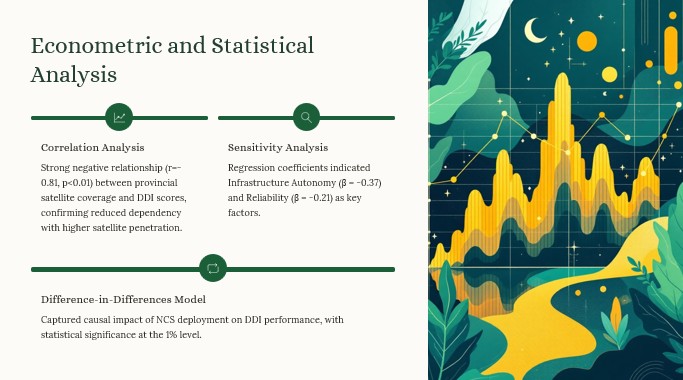 |
Next, I applied econometric and statistical analysis to examine the impact of satellite coverage on digital dependency. The results show a strong negative correlation, meaning higher satellite penetration is associated with lower digital dependency, with infrastructure autonomy and reliability playing key roles. Using a difference-in-differences model, we also confirm a statistically significant causal impact of the national communication satellite deployment.
|
| ICACT20260272 Slide.13
[Big Slide]
|
Chrome Click!! |
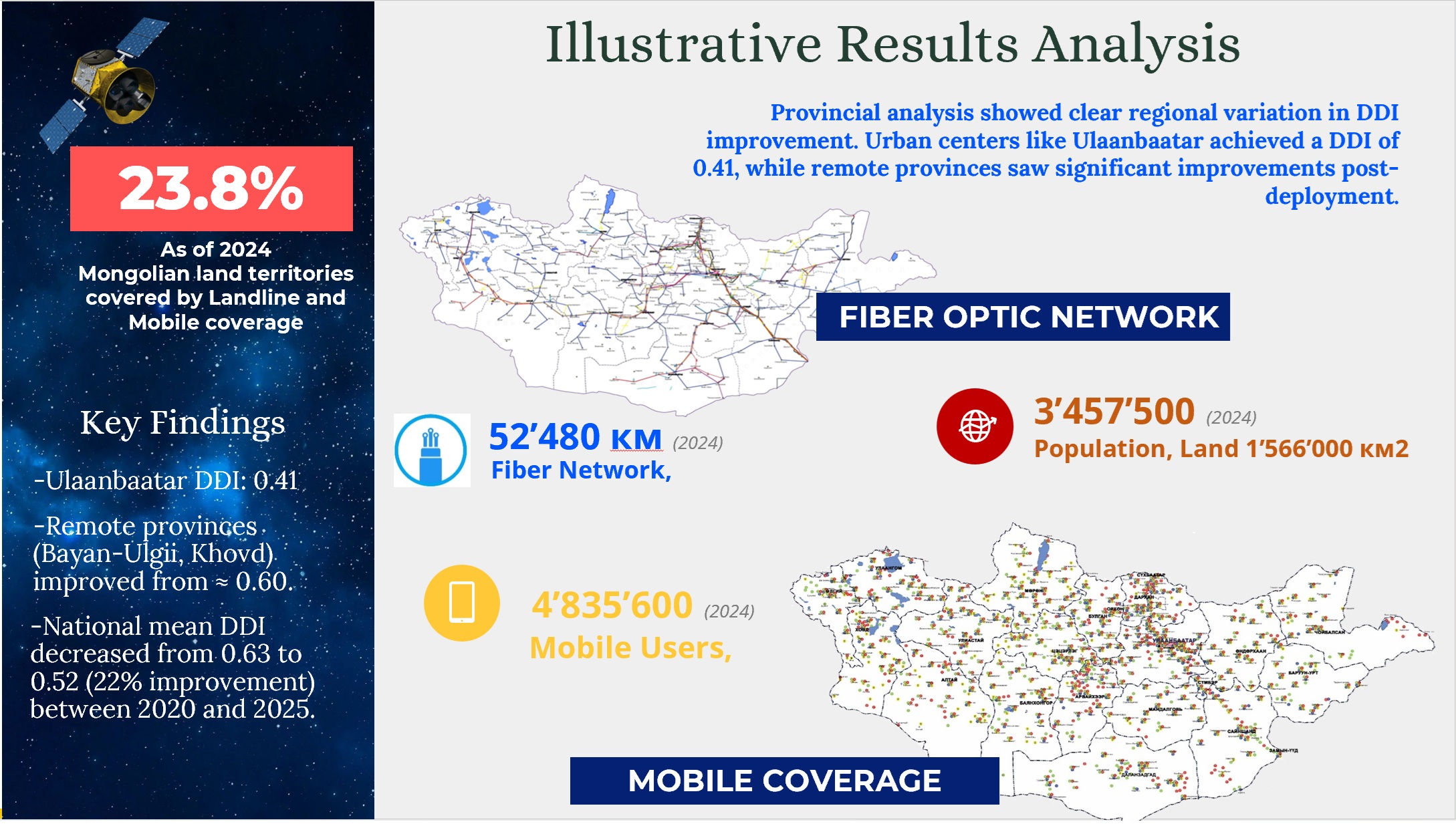 |
To illustrate these results, we analyze DDI changes at the provincial level. Urban areas like Ulaanbaatar show relatively lower DDI levels, while remote provinces such as Bayan-Ulgii and Khovd experienced notable improvements after satellite deployment. Overall, the national average DDI decreased significantly between 2020 and 2025, highlighting the positive regional impact of the national communication satellite.
|
| ICACT20260272 Slide.14
[Big Slide]
|
Chrome Click!! |
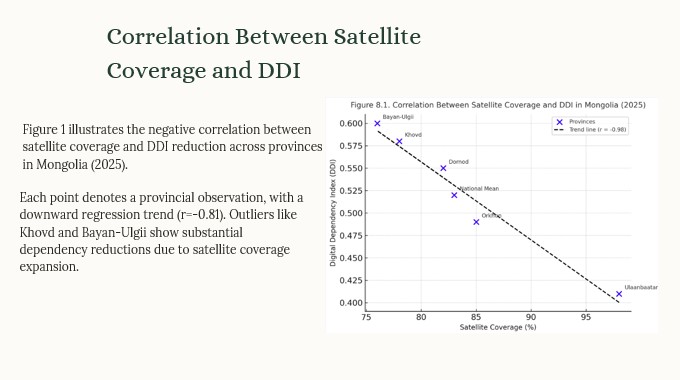 |
This figure shows the relationship between satellite coverage and the Digital Dependency Index across provinces. We observe a clear negative trend, meaning provinces with higher satellite coverage tend to have lower DDI values. Notably, remote areas such as Khovd and Bayan-Ulgii demonstrate strong reductions in digital dependency as coverage expands.
|
| ICACT20260272 Slide.15
[Big Slide]
|
Chrome Click!! |
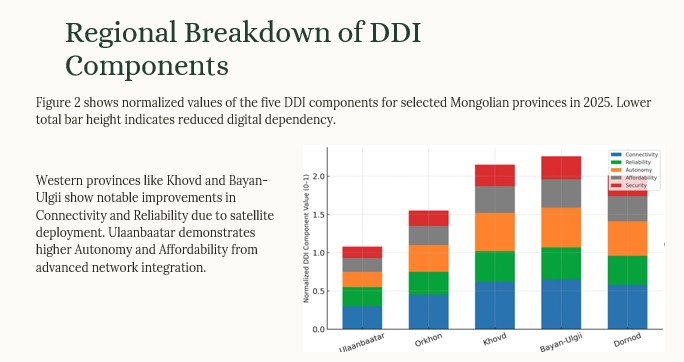 |
This chart breaks down the DDI into its main components at the regional level. Western provinces such as Khovd and Bayan-Ulgii show clear improvements in connectivity and reliability, largely driven by satellite deployment. In contrast, Ulaanbaatar benefits more from higher autonomy and affordability due to advanced network integration.
|
| ICACT20260272 Slide.16
[Big Slide]
|
Chrome Click!! |
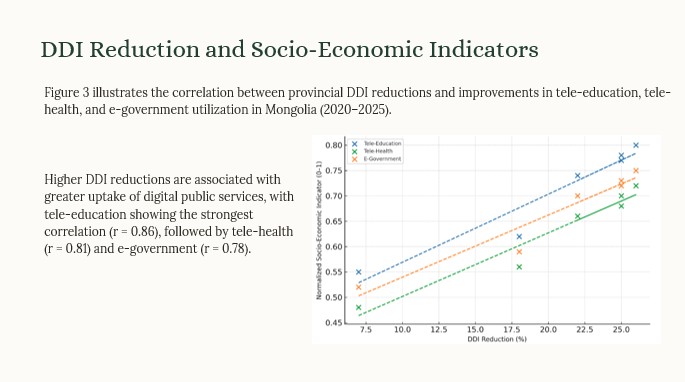 |
This figure links reductions in the DDI with improvements in key socio-economic services. Provinces with larger DDI reductions show higher usage of tele-education, tele-health, and e-government services. Among these, tele-education demonstrates the strongest association, highlighting the broader social benefits of improved satellite-enabled connectivity.
|
| ICACT20260272 Slide.17
[Big Slide]
|
Chrome Click!! |
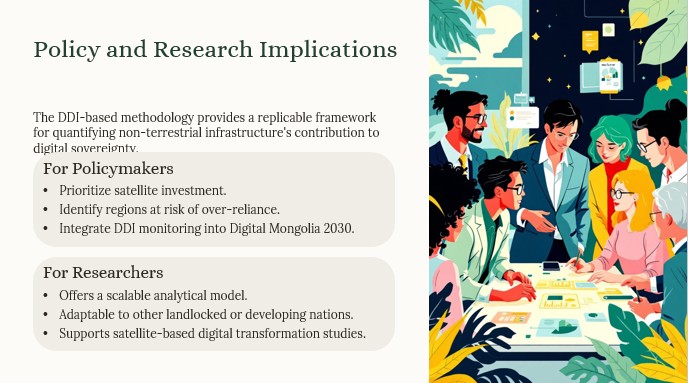 |
These findings have clear implications for both policy and research. For policymakers, the results highlight the importance of prioritizing satellite investment, targeting vulnerable regions, and integrating DDI monitoring into national digital strategies. For researchers, the DDI-based approach offers a scalable and adaptable framework for studying satellite-enabled digital transformation.
|
| ICACT20260272 Slide.18
[Big Slide]
|
Chrome Click!! |
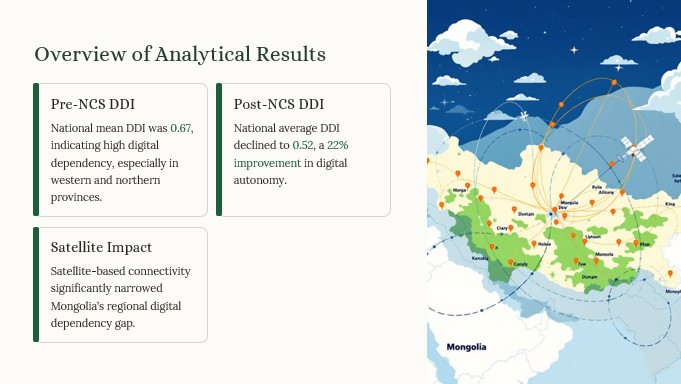 |
“These findings have clear implications for both policy and research. For policymakers, the results highlight the importance of prioritizing satellite investment, targeting vulnerable regions, and integrating DDI monitoring into national digital strategies. For researchers, the DDI-based approach offers a scalable and adaptable framework for studying satellite-enabled digital transformation.
|
| ICACT20260272 Slide.19
[Big Slide]
|
Chrome Click!! |
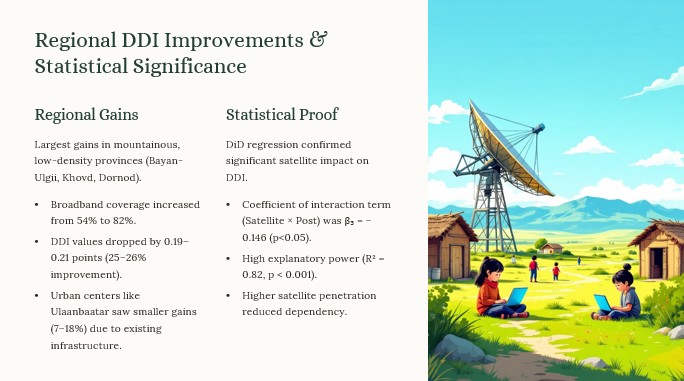 |
These results are especially clear at the regional level. Mountainous and low-density provinces show the largest DDI improvements after satellite deployment, while urban centers experience smaller gains due to existing infrastructure. Importantly, the difference-in-differences analysis confirms that this impact is statistically significant, reinforcing the role of satellite connectivity in reducing digital dependency.
|
| ICACT20260272 Slide.20
[Big Slide]
|
Chrome Click!! |
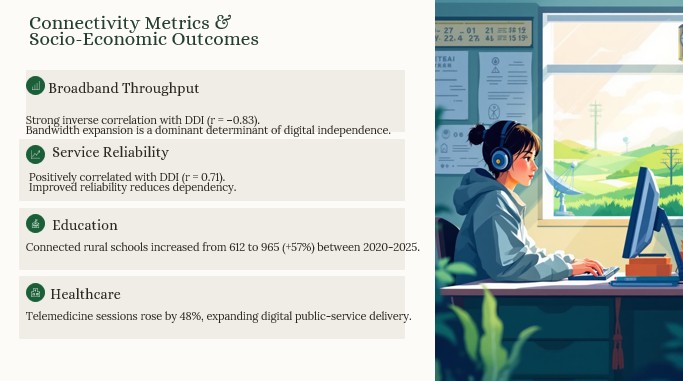 |
Improved connectivity metrics are closely linked to socio-economic outcomes. Higher broadband throughput and better reliability are associated with lower digital dependency, while education and healthcare services show clear growth through expanded school connectivity and telemedicine use.
|
| ICACT20260272 Slide.21
[Big Slide]
|
Chrome Click!! |
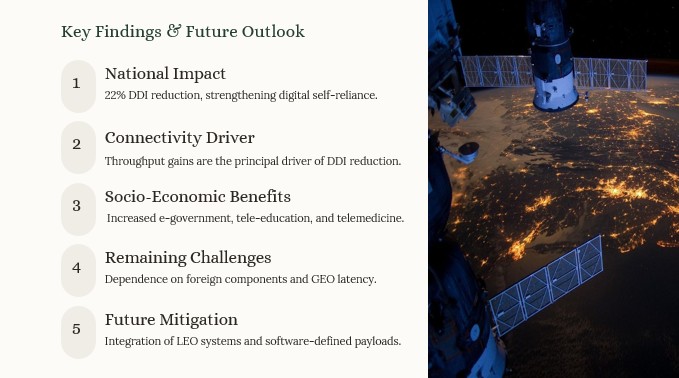 |
To conclude, the results show a clear national impact, with a 22% reduction in the DDI and stronger digital self-reliance. Connectivity improvements, especially higher throughput, are the main drivers behind this progress, delivering tangible benefits in e-government, education, and healthcare. Looking ahead, addressing remaining challenges such as foreign dependence and GEO latency will require integrating LEO systems and more flexible, software-defined satellite solutions.
|
| ICACT20260272 Slide.22
[Big Slide]
|
Chrome Click!! |
 |
Thank you for your attention, and I welcome any questions.
|















